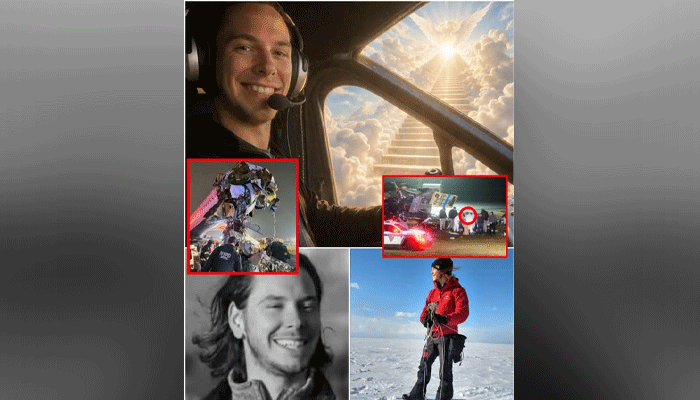
A Deadly Collision at LaGuardia Airport: Tragedy Strikes During a Routine Landing
On the night of Sunday, March 25th, 2026, LaGuardia Airport in New York became the scene of an unimaginable tragedy. An Air Canada Express flight, arriving from Montreal, collided with a Port Authority fire truck while attempting to land on Runway 4. The incident left two pilots dead and 41 individuals hospitalized, many of whom were passengers aboard the flight. The crash not only shook the passengers and crew, but it also had devastating effects on first responders and the wider community.
The flight, Air Canada Flight AC8646, was a Bombardier CRJ-900 jet, a smaller regional aircraft with a capacity of 72 passengers. The plane had been making its final approach to LaGuardia Airport, nearing the runway in preparation for landing. With four crew members and 72 passengers aboard, including a group of Orthodox Jews from the New York area, the atmosphere should have been one of relief, as the flight neared its destination.
However, what followed was a chain of tragic events. At the same time, an emergency fire truck, responding to a call concerning a United Airlines flight, was attempting to cross the runway at the very moment the Air Canada flight was about to land. The truck, a crucial part of the airport’s emergency response team, was reportedly responding to an emergency situation involving a strong odor aboard another aircraft. Despite having clearance to cross the runway, the fire truck was caught in the path of the landing Air Canada plane, leading to a catastrophic crash.
An air traffic controller, desperate to avert the disaster, can be heard frantically shouting into the radio, “Stop, stop, stop, stop!” The tension was palpable, but the worst fears of the air traffic control team were realized when the two vehicles collided. The force of the crash caused severe damage to the plane’s front, causing it to tilt upward, leaving the cockpit and the front of the aircraft nearly destroyed.
The impact was felt immediately. Two pilots, the captain and co-pilot, were tragically killed in the crash. Their bodies were found in the mangled cockpit, trapped by the wreckage. Passengers aboard the plane were thrown into chaos. Emergency oxygen masks deployed as the aircraft came to a screeching halt on the runway, surrounded by a cloud of debris and smoke. The scene that followed was one of utter devastation.
At least 41 people were rushed to nearby hospitals, including two of the Port Authority police officers from the fire truck. The officers, who were part of the Aircraft Rescue and Fire Fighting (ARFF) Unit, suffered serious injuries, including broken bones, but were expected to survive. The injuries among the passengers varied in severity, with some being treated for minor cuts and bruises, while others were critically wounded. In the chaos of the emergency response, a female flight attendant was thrown from her seat and launched through the front of the plane. Miraculously, she survived the horrific ordeal, with help from nearby police officers who assisted in pulling her to safety.
The injured were taken to multiple hospitals, including Elmhurst and Queens Presbyterian hospitals, where they were treated for their wounds. At least 32 of the 41 hospitalized individuals were released after receiving medical care. However, several passengers and first responders remained in serious condition, with their injuries requiring extensive medical attention. A somber mood loomed over the airport and the surrounding community, as news of the tragedy spread quickly.
The cause of the crash was quickly under investigation. Officials from the Federal Aviation Administration (FAA) and the National Transportation Safety Board (NTSB) arrived at the scene to begin their inquiry. Audio recordings from the air traffic control tower revealed the frantic moments leading up to the crash, including the repeated calls to the fire truck to stop its movement across the runway. Despite these urgent requests, the rescue truck did not halt in time to avoid the incoming aircraft, leading to the disastrous collision.
In the aftermath of the crash, LaGuardia Airport was temporarily closed, throwing the travel hub into chaos. The closure disrupted flights for the entire day, with many passengers stranded at the airport or forced to find alternate routes. The FAA issued a ground stop for the airport, delaying flights and causing significant disruptions in New York’s already busy airspace. This closure also added to the tension in the city, as the airport is one of the busiest in the United States, serving over 30 million passengers annually.
At the scene, investigators examined both the wreckage of the fire truck and the airplane. The rescue truck, which had been fully turned onto its side, was completely mangled, with debris scattered across the runway. The airplane’s fuselage was severely damaged, and emergency crews worked tirelessly to assess the situation and begin clearing the wreckage. The NTSB launched a full investigation to determine the exact cause of the crash, focusing on whether there had been any communication breakdowns, procedural errors, or mechanical failures that contributed to the collision.
The crash was particularly disturbing because of the role the fire truck played in the accident. The truck had been responding to an emergency call regarding a United Airlines flight, which had reported a strong odor and a crew feeling unwell. The United Airlines flight had declared an emergency, and the truck had been given clearance to cross Runway 4 to assist. However, the unfortunate timing of this clearance meant that the truck and the Air Canada flight collided just moments after the truck had crossed into the aircraft’s flight path.
As the investigation continues, officials are also reviewing the actions of the air traffic controller, whose frantic warnings over the radio were heard just moments before the crash. The controller’s voice was filled with distress, as they pleaded for the truck to stop, but the collision was unavoidable. This tragic event raises serious questions about the safety procedures at LaGuardia Airport and whether any changes need to be made to prevent such accidents from happening in the future.
This tragic accident has left a profound impact on the families and friends of the victims, as well as the aviation community. Two lives were lost, and many others were forever altered by the events that unfolded that fateful night. In the wake of the crash, LaGuardia Airport and the Port Authority have pledged to review their safety protocols and improve communication between air traffic control and emergency response teams.
The grief felt by the families of the victims is immeasurable. The loss of two pilots who were doing their job—guiding a plane full of passengers to safety—has left a hole in the hearts of those who loved them. The passengers aboard the flight will also carry the memories of that night for the rest of their lives. And for the first responders who were injured while doing their duty, the physical and emotional scars will take time to heal.
As authorities continue their investigation into the cause of the crash, the survivors are left to pick up the pieces of their lives. The memories of the fateful night will haunt them, but they will also be a reminder of the strength and resilience of the human spirit. Even in the face of tragedy, the survivors of this horrific crash will carry on, united by their shared experience and the hope that their story can help prevent similar disasters in the future.