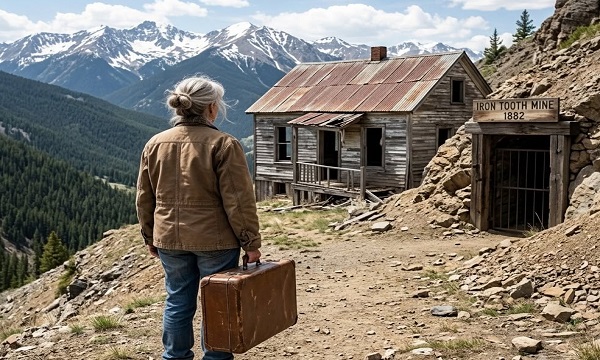
The old suitcase felt heavier with every step.
Not because of what was inside—it held little more than a few clothes, worn family photographs, and a faded quilt—but because it was all she had left.
Behind her stretched miles of dusty road. Ahead stood a weather-beaten shack leaning against the side of a lonely mountain, its roof rusted and its porch collapsing into the dry earth. Beside it yawned the dark entrance to an abandoned mine. A weathered wooden sign still clung above the opening.
IRON TOOTH MINE 1882
The elderly woman stopped and let out a slow breath.
“So… this is home.”
Just three days earlier, she had lived in the comfortable farmhouse she had shared with her late husband for nearly forty years.
Then everything changed.
Her husband had passed away after a brief illness, leaving no updated will.
Although she had cared for him until his final breath, the farm legally belonged to his only son from his first marriage.
The stepson had waited exactly one week before telling her to leave.
“I’ve already found a buyer,” he had said coldly.
She stared at him in disbelief.
“I have nowhere else to go.”
“That’s not my problem.”
She reminded him of birthdays she had organized, Christmas dinners she had cooked, fevers she had sat beside all night when he was a child.
He remembered none of it.
Within forty-eight hours, her belongings sat on the porch.
She walked away carrying only one suitcase.
The only kindness came from an elderly attorney.
“There is one more property,” he explained quietly. “Your husband purchased it decades ago but never spoke about it.”
He slid a yellowed deed across the desk.
One hundred acres.
A deserted mountain field.
An abandoned mine.
Worth almost nothing.
Most people would have laughed.
She accepted it with gratitude.
At least no one could take it from her.
The first night was miserable.
Wind howled through broken windows.
Rain dripped through holes in the roof.
Coyotes cried somewhere beyond the ridge.
She wrapped herself in the old quilt and promised herself she would survive one more sunrise.
Then another.
Then another.
Life became simple.
She hauled water from a distant spring.
She patched broken walls using discarded lumber.
She planted potatoes in the stubborn soil despite every neighbor insisting nothing could grow there.
Each evening she sat on the porch watching the mountains glow orange beneath the setting sun.
Loneliness lingered.
But peace slowly replaced bitterness.
One afternoon, while clearing weeds near the abandoned mine entrance, she noticed something unusual.
The heavy iron gate looked newer than the surrounding timber.
Someone had reinforced it decades after the mine supposedly closed.
Curious, she brushed away layers of dirt.
Hidden beneath vines was a rusted brass keyhole.
Strange.
If the mine was abandoned…
Why bother locking it?
The key, of course, was long gone.
She thought little of it.
Until a week later.
While repairing loose floorboards inside the shack, her hammer struck something metal beneath the wood.
Clink.
She pried up the board.
Inside lay a small iron box wrapped in oilcloth.
Her hands trembled.
Inside the box rested several old papers, a tarnished pocket watch, and an unusually large brass key.
Attached was a faded note written in careful handwriting.
“If anyone honest ever owns this place again… the mountain still remembers.”
No signature.
Only a date.
The brass key fit perfectly.
The gate groaned open after more than a century.
A stale breath of cold air rolled from the darkness.
Lantern in hand, she stepped carefully into the tunnel.
Old mining carts sat frozen in time.
Rotting support beams creaked overhead.
Dust covered everything.
After nearly twenty minutes she reached what appeared to be the end.
Solid rock.
Or so she thought.
Her lantern revealed strange chisel marks.
Not natural.
Someone had sealed part of the wall.
She pushed.
Nothing.
She searched the edges until her fingers found a hidden iron lever concealed beneath loose stones.
With enormous effort she pulled.
The wall shifted.
A narrow stone doorway slowly opened.
Beyond it waited a chamber unlike anything she had imagined.
Wooden crates.
Iron chests.
Shelves lined with leather-bound ledgers.
At the center stood stacks of heavy bars wrapped in faded canvas.
She peeled back one corner.
Gold.
Not coins.
Not jewelry.
Gold bars.
Dozens of them.
She sank onto a crate in stunned silence.
The ledgers explained everything.
During the late 1800s, the mine had unexpectedly struck an incredibly rich gold vein beneath the iron deposits.
The owners secretly extracted the gold while officially reporting only iron production.
They feared competitors—and corrupt officials.
Before transporting the final shipment, a devastating cave-in killed much of the crew.
The surviving partners hid everything behind the false wall, intending to return.
None ever did.
Generations passed.
The secret vanished.
Until now.
Many people would have hidden the discovery.
She refused.
She contacted state historians and federal authorities.
The investigation lasted nearly a year.
Experts confirmed the records.
Because no legal heirs to the mining company remained and the property ownership had transferred lawfully through multiple generations, a significant portion of the recovered treasure legally belonged to her after preservation requirements and historical claims were settled.
The story spread across the country.
Reporters arrived by the dozens.
Everyone asked the same question.
“What will you buy first?”
She smiled.
“A new roof.”
The money changed her circumstances.
It never changed her heart.
She restored the old house instead of replacing it.
The abandoned mine became a carefully preserved historical site.
A small museum displayed the miners’ journals so their forgotten lives would never disappear again.
She established scholarships for students studying geology, mining safety, and local history.
She funded emergency housing for elderly people who had been forced from their homes.
Whenever asked why, she answered simply,
“I know what carrying one suitcase feels like.”
Months later, an expensive black SUV rolled slowly into the driveway.
Her former stepson climbed out.
He looked nervous.
Older somehow.
Smaller.
“I heard…” he began.
She waited patiently.
“I made a terrible mistake.”
Silence filled the porch.
“I was hoping… maybe we could start over.”
He glanced toward the renovated home.
Toward the visitors exploring the museum.
Toward the life she had rebuilt.
“I don’t deserve forgiveness,” he admitted.
She nodded.
“No.”
His shoulders slumped.
Then she continued.
“But forgiveness isn’t something people earn.”
Tears welled in his eyes.
“I’ve regretted that day ever since.”
She believed him.
Not because of his words.
Because regret had stripped away the arrogance she once knew.
She invited him inside.
Not because of the gold.
Not because they were family by law.
Because bitterness had already stolen enough years from both of them.
Every evening she still carried the old brown suitcase onto the porch before putting it back inside.
Visitors often asked why she kept something so worn when she could afford anything she wanted.
She would gently place her hand on the cracked leather.
“This reminds me,” she said.
“Gold didn’t save me.”
“The mountain didn’t save me.”
“What saved me was refusing to believe my life was over the day someone told me I had nothing.”
The mountains stood silent behind her.
The old mine rested peacefully beneath the weathered sign that still read IRON TOOTH MINE 1882.
The greatest treasure hidden there had never truly been the gold.
It was the second chance waiting for someone brave enough to keep walking, even when all they carried was one worn suitcase and a heart that refused to give up.