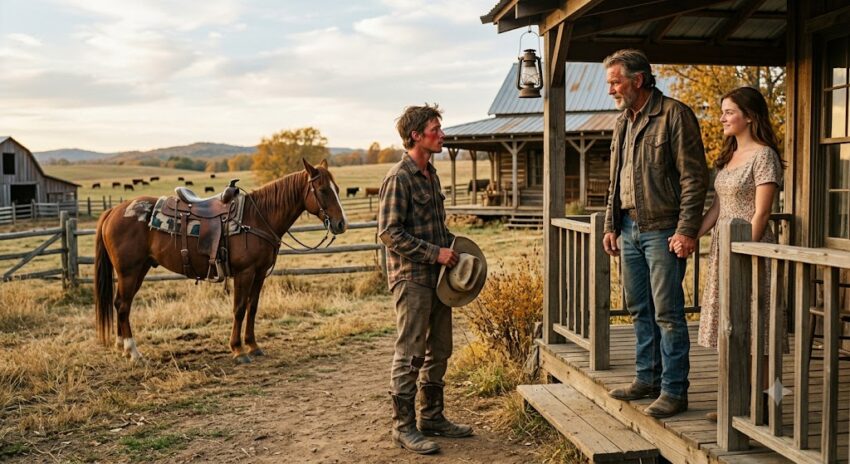
The first time I saw the young cowboy standing at my gate, I almost laughed.
Not because he looked funny. Not because he seemed foolish.
I laughed because I thought he had no chance.
My daughter was the prettiest young woman in three counties. Men rode from miles away just to find an excuse to stop by our ranch. Wealthy ranchers’ sons came wearing polished boots and fancy jackets. Bankers from town tipped their hats and brought flowers.
And then there was him.
A skinny cowboy with sunburned cheeks, patched trousers, and a horse that looked nearly as tired as he did.
He stood quietly by the fence, holding his hat in both hands.
“My name is Tom,” he said.
I nodded.
“What can I do for you?”
He swallowed hard.
“I came to ask permission to court your daughter.”
I looked him up and down.
The poor kid couldn’t have owned more than two shirts.
His boots were worn smooth.
His saddle had been repaired so many times it looked like a quilt.
I should have sent him away.
Instead, I asked one question.
“How much land do you own?”
His face reddened.
“None, sir.”
“How many cattle?”
“None.”
“A house?”
“No, sir.”
I folded my arms.
“What exactly do you have?”
He hesitated.
Then he answered quietly.
“My word.”
I expected him to look embarrassed.
Instead, he looked me straight in the eye.
And somehow that bothered me.
Because most rich men talked confidently about money.
This young man talked confidently about character.
I dismissed him politely.
But after he rode away, my wife surprised me.
“He seems nice.”
“Nice doesn’t feed a family.”
She smiled.
“Neither does arrogance.”
I pretended not to hear her.
For the next several months, Tom kept showing up.
Every Sunday after church.
Every town gathering.
Every community dance.
He never pushed.
Never bragged.
Never tried to impress anyone.
He simply spent time talking with my daughter.
And the strange thing was that she genuinely enjoyed it.
One evening I found her sitting on the porch smiling at a small carved wooden horse.
“What’s that?” I asked.
“Tom made it.”
I picked it up.
The carving wasn’t perfect.
But every detail had been carefully crafted by hand.
“He spent three evenings making this,” she said.
Three evenings.
A wealthy man would have bought something expensive.
Tom had invested time.
I handed it back without saying anything.
Still, I remained unconvinced.
Love was wonderful.
But love didn’t pay bills.
A year later, a wealthy ranch owner named Walter began pursuing my daughter.
Walter owned thousands of acres.
Hundreds of cattle.
A large house.
He arrived in a polished carriage.
Brought expensive gifts.
Promised a comfortable life.
I secretly hoped she would choose him.
Any father would.
One afternoon I sat her down.
“Have you considered Walter seriously?”
She looked surprised.
“Why?”
“Because he can provide.”
She smiled softly.
“So can Tom.”
I nearly choked.
“Tom has nothing.”
“No.”
She looked toward the distant hills.
“He has integrity.”
I sighed.
Youth always believed integrity paid mortgages.
Life usually taught otherwise.
Months passed.
Then one terrible summer changed everything.
The drought arrived without warning.
Grass turned brown.
Creeks dried up.
Cattle became thin.
Hay prices exploded.
Even wealthy ranchers began to panic.
Walter was among them.
At first he seemed confident.
But as conditions worsened, his true character emerged.
He started underpaying workers.
Firing older ranch hands.
Refusing to help struggling neighbors.
Every decision centered around protecting his money.
People began whispering about him.
Then one day a widowed neighbor lost nearly all her cattle.
She had three children and no husband.
She was desperate.
Many wealthy ranchers ignored her.
Including Walter.
Tom did not.
Despite barely earning enough himself, he organized volunteers.
Gathered feed.
Repaired broken fences.
Worked for days helping her save what remained.
When I heard about it, I shook my head.
The boy was sacrificing precious time and resources he couldn’t afford.
Yet somehow people admired him even more.
I didn’t understand it.
At least not yet.
The following winter became one of the harshest anyone could remember.
Snowstorms arrived early.
Roads disappeared.
Temperatures plummeted.
One night a blizzard struck with terrifying force.
Visibility vanished.
Wind screamed like an angry animal.
Around midnight, someone pounded on our door.
I opened it.
Tom stood outside covered in snow.
“Your south fence collapsed.”
My stomach dropped.
That fence protected dozens of cattle.
Without it, they could wander into the storm and die.
I grabbed my coat.
Several ranch hands joined us.
For hours we fought wind and snow.
The conditions were brutal.
At one point a ranch hand became trapped beneath fallen timber.
Most men would have protected themselves first.
Tom rushed directly into danger.
Together we pulled the man free.
By sunrise we had saved both the cattle and the worker.
Back at the house, exhausted and freezing, I finally asked him.
“Why did you come all the way here to warn us?”
He looked confused.
“Because it was the right thing to do.”
As if no further explanation were necessary.
That answer stayed with me.
Because increasingly I noticed a pattern.
Whenever a situation offered him a chance to gain something, Tom wasn’t interested.
Whenever a situation offered him a chance to help someone, he showed up immediately.
Years of ranching had taught me how rare that was.
The next spring, disaster struck my own family.
I fell from a horse.
The landing shattered my leg.
For months I couldn’t work properly.
The ranch began falling behind.
Fences needed repairs.
Equipment needed maintenance.
Cattle needed attention.
I hated feeling useless.
The first week after my injury, Tom appeared.
“I heard what happened.”
I nodded stiffly.
“I’m fine.”
He smiled.
“No, you’re not.”
Then he grabbed a hammer and went to work.
The next day he returned.
And the next.
And the next.
I assumed he expected payment.
Eventually I asked.
“What do I owe you?”
His expression looked genuinely puzzled.
“Nothing.”
“Nothing?”
“You’d do the same for me.”
The embarrassing truth was that I wasn’t sure I would.
At least not with the same generosity.
That realization stung.
For nearly three months he helped maintain the ranch.
Sometimes before sunrise.
Sometimes after dark.
Never complaining.
Never asking for anything.
One evening I watched him repairing a gate while my daughter carried him a glass of lemonade.
They sat together laughing.
The setting sun painted the fields gold.
For the first time, I saw them not as a young couple chasing dreams.
I saw them as partners.
Real partners.
The kind who made each other stronger.
A few weeks later, Walter returned.
He arrived with expensive clothes and polished boots as always.
But something felt different.
Desperate.
Forced.
During dinner he spent nearly two hours discussing his money.
His land.
His future plans.
His investments.
My daughter looked bored.
When he finally left, she exhaled with relief.
That’s when I understood.
Walter wanted a wife who would admire his wealth.
Tom wanted a wife he could build a life with.
There was a world of difference.
That autumn, Tom came to see me again.
The same nervous expression.
The same hat held in both hands.
But this time I noticed something else.
Confidence.
Not arrogance.
Not pride.
Just quiet certainty.
We sat on the porch.
For several minutes neither of us spoke.
Finally he cleared his throat.
“Sir, I know I’m not wealthy.”
I nodded.
“I know I can’t offer her a large ranch.”
Another nod.
“But I can promise three things.”
I listened carefully.
“I’ll work hard every day.”
His voice remained steady.
“I’ll treat her with respect.”
He swallowed.
“And I’ll love her for the rest of my life.”
Silence followed.
The younger version of me might have demanded financial statements.
Land deeds.
Business plans.
But life had taught me something important.
Money reveals character less than hardship does.
And hardship had already revealed his.
I looked toward the pasture.
Toward the ranch.
Toward everything I had spent decades building.
Then I looked back at him.
The poor cowboy with patched clothes.
The young man who helped widows.
Saved workers.
Protected neighbors.
Worked without expecting rewards.
Loved my daughter with all his heart.
And suddenly the answer felt obvious.
I smiled.
The expression of relief on his face appeared before I even spoke.
“Tom.”
“Yes, sir?”
“My daughter doesn’t need a rich man.”
His eyes widened.
I continued.
“She needs a good man.”
For a second he couldn’t speak.
Then tears appeared in his eyes.
He quickly looked away.
Trying to hide them.
I pretended not to notice.
Men of that generation often did.
But I was fighting tears myself.
After a moment he managed to whisper.
“Thank you.”
“No.”
I shook my head.
“Thank you.”
He looked confused.
I laughed.
“For teaching an old rancher something he should’ve known years ago.”
The wedding took place the following spring.
Nothing extravagant.
No luxury.
No grand displays.
Just family, friends, neighbors, and genuine happiness.
And something remarkable happened.
Nearly the entire community showed up.
The widow he had helped came.
The ranch hand whose life he saved came.
Families he had quietly assisted over the years came.
People traveled long distances just to celebrate with him.
That day I realized a strange truth.
Tom had been accumulating wealth all along.
Not money.
Something far more valuable.
Trust.
Respect.
Friendship.
Love.
Years later, he and my daughter built a modest ranch of their own.
It wasn’t large.
It wasn’t famous.
But it prospered.
Not because luck favored them.
Not because someone handed them success.
Because they worked together.
Because they treated people fairly.
Because their reputation opened doors money never could.
Today, when people ask me the secret to a successful marriage, I tell them this story.
I tell them about the poor cowboy who came asking for my daughter’s hand.
I tell them how I once measured men by their possessions.
And how life taught me to measure them by their character instead.
Money can build a house.
Character builds a home.
Money can hire workers.
Character earns loyalty.
Money can attract attention.
Character earns respect.
And if you are fortunate enough to choose between a rich man and a good man, remember something an old rancher learned too late:
A rich man may become poor.
A good man remains valuable forever.
Because when storms come—and they always do—the strength of a person’s heart matters far more than the size of their bank account.
And that’s why, when a poor cowboy came asking for my daughter’s hand, I finally said yes.
Not because he was wealthy.
But because he was exactly the kind of man every father hopes his daughter will find.