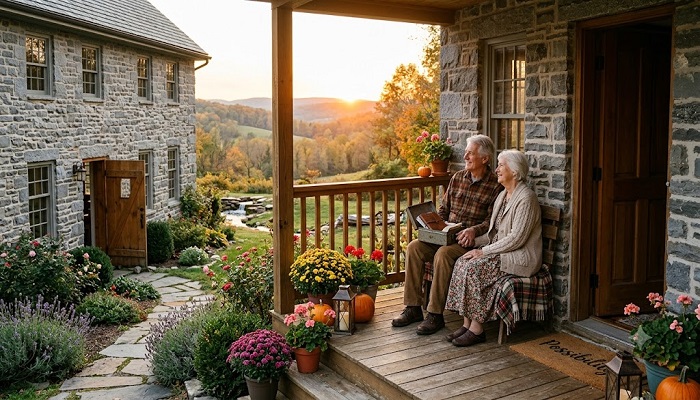
The cottage sat alone on the edge of a forgotten valley, its gray stone walls swallowed by ivy and time.
People in the nearby town called it “the ruin.”
Children dared each other to run up to its broken gate and touch the front door before sunset.
Adults avoided it entirely.
For nearly forty years, nobody had lived there.
The roof sagged.
Half the windows were gone.
A giant oak tree had pushed its roots beneath one corner of the foundation.
Every winter, locals predicted the old place would finally collapse.
Yet somehow it remained standing.
When the county announced an auction for abandoned properties, hardly anyone paid attention.
The stone cottage was listed with a starting bid of eleven dollars.
Not eleven thousand.
Just eleven.
Most people assumed there had to be a catch.
Maybe the foundation was beyond repair.
Maybe the land had legal problems.
Maybe ghosts lived there.
Whatever the reason, nobody wanted it.
Nobody except an elderly couple named M. and E.
They were both in their seventies.
Neither had much money.
M. had spent most of his life repairing farm equipment.
E. had worked at a school cafeteria.
They lived quietly in a small rented trailer outside town.
Their savings account contained less than many people spent on a vacation.
When they arrived at the auction, several attendees recognized them immediately.
“Surely they aren’t here for the cottage.”
“They couldn’t possibly fix that place.”
“Maybe they just came to watch.”
The auctioneer opened bidding.
Silence.
He repeated the opening amount.
Still silence.
Finally, M. raised a hand.
“Eleven dollars.”
The auctioneer looked around.
Nobody responded.
Once.
Twice.
Sold.
The room erupted in laughter.
Someone actually clapped.
Another person shouted, “Congratulations on buying a pile of rocks!”
More laughter followed.
M. simply smiled.
E. squeezed his hand.
Together they walked out with ownership papers for a property everyone else considered worthless.
The next morning they drove to the cottage.
The road leading there was barely visible beneath weeds.
The gate hung crooked.
Birds nested inside the chimney.
The front door required both of them to push before it finally opened.
Dust filled the air.
Broken furniture lay scattered across the floor.
Rain had damaged portions of the ceiling.
A family of raccoons immediately fled from an upstairs room.
E. looked around quietly.
“Well,” she said.
“Well,” M. replied.
Then they both laughed.
It was ridiculous.
Most people their age were downsizing.
These two had just purchased a disaster.
Yet something about the place felt different.
The walls were solid.
The stone foundation appeared surprisingly strong.
The structure had problems, but it wasn’t dead.
It simply needed someone willing to care.
And for the first time in decades, it had owners.
They began working immediately.
Every morning they arrived before sunrise.
Every evening they left after dark.
At first progress seemed impossible.
They hauled away truckloads of debris.
They removed rotted boards.
They cleared vines that covered entire sections of wall.
Neighbors occasionally drove past just to watch.
Many shook their heads.
“They’ll quit by winter.”
“They don’t have enough money.”
“They don’t have enough strength.”
“They’re too old.”
The predictions continued month after month.
But M. and E. ignored them.
They worked slowly.
Patiently.
One stone at a time.
One board at a time.
One day at a time.
Whenever money ran low, M. repaired tractors and generators for local farmers.
E. baked pies and sold them at community events.
Every dollar went back into the cottage.
Sometimes progress measured only a few feet.
Sometimes a single repaired window represented an entire week of effort.
Yet the cottage slowly transformed.
The weeds disappeared.
The roof was reinforced.
New glass filled the windows.
Flowers appeared along the walkway.
The old ruin began looking alive again.
Still, many people laughed.
The project had already consumed more than a year.
“Why not buy a normal house?”
“Why waste your retirement?”
“What’s the point?”
Neither of them answered.
Because the truth wasn’t easy to explain.
They had spent their entire lives working.
Entire decades.
There had always been bills.
Responsibilities.
Jobs.
Obligations.
Dreams had been postponed repeatedly.
The cottage represented something different.
Not an investment.
Not a financial decision.
A purpose.
A challenge.
A final adventure together.
That was worth more than money.
Then, during the second summer, something unexpected happened.
M. discovered a loose stone behind the fireplace.
At first he thought nothing of it.
Old buildings often had damaged masonry.
But this stone moved differently.
It seemed intentional.
Carefully placed.
Curiosity took over.
He removed it.
Behind the stone sat a narrow cavity.
Inside rested a small metal box.
The box was rusted but intact.
E. joined him immediately.
Together they carried it to a table.
The lock had long ago deteriorated.
It opened easily.
Inside they found documents.
Letters.
Maps.
Photographs.
And a leather journal.
The earliest entries dated back more than a hundred years.
The cottage’s first owner had been a stonemason who immigrated from Europe with almost nothing.
He built the home by hand.
Every stone.
Every wall.
Every room.
The journal described years of hardship, droughts, economic crashes, and personal loss.
Yet it also contained extraordinary detail about the property.
The land.
The nearby hills.
The underground springs.
The forests.
M. became fascinated.
Night after night he read every page.
One entry in particular caught his attention.
The original owner repeatedly mentioned a freshwater spring flowing beneath the valley.
He described it as unusually powerful.
According to the journal, local farms once depended on it during dry years.
Over time, however, people forgot its exact location.
The spring eventually disappeared from local memory.
Most assumed it had dried up.
But the journal suggested otherwise.
M. and E. decided to investigate.
Using old sketches from the journal, they explored portions of their property.
Several days later they discovered a depression hidden among dense vegetation.
Beneath layers of dirt and fallen branches they found stonework.
Old stonework.
Human-made.
Carefully constructed.
Excitement grew.
After clearing the area, they uncovered the remains of a spring house.
And beneath it?
Water.
Cold.
Clear.
Constantly flowing water.
The spring had never disappeared.
It had merely been forgotten.
Word spread quickly.
Local farmers visited.
County officials visited.
Hydrologists visited.
Tests confirmed the water source remained remarkably productive.
In fact, the spring produced significantly more water than anyone expected.
Suddenly the abandoned property everyone had mocked became extremely important.
The region had experienced increasing drought conditions over recent years.
Water access was becoming a serious concern.
The rediscovered spring attracted attention throughout the county.
People who had laughed at the elderly couple now drove out to see the cottage.
Many arrived expecting exaggeration.
Instead they found restored stone walls.
Gardens.
Fresh paint.
And a hidden spring flowing beneath the valley.
The transformation stunned them.
But the greatest surprise came later.
Researchers examining historical records uncovered something else.
The spring had once supported dozens of farms during a severe drought nearly a century earlier.
Without it, several communities might not have survived.
The discovery made local news.
Then regional news.
Reporters arrived.
Photographers arrived.
Television crews arrived.
Everyone wanted to interview the elderly couple who had purchased a forgotten ruin for eleven dollars.
One reporter asked M. if he felt lucky.
He thought for a moment.
Then shook his head.
“No.”
The reporter appeared confused.
“No?”
M. smiled.
“Lucky would have been finding it on the first day.”
He pointed toward the cottage.
“We worked two years before we discovered anything.”
The answer spread widely.
People loved it.
Because it was true.
Most saw only the result.
Few remembered the thousands of hours spent repairing walls and hauling debris.
The hidden spring became a symbol of perseverance.
Schools invited M. and E. to speak with students.
Community groups asked for tours.
Visitors traveled from neighboring counties.
Yet despite the attention, the couple remained unchanged.
They still arrived every morning.
Still planted flowers.
Still repaired fences.
Still treated the cottage as home.
Eventually county leaders proposed preserving portions of the property as a historical site.
The original spring house was carefully restored.
Educational signs explained its history.
Local residents became proud of the place they once mocked.
Children no longer called it “the ruin.”
Instead they referred to it as “the stone cottage.”
A landmark.
A reminder.
A piece of living history.
Several years later another drought struck the region.
The worst in decades.
Reservoir levels dropped.
Streams shrank.
Farmers worried.
But the spring beneath the cottage continued flowing.
Exactly as it had a century earlier.
Emergency agreements allowed water from the property to assist nearby agricultural operations.
The resource proved invaluable.
Many farms survived because of it.
The same people who once laughed at the elderly couple now thanked them.
Publicly.
Repeatedly.
One farmer visited the cottage with tears in his eyes.
His family had worked the same land for generations.
Without access to additional water, he might have lost everything.
Instead he survived.
Thanks to a property nobody wanted.
Thanks to a spring everyone forgot.
Thanks to two stubborn retirees who refused to listen when others called them foolish.
Years passed.
The cottage became famous throughout the area.
Tourists occasionally stopped by.
Historians wrote articles.
Photographers captured images during every season.
Yet M. and E. remained most proud of something much simpler.
The front porch.
Every evening they sat there together.
Watching sunlight fade across the valley.
Listening to birds.
Listening to wind moving through the trees.
Sometimes visitors asked what inspired them to buy such a hopeless property.
The answer never changed.
“We saw possibility.”
Not treasure.
Not fame.
Not hidden water.
Possibility.
Most people see only what something is.
Very few see what it could become.
One autumn evening, many years after the purchase, a young couple visited.
They had recently bought an old farmhouse everyone considered beyond repair.
Friends and relatives thought they were making a mistake.
The situation sounded familiar.
They asked M. for advice.
The old man looked toward the stone cottage.
Its walls glowed gold beneath the setting sun.
Then he smiled.
“When we bought this place, everyone laughed.”
The young couple nodded.
“They laugh at us too.”
“Good.”
The answer surprised them.
“Good?” the young husband asked.
M. chuckled.
“If nobody thinks you’re crazy, your dream probably isn’t big enough.”
Everyone laughed.
Then he became serious.
“Don’t focus on what people say. Focus on the work. Dreams aren’t built in a day. They’re built in thousands of ordinary days nobody notices.”
The young couple never forgot those words.
Neither did many others.
Because the story of the stone cottage was never really about hidden springs or historical discoveries.
It was about faith.
Patience.
Determination.
The courage to believe something broken could become beautiful again.
And perhaps that was why the story endured.
Not because an elderly couple purchased a property for eleven dollars.
Not because they uncovered something valuable.
But because they saw worth where everyone else saw failure.
Long after the reporters disappeared.
Long after the headlines faded.
Long after the excitement ended.
The cottage remained.
Standing proudly above the valley.
Its stone walls stronger than ever.
Its gardens blooming.
Its spring flowing.
And every visitor who heard the story learned the same lesson.
The world often laughs at possibilities it doesn’t understand.
Until one day those possibilities become reality.
Then suddenly nobody is laughing anymore.