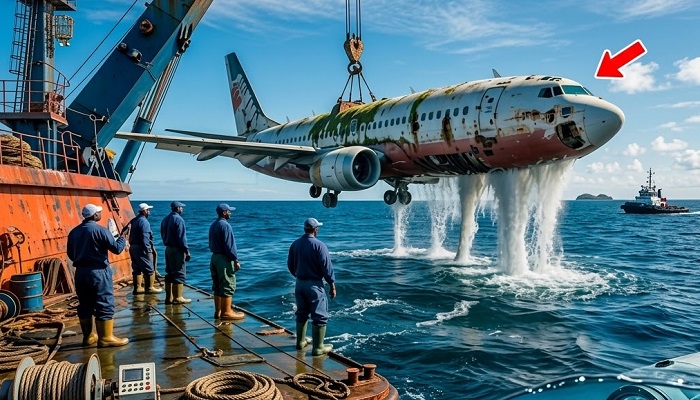
The Pacific Ocean had always kept its secrets.
Some were small—lost fishing nets, anchors swallowed by storms, forgotten cargo containers drifting into darkness.
Others were much larger.
And far more dangerous.
The crew of the trawler had spent nearly twenty years working the waters hundreds of miles off the American West Coast. They knew every mood of the sea.
They knew where the tuna traveled.
They knew where the currents shifted.
They knew where storms formed.
But none of them knew what lay beneath them that cold October morning.
The day began like any other.
Gray clouds hung low over the horizon.
The ocean rolled gently beneath the vessel.
The men were preparing to haul up a massive deep-water net that had been soaking for several hours.
The captain stood near the wheelhouse sipping coffee while deckhands moved into position.
Then the winch groaned.
At first nobody thought much about it.
Heavy catches happened.
Sometimes the net snagged driftwood.
Occasionally it caught abandoned equipment.
But this felt different.
The cable strained so hard that the hydraulic system screamed.
The boat tilted several degrees.
One deckhand looked over the rail.
“What in the world is down there?”
The captain stepped outside.
“Keep lifting.”
The winch continued pulling.
Slowly.
Painfully.
Minute after minute passed.
The object rose from nearly three hundred feet below.
Then something metallic appeared beneath the surface.
Everyone stopped talking.
The ocean parted.
A wing emerged.
For several seconds nobody moved.
Nobody breathed.
An airplane.
A real airplane.
The aircraft was covered in coral, seaweed, and decades of marine growth.
One wing was partially broken.
The nose had collapsed inward.
But there was no mistaking what it was.
The fishing crew had just hauled a plane from the bottom of the Pacific Ocean.
“Call the Coast Guard,” the captain said quietly.
Within hours officials arrived.
Experts quickly identified the aircraft as a military transport plane from the 1950s.
Records showed it had vanished during a routine flight more than seventy years earlier.
No distress signal had ever been received.
No wreckage had ever been found.
The aircraft had simply disappeared.
Families spent decades wondering what happened.
Eventually the mystery faded into history.
Until now.
The discovery made national headlines.
Historians became excited.
Military investigators arrived.
Recovery teams prepared to transport the wreckage to shore.
But before that could happen, they wanted to inspect the interior.
Nobody expected to find much.
After all, the plane had spent seven decades underwater.
Most believed the inside would be empty.
Destroyed.
Scattered.
Gone.
They were wrong.
When divers opened the damaged cargo door, their lights pierced darkness untouched since the Eisenhower administration.
The beam revealed rows of seats.
Equipment crates.
Fragments of uniforms.
And something else.
Everything seemed strangely preserved.
Not perfect.
But far better than anyone expected.
Cold temperatures and lack of oxygen had slowed decay.
The plane had become a time capsule.
Then one diver spotted a metal locker near the rear compartment.
The door was sealed shut.
A layer of corrosion covered the handle.
It took several minutes to pry open.
When it finally swung outward, a cloud of silt drifted into the water.
Inside sat three waterproof containers.
Each carried military markings.
The divers exchanged glances.
Nobody opened them underwater.
Instead, they carefully transported them to the surface.
Hours later, inside a secure examination facility, investigators gathered around the containers.
The first held personnel records.
The second contained navigation logs.
The third contained something nobody expected.
Hundreds of photographs.
Perfectly preserved.
Black-and-white images filled the box.
Pilots standing beside aircraft.
Families gathered around dinner tables.
Children smiling at cameras.
Birthday celebrations.
Picnics.
Weddings.
Ordinary moments frozen in time.
For a while the room became silent.
The discovery transformed the wreck from a historical curiosity into something deeply human.
These weren’t just names in old records anymore.
These were people.
Real people.
People who had once laughed, dreamed, worried, and loved.
Investigators spent weeks identifying faces.
Some families of the missing crew were still alive.
Grandchildren.
Great-grandchildren.
Relatives who had grown up hearing stories about fathers and grandfathers who never came home.
Many cried when shown the photographs.
One woman in her seventies stared at a picture of a smiling young pilot.
She had never seen her father before.
He disappeared years before she was born.
The photograph was the first image she had ever held of him.
Reporters covering the story believed the photographs were the greatest discovery.
They were mistaken.
The biggest surprise came later.
Far later.
As investigators examined the aircraft, they noticed something unusual beneath the cargo floor.
A panel seemed out of place.
The design didn’t match original blueprints.
At first they assumed it was a repair.
Then scans revealed a hidden compartment.
Nobody knew it existed.
Military records contained no mention of it.
Engineers carefully removed the floor.
Below it sat a steel box roughly the size of a refrigerator.
It had survived remarkably well.
The compartment appeared intentionally concealed.
Suddenly the investigation changed.
Questions multiplied.
Why was it hidden?
Who put it there?
What was inside?
Speculation exploded.
Some guessed classified equipment.
Others suggested intelligence documents from the Cold War.
Conspiracy theories spread online within hours.
The truth turned out to be stranger.
The box required several days to open safely.
When technicians finally lifted the lid, everyone leaned forward.
Inside were dozens of cylindrical metal tubes.
Each tube contained tightly rolled documents.
There were also maps.
Engineering drawings.
Technical notes.
Correspondence.
Thousands of pages.
The discovery stunned historians.
The documents belonged to an experimental aerospace project that had been abandoned decades earlier.
Much of the material had never appeared in official archives.
Researchers believed it had been lost forever.
Apparently the transport aircraft had been carrying copies to another military facility when it vanished.
The hidden compartment existed because the material was considered highly sensitive at the time.
Yet the most important revelation wasn’t military.
It was personal.
Buried among the technical papers investigators discovered a small leather journal.
Its cover had nearly disintegrated.
Inside were handwritten entries.
The journal belonged to one of the flight crew members.
Page after page described life aboard military bases during the early Cold War.
The writer spoke about loneliness.
Fear.
Friendship.
Dreams of returning home.
The final entry was dated the day of the flight.
Investigators expected dramatic last words.
There weren’t any.
Instead, the final paragraph read:
“Looking forward to seeing home again soon. Maybe take the kids fishing next spring.”
Nothing heroic.
Nothing cinematic.
Just an ordinary hope.
And somehow that made it heartbreaking.
The journal became the emotional centerpiece of the recovery.
Millions read excerpts after the family granted permission.
People connected with it because it felt familiar.
Everyone understood longing for home.
Everyone understood making plans for tomorrow.
Not knowing tomorrow might never come.
Months passed as investigators continued studying the wreck.
Eventually they solved the mystery of the crash itself.
Weather records revealed a powerful storm system had developed unexpectedly along the aircraft’s route.
Combined with a mechanical failure discovered in the recovered engine components, the storm likely proved fatal.
The plane descended rapidly.
It struck the ocean.
Then sank into a deep underwater trench where it remained hidden for more than seventy years.
The explanation brought closure.
But it wasn’t what most people remembered.
The public remembered the photographs.
The journal.
The stories.
The humanity.
The fishing crew returned to work after media attention faded.
They preferred quiet lives.
Still, people often asked them what it felt like to discover the plane.
One deckhand always gave the same answer.
“It felt like the ocean wanted to give something back.”
At first listeners usually laughed.
But then they thought about it.
For seventy years the Pacific had held an entire chapter of history.
Generations had lived and died without answers.
Children grew old wondering what happened to parents.
Families carried uncertainty their entire lives.
Then, by pure chance, a fishing net brushed against forgotten metal resting on the ocean floor.
A single moment changed everything.
The photographs returned faces to names.
The journal returned voices to silence.
The records returned truth to mystery.
And perhaps most importantly, the discovery returned people to their families.
Not physically.
That was impossible.
But emotionally.
Historically.
Humanly.
The final ceremony occurred the following summer.
Relatives of every crew member gathered near the coast.
The recovered photographs were displayed in a memorial exhibit.
Military representatives attended.
Historians attended.
Members of the fishing crew attended.
As the sun began setting over the Pacific, families walked slowly through the display.
Many stopped before the photographs.
Some smiled.
Some cried.
Some simply stared.
A young boy stood beside one image showing a pilot in uniform.
“Who is that?” he asked his grandmother.
She looked at the picture for a long time.
Then she answered softly.
“That’s your great-grandfather.”
The boy studied the face.
“He looks happy.”
The old woman nodded.
“Yes.”
Tears filled her eyes.
“He does.”
The waves rolled gently against the shore.
The same ocean that had hidden the truth for seven decades stretched endlessly toward the horizon.
For years it had guarded its secret in darkness.
Now the secret belonged to everyone.
And somewhere beyond the fading sunlight, beneath miles of water, the empty aircraft rested once more.
Its mission finished at last.
Not because it reached its destination.
But because it finally brought its passengers home.