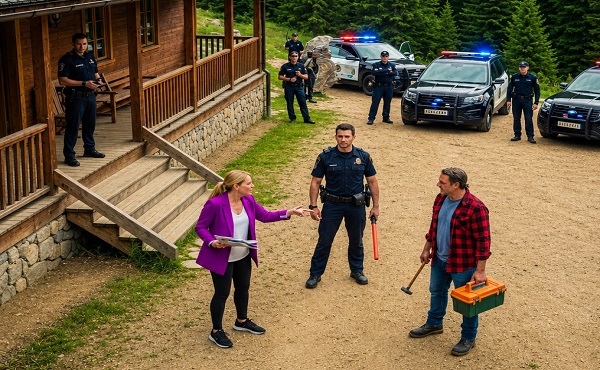
I bought the foreclosed mountain cabin for twelve thousand dollars because after a divorce strips a man down to almost nothing, even a broken house can look like a second chance.
That was what I told myself, anyway, driving up into the Colorado mountains with Miguel in the passenger seat and a thermos of gas-station coffee rattling between us. The road climbed out of Woodland Park in long, twisting curves, through stands of ponderosa pine and patches of late-summer grass burnt gold by the sun. Every few miles, the view opened wide enough to make a man believe his life could still become something other than the wreckage in his rearview mirror.
Miguel kept flipping through the folder on his lap, the one with the tax auction papers, the county photos, and the materials estimate he had already warned me was probably too optimistic.
“Boss,” he said, “you sure about this place?”
I kept both hands on the wheel. “No.”
He looked at me.
“But I’m sure about needing something to work on.”
Miguel grunted. He had known me long enough not to argue with that. He was my best subcontractor back when I still had a contracting business big enough to need crews, schedules, and a bookkeeper who yelled at me about receipts. Fifteen years in Denver had given me a decent reputation, a steady stream of renovation jobs, a house in the suburbs, two trucks, a workshop full of tools, and the arrogant comfort of thinking the life I had built would keep standing because I had built it carefully.
Then my wife Lisa decided she needed to “find herself” with a yoga instructor named Brad who wore linen pants in February and described himself as a “breathwork guide.” He had a man bun, a pendant necklace, and the kind of spiritual vocabulary that made normal betrayal sound like personal growth.
Colorado’s no-fault divorce laws did not care that Lisa had found herself in another man’s bed. They cared about assets, accounts, equity, business valuation, and the cold mathematics of splitting a life in half. By the time the paperwork was done, the house was gone, most of my tools were sold, the truck I loved went into the settlement, and my business collapsed under the weight of legal fees, lost time, and clients who could not wait around while my personal life burned down.
So there I was at forty-five, living in a studio apartment that smelled faintly of old cigarettes no matter how much I scrubbed the walls, driving a used pickup with one cracked taillight, and wondering how a man who knew how to rebuild kitchens, decks, foundations, barns, and half-collapsed mountain cabins had failed so completely at maintaining his own life.
Then I saw the auction listing.
Mountain cabin. Two acres. Woodland Park area. Tax foreclosure. Starting bid eight thousand dollars.
The photos were bad enough to scare away dreamers and good enough to interest a contractor who had more labor than cash. Rotting deck. Broken windows. Sagging porch. Weeds tall enough to hide a dog. The roof looked tired but not hopeless. The foundation, at least in the county photos, looked repairable. The cabin had belonged to a man named Harold Brennan, seventy-three, who had lived there alone for decades before falling behind on taxes and dying without a will. The county had tried to locate relatives, published notices, waited out the required process, cleared the title, and put the property up for auction.
Advertisements
Nobody else bid.
For twelve thousand dollars, I bought two acres of pine trees, a wrecked cabin, and the first thing in months that felt like mine.
The plan was simple. Miguel and I would inspect the place, make a repair list, secure the structure, and spend the next year turning it into a modest mountain retreat. I figured if I put in sweat instead of money, I could maybe sell it for sixty thousand, maybe more if the market cooperated. It was not a fortune, but it was enough to restart. Enough to buy tools again. Enough to stop feeling like my life had been reduced to a rented room and a stack of legal bills.
I had done everything by the book. Deed search. Title insurance. County confirmation. Tax auction paperwork. Survey maps. Clear title. When you buy through a valid county tax auction, previous liens and claims are supposed to be wiped clean. That was the whole point. I had no reason to think anything stood between me and that broken little cabin except work.
Then we rounded the final curve, and I hit the brakes so hard Miguel’s folder slid off his lap.
There were cars in the driveway.
Not one car. Three.
A blue minivan, a dented black sedan, and a silver SUV with expired temporary tags. The yard had been mowed. The cabin had fresh sage-green paint on the siding. Flower pots sat on the porch. Kids’ bicycles lay scattered near the steps. A plastic playhouse leaned against a pine tree. Smoke rose from the chimney.
The abandoned cabin I had purchased was not abandoned.
It looked lived in.
Miguel slowly reached down, picked up the folder, and said, “Boss.”
“I see it.”
“You expecting anybody?”
“No.”
“Maybe caretakers?”
“No.”
The smell reached us when I opened the truck door. Wood smoke, pine needles, and something cooking inside the cabin. Lunch. In my kitchen. From my stove. In the property I legally owned but apparently could not enter.
I walked up the porch steps with the deed in my hand, trying to stay calm because confusion can become anger too quickly if a man lets it. Before I could knock, the front door opened.
A blonde woman in designer yoga pants stood there holding a coffee mug.
She was in her early fifties, though clearly invested in looking younger. Bleached hair, expensive sunglasses pushed up on her head, pink athletic jacket, perfect nails, the kind of expression people use when they are about to make a cashier’s day miserable. She looked me up and down like I was selling pest control.
“Can I help you?” she asked.
“My name is Jake Morrison.” I held up the deed. “This is my property.”
She glanced at the papers for less than a second, then laughed.
Not surprised. Not nervous.
Amused.
“Oh, sweetie,” she said. “We’ve been living here over a year. Adverse possession laws. Look it up.”
For a moment, I had no answer.
She took a sip from her mug.
“Good luck with that eviction.”
Then she closed the door in my face.
I stood there on my own porch, holding a deed to a house I could not enter, listening to the sounds of someone moving around inside. A cabinet closed. A teenager laughed. A dog barked once. Somewhere in that house, my house, a timer went off in the kitchen.
Miguel came up behind me.
“What the hell just happened?”
“I have no idea,” I said. “But we’re about to find out.”
I knocked again, harder this time.
The door opened halfway. The blonde woman stood there again, but now a young man hovered behind her. Tall, skinny, probably twenty-five, with a scraggly beard, bloodshot eyes, and the slouched posture of someone who had strong opinions about society but no recent employment history.
“Ma’am,” I said carefully, “I need to see documentation proving you have the right to be here.”
She smiled with fake sweetness. “I don’t need to prove anything to you. We’re the residents. You’re the one trespassing.”
“That is not how this works.”
“Tyler,” she said without looking away from me, “call the sheriff. This man is harassing us.”
The young man grinned and pulled out his phone. “Already dialing, Mom.”
That was how I learned her name.
Brenda Hutchkins.
Twenty minutes later, a sheriff’s cruiser came up the road, and my stomach sank when I saw Deputy Rick Morrison step out. No relation to me, though that did not stop people from joking about it whenever his name came up in town. The reason my stomach sank was not his badge. It was the way he walked straight to Brenda and hugged her.
“Brenda,” he said, “what’s the problem here?”
She changed instantly.
One second, she was smug and polished. The next, her shoulders collapsed inward, her voice trembled, and her eyes filled with tears so fast it looked rehearsed because it was.
“This man claims he owns our home,” she said. “He showed up threatening us, taking pictures, making us feel unsafe. My daughter is inside terrified.”
“I did not threaten anyone,” I said, stepping forward with the deed. “I bought this property at county auction three months ago. Here are the documents.”
Deputy Rick barely glanced at them.
“Sir,” he said, “even if you purchased the property, Colorado law is very clear about tenant rights. You can’t just show up and harass people who have been living somewhere.”
“They are not tenants. They’re squatters.”
“That’s a civil matter.”
“It’s my house.”
“Court can sort that out.”
Brenda began crying harder. Full theater now. One hand to her mouth, shoulders shaking, breath catching.
“We’ve lived here peacefully for over a year,” she sobbed. “We cared for this place after Harold died. Now this man wants to throw a single mother and her children onto the street. What if he comes back at night? What if he hurts us?”
Deputy Rick’s expression hardened.
I knew that look. The story had locked in. To him, I was not the legal owner anymore. I was the angry man making a crying woman afraid.
“Sir,” he said, “I’m going to need you to leave immediately. Any further contact with these residents will be considered harassment, and I may have no choice but to arrest you.”
The smell of wood smoke drifted from my chimney.
My chimney.
I looked past him at the cabin I had bought to rebuild my life. Brenda stood in the doorway behind the deputy, still dabbing her eyes, but when Rick turned away, she looked directly at me and smiled.
That smile told me more than her tears ever could.
Miguel and I drove back down the mountain in silence. My hands stayed locked around the steering wheel.
“This is insane,” I finally said. “They’re living in my house, and I’m the one threatened with arrest.”
Miguel looked out at the trees. “People like that know the system better than honest people.”
He was right.
By the time I reached my apartment, Brenda had already moved faster than me.
She posted on three neighborhood Facebook groups before dinner.
URGENT: Corporate slumlord trying to steal our family home.
The post was a masterpiece of manipulation. According to Brenda, she had cared for Harold Brennan in his final days. She had maintained the cabin out of love and respect. She and her children had lived there over a year. Then a predatory investor showed up with paperwork demanding they leave immediately. She described me as threatening, aggressive, and wealthy. Wealthy. I read that word while sitting on a futon in a studio apartment that still smelled like the previous tenant’s ashtray.
Within two hours, there were dozens of comments.
This is what’s wrong with America.
Rich people buying up affordable housing.
Leave that family alone.
Hope that greedy bastard gets what’s coming to him.
Somebody should teach him a lesson.
These people had never met me. They did not know I was divorced, broke, and trying to rebuild a life with a cabin nobody else wanted. They did not know I had bought the property legally. They did not know Brenda was standing in my kitchen eating lunch while calling me a predator online.
They knew only the story she gave them, and people love a story that tells them where to place their anger.
That night, I did not sleep.
Shock became anger. Anger became focus.
I remembered something from years of working around property disputes: adverse possession in Colorado was not a magic phrase you tossed out after squatting in a house for a few months. It required years of actual, hostile, open, continuous possession under specific conditions, and Brenda’s smug “look it up” confidence suddenly looked less like legal knowledge and more like a rehearsed line that had worked on someone before.
The next morning, I started making calls.
County assessor. Recorder’s office. Utility companies. Local businesses. A real estate attorney recommended by a former client. Everyone in Woodland Park who might know the name Brenda Hutchkins.
By noon, I had three facts.
First, Brenda owed money to half the businesses in town.
Second, she had attempted similar occupancy scams in at least two other counties.
Third, despite claiming over a year of residence, utility connections at the cabin dated back only eight months.
That did not make me feel better.
It made me hungry.
The hunt had begun.
Three days later, Brenda went on local television.
I was drinking gas-station coffee in my apartment when my phone started exploding with texts from numbers I did not recognize.
Saw you on the news, you piece of trash.
Hope you’re proud terrorizing families.
Leave that woman alone.
I turned on Channel 9 and saw Brenda standing in front of my cabin, looking exhausted and fragile. Her teenage daughter, Madison, stood beside her holding a handmade sign: DON’T LET THEM MAKE US HOMELESS. Tyler stood on the porch hammering a board into place like a hardworking son protecting the family homestead, which was probably the first honest-looking work he had performed in months.
The reporter, Sarah Collins, looked painfully young.
“This is Sarah Collins from Woodland Park, where a local family says they face eviction from their home of over a year after a corporate investor purchased the property at auction.”
Brenda dabbed her eyes.
“We cared for Harold when he was dying,” she said. “We maintained this property. We paid for repairs ourselves. Now this man shows up with papers and wants to throw my children onto the street.”
My jaw tightened so hard it hurt.
The screen flashed to a GoFundMe page raising money for Brenda’s legal defense. The goal was ten thousand dollars.
I nearly threw my mug.
Instead, I called the attorney.
Her name was Rosemary Reeve, a former San Francisco corporate fraud lawyer who had burned out, moved to the mountains, and now ran a small practice from a home office that smelled like jasmine tea and old law books. She had silver-streaked hair, sharp eyes, and the calm manner of someone who had spent years watching liars underestimate documents.
She read through my papers without interruption.
“Textbook fraud,” she said finally.
“Can we prove it?”
She smiled slightly. “Jake, I tracked corporate scammers for twenty years. They always leave breadcrumbs.”
Within days, Rosemary helped me map Brenda’s operation.
Jefferson County. Boulder County. Larimer County. Same pattern. Target distressed or vacant properties. Move in quietly. Claim caretaker status. Play victim when confronted. Drag the dispute into court long enough to extract settlement money, delayed eviction, or both. She had not always won, but she had always left before consequences caught up.
Then we found her real home.
A double-wide trailer forty miles away with active utilities, current taxes, and neighbors who confirmed Brenda still came and went regularly. She had been living there while running my cabin as an illegal short-term rental under the name Mountain Getaway Retreat.
One hundred fifty dollars a night.
Booked solid through tourist season.
She had made thousands renting my property to strangers while I was signing divorce papers.
Rosemary leaned back when we found the listing.
“There’s your motive.”
“There’s more,” I said.
Because Brenda, never satisfied with one scam when three would do, had filed a homestead tax exemption claiming the cabin as her primary residence. Same cabin she was renting to tourists. Same cabin she did not own. Same cabin tied to the estate of a dead man whose relationship with her was growing stranger every day.
Frank Murphy at the hardware store gave us the next piece.
Frank was a barrel-chested man with grease permanently under his fingernails and no patience for people who stiffed him.
“That woman,” he said when I mentioned Brenda. “She owes me five hundred dollars.”
“For what?”
“Paint, lumber, roof patch, some fasteners. Said she’d pay when her insurance settlement came through.”
“What insurance settlement?”
He shrugged. “Ask her.”
He showed me receipts. Sage-green exterior paint. Deck boards. Roofing supplies. Garden gnomes. Yes, garden gnomes. The same little ceramic criminals now lined up on my porch.
At Mountain View Restaurant, Lisa Rodriguez told another story. Brenda had come in twice a week claiming her dying mother needed free meals. Lisa and her staff had helped for months until Lisa’s cousin saw Brenda buying steaks and wine at Walmart the same day she claimed her family was starving.
“When I confronted her,” Lisa said, “she told people we discriminated against single mothers.”
The pattern was clear.
Brenda did not just squat.
She fed on compassion.
Then she tried to freeze my bank account.
A bank representative called one afternoon to ask about a fraud claim alleging I had written bad checks tied to property I did not own. It was clumsy, but vicious. If it had worked, even temporarily, I would have been fighting Brenda in court without access to what little money I had left.
That night, I researched state tax law until my eyes burned. When someone claims a property as a primary residence while actually living elsewhere, especially for tax benefit, it can cross from civil nonsense into criminal fraud. Add unreported rental income, fraudulent charity claims, possible mail fraud, and the picture grew uglier.
The next morning, I made three calls.
The IRS fraud hotline.
The Colorado Department of Revenue.
And Channel 9.
“Hi, Sarah,” I said when the young reporter answered. “This is Jake Morrison, the predatory landlord from your story. I have some documents about Brenda Hutchkins you may want to see.”
By noon, Brenda’s GoFundMe had been suspended for suspected fraudulent claims. By three, a state tax investigator was driving up the mountain to my cabin.
The hunter was becoming the hunted.
Two weeks later, Brenda decided to burn everything down without lighting a match.
I was reviewing contractor bids when Miguel called.
“Boss,” he said, voice tight with anger, “get up here now. Bring a camera.”
The drive felt endless.
When I reached the cabin, my heart stopped.
Every south-facing window was smashed. The front door hung crooked. Broken glass glittered across the porch. Tyler sat on the steps drinking beer like a man enjoying the view after a hard day’s destruction.
“What happened?” I asked.
He looked up with bloodshot eyes and a cocky grin.
“Structural issues, landlord. Safety hazards. Had to do emergency repairs.”
Inside was worse.
Holes punched through drywall. Kitchen sink ripped from the counter. Water spreading across hardwood. Cabinets broken. Interior doors kicked in. Copper pipes exposed. Tyler had taken a sledgehammer to my future and called it repair.
“Mom’s documenting everything,” he said. “Going to show how you let this dump fall apart. Real slumlord behavior.”
Brenda emerged from the bedroom in spotless designer workout clothes, phone raised and recording.
“Jake, perfect timing,” she said. “We’re documenting all the safety issues you’ve ignored as property owner. We’ve been forced to make emergency repairs to protect my children.”
The audacity was breathtaking.
She was recording her son’s destruction and blaming me.
But I had learned by then.
I had installed hidden cameras two weeks earlier.
Brenda had not noticed them. Tyler certainly had not.
Every window smashed. Every swing of the sledgehammer. Every pipe torn free. Every laugh. Every instruction from Brenda. All recorded in clear high-definition video, timestamped and backed up.
“Brenda,” I said, “are you familiar with Colorado’s criminal mischief statute?”
Her confidence flickered. “What?”
“Property damage over two thousand dollars becomes serious.”
I showed her the footage on my phone.
Tyler swinging the sledgehammer with drug-fueled enthusiasm. Brenda pointing where to hit next. Twelve hours of video. Every act of vandalism.
Brenda went pale beneath her makeup.
“Fifteen thousand dollars in damage so far,” I said. “And the best part is, you filmed yourselves doing it.”
My phone buzzed a minute later after I walked outside.
Unknown number.
Drop the case or this gets worse. We know where you live.
I took a screenshot and sent it to Rosemary.
Then something strange happened.
While documenting the damage, I found a hidden cavity in the bedroom wall Tyler had smashed open. Inside, wrapped in plastic and tucked between old studs, were documents that did not belong to Brenda, Tyler, or me.
Medical records.
Insurance papers.
Bank statements.
Power of attorney forms.
All belonging to Harold Brennan.
The previous owner.
I spread them across my apartment floor that night. As I read, the property dispute disappeared and something much darker emerged.
Harold had not simply died and left an abandoned cabin.
He had been isolated.
Controlled.
Possibly financially abused.
Brenda had inserted herself into his life during his final year as a caregiver. There were power of attorney forms with questionable signatures. Bank account changes routing Social Security deposits into accounts she controlled. Medical records showing he became confused, weak, and increasingly dependent after she entered his life. A life insurance policy named Brenda as beneficiary.
Forty thousand dollars.
The signature did not look like Harold’s earlier handwriting.
I called Rosemary after midnight.
“Jake,” she said after reviewing the scanned documents, her voice quiet, “what you are describing is not squatting.”
“What is it?”
“Elder abuse. Insurance fraud. Potentially homicide.”
The word sat in the air like a loaded gun.
Homicide.
The next morning, I found my truck vandalized in my apartment parking lot. PREDATOR had been spray-painted across the side in neon orange. A note under the wiper read: FINAL WARNING.
Instead of frightening me, it clarified everything.
Brenda was desperate.
Desperate people do not make threats when they are safe. They make threats when pressure is getting close to the thing they most need hidden.
I called the FBI field office in Denver.
“Special Agent Martinez,” a crisp voice answered.
“My name is Jake Morrison. I need to report suspected elder abuse, insurance fraud, and possible homicide.”
Three hours later, Special Agent Sarah Martinez sat in my studio apartment reviewing Harold’s hidden documents. She was in her forties, composed, direct, and impossible to impress with emotion alone. She drank black coffee from a paper cup while moving through the records page by page.
Finally, she looked up.
“Mr. Morrison, what started as a property dispute may have become a federal investigation.”
“I figured.”
“If Harold Brennan was exploited, if insurance money was collected through false statements, if mail or banking systems were used, this becomes much bigger than your cabin.”
“What do you need from me?”
“Everything. And from now on, no direct contact with Brenda unless unavoidable. Document threats. Preserve originals. Do not confront her about Harold.”
As she left with copies of the documents, I realized the stakes had moved far beyond anything I had imagined.
I was not just fighting for my property anymore.
I was fighting for a dead man who might have been murdered by the person now cooking in his kitchen and calling me the villain.
The call came at two in the morning, three days later.
“Jake,” Agent Martinez said, “we need to meet. Now. Bring everything you have on Brenda Hutchkins.”
We met at an all-night truck stop outside Colorado Springs. Diesel fumes and burnt coffee filled the air. Martinez slid a manila folder across the sticky table.
“Harold Brennan may not be the only victim,” she said.
The first photo showed Harold eighteen months earlier: smiling, healthy-looking, standing in front of the cabin with a fishing rod. The second photo, taken weeks before his death, showed a skeletal version of the same man, hollow-eyed and nearly unrecognizable.
Martinez’s voice stayed low. “We’re looking at a pattern. Elderly men. Isolated. Assets. No close family nearby. Sudden decline after Brenda enters their lives. Insurance changes. Money movement. Deaths treated as natural.”
My mouth went dry.
“She’s done this before?”
“At least three possible prior cases. Maybe more.”
“Serial?”
“Financial predator at minimum. Possibly serial homicide.”
The fluorescent lights hummed overhead.
“She didn’t stumble onto Harold,” Martinez continued. “She met him at a senior grief support group. Posed as a widow seeking comfort. She selected him.”
The timeline turned my stomach.
Brenda befriended Harold, became indispensable, gradually cut him off from neighbors and relatives, changed routines, intercepted mail, managed medication, controlled bank accounts, and positioned herself as caretaker. When Harold’s nephew in Florida tried to call, calls stopped being returned. Messages disappeared. Mail was redirected.
Then Martinez told me about Fletcher Brennan.
Harold’s nephew. He had been trying to prove something was wrong for two years. Private investigators. Medical record requests. Financial tracking. Security footage from the senior center. Fletcher had been chasing Brenda before I even knew she existed.
“Your purchase threatened her,” Martinez said. “She expected the property to remain in limbo long enough for her to use it, rent it, and maybe force a settlement. You complicated everything.”
“What happens now?”
“We build a case she cannot escape.”
The next morning, my studio apartment became a temporary war room.
Agent Martinez arrived with Fletcher Brennan, Harold’s nephew from Florida, and enough evidence boxes to bury my coffee table. Fletcher was a thin, intense man in his fifties, with tired eyes and a handshake hard enough to tell me grief had not softened him.
“She killed my uncle,” he said simply. “And she is going to pay for it.”
For hours, we went through documents. Financial records. Medical notes. Photos taken secretly by Harold’s neighbor, Mrs. Reese, who had grown suspicious of Harold’s sudden decline. Phone logs. Bank withdrawals. Insurance forms. Mail forwarding records. Forged signatures.
Fletcher had built the case like a man possessed.
“Harold called me every Sunday for thirty years,” he said. “Every Sunday. Then Brenda appeared, and suddenly he was too tired, too confused, too upset, too sick. That’s what she told everyone. She made herself the gatekeeper.”
The handwriting evidence was heartbreaking.
Harold’s earlier signature was neat and steady. Later signatures on beneficiary changes, power of attorney documents, and bank forms grew increasingly shaky, then suddenly too smooth in ways that suggested copying rather than weakness.
“She was forging him,” I said.
Fletcher nodded. “While telling everyone he was declining naturally.”
The insurance company had its own concerns. Harold’s policy contained protections against fraudulent beneficiary arrangements, including questions about cohabitation and caregiving relationships. Brenda had allegedly submitted documents claiming she lived elsewhere, all while occupying the cabin and controlling Harold’s mail.
Martinez laid out the strategy.
Three parallel investigations. FBI for fraud, financial crimes, and possible homicide. IRS for unreported income and false filings. Insurance company for criminal fraud. Local charges for trespass, vandalism, threats, and identity-related offenses.
“She cannot fight everyone at once,” Martinez said. “And she is escalating. That helps us.”
It sounded strange at first, but she was right. Every threat, every lie, every destruction of property, every attempt to intimidate me supported obstruction, witness intimidation, and consciousness of guilt.
Brenda thought she was wearing me down.
Instead, she was documenting herself.
A week later, she went completely feral.
Fake Facebook accounts targeted my business. Fake reviews called me a racist slumlord, a predator, a danger to women and children. Doctored photos of me spread through local groups. Someone posted my apartment complex address. Then she dragged Lisa into it, commenting on my ex-wife’s social media that I had been abusive during our marriage and had stolen property from vulnerable people.
To Lisa’s credit, she called me immediately.
“Jake,” she said, sounding more concerned than she had since the divorce began, “some crazy woman is posting lies about you.”
“Do not engage with her.”
“She said you beat me.”
“She lies professionally.”
There was a pause.
“Are you safe?”
That question, from Lisa of all people, surprised me.
“I’m working on it.”
Two days later, Tyler came to my apartment parking lot.
He leaned against my truck smoking a cigarette, trying to look dangerous and mostly succeeding at looking unwashed.
“Jake, right?” he said. “Mom wants to make a deal.”
“I’m not interested.”
“You haven’t heard it.”
“I still know.”
He flicked ash onto my windshield. “Split Harold’s insurance money. Twenty grand each. Drop the eviction. Everybody walks away happy.”
The kid had no idea my phone was recording from my jacket pocket.
“What insurance money?” I asked.
“Don’t play dumb. Mom found Harold’s policy papers. Forty grand. We cut you in for half.”
“Tyler,” I said calmly, “I’m not interested in your mother’s blood money.”
His expression darkened.
“That’s a mistake. Accidents happen to people who don’t know when to quit.”
I sent the recording to Martinez before I even reached my apartment.
Then Tyler broke into my apartment while I was at work.
He came looking for documents and found FBI surveillance equipment instead. Cameras captured him searching my papers, photographing legal documents, and stealing my laptop. Federal evidence theft. Breaking and entering. Obstruction.
“They’re falling apart,” Martinez said when we reviewed the footage. “She’s getting sloppy. He’s already sloppy.”
The final crack came from Madison.
Brenda’s seventeen-year-old daughter walked into the sheriff’s department and asked to speak to someone about her family.
Martinez called me that night.
“She wants to testify,” she said. “Against Brenda.”
Madison had known things for months. Maybe longer. She had heard Brenda brag about “taking care” of Harold. She had seen Tyler help destroy property. She had watched her mother’s behavior become increasingly unstable. Now Brenda was talking about burning down the cabin and blaming me. Worse, Madison had heard Brenda discussing people who could make me disappear before the town hall meeting scheduled for the next night.
I felt the room tilt around me.
“Disappear,” I repeated.
“Contract violence,” Martinez said. “We intercepted related communication. Three men tied to a motorcycle crew were picked up this afternoon with gasoline, weapons, and five thousand dollars in cash.”
For a moment, I could not speak.
I had thought Brenda wanted my property.
Then I thought she wanted money.
Then justice for Harold.
Now I understood that to Brenda, people were obstacles. If paperwork did not move them, fear might. If fear did not, violence would.
Madison secretly recorded her mother that night.
The recording was worse than I expected. Brenda’s voice, slurred and furious, describing Harold as stupid, saying he “never saw it coming,” bragging that she had done what she needed to do, saying I was supposed to be easy because divorced men usually gave up when their lives became miserable enough.
“But this one won’t quit,” Brenda said on the recording. “So he has to disappear.”
Agent Martinez’s jaw hardened when we listened.
“That is enough.”
The town hall meeting was already scheduled for Thursday at seven. It had been organized as a public discussion about property rights and tenant protections because Brenda had demanded a platform after her social media campaign. Martinez decided to let it happen, with agents in the room, local deputies outside, media present, and Madison prepared to testify if needed.
“She wants a stage,” Martinez said. “We’ll give her one.”
The Woodland Park Community Center was packed that night.
More than two hundred people filled folding chairs and lined the walls. Media crews from Denver stations stood near the back. The air smelled like burnt concession-stand coffee, nervous sweat, and the faint dusty odor of old municipal carpet. I sat in the back row with Miguel on one side and Rosemary on the other. Fletcher Brennan sat three rows ahead, hands folded tightly.
At 7:15, Brenda made her entrance.
In a wheelchair.
Apparently, her disability had developed overnight.
Tyler pushed her slowly down the aisle. Madison followed behind, pale but composed, clutching a tissue box. Brenda had outdone herself: neck brace, arm sling, oxygen tank beside the wheelchair, soft blanket over her lap. The crowd murmured sympathetically. A few people applauded her courage for attending.
I looked at Rosemary.
She whispered, “Commitment to the role.”
The mayor called the meeting to order and allowed Brenda to speak first.
She took the microphone in trembling hands.
“Thank you all for coming,” she said, voice barely above a whisper. “I’m here despite my doctor’s orders because vulnerable families in this community deserve protection.”
She dabbed at her eyes.
“My children and I have called Harold Brennan’s cabin our home for over a year. We cared for Harold in his final days. We maintained his property. We honored his memory by filling his home with love. Now a corporate investor wants to throw us into the street.”
Several people nodded.
Tyler took the microphone. “This man has made our lives hell. Mom’s health is worse because of the stress. We just want peace.”
That was when I stood.
“Mrs. Hutchkins,” I said loudly enough for everyone to hear, “would you mind explaining how you knew Harold Brennan?”
The room turned toward me.
Brenda’s face tightened. “Harold was like family.”
“What illness did he have?”
“He had dementia. He couldn’t care for himself.”
I walked toward the front.
“That’s interesting,” I said, “because his medical records show no dementia diagnosis before you became his caregiver.”
Agent Martinez stood from the audience, badge visible.
“FBI Special Agent Sarah Martinez,” she said. “Mrs. Hutchkins, you are under federal investigation related to the death of Harold Brennan.”
The room exploded.
Gasps. Shouts. Cameras shifting. People turning in seats.
Brenda’s performance cracked, then snapped back.
“This is harassment,” she shrieked. “They’re trying to silence me because I’m exposing corruption.”
Fletcher stood slowly.
“My name is Fletcher Brennan,” he said. “Harold was my uncle.”
The room went silent.
He walked to the front, grief carved into every line of his face.
“My uncle did not die alone because no one loved him. He died isolated because this woman kept us away. She controlled his phone, his mail, his money, and his medicine. She took his property, his insurance, and possibly his life.”
“Lies,” Brenda snapped. “All lies.”
Martinez opened a folder. “We have forged power of attorney documents, insurance records, financial transfers, mail records, witness statements, and recordings.”
Brenda’s eyes darted around the room. She looked at Tyler. At Madison. At the cameras. At me.
Then Fletcher said, “Harold never had dementia.”
“He deserved better than you,” Brenda shouted.
The room froze.
She pushed herself up from the wheelchair without seeming to remember she was pretending she could not stand.
“He was wasting that place,” she screamed. “Wasting everything. I made better use of it than he ever did.”
The room erupted.
Martinez moved forward.
“Brenda Hutchkins, you are under arrest for federal fraud offenses, conspiracy, and charges related to the death of Harold Brennan. Additional charges are pending.”
Brenda tried to pull away, but there was nowhere to go.
The wheelchair rolled backward and hit the microphone stand. Tyler cursed and backed up. Madison stood still, crying silently, not from fear this time, but release.
As the cuffs clicked around Brenda’s wrists, the crowd began clapping.
Not polite applause.
Not entertainment.
Relief.
Justice had finally arrived in public, where Brenda could not edit the story before anyone heard it.
Six months later, I sat on the porch of the mountain cabin watching sunrise paint the Colorado peaks gold and pink.
The cabin did not look like the wreck I had bought at auction anymore. Neighbors and volunteers had helped repair what Tyler destroyed. Frank from the hardware store donated lumber. Lisa from the restaurant organized meals for the crew. Miguel and I rebuilt the deck, replaced windows, repaired plumbing, patched drywall, and restored the cabin one honest day at a time.
Even Deputy Rick showed up one Saturday, red-faced and embarrassed, to help install a window.
“I should have listened to you from the start,” he said.
“She was good at manipulation.”
He nodded. “Too good.”
Brenda’s trial was everything Fletcher had waited years to see. The federal fraud case was airtight. The murder-related proceedings took longer, but prosecutors built them carefully with medical evidence, financial records, recordings, testimony, and the pattern of prior victims. Brenda’s final performance—childhood trauma, mental illness, desperate motherhood—collapsed under the weight of evidence. Tyler took a plea for property destruction, obstruction, and related crimes. Madison testified against her mother with a courage that brought people in the courtroom to tears. She went to live with relatives in Texas, where, last I heard, she was in school, in therapy, and slowly learning that family does not have to mean fear.
Fletcher moved to Colorado part-time after the trial. He bought a small place not far from the cabin and came by often. The first time we sat together on the porch after sentencing, he looked out at the pines for a long time.
“Harold loved this view,” he said.
“I wish I’d met him.”
“He would’ve liked you.”
“I bought his house.”
“You saved his name.”
I did not know what to say to that.
The recovered insurance money, along with donations that came after the case went public, helped create the Harold Brennan Memorial Fund for elder protection in rural communities. Rosemary handled the paperwork. Martinez connected us with agencies. Fletcher spoke at senior centers. Banks began flagging suspicious account changes involving isolated elderly customers. Local deputies received training on caregiver financial abuse. Senior centers started buddy systems so no one could be quietly cut off the way Harold had been.
That became the real victory.
Not getting the cabin back.
Not exposing Brenda.
Not watching people who had called me a predator apologize quietly when they realized they had believed a killer’s performance.
The victory was turning Harold’s death into a shield.
My life changed too.
Miguel and I restarted under a new company name: Mountain Honest Contracting. Honest work for honest people. We specialized in helping fraud victims, foreclosure buyers, and older homeowners secure, repair, and reclaim properties. It was not glamorous. It was not always profitable. But every time we installed a new lock, repaired a vandalized wall, or helped an elderly widow review a suspicious contract, I felt like I was rebuilding more than houses.
Rosemary and I spent a lot of late nights together building the case. Late nights became early morning coffee. Legal strategy became conversations about divorce, burnout, loss, and second chances. Her jasmine tea migrated from her office to my kitchen. She now sits beside me on this porch more mornings than not, laptop open, hair loose, smiling at the mountains like she is still surprised peace can exist after ugly things.
The cabin’s value rose from twelve thousand dollars to more than one hundred thousand after the repairs, but its real worth cannot be measured that way. Once a month, we host a community barbecue. In winter, people gather around the fireplace for storytelling nights. In summer, local kids camp in tents under the pines. Harold’s cabin, the place Brenda used for greed and death, became a place of repair.
Sometimes I think about that first day.
Brenda standing in the doorway with a coffee mug, laughing at my deed.
“Oh, sweetie,” she said. “Adverse possession laws. Look it up.”
She thought she had picked the perfect victim. A divorced contractor, broke, exhausted, isolated, too ashamed and overwhelmed to fight for what was legally his. She thought I would get tired, accept defeat, maybe sell the claim for pennies and walk away.
Maybe before the divorce, before losing everything, I might have.
But once life strips you down, you discover what is load-bearing.
Not your house. Not your marriage. Not your bank account. Not your reputation when a liar can smear it in an afternoon.
What holds is the decision not to surrender what you know is true.
I bought a broken cabin because I needed a second chance.
I found squatters.
Then a fraud ring.
Then a murdered old man.
Then a serial predator hiding behind tears, children, fake victimhood, and paperwork.
The mountain air tasted like vengeance for a while, I admit that. But justice is cleaner than vengeance. Vengeance wants destruction. Justice wants the truth restored, the vulnerable protected, and the people who weaponized kindness finally stopped.
Every sunrise over these pines reminds me that evil often enters softly. With a sob story. A request for help. A claim of hardship. A performance designed to make decent people hesitate. Compassion is a beautiful thing, but compassion without discernment becomes a doorway for predators.
Harold Brennan was not foolish.
He was lonely.
There is a difference.
Brenda exploited that loneliness, just as she exploited public sympathy, tenant laws, court delays, social media outrage, and every person willing to believe the first emotional story they heard. That is what predators do. They do not only steal property or money. They steal trust from entire communities.
The only way to answer that is together.
Frank with his hardware receipts. Lisa with her restaurant stories. Rosemary with her legal mind. Fletcher with his relentless grief. Madison with her courage. Martinez with her patience. Miguel with his loyalty. Neighbors with hammers and casseroles. Everyone carrying one piece of the truth until the weight became too much for Brenda’s lies to hold.
I still keep the county deed in a frame inside the front hall.
Not because paper is sacred.
Because truth sometimes needs a record.
And every time I pass it, I remember standing on my own porch while a stranger laughed in my face and told me to look up the law.
So I did.
And that was her first mistake.
THE END