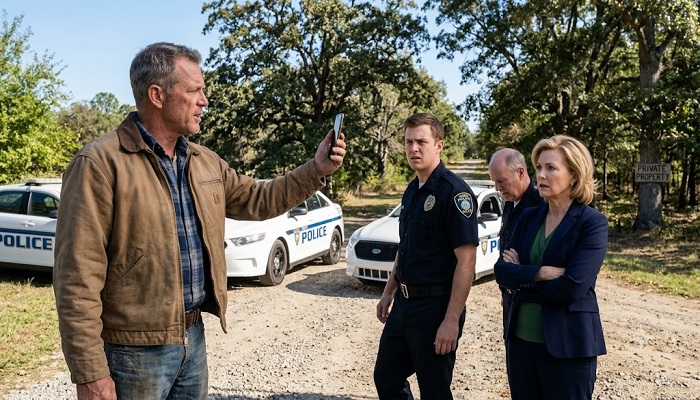
The day I put up a warning sign on my own land, the HOA called the police on me.
Not because I threatened anyone. Not because I blocked a public road, damaged property, or stood outside with a shotgun yelling at hikers to get off my lawn like some cranky old movie stereotype. All I did was tell people, in plain black letters on a white metal sign, that the trail cutting across the back corner of my property was private land and needed to be respected.
By sunset, two police cruisers were parked in my driveway.
Behind them stood Karen Hullbrook, president of the Lake View Estates Homeowners Association, arms folded, chin lifted, smiling like a woman who had already won a fight I had not realized we were having.
The younger officer told me there had been a complaint.
The older one said they needed to clarify a “community access concern.”
Karen stood behind them without saying a word, but her face said everything. She had brought them there to make me feel small on my own porch. She had expected me to panic, lose my temper, maybe say something stupid. People like Karen do not just want compliance. They want performance. They want you angry enough to look unreasonable and frightened enough to surrender.
The younger officer pointed toward the back of my land.
“We’ve been asked to determine whether that sign was placed on property outside your legal boundary.”
I laughed.
I should not have, probably, but I did. It came out before I could stop it, sharp and humorless, because the whole thing sounded insane. A week earlier, I was picking up beer cans off a dirt path. Now I was standing in my driveway being told that I might be trespassing on my own land.
Karen’s smile widened.
That was when I pulled my phone from my pocket, opened the camera, and started recording.
The younger officer frowned. “What are you doing?”
Advertisements
I held the phone steady, pointed directly at them.
“Before we continue,” I said calmly, “what are your names and badge numbers?”
For the first time since they arrived, nobody spoke.
Not the younger officer. Not the older one. Not Karen.
Especially not Karen.
Her smile vanished so quickly it was almost worth the whole miserable morning.
That was the exact moment this stopped being an argument over a trail.
Because the more they pushed, the more they revealed. And before it was over, that simple warning sign would uncover altered maps, secret development plans, a late-night break-in, two corrupt police officers, and a marina project worth millions of dollars that nobody in that neighborhood wanted me to know about.
But to understand how one sign nearly turned into a criminal investigation, you have to understand how I got there.
My name is Ronald Hunt. I am fifty-four years old, and I have spent most of my life working construction. Not the clean kind of construction where people wear spotless hard hats and point at drawings from a distance. The real kind. The kind that leaves your hands permanently rough and your knees sounding like a bowl of gravel every time you stand up. I built houses, garages, barns, warehouses, lake cabins, equipment sheds, additions, porches, and more decks than I can count. If you drove through Benton County or any of the towns around it, chances were good I had helped build something you passed every day without noticing.
That was fine by me.
A good builder gets used to being invisible. Nobody thinks about the man who framed the wall unless the wall fails. Nobody remembers who poured the foundation unless it cracks. You do the work right, and your reward is that nobody has to think about you again.
Construction taught me a few things that mattered later. Measure twice. Keep records. Trust actions more than words. Never sign anything you have not read yourself. And when something is out of square, do not argue with the tape measure.
A few years before all this happened, my marriage ended.
There was no dramatic betrayal. No affair. No screaming, no smashed dishes, no locked doors or lawyers salivating over scandal. We simply grew apart slowly, which in some ways felt worse because there was no single villain to blame. My wife wanted the city. I wanted quiet. She wanted travel, restaurants, people, energy. I wanted land, trees, a porch, and the sound of wind moving through leaves. After thirty years together, we had become different people standing in the same house wondering who had moved.
The divorce cost me money. More than I wanted to lose. My two sons were already grown by then. One lived in Colorado and worked in software. The other was finishing graduate school in Tennessee. I talked to them often, and they were good boys—good men, really—but they had their own lives. The old house felt hollow after their mother moved out. Too many rooms. Too many echoes. Too many little reminders that a life can be sturdy for decades and still come apart at the joints.
So I sold it.
Then I started looking for land.
Not in a subdivision. Not under someone else’s rules. Not somewhere with a committee deciding mailbox colors or lawn heights or whether a pickup truck in a driveway offended “community harmony.” I had heard enough HOA horror stories from clients over the years to know I wanted nothing to do with one. I checked every property carefully. Deeds. Surveys. County maps. Restrictions. Easements. Covenants. I read everything.
That was how I found the four acres.
Mostly oak trees, with a little creek running along one side, open sky overhead, and a lake close enough that when the wind shifted, you could smell the water. The land sat just outside town, near a neighborhood called Lake View Estates but not inside it. That mattered. The parcel was independent. Private. No HOA. No restrictive covenants. No shared maintenance agreement. No architectural committee. Exactly what I wanted.
The house on it was not much to look at. Most people would have torn it down and started over. I saw bones worth saving. New roof. New porch. New windows. New flooring. Electrical updates. Plumbing repairs. A proper gravel drive. I did most of it myself because I trusted my hands and because work was easier than thinking too much.
When I finished, the place was not fancy. It would never be in a magazine. But it was solid, comfortable, and mine. That word meant more to me than it probably should have.
The front porch became my favorite place on earth.
Every evening, I sat there with a cold beer and watched the sun drop behind the trees. No traffic. No sirens. No neighbors arguing over leaf blowers or barking dogs. Just birds, wind, creek water, and silence. Real silence. The kind that does not feel empty. The kind that feels earned.
For nearly a year, life was exactly what I had hoped it would be.
Then I noticed the trail.
A narrow dirt path cut across the back corner of my property and disappeared toward the lake. At first, I did not think much of it. People used it occasionally. Families walking toward the water. Kids on bicycles. Couples out for evening strolls. An older man with a walking stick who nodded politely every time he passed. The previous owner had apparently never blocked access, and I figured life was easier if a man picked his battles carefully.
Besides, I had no interest in becoming the angry old guy yelling at strangers from his porch. Nobody was bothering me. Nobody was damaging anything. So I let it go.
That was my first mistake.
Summer arrived, and the trail changed.
The first thing I found was an empty soda can near the creek. No big deal. I threw it away. A few days later, there were more. Then fast food wrappers. Then beer bottles. Then cigarette butts pressed into the dirt like little black insults. Every weekend got worse. Soon, I was carrying a trash bag every time I walked my own property.
But the trash was not what bothered me most.
What bothered me was the attitude.
People were not acting like guests anymore. They were acting like they owned the place. Someone moved a section of old fencing to widen the trail. Someone built a little fire pit near the creek. A group left lawn chairs under the trees as if they had reserved the spot for next Saturday. Someone carved initials into an oak that had probably been standing there before their grandparents were born.
I tried to stay patient.
Most people are decent. That is what I wanted to believe.
Then one evening, while checking the property line near the trail, I saw a woman standing at the far edge of the path.
She was not walking. Not exercising. Not heading toward the lake. She was standing still, studying the land. Looking from the trees to the creek to the trail entrance to the lake beyond it. Evaluating. Measuring with her eyes.
I slowed.
The moment she realized I had noticed her, she turned and walked away.
I remember thinking it was odd.
Not important.
I was wrong.
A few days later, I was repairing a loose fence rail near the trail when I heard teenage laughter coming through the trees. Four or five boys came down the path carrying a cooler. One of them tossed an empty beer can into the brush without slowing down. Another kicked a fence post as he passed.
I set my hammer down.
I was not angry yet. I just wanted a conversation.
“Hey, fellas.”
They stopped. A couple looked nervous immediately, which told me they knew they were not exactly behaving like saints.
I pointed toward the can. “You mind picking that up?”
They exchanged glances. Finally, the tallest kid bent down, grabbed it, and shoved it into the cooler.
“Sorry, sir.”
“No problem,” I said. “Just show a little respect. You’re walking across private property.”
Most of them nodded. One apologized again. The whole thing lasted less than a minute. No yelling. No threats. No argument. I went back to fixing the fence feeling like maybe I had solved it the adult way.
At eight that night, somebody pounded on my front door.
When I opened it, the woman from the trail stood on my porch.
Mid-fifties. Expensive workout clothes. Perfect hair. The kind of bright, hard eyes that tell you a person has confused being difficult with being strong.
“Did you threaten my son?”
I blinked. “Excuse me?”
“My son was walking to the lake today, and you confronted him.”
It took me a second to connect her to the boys with the cooler.
“I asked them not to throw trash on my property.”
“They’re minors.”
“So?”
“So if you ever approach them again, I will report you for harassment.”
I stared at her.
Then I laughed. Not because I wanted to. Because the sentence was so absurd my body did not know what else to do.
Her face flushed bright red.
“You think this is funny?”
“No,” I said. “I think it’s funny that I’m being lectured about property rights while standing on my own porch.”
Her eyes narrowed.
“That trail has been used by residents for years.”
“That does not make it public.”
“It serves the community.”
“So does the grocery store. That doesn’t mean people can sleep in the produce section.”
She did not appreciate the comparison.
“What you’re doing is selfish.”
That word caught me.
Selfish.
I had spent nearly a year letting strangers cross my land, cleaning up their trash, repairing damage they caused, and somehow I was the selfish one.
I folded my arms. “Who are you?”
She lifted her chin. “Karen Hullbrook. President of Lake View Estates.”
That was the first time I heard her name.
She took one step closer. “The trail is important to our community.”
“My property is important to me.”
For a moment, neither of us spoke.
Then she said, “The people in this neighborhood have been using that trail for decades.”
The way she said it was not casual. It sounded like a warning. Like she was establishing ownership, or trying to.
A few seconds later, she turned and walked back toward her SUV. Before getting in, she looked over her shoulder.
“This isn’t over, Mr. Hunt.”
Then she drove away.
I stood there long after her taillights disappeared, bothered by something I could not name.
Then it hit me.
How did she know my name?
I had not introduced myself. The boys had not asked. There was no reason she should have known who I was unless she had already looked me up.
County property records are public. Any landowner knows that. But most people do not dig through ownership records because their kid got told not to litter.
That meant Karen had been researching me.
Maybe she had been researching the property before she ever stepped onto my porch.
The next morning, I drove into town and bought a sheet of white metal, a steel post, and a fresh can of black paint. If people needed a reminder that they were walking across private property, I would give them one.
The sign I made that afternoon was simple.
PRIVATE PROPERTY. PLEASE RESPECT THE LAND.
No threats. No legal jargon. No attitude. Just a clear, polite statement. I mounted it at the trail entrance on my side of the property line, high enough to be seen and deep enough to last. When I stepped back, I was satisfied. It looked professional. Fair. Reasonable.
For three days, nothing happened.
Then I found a crushed beer can sitting directly beneath it.
Not nearby. Not accidentally dropped.
Placed.
I threw it away.
The next morning, there were two cans. Then four. Then cigarette butts. Then an empty sports drink bottle balanced on the top edge of the sign.
That was when I realized the sign was not being ignored.
It was being challenged.
A week later, someone spray-painted a red slash across it.
I took photographs, cleaned the paint, and moved on. But deep down, something had changed. The trail no longer felt like an inconvenience. It felt like a test.
Then the HOA letter arrived.
Official envelope. Official letterhead. Official nonsense.
According to Lake View Estates, the path crossing my property was a “historic community access route.” Residents had used it continuously for decades. Restricting access would create hardship. The letter requested removal of any signage discouraging public use.
Public use.
I read that phrase three times.
The public was not paying my taxes. The public was not maintaining my fence. The public was not cleaning beer bottles out of my creek.
The next morning, I drove to the county records office. The woman behind the counter, Marsha, looked like she had been working there longer than some of the buildings in town had existed. Efficient, calm, and unimpressed by drama. I explained the situation. She pulled deeds, surveys, plats, and easement records.
Twenty minutes later, she looked at me over her glasses.
“Mr. Hunt, there is no recorded easement on your property.”
“None?”
“None.”
She tapped the survey. “The trail runs directly through your parcel. If someone wants a legal easement, it has to be documented. There is nothing here.”
I thanked her and drove home feeling better.
The law seemed simple. The land was mine. The trail was mine. End of story.
It should have been.
That evening, I sat at my kitchen table reading the HOA letter again when something bothered me. Attached to the letter was a property map. At first glance, it looked ordinary. Then I looked closer.
My stomach tightened.
According to their map, the trail had somehow shifted several yards east, just enough to place it outside my boundary line.
I grabbed the certified county survey from the records office and laid both maps side by side.
The difference jumped off the page.
One map was wrong, and it was not the county’s.
Suddenly, Karen’s letter made sense. She was not just arguing that residents had used the trail for years. She was preparing to claim the trail was not on my land at all. If she could convince people of that, then my private property sign was not merely inconvenient.
It was trespassing.
By me.
On my own land.
That realization sent a chill through me.
Somebody was building a story.
A few days later, I made a second sign.
This one was not polite.
NO TRESPASSING. PRIVATE PROPERTY. VIOLATORS WILL BE PROSECUTED.
I planted the steel post deep and locked it in with concrete. The sign was clear, legal, and impossible to misunderstand.
For two days, the world stayed quiet.
On Sunday evening, I was sitting on the porch with a beer when my phone rang.
Tom Fletcher.
Tom had been my attorney for years. More than that, he was my friend. The kind of friend who could disappear for six months and resume the same conversation like no time had passed.
“You sound happy,” he said.
“I put up a new sign.”
There was a pause. “Oh no.”
I laughed. “That’s exactly what Karen’s going to say.”
I told him everything: the trash, the vandalism, the HOA letter, the altered map, the county records, the new sign.
When I finished, he was quiet.
That got my attention. Tom usually told me to slow down and assume incompetence before malice. Not this time.
“Keep copies of everything,” he said.
“Already doing it.”
“Good.”
“You think I’m overreacting?”
“No.”
That answer came too quickly.
“If someone knowingly sends you an inaccurate property map,” he said, “they are trying to establish a narrative.”
That word stayed with me.
Narrative.
Not facts. Not evidence. A story. A version of reality Karen wanted everyone else to believe.
The next morning, two town police cruisers rolled into my driveway.
Karen stepped out of the passenger side of the first one.
“Well,” I muttered. “Here we go.”
The officers who approached were town police, not county deputies. That detail mattered later. Officer Meyers was younger, stiff-backed, with the expression of someone who had decided authority meant not smiling. Officer Dugan was older and looked less certain about why he was there.
“Mr. Hunt,” Meyers said, “we received a complaint regarding restricted access to community property.”
“Community property?”
Karen stood behind him, watching.
Dugan opened a folder and showed me the same altered map.
“This pathway has reportedly served as public access for many years.”
“That is not a county survey.”
“It’s the documentation we were provided.”
“By her?”
Neither officer answered.
Meyers pointed toward my sign. “We recommend removing the sign until ownership questions can be clarified.”
Recommend.
Not order.
Words matter.
“No,” I said.
Meyers blinked. “No?”
“No.”
Karen looked like she had expected something more dramatic from me. Anger. Fear. Confusion. Instead, I pulled out my phone and started recording.
“What are you doing?” Meyers asked.
“Before we continue, what are your names and badge numbers?”
The silence that followed told me more than any answer could have.
Karen stopped smiling.
Meyers shifted. “Why do you need that?”
“Because if you are giving me an unlawful order regarding my private property, I will need this footage for the complaint.”
Meyers looked at the gravel.
“Officer Meyers. Badge 214.”
Dugan followed reluctantly. “Officer Dugan. Badge 73.”
I repeated both numbers into the camera, then held up the certified county survey.
“If your map says one thing and the county says another, why are you standing on my porch instead of talking to the county surveyor?”
Nobody answered.
Not Karen.
Not the officers.
Nobody.
They left ten minutes later because they had nothing. No court order. No certified survey. No legal authority. Just Karen’s complaint and a questionable map.
Before getting into her SUV, Karen gave me a look that said she was already planning the next move.
I called Tom as soon as they left.
After I described everything, he said, “Now you document the pattern.”
“I’ve been documenting.”
“No,” he said. “You’ve been collecting evidence. Documentation proves a pattern.”
That afternoon, I bought cameras. Four high-resolution security cameras, two trail cameras, motion sensors, backup batteries, cloud storage, and a network video recorder. If someone walked onto my property, I wanted a record. If someone touched my fence, I wanted a record. If someone tampered with the sign, I wanted a record.
People lie.
Video does not.
For three nights, nothing major happened. People stopped to look at the sign. Some took pictures. One man walked along my fence line for no obvious reason.
Then at 9:30 on the fourth night, my phone buzzed.
Motion detected. Rear trail camera.
Two figures appeared on screen. One was Karen. The other was a tall, well-dressed man I had never seen before. They were not walking to the lake. They were moving along my property line, stopping every few minutes, shining a flashlight, pointing, discussing.
People do not survey land in the dark unless they do not want to be seen.
The man unfolded a map near an old oak tree.
The camera did not catch every word, but it caught enough.
“If we get this part,” he said, pointing toward the trail, “phase two becomes easy.”
Phase two.
Karen folded her arms. “Once the access issue is settled, the lakefront parcel won’t be a problem.”
The lakefront parcel.
My lakefront parcel.
I sent the footage to Tom the next morning.
He called within an hour.
“Tell me I’m hearing things,” I said.
“You’re not.”
“What kind of plan has phases?”
“The kind that starts small and ends with somebody claiming a lot more than a walking path.”
He paused.
“Ron, men in expensive clothes do not walk property lines in the dark over neighbor complaints. There is money involved.”
“What kind of money?”
“The kind that makes reasonable people unreasonable.”
Then he said the words that changed how I saw everything.
“You are not dealing with a homeowner anymore. You are dealing with a developer.”
Three days later, an unknown number called while I was repairing fence near the creek.
“Mr. Hunt?” a woman asked.
“Yes.”
“I need to talk to you.”
“Who is this?”
“My name is Sarah Whitman. I used to work with Karen Hullbrook.”
The fear in her voice was impossible to miss.
“Not over the phone,” she said.
Two hours later, I sat across from Sarah in a corner booth of a diner twenty miles outside town. She arrived five minutes late, mid-forties, tired eyes, business clothes, and the look of someone who had not slept properly in weeks. She checked windows, exits, faces.
Then she slid a manila folder across the table.
“What’s this?” I asked.
“The reason Karen wants your land.”
Inside were development proposals, engineering studies, internal emails, budget projections, and a colored site map.
A marina.
Boat slips. Docks. Parking areas. Walking paths. Restaurant space. Lake access. Tourism projections.
My property was highlighted in yellow.
I stared at it. “What the hell is this?”
“A project they have been discussing for almost a year.”
Almost a year.
Karen had been planning this long before I ever knew her name.
Sarah pointed to the map. “The trail is phase one. Once they establish permanent access, they intend to argue the area serves a broader community purpose. Then they pressure you for the lakefront parcel.”
“Why?”
Sarah gave me a tired look. “Money.”
At the bottom of the proposal was a company name: Lake View Development Partners LLC.
“The HOA is not the real force,” Sarah said. “Karen is helping them. She gets influence, maybe money, maybe both. But they are the ones who want your shoreline.”
“Why are you giving this to me?”
Sarah looked away.
“My father lost land like this. Different state, different people. Same game. They start with access. Then expectations. Then pressure. Eventually somebody with less money gives up.”
She placed a flash drive on the table.
“I copied everything before I resigned.”
“Why resign?”
“Because Karen knows information is leaking.”
My stomach tightened.
“Does she know it’s you?”
“Not yet.”
That word hung between us.
Before she left, Sarah looked at me.
“When she realizes she cannot scare you, she will come after the evidence.”
She was right.
Three nights later, my trail camera caught two people dressed in dark clothing removing my sign. They used a pry bar, unbolted the steel panel, and carried it away. Then one kicked out a survey marker installed by a licensed surveyor. The other damaged a section of fence.
I watched live from my bedroom, keys in hand, wanting badly to drive down there and confront them.
Then Tom’s voice echoed in my head.
People get reckless when they think they’re running out of options.
So I stayed where I was.
I recorded.
I built the pattern.
The next morning, Tom sent a preservation of evidence notice to the HOA’s attorney, demanding preservation of all emails, communications, meeting minutes, texts, development records, maps, and materials tied to the trail dispute. The letter referenced video evidence of vandalism, destruction of survey markers, and damage to private fencing.
Once Karen received it, she knew we had evidence.
From that moment on, the trail was no longer her biggest concern.
The evidence was.
The following Thursday, while I was in Tom’s office organizing documents, my phone buzzed.
Motion detected. Front porch camera.
I opened the app and froze.
Karen stood on my porch.
Officer Meyers stood beside her.
Officer Dugan stood behind them.
They were looking around, checking windows, making sure nobody was home.
Then Karen moved toward the side door, the mudroom entrance hidden from the road. She pulled a slim tool from her purse, crouched beside the lock, and within thirty seconds, the door opened.
Tom leaned over my shoulder.
“My God,” he said.
They entered together.
Karen first. Meyers second. Dugan third.
Tom pointed at the screen. “Ron, from this moment forward, they are committing a felony.”
I called the Benton County Sheriff’s Office, not the town police department.
The dispatcher listened carefully.
“You have video?” she asked.
“Live video.”
I took a breath. “Two of the people inside my house are town police officers in uniform. They are armed. They do not have a warrant. They do not have permission. They are searching my home.”
Her tone changed immediately.
“Stay on the line, Mr. Hunt. Units are rolling.”
Tom and I watched the cameras while deputies drove toward my house.
Karen did not search for deeds. That would have made no sense. County records were public. Destroying my copies would not change ownership.
She went straight to the utility room.
The room with my modem, router, and network video recorder.
“She’s looking for evidence,” Tom said.
Meyers searched my office, opening drawers, checking cabinets, looking for flash drives, hard drives, documents. Dugan stood near the door like lookout.
Then Karen found the lock box.
Inside were backup drives with copies of footage, documents, Sarah’s files, everything.
She smiled.
That smile lasted less than a minute.
Blue lights flashed across my driveway.
County deputies arrived fast, controlled, professional. One secured the front. One moved to the side. One entered and identified himself. The audio was not perfect, but the questions were clear.
“Does anyone here have a warrant?”
No answer.
“Does anyone have permission from the homeowner to be inside this residence?”
No answer.
The deputy noticed the lock box in Karen’s hands.
“What is that?”
She hesitated.
Bad choice.
“Why were you removing property from this residence?”
No good answer existed.
The deputies separated them. Karen in one room. Meyers and Dugan in another. Questions began. Stories shifted. Excuses formed.
Then a deputy found a folded document in Karen’s purse.
The altered map.
The same fake boundary map she had given the officers. The same map attached to the HOA letter. The same map that moved the trail off my land.
Within minutes, another deputy had certified county survey records spread across my kitchen table beside Karen’s map.
Real map.
Fake map.
The differences were obvious.
Boundary lines shifted. Measurements altered. Trail relocated.
One deputy looked at Karen.
“Where did this map come from?”
She said nothing.
Then they opened one of the USB drives from my lock box.
Meeting minutes. Internal HOA emails. Development proposals. Budget projections. Messages about trail access, marina revenue, public benefit language, and property acquisition strategy.
One email destroyed everything.
Acquire trail access first. Ownership challenge becomes significantly easier afterward.
There it was.
The trail had never been the issue.
It was phase one.
The next morning, I spent four hours at the sheriff’s office giving statements. By the end of the week, subpoenas had been issued. Then search warrants. Then forensic document reviews. The deeper investigators dug, the uglier it got.
The altered map was not an accident. Measurements had been changed deliberately. Internal emails showed months of planning. The HOA had coordinated with Lake View Development Partners. Karen had pressured officers Meyers and Dugan through personal connections and campaign donations to the town police association. The goal had been to build a narrative of historic public use, use that narrative to claim access, then leverage access into control of the lakefront parcel.
My land.
Three months later, the courtroom was packed.
Not because people cared about a trail. Because by then, the story had become much bigger: altered maps, a marina proposal, corrupted police response, a break-in, evidence tampering, and a development plan worth millions.
Karen walked in wearing the same confidence she had worn on my porch months earlier.
By lunchtime, it was gone.
The county surveyor testified first. The trail was on my property. Always had been. No easement. No ambiguity.
Then the forensic document examiner testified. Karen’s map had been modified deliberately. Boundary lines moved. Measurements changed. Annotations added. Not a mistake.
Then Sarah Whitman took the stand.
For nearly an hour, she described the meetings, the pressure campaign, the developer involvement, the marina plan, and the strategy to acquire trail access first. Her voice shook at times, but she did not back down.
Finally, the security footage played.
The vandalism. The removal of the sign. The destruction of the survey marker. The fence damage. Then the break-in. Karen entering my home. Meyers and Dugan following. The search. The lock box. The deputies arriving.
Nobody had to explain what the court was seeing.
The footage spoke for itself.
A few weeks later, the rulings came down.
The HOA’s claims were dismissed. The proposed marina collapsed. Lake View Development Partners withdrew under investigation. Karen resigned before the board could remove her. Meyers and Dugan lost their badges and faced additional proceedings. The HOA’s insurance carrier distanced itself. Several board members resigned. The county prosecutor announced further review.
And just like that, nobody wanted to argue about the trail anymore.
A month later, I stood beside it one last time.
The replacement sign was stronger than the first. The survey marker was reset. The fence repaired. The woods were quiet. Peaceful. Mine.
I added a small wooden plaque beneath the no-trespassing sign.
Nothing vulgar.
Nothing threatening.
Just a reminder.
It read: YOU CALLED THE POLICE ON THE OWNER. THAT DIDN’T GO WELL.
I stood there for a moment and smiled.
That evening, I carried a cold beer onto my porch and sat in the same chair where this whole thing had started. The sun disappeared behind the trees. The creek caught the last orange light of day. For the first time in months, there were no letters waiting in the mailbox, no lawyers to call, no alerts buzzing on my phone, no HOA president plotting her next move.
Just quiet.
The kind of quiet I had bought the land to find.
Funny thing is, I never bought those four acres because they were valuable. I bought them because they were peaceful. Karen saw a development opportunity, a future marina, a way to turn shoreline into profit. I saw a place to sit on a porch and watch sunset without anyone telling me how to live.
In the end, the land never changed.
The surveys never changed.
The property lines never changed.
The truth never changed.
The only thing that changed was that eventually everyone else was forced to see it too.
Property rights do not disappear because an HOA wants them to. They do not vanish because someone repeats the word community until it sounds noble. They do not bend because a developer sees money in your trees, your creek, your lakefront, your peace.
And they definitely do not disappear because someone shows up with a badge and a lie.
The land was always mine.
THE END