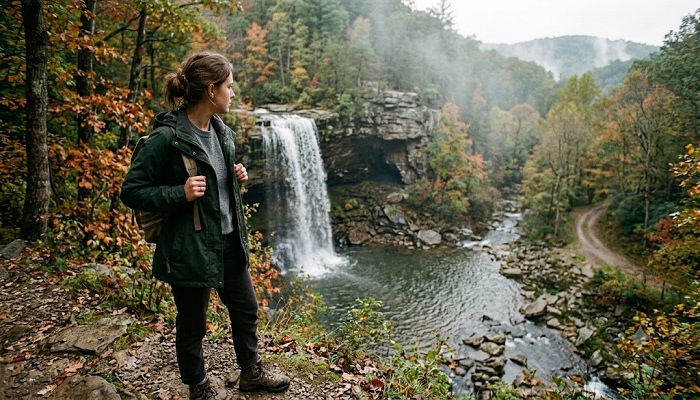
Widowed at 21, She Hid Behind a Waterfall for a Year — Then the Town Discovered What Her Dead Husband Left There
They buried Grace Whitaker’s husband on a Tuesday, and by Friday his mother had changed the locks on the house.
“Widows don’t inherit dreams,” Deborah Whitaker said, sliding a cardboard box of Grace’s clothes across the porch with the toe of her red church shoe. “They inherit what the family allows them to keep.”
Grace stood in the rain with a grocery bag full of funeral cards, a wedding ring loose on her finger, and the last voicemail Mason had ever left her still unopened on her phone.
Behind Deborah, the warm yellow windows of the farmhouse glowed like Grace had never lived there.
Like she had never washed Mason’s work shirts in the mudroom sink.
Like she had never painted the nursery door pale green before the miscarriage.
Like she had never slept beside him through three winters while the old pipes clanged and the coyotes screamed beyond the pasture.
Deborah folded her arms.
“You’re twenty-one,” she said. “You’ll survive.”
Grace looked past her, to the barn where Mason’s tools were still hanging in a neat row.
His hammer.
His level.
His red-handled pliers.
His leather work gloves with the left thumb worn thin.
She did not cry.
That bothered Deborah more than tears would have.
“You hear me?” Deborah snapped. “You have until dark to leave town.”
Grace picked up the cardboard box.
The rain ran down her cheeks, but her eyes stayed dry.
“I heard you,” she said.
And that was all.
At sunset, when most of Laurel Creek, Tennessee, was eating casseroles and whispering about the poor little widow who had lost everything, Grace drove Mason’s old pickup through the north logging road with no headlights.
In the glove compartment was a folded map.
Not a county map.
Not a trail map.
A map Mason had drawn by hand, on the back of an unpaid electric bill, with one sentence written beneath a crooked blue line.
If anything happens to me, go where the water hides the door.
The waterfall was three miles beyond the old mill, where blackberry vines swallowed the path and the air always smelled like wet stone.
Locals called it Widow’s Veil because of the thin white sheet of water that spilled from a limestone ledge into a black pool below.
Teenagers went there in summer to drink beer.
Fishermen went there to lie about trout.
Children dared each other to stand close enough for the mist to soak their shoes.
Nobody knew what was behind it.
Nobody except Mason.
And now Grace.
She parked under a stand of sycamores and waited until the last strip of purple light drained from the trees.
Then she took Mason’s flashlight, a pry bar, a roll of plastic sheeting, three cans of beans, two bottles of water, one wool blanket, and the small steel box he had kept under their bed.
The roar of the falls covered every sound.
Her boots slid on moss.
Cold spray needled her face.
She stepped into the curtain of water and almost lost her breath.
For one blind second, there was nothing but white noise and freezing pressure.
Then her hand hit stone.
Not rough stone.
Cut stone.
Mason had carved a narrow handhold into the cliff.
Grace followed it sideways through the falling water until her shoulder pushed into a gap.
A crack.
A seam.
A door made of rock and shadow.
She squeezed through and dropped hard onto damp ground.
The flashlight beam shook in her hand.
Behind the waterfall, the world opened.
Not into a cave.
Into a room.
A real room.
Twenty feet wide.
Maybe thirty deep.
The walls were limestone, but Mason had framed them with salvaged wood. He had sealed the floor with gravel and rubber matting. A small iron stove sat in the corner with a black pipe running into a natural chimney crack. Shelves lined one wall, stacked with canned food, mason jars, medical supplies, batteries, rope, nails, tarps, lanterns, and three five-gallon buckets labeled in Mason’s blocky handwriting.
WATER FILTERS.
DRIED FOOD.
DO NOT TOUCH UNLESS EMERGENCY.
Grace stood very still.
Her knees wanted to fold.
Her mouth opened, but no sound came out.
On the far wall, above a narrow cot, Mason had pinned a photograph.
Their wedding day.
Grace in a simple white dress from a thrift shop in Knoxville.
Mason in clean jeans, a gray vest, and the smile he only wore when he thought nobody was watching.
Beside the photo was another note.
Gracie,
I know you hate surprises.
I built this because I love you.
Not because I expect the worst.
Because I’ve seen what people become when land, money, and fear get involved.
If I’m wrong, we’ll laugh about this someday.
If I’m right, stay quiet.
Watch everything.
Trust no one who asks too fast.
And open the blue box only when you understand why they wanted me gone.
Grace sank onto the cot.
The blue box was already in her hands.
She looked at it for a long time.
Then she put it under the cot without opening it.
Not yet.
Not while her heart was still punching her ribs.
Not while Deborah’s voice was still fresh in her ear.
Not while the whole town thought Grace Whitaker had been erased with one shove from a porch.
She took off her wet jacket.
She hung it on a nail Mason had hammered into the wall.
Then she walked the room slowly.
Counting.
Thinking.
Learning the shape of his secret.
There were vents hidden through cracks in the rock.
A rain catchment channel fed into a covered barrel.
A small battery bank connected to a solar line that must have run up through the woods somewhere above the falls.
A stack of notebooks sat on a crate beside the stove.
Not love letters.
Plans.
Supply lists.
Measurements.
A sketch of the waterfall.
A sketch of the old mill.
A sketch of the Whitaker farm.
A sketch of the county courthouse basement.
Grace touched that page twice.
She had never known Mason to draw the courthouse.
Her husband had been a carpenter, not a lawyer.
A quiet man, not a fighter.
He fixed porch steps for widows who paid him in peach jam. He replaced church doors and refused to charge labor. He knew how to hang cabinets, split firewood, mend fences, and make cheap coffee taste expensive with cinnamon and a little brown sugar.
But the man who built this shelter had not been only quiet.
He had been preparing.
For something.
For someone.
For her.
That first night, Grace did not sleep.
She sat on the cot in the thunder of the hidden room while the waterfall roared outside like a living wall.
She listened to rain hammer the cliff.
She listened to mice move somewhere in the rocks.
She listened to her own breathing slow from panic into calculation.
By dawn, she had made three decisions.
She would not call Deborah.
She would not call the sheriff.
She would not leave Laurel Creek until she knew why Mason had hidden a shelter behind a waterfall and why his family had thrown her out before his grave dirt dried.
Because grief could wait.
Because fear could wait.
Because hunger could wait.
Because answers could not.
Because Mason had not written If anything happens to me by accident.
Because a woman with nothing left can either disappear or become impossible to find.
Grace chose the second.
By noon, the town had started talking.
Laurel Creek had eight hundred people, two gas stations, four churches, one diner, and enough gossip to power the place through a blackout.
At Earlene’s Diner, coffee cups paused in midair when Deborah Whitaker walked in wearing black lace and victory.
“She’s gone,” Deborah announced before anyone asked.
Earlene, who owned the diner and heard everything before God did, wiped the counter slowly.
“Grace?”
Deborah gave a little sigh.
“As expected. The girl couldn’t handle reality. Packed up and ran. Poor thing was always fragile.”
That word traveled fast.
Fragile.
By three o’clock, folks at the feed store said Grace had gone back to Georgia.
By five, people outside the church said she had taken a bus to Nashville.
By Sunday morning, somebody claimed she had left with a trucker.
By Monday, Deborah was standing in the front row at Laurel Creek Community Bank with Mason’s death certificate, a folder of papers, and her oldest son, Travis, beside her.
Travis Whitaker was thirty-two, broad-shouldered, handsome in a way that turned unpleasant when he smiled. He wore pressed shirts and polished boots and always looked like he had just forgiven someone for being beneath him.
Grace watched them from across the street through the dusty windshield of Mason’s pickup.
She had parked behind the abandoned pharmacy, wearing his old ball cap low over her face.
Deborah and Travis walked into the bank.
Twenty minutes later, they walked out.
Deborah was smiling.
Travis was not.
Grace noticed that.
She also noticed the man in the gray suit who followed them out and spoke in a low voice near the ATM.
Mayor Calvin Price.
Laurel Creek’s mayor, real estate broker, funeral hand-shaker, and the kind of man who could make a threat sound like advice.
He had stood beside Deborah at Mason’s funeral.
Grace remembered his cologne.
Sharp.
Expensive.
Wrong for a cemetery.
She watched Calvin hand Travis a folded paper.
Travis tucked it inside his jacket.
Deborah looked both ways, not because she feared traffic, but because she feared witnesses.
Grace lowered herself in the seat until they passed.
Then she waited.
Not one minute.
Not five.
Twenty.
Mason had taught her that when deer sensed movement, they looked first where they expected danger to be. People did the same.
When the street emptied, Grace stepped out, crossed behind the pharmacy, and slipped into the alley beside the bank.
The back door had a keypad.
She did not try it.
She went to the trash cans instead.
Most people locked doors and forgot paper.
Grace opened the recycling bin.
Bank envelopes.
Receipts.
Shredded forms.
Coffee cups.
She dug with steady hands.
Ten minutes later, she found the corner of a torn document with Mason’s name on it.
Not enough to read the whole thing.
Enough to read three words.
PROPERTY TRANSFER REQUEST.
Her pulse beat once, hard.
She folded the scrap into her pocket.
Then she returned to the waterfall.
That became her life.
Quiet movement.
Small risks.
No wasted emotion.
At night, she worked on the shelter.
She cleaned the stove pipe.
She organized the supplies.
She found Mason’s hidden tools under a floor panel and repaired the loose plank near the cot.
She learned which rocks were safe to step on when entering through the falls.
She marked the path with invisible signs only she would notice: a bent twig, a pale stone, three cuts on the underside of a branch.
During the day, she watched Laurel Creek.
She wore Mason’s jackets.
She cut her long brown hair to her jaw with sewing scissors and dyed it darker with box color from the dollar store in the next county.
She paid cash.
She spoke little.
She became the sort of woman people glanced over and forgot.
At Earlene’s Diner, she sat in the last booth once a week with a menu lifted high and listened.
Deborah called her unstable.
Travis called her ungrateful.
Mayor Price called her situation unfortunate.
Sheriff Harlan Reed called it a family matter.
That was the first mini-payoff.
Grace learned the sheriff was not lazy.
He was careful.
Too careful.
Every time Mason’s name came up, Harlan Reed’s jaw tightened. He touched the edge of his coffee mug with his thumb, like he was counting seconds until the subject changed.
Grace wrote that down.
She had taken one of Mason’s notebooks and made columns.
Name.
What they said.
What they avoided.
What they wanted.
Mason had always said people told the truth with the shape of their silence.
Grace started listening to silence.
The second mini-payoff came from the post office.
She waited until Mrs. Holloway, the clerk, went to lunch. Then Grace stepped into the lobby and checked the trash by the sorting table.
She found a yellow notice addressed to Mason Whitaker.
RETURNED TO SENDER.
The return address was a law office in Chattanooga.
Grace knew no one in Chattanooga.
She walked two miles to the gas station pay phone because her own phone had been turned off the day after Deborah took the house.
She dialed the number from the letterhead and used a name from a cereal commercial.
“Baker residence,” the receptionist said.
Grace lowered her voice. “This is Anna Collins. I’m calling about a returned letter for Mason Whitaker.”
A pause.
“Are you family?”
Grace looked at her wedding ring.
“Yes.”
Another pause.
“Mr. Whitaker missed an appointment with Mr. Sutherland.”
“What kind of appointment?”
“I’m sorry, I can’t disclose—”
“He’s dead,” Grace said.
The receptionist went quiet.
Grace heard typing.
“I’m very sorry.”
“What was the appointment about?”
“I can’t give details over the phone.”
Grace closed her eyes.
She could almost hear Mason saying, Don’t push the first door. Find the second.
So she softened.
“I understand. His mother is handling everything. Deborah Whitaker. Did she receive the file?”
“No,” the receptionist said quickly. “Mr. Whitaker specifically noted that no information should be released to Deborah, Travis, or Mayor Price.”
Grace opened her eyes.
There it was.
A door.
“Thank you,” she said. “That helps.”
“Ma’am?”
Grace hung up.
That night, she finally opened the blue box.
Inside was not money.
Not jewelry.
Not a gun.
Papers.
A flash drive.
A brass key.
Three photographs.
And a deed.
Grace read the deed sitting cross-legged on the shelter floor while the waterfall shook the room.
Mason Whitaker had not owned just the farmhouse.
He had owned forty-six acres of wooded ridge above Widow’s Veil.
He had bought it quietly from an old surveyor named Paul Henley two years before he died.
The waterfall.
The cave.
The logging road.
The old mill trail.
All of it.
Grace read the next paper twice.
Then a third time.
Mason had transferred the land to her name six months before the accident.
Not after the wedding.
Not in a will.
Already done.
Recorded.
Stamped.
Legal.
Grace pressed her hand flat against the paper.
The shelter was not on Whitaker family land.
It was on hers.
That changed the room.
The walls felt less like hiding.
More like a boundary.
The third paper was a copy of a proposed development plan.
WIDOW’S VEIL LUXURY CABINS.
Twenty-four rental cabins.
A wedding venue.
A private overlook.
A paved access road.
A restaurant called The Falls Room.
Developer: Laurel Ridge Holdings.
Registered agent: Calvin Price.
Grace stared at the name.
Mayor Calvin Price.
Beside the plan was a handwritten note from Mason.
They think I’ll sell after the appraisal comes in.
I said no.
Travis heard.
Deborah knows.
Don’t believe the accident report.
The waterfall kept roaring.
Grace read that sentence until the words blurred.
Mason had died on County Road 9 when his truck slid off a curve and hit a sweetgum tree.
The sheriff said rain.
The tow driver said bad tires.
Deborah said God takes the good ones.
Grace had believed the shape of the grief because grief fills every room.
But Mason had written one line that put a crack through all of it.
Don’t believe the accident report.
For the first time since the funeral, Grace made a sound.
Not a sob.
A low, cold laugh.
The kind that comes when pain finds a target.
The next morning, Deborah Whitaker found a white envelope tucked under her windshield wiper outside the church thrift sale.
Inside was a photocopy of the deed.
No note.
Just the deed.
Grace watched from the tree line across the street.
Deborah went pale.
Travis, standing beside her with a box of donated coats, snatched the page.
His mouth moved.
Grace could not hear him.
But she could read fury.
Deborah looked around the parking lot.
People were coming and going, carrying bundt cakes and old lamps. Nobody paid attention at first.
Then Deborah slapped Travis’s arm and hissed something.
He folded the paper fast.
Too late.
Earlene had seen.
So had Mrs. Holloway.
So had Pastor Jim’s wife, who could spread a whisper through three pews without turning her head.
By lunch, Laurel Creek knew Grace Whitaker might not have left town empty.
By dinner, it knew Deborah might have lied.
That was enough for now.
Grace did not need the town to love her.
She needed it to doubt Deborah.
Doubt was a wedge.
Mason had taught her that too.
You don’t split wood by hitting everywhere.
You find the crack.
Over the next week, Grace widened it.
A copy of the development plan appeared folded inside a menu at Earlene’s Diner.
A second copy slipped through the mail slot at the town newspaper office, which was mostly one elderly man named Frank who printed obituaries, high school baseball scores, and angry letters about potholes.
A third copy landed on Sheriff Reed’s desk at 6:10 a.m. with a sticky note.
Ask who benefits.
Grace watched the sheriff read it through the blinds.
He did not throw it away.
He locked his office door.
Then he made a phone call.
Within an hour, Mayor Price arrived.
Grace stood in the alley across from the sheriff’s office wearing a hoodie and sunglasses.
Calvin Price stepped out of his black SUV and adjusted his cuffs.
He smiled at a woman pushing a stroller.
He waved at two men unloading feed.
Then he entered the sheriff’s office and did not come back out for forty-three minutes.
When he did, his smile was gone.
Grace wrote that down.
Time in office: 43 minutes.
Face tense.
Left alone.
No handshake.
That evening, someone drove up the logging road toward Widow’s Veil.
Grace heard the engine before she saw the headlights.
She was inside the shelter sorting Mason’s flash drive files on an old laptop he had sealed in plastic.
The sound cut through the waterfall.
Not tourists.
Too slow.
Too deliberate.
She shut the laptop.
Turned off the lantern.
Moved to the narrow viewing slit Mason had carved through a crack beside the falls.
A truck stopped near the pool.
Two men got out.
Travis Whitaker.
And a younger man Grace recognized from the county maintenance crew.
Dale Bixby.
They carried flashlights and a crowbar.
“Search everywhere,” Travis said.
The waterfall swallowed most words, but not his anger.
Dale swung his light across the rocks.
“What are we looking for?”
“Anything Mason built.”
Grace’s fingers curled around the cold stone.
Dale laughed nervously.
“Behind a waterfall? Come on.”
Travis turned on him.
“My brother spent two years sneaking out here. He had something. Papers. A copy. A recorder. Something.”
Grace stopped breathing.
There was more.
Travis knew there was more.
Dale climbed along the pool edge, slipping on algae.
His flashlight beam swept across the falling curtain.
For one second, it flashed directly over the hidden opening.
Grace did not move.
Water pounded between them.
Dale reached toward the rock.
Then Travis shouted, “Not there. Check the old mill foundation.”
Dale turned away.
Grace let air leave her lungs one inch at a time.
They searched for thirty minutes.
They found nothing.
Because Mason had not been careless.
Before leaving, Travis stood at the edge of the pool and looked into the falling water.
“I know you were too stubborn to die with it,” he said softly.
Grace felt the words in her bones.
He was not talking to her.
He was talking to Mason.
Then Travis threw something into the pool.
A silver object.
It sank fast.
After the truck left, Grace waited until full dark.
Then she tied Mason’s rope around her waist, stripped down to her tank top and jeans, and stepped into the black pool.
The cold hit like teeth.
She sucked in a breath.
The water was deeper than it looked. Her boots dragged her down. Her hands swept mud, stones, slick leaves.
Once.
Twice.
Third dive.
Her fingers closed around metal.
She kicked up, gasping.
On the bank, under moonlight, she opened her palm.
A key.
Not the brass key from Mason’s blue box.
A newer one.
Stamped with tiny numbers.
A storage unit key.
Unit 17.
Grace laughed again, but there was no humor in it.
Travis had not thrown away trash.
He had thrown away fear.
The next day, Grace went to the self-storage place outside Cedar Bend, twelve miles away.
She wore a thrift-store coat, a gray beanie, and fake glasses.
The office smelled like dust and lemon cleaner.
An old man watched a game show behind the counter.
“Lost my paperwork,” Grace said. “Unit 17.”
He slid a clipboard toward her.
“Name?”
Grace did not answer right away.
She looked at the wall.
A framed license.
CEDAR BEND STORAGE.
Owned by Bixby Property Services.
Dale Bixby’s family.
Another thread.
“Whitaker,” she said.
The old man looked up.
“Mason or Travis?”
Grace kept her face blank.
“Mason.”
The old man’s eyes shifted to the window.
“Unit’s current.”
“I have the key.”
“Then you got access.”
He pressed a buzzer.
The gate opened.
Unit 17 was in the back row.
Grace stood before the orange door with her pulse steady because she had learned something important since becoming a ghost.
Panic was loud.
Preparation was quiet.
The key turned.
The door rolled up.
Inside were empty paint cans, broken chairs, a cracked mirror, old lumber, and a deep freezer with no cord.
Grace almost smiled.
Mason loved hiding things inside things nobody wanted.
She opened the freezer.
Empty.
She checked under the liner.
Nothing.
She tapped the walls.
Solid.
Then she noticed the cracked mirror leaned against the back wall.
Not dusty.
Moved recently.
Behind it was a rectangular patch of plywood screwed into the wall.
Grace used the small screwdriver from her boot.
Four screws.
Panel off.
A black duffel bag.
Inside the duffel bag were three things.
A county maintenance radio.
A dash camera.
And a sealed plastic folder labeled with Mason’s handwriting.
ROAD 9 — NIGHT OF ACCIDENT.
Grace sat on the floor of the storage unit.
For a moment, the air went thin.
Then she opened the folder.
There were printed photos.
Not from Mason’s truck.
From a trail camera.
A county truck parked on County Road 9 at 11:42 p.m.
Dale Bixby standing near the curve with an orange cone.
Travis Whitaker leaning into the driver-side window of Mason’s truck.
Another photo.
Mayor Price’s SUV stopped behind them.
Another.
A blurred shape at the edge of frame.
Sheriff Reed.
Grace stared.
No.
Not Sheriff Reed.
His cruiser.
But the driver’s door was open.
The camera had not caught his face.
Grace’s stomach tightened.
Mason had not died alone.
Someone had blocked that road.
Someone had met him there.
Someone had turned rain into a story.
Inside the folder was one more item.
A memory card taped to a note.
Gracie, if you find this, do not take it to Reed first.
Grace read the sentence again.
Do not take it to Reed first.
She packed everything back into the duffel.
Then she heard tires outside.
A vehicle stopped at the end of the row.
Grace froze.
Voices.
Two men.
One older.
One younger.
Dale Bixby said, “I told you, nobody’s been in there.”
Mayor Price answered, “The gate logs say otherwise.”
Grace moved fast.
She pulled the duffel strap across her chest, stepped behind the freezer, and looked up.
There was a gap between the unit walls and the ceiling beams.
Small.
Dirty.
Possible.
She climbed onto the freezer, braced one boot on the wall ridge, and pulled herself into the narrow overhead space just as footsteps stopped outside Unit 17.
The lock rattled.
The door rolled up.
Light filled the storage unit.
Dale stepped inside first.
Mayor Price followed.
His polished shoes crunched on grit.
“See?” Dale said. “Same junk.”
Calvin Price did not answer.
He walked to the back wall.
He looked at the mirror.
He looked at the screws on the ground.
Grace’s fingers dug into the wooden beam above them.
Dale whispered a curse.
Price turned slowly.
“You said nobody knew.”
“I thought—”
“You thought?” Price’s voice stayed soft. That was worse than shouting. “That girl disappears for three weeks, papers start showing up, and now this unit is opened. You thought?”
Dale swallowed.
“Maybe Travis came back.”
“Travis doesn’t think that far ahead.”
Grace filed that away.
Price stepped closer to the freezer.
Grace could see the top of his head.
Silver hair.
Perfect part.
He opened the freezer.
Empty.
He shut it.
Then he looked up.
Grace did not breathe.
His eyes moved along the ceiling gap.
Darkness held her.
Dust tickled her nose.
Her arms trembled.
Dale’s phone rang.
The sound cracked the moment.
Price snapped, “Answer it.”
Dale looked at the screen.
“It’s Travis.”
“Of course it is.”
Dale answered.
Grace could hear Travis shouting even from above.
“Where are you? Mom’s losing it. That newspaper man called asking about Laurel Ridge. Did you check the unit?”
Price grabbed the phone.
“Travis,” he said, calm as a funeral director. “Listen to me carefully. Stop talking on phones.”
A pause.
Then Price ended the call.
He turned to Dale.
“Burn what’s left.”
Dale stared.
“The whole unit?”
“The whole row, if needed.”
Grace’s throat went dry.
Dale shifted. “There are cameras.”
Price smiled faintly.
“You work for county maintenance. Find a power issue.”
They left the unit open.
Grace waited until their footsteps faded.
Then she dropped down, landed hard, grabbed the duffel, and ran.
She made it through the back fence by cutting a hole in the chain link with Mason’s pliers.
Behind her, ten minutes later, smoke rose from Cedar Bend Storage.
By sunrise, the local news called it an electrical fire.
By noon, Mayor Price stood on camera praising the firefighters.
By evening, Grace watched the clip on the shelter laptop and saw his tie.
Blue.
The same blue tie he wore at Mason’s funeral.
She paused the video on his face.
Then she inserted the memory card.
The first file was audio.
Rain.
Windshield wipers.
Mason’s voice.
“Recorder on. Eleven thirty-seven p.m. County Road 9. Travis called. Says Mom is sick. Doesn’t sound right. If this is nothing, I’m an idiot.”
Grace covered her mouth.
Mason breathed in the recording, close to the mic.
His truck slowed.
Then another voice.
Travis.
Muffled through rain.
“You brought it?”
Mason: “Where’s Mom?”
Travis: “She’s fine. Give me the file.”
Mason: “You said she was hurt.”
Travis: “You said no to eight million dollars.”
Mason: “It’s Grace’s land now.”
Silence.
Then Travis, lower.
“You did what?”
Mason: “It’s done.”
Another door opened.
Mayor Price’s voice.
“Mason, don’t make this ugly.”
Grace’s nails pressed crescents into her palm.
Mason said, “It got ugly when you started forging easements.”
A slap of paper.
Rain.
Price: “You have no idea what this town needs.”
Mason: “I know what it doesn’t need. You carving cabins into protected land and washing money through my family.”
Grace stopped.
Money.
That was the word Mason had circled in three notebooks but never explained.
Then Sheriff Reed’s voice cut through.
Not calm.
Afraid.
“Enough. Mason, get back in the truck.”
Grace went cold.
Reed was there.
Mason said, “Harlan, tell me you’re not part of this.”
The sheriff said nothing.
Then everything happened fast.
Travis cursed.
Mason grunted.
Something hit metal.
Mason shouted, “Grace owns it!”
A gunshot cracked through the recording.
Grace jerked back from the laptop.
The waterfall thundered on.
On the audio, Mason gasped.
Not dead.
Wounded.
Price said, “You stupid son of a—”
Reed shouted, “That wasn’t the plan!”
Travis screamed, “He was reaching!”
Mason was breathing hard.
Then his voice, faint but clear.
“Gracie… run.”
The recording ended.
Grace sat frozen.
Her heart did not beat.
It dropped.
Somewhere beyond the waterfall, an owl called once.
Grace had imagined Mason’s accident a thousand times.
Rain.
Tires.
Tree.
Impact.
She had imagined fear, maybe pain, maybe a few seconds of confusion.
She had not imagined him alive on a wet road, surrounded by men who smiled at his funeral.
She had not imagined him using his last breath to protect her.
For one dangerous minute, Grace wanted to take Mason’s hammer from the tool wall and walk straight into town.
She could picture it.
Deborah’s porch.
Travis’s face.
Mayor Price’s polished shoes.
Sheriff Reed’s hand near his belt.
But rage was a match.
Evidence was fire.
So Grace waited.
She copied the audio onto three drives.
She hid one inside the stove pipe.
One under a flat rock near the pool.
One in a hollow fence post two miles away.
Then she listened to the recording again.
Not to hurt herself.
To learn.
There was a sound at 02:14.
A second engine.
Not Mason’s truck.
Not Price’s SUV.
A diesel rattle.
Large.
County truck, maybe.
Then at 03:02, after the gunshot, there was a whisper.
A woman’s voice.
“Calvin, end it.”
Grace replayed it.
Again.
Again.
Soft.
Close to the recorder.
Not Deborah.
Not young.
A woman with authority.
Calvin, end it.
Grace wrote those three words in her notebook and underlined them until the paper tore.
Twist number one had already cracked the town open.
Mason had been murdered over land.
But twist number two was waiting behind it.
Someone else had been there.
Someone who gave orders to the mayor.
The next morning, Grace put on her old blue dress.
The one Mason liked because he said it made her look like summer.
She brushed her short dark hair straight.
She wore no makeup except lipstick from a tube Deborah had once mocked as too bold.
Then she walked into Earlene’s Diner at noon.
Not hiding.
Not hunched.
Not dressed like a ghost.
Every fork in the diner stopped halfway to every mouth.
Earlene dropped a towel.
Deborah Whitaker sat in the corner booth with Travis, Pastor Jim, and Mayor Price.
Sheriff Reed stood at the counter waiting for coffee.
Grace opened the door, and the little bell above it rang like a courtroom.
For three seconds, nobody moved.
Then Deborah stood so fast her purse fell.
“My God,” she whispered.
Grace looked at her.
“Not yours.”
A sound moved through the diner.
Half gasp.
Half laugh.
Travis’s face went red.
Mayor Price recovered first.
“Grace,” he said warmly, standing. “Everyone’s been worried sick.”
Grace walked to the counter.
She did not look at him.
“Coffee, Earlene. Black.”
Earlene blinked, then grabbed a mug.
Her hands shook a little.
Grace set a five-dollar bill on the counter.
Sheriff Reed was two stools away.
He looked older than he had at the funeral.
The skin under his eyes sagged.
His uniform collar sat crooked.
“Grace,” he said quietly.
She turned to him.
“Sheriff.”
His mouth tightened.
“We should talk.”
“We should.”
He glanced toward Price.
“Privately.”
Grace lifted the coffee and took one slow sip.
“No.”
The diner went even quieter.
Mayor Price’s smile thinned.
Deborah stepped forward.
“You cruel little girl,” she hissed. “Letting everyone think you were dead or missing or—”
“Did you file the property transfer request?” Grace asked.
Deborah stopped.
Pastor Jim shifted in his seat.
Travis stood.
“Careful.”
Grace placed the coffee down.
She looked at Travis.
“You first.”
His jaw worked.
Mayor Price laughed softly.
“Grief has obviously taken a toll. Grace, maybe you should sit down before you say something damaging.”
Grace reached into her purse.
Every eye dropped to her hand.
She pulled out a folded paper and set it on the counter.
Not the audio.
Not the photos.
Something smaller.
A copy of the deed.
Stamped.
Recorded.
Final.
“This is my land,” Grace said.
Deborah’s nostrils flared.
Travis said, “That paper doesn’t mean—”
“It means you had no right to enter it two nights ago,” Grace said.
That hit.
Travis glanced at Price before he could stop himself.
Grace saw it.
So did half the diner.
Mini-payoff.
She did not need to accuse.
She only needed to make them react.
Grace picked up her coffee.
“To everyone who repeated that I was fragile,” she said, looking around the room, “I understand. It was an easy story. A crying widow. A locked house. A family with money. A mayor with a smile. Easy stories save people from asking hard questions.”
Earlene’s eyes filled.
Grace continued.
“I’m not asking anyone to choose sides today.”
Mayor Price’s smile returned slightly.
Grace turned toward him.
“I’m asking everyone to remember what side people chose before they knew I could come back.”
The smile vanished.
Grace left the diner with the bell ringing behind her.
By nightfall, Laurel Creek had split into camps.
Deborah’s camp said Grace was unstable and attention-seeking.
Mayor Price’s camp said development would bring jobs, and Mason had been “emotionally unpredictable” before his death.
Earlene’s camp said folks ought to stop talking and start listening.
Sheriff Reed’s camp had only one member.
Sheriff Reed.
He drove to Widow’s Veil just after midnight.
Grace watched his cruiser approach from the viewing slit.
He parked near the pool but did not get out right away.
Five minutes passed.
Then he stepped into the mist with no hat, raincoat hanging open.
“I know you’re here,” he said.
Grace did not move.
Reed looked at the waterfall.
“Mason trusted this place. I figure you do too.”
Still nothing.
He took something from his pocket and set it on a flat rock.
A small cassette tape.
Then he backed away.
“I didn’t pull the trigger,” he said. His voice broke on the last word, but he swallowed it down. “That’s not enough. I know that.”
Grace listened.
Reed looked into the falling water like he could see her through it.
“I was told it was a meeting. I was told Mason had threatened Travis. I was told to keep the peace.”
He laughed once, bitter and thin.
“Calvin called it peace.”
Grace’s hand tightened around Mason’s pry bar.
Reed continued.
“When it went bad, I froze. Then I helped them write the lie because they had something on my son. Pills. A crash. A girl in Chattanooga. I thought I could fix it later.”
His face twisted.
“There is no later. Not for Mason.”
He pointed to the tape.
“That’s dispatch from that night. Original copy. Before the edits. If you’re smart, you won’t trust me with what you have. But maybe you’ll trust that I’m tired.”
He returned to the cruiser.
Before he opened the door, he said one more thing.
“Grace, whoever you think is at the top of this, you’re wrong.”
She stopped breathing.
Reed looked back.
“Calvin takes orders too.”
Then he drove away.
Grace waited twenty minutes before retrieving the tape.
Inside the shelter, she played it on a small recorder Mason had packed.
Most of it was static.
Then dispatch.
“Unit 3, report County Road 9.”
Reed’s voice.
“On scene.”
A pause.
Another voice.
A woman.
The same whisper from Mason’s recording.
But clearer.
“You will classify as single-vehicle weather-related. No medical examiner delay. No outside agency.”
The dispatcher sounded nervous.
“Ma’am, I need your authorization code.”
The woman gave it.
“State Office 7-Delta.”
Grace sat forward.
State office.
Not county.
Not town.
Then the dispatcher said the name.
“Confirmed, Director Whitaker.”
Grace’s blood turned to ice.
Director Whitaker.
There was only one Whitaker in state government.
Evelyn Whitaker.
Mason’s aunt.
Deborah’s older sister.
Former Tennessee Emergency Management director.
Current candidate for lieutenant governor.
The woman smiling from campaign signs all over the county.
Protecting Families. Preserving Tennessee.
Grace stared at the recorder.
The shelter suddenly felt smaller.
Mason had not uncovered a small-town land grab.
He had stepped into a political machine.
The next day, men in orange vests appeared on Grace’s land.
Surveyors.
Six of them.
They carried stakes, tripods, and equipment cases.
Grace watched from above the ridge, lying flat in pine needles with binoculars.
They marked trees with pink tape.
They measured the trail.
They photographed the waterfall.
One man unfolded a map with a state seal on it.
Not city.
State.
At noon, a black Suburban arrived.
Mayor Price got out.
Travis Whitaker got out.
Then a woman in a cream-colored coat stepped onto the wet grass.
Evelyn Whitaker was sixty-two, elegant, silver-haired, and calm in the way rich people called grace when poor people called it control.
Grace recognized her from Mason’s funeral.
She had hugged Grace with dry eyes and cold perfume.
“My sweet girl,” she had whispered then. “Let us handle everything.”
Now Evelyn stood before the waterfall like she owned the mountain.
Price spoke first.
“She surfaced.”
Evelyn removed her gloves finger by finger.
“I know.”
Travis paced.
“She has the deed.”
Evelyn looked at the falls.
“Paper burns.”
Grace’s body went still.
Price cleared his throat.
“With respect, that strategy is becoming risky.”
Evelyn turned her head slightly.
Price lowered his eyes.
Travis said, “Then what do we do?”
Evelyn smiled.
Not wide.
Not cruel.
Administrative.
“We don’t chase a widow through the woods. We give the public a reason to fear her.”
Grace’s fingers sank into the dirt.
Evelyn continued.
“There will be a safety inspection. Then a concern about illegal habitation. Then environmental contamination. Then a mental health welfare request. By the time she produces whatever Mason left behind, she will look unstable, trespassing, and desperate.”
Price nodded slowly.
Travis kicked a rock.
“What if she has the recording?”
Evelyn did not answer right away.
Then she looked directly toward the ridge.
For one impossible second, Grace thought Evelyn could see her.
“She doesn’t know what she has,” Evelyn said.
Grace slid backward without making a sound.
That evening, Grace returned to the shelter and found the first sign that someone had gotten close.
A wet boot print on the stone inside the waterfall entrance.
Not hers.
Too large.
Fresh.
She shut off the lantern.
Listened.
Water.
Stone.
Drip.
Then a scrape from deeper in the cave.
Grace gripped the pry bar.
Mason’s shelter had a back crawlspace, hidden behind shelves. He had marked it as emergency exit, though Grace had never gone far inside because it narrowed after twenty feet.
Someone was in there.
She moved barefoot now.
Slow.
Silent.
Past the stove.
Past the cot.
Past the shelves.
A shadow shifted.
Grace swung the pry bar into the shelf beside the figure, not at his head.
The crash was explosive.
Jars shattered.
A man cursed and fell sideways.
Grace drove her knee into his wrist.
A flashlight skittered across the floor.
“Don’t move,” she said.
The man groaned.
“Grace?”
She froze.
Not Travis.
Not Dale.
“Who are you?”
The man lifted his face into the flashlight beam.
Late twenties.
Dark beard.
Bleeding lip.
Eyes wide with panic.
“My name is Owen Sutherland.”
Grace’s mind snapped to the returned letter.
The law office in Chattanooga.
Sutherland.
She pressed the pry bar closer.
“Why are you in my shelter?”
Owen swallowed.
“Mason sent me.”
“Mason’s dead.”
“I know.”
“When?”
Owen’s face changed.
“Two days before.”
Grace’s heart hammered once.
“What did he send you to do?”
Owen reached slowly toward his jacket.
Grace pressed the pry bar into his chest.
“Don’t.”
“Inside pocket,” he said. “Letter. From Mason. For you.”
Grace took it herself.
The envelope was sealed.
Her name was written across the front.
Gracie.
Mason’s handwriting.
Her knees almost weakened, but she locked them.
She tore it open.
Gracie,
If Owen finds you, it means things moved faster than I hoped.
He is not family.
That is why I trust him.
He helped record the deed transfer and copied my evidence when I realized the county clerk’s office had been compromised.
But listen to me.
The waterfall shelter was never the final hiding place.
It was the first door.
If I die, they will look for documents, drives, photos, land records.
Let them.
The real proof is under the floor of the church.
Grace looked up.
Owen was watching her.
“What proof?” she asked.
He shook his head.
“I don’t know. Mason wouldn’t tell me over the phone. He said if anything happened, I had to find you before Evelyn did.”
Grace sat back on her heels.
The church.
Laurel Creek First Baptist.
The place where Deborah cried in the front pew.
The place where Evelyn gave campaign speeches about morality.
The place where Mason’s funeral had been held.
Grace looked at Mason’s letter again.
At the bottom, written in smaller letters, was one more line.
And Gracie, if the church bell rings at midnight, don’t go outside.
At 11:58 p.m., the first bell rang.
Not from the shelter.
Not from memory.
From town.
Deep.
Slow.
Impossible.
Laurel Creek First Baptist was three miles away.
The bell had not been rung at night in thirty years.
Owen stared toward the waterfall entrance.
A second bell rolled through the mountain.
Then a third.
Grace grabbed Mason’s field binoculars and moved to the viewing slit.
Beyond the falls, through the trees and darkness, faint orange light flickered over the ridge.
Fire.
Not at the storage units.
Not on the road.
In town.
The fourth bell rang.
Owen whispered, “What does that mean?”
Grace watched smoke climb into the night above Laurel Creek.
Her voice came out steady.
“It means they found the second door before we did.”
Then her phone, dead for weeks, lit up on the table.
No service.
No battery.
Still glowing.
One new voicemail.
From Mason.
Dated tonight.