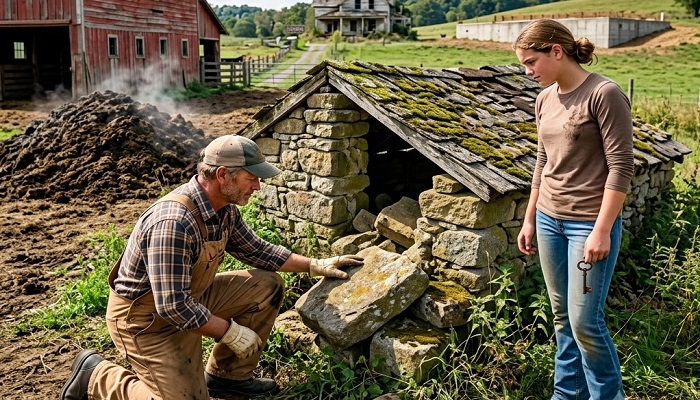
I Returned the $400,000 Cattle Barn… and Bought the Collapsed Stone Shed My Grandmother Refused to Sell
PART I: The Ruin Instead of a Future
The Scottish Highlands don’t care about your plans. Up here, the weather is a living, breathing antagonist, a relentless force of wind and freezing rain that can strip the heat from a calf’s bones in minutes. I’m Sarah Whitcomb. I grew up working my uncle’s cattle ranches in Montana, learning to rope and ride in the dust, but my blood belongs to this brutal, beautiful green expanse. When my grandfather passed, I crossed the Atlantic to help my father, Ian Whitcomb, run the ancestral family estate—a sprawling, struggling cattle operation that had been in our family for five generations.
But my father was tired. He was tired of the mud, tired of the Highland winters, and most of all, tired of fighting the land.
“It’s the only way forward, Sarah,” he said, tapping a thick, calloused finger against the glossy architectural blueprints spread across our farmhouse kitchen table. Outside, the rain lashed against the windowpanes like buckshot. “A fully enclosed, climate-controlled, automated cattle barn. Four hundred thousand dollars. We take the loan, we build the facility, and we never have to dig a dead calf out of the snow again.”
I stared at the blueprints. The proposed structure was a monstrosity of corrugated steel, concrete, and motorized ventilation fans. It belonged in a factory, not on a pasture. But the price tag was what really made my stomach turn.
“Dad, four hundred grand?” I said, my American drawl contrasting sharply with his softened Scottish burr. “That’s a twenty-year note. You’re putting the entire deed up as collateral. If beef prices drop, or feed goes up, the bank takes the farm.”
“The bank isn’t holding the note,” he replied, looking away, suddenly finding the bottom of his tea mug fascinating. “The contractor is financing it in-house. Apex Agri-Build. They’re offering a locked-in interest rate. It’s a lifeline, Sarah. I’ve already signed the preliminary agreements. They break ground next week.”
I didn’t like it. I didn’t like the urgency, and I certainly didn’t like corporate contractors acting as lenders. That night, after my father went to sleep, I booted up my laptop. I spent four hours digging through corporate registry databases, tracing the LLCs and holding companies connected to Apex Agri-Build.
By 2:00 AM, I found the bottom of the rabbit hole.
Apex Agri-Build wasn’t just a construction firm. They were a shell subsidiary for the Northern Highland Land Consortium—the exact same corporate conglomerate that had been quietly, aggressively buying up distressed farms all across the county for the last five years.
It was a trap. They weren’t building a barn to save our cattle; they were building a massive, unpayable debt to take our land. They would saddle us with a $400,000 mortgage, wait for a bad season, and foreclose.
The next morning, I drove the rusted Land Rover into the village, marched into the Apex site office, and slapped a cancellation notice on the manager’s desk. I cited the three-day federal and local cooling-off period for commercial loans. I legally killed the barn.
When I got back to the farm, my father was furious. He yelled until his face was the color of a bruised plum, calling me an arrogant American who didn’t understand the realities of modern Highland farming. He packed a bag and drove off to stay with my aunt in Inverness, leaving me alone with two hundred head of pregnant Highland cattle and a rapidly approaching winter storm season.
I needed shelter for the herd, and I needed it without going into debt.
I looked up the hill. At the highest point of our northern pasture sat the old stone shed.
It was a crumbling, miserable structure. Half the slate roof had caved in decades ago, and the thick, dry-stone walls were choked with moss and ivy. But my grandmother, a fierce, indomitable woman who had lived to be ninety-two, had always been obsessed with it. “Ye never sell the upper hill, Sarah,” she used to tell me when I visited as a little girl, gripping my wrist with terrifying strength. “Even if you’re starving, even if the bank is at the door. You keep the stone shed.”
I grabbed my heavy Carhartt jacket, a pair of leather work gloves, and a crowbar. I hiked up the muddy slope.
For the next two weeks, I worked like a dog. I hired two local hands—Mateo, a Spanish immigrant who knew more about masonry than anyone in the county, and old Callum, a retired shepherd. Together, we cleared a century of collapsed slate and rotten timber. We patched the roof with salvaged tin and reinforced the thick stone walls.
The village made me their favorite joke.
I walked into the local pub one evening to buy Mateo and Callum a pint, and the room fell silent. Angus, a farmer who had just sold half his acreage to the Consortium, laughed loudly from the bar.
“Here she is!” Angus mocked, raising his glass. “The Yank who traded a four-hundred-thousand-dollar future for a pile of rocks! I hear you’re building a museum up there, Sarah. Going to charge the cows admission to get out of the rain?”
The pub erupted in laughter. She bought a ruin instead of a future. That was the whisper. I ignored them, drank my stout, and went back to work.
But as we began clearing the centuries of compacted mud and sheep dung from the floor of the stone shed, my crowbar hit something hard. Not bedrock. It was perfectly flat.
I knelt down, using a heavy wire brush to scrub away the dirt.
It was a massive slab of hand-carved granite. As Mateo and I dug further, we realized the entire shed wasn’t just built on dirt; it was built on a meticulously engineered, slightly sloped floor of interlocking stone plates.
“Look at this,” Mateo said, tracing a deep, carved groove that ran down the center of the stone floor. The groove led out the back of the shed, disappearing under the mud of the pasture.
We grabbed shovels and followed the line outside. We dug a trench a hundred yards down the hill. We found massive, subterranean stone culverts—ancient French drains built hundreds of years ago. The stone shed wasn’t just a shelter; it was the apex of an ancient, gravity-fed drainage system designed to pull water away from the high pasture and channel it safely into the lower loch. It had been clogged by decades of neglect.
We spent three days clearing the primary grates. When the last blockage of mud and roots was pulled free, a rush of trapped groundwater surged down the hill with the roar of a jet engine.
A week later, the Great Autumn Gale hit.
It was the worst storm the Highlands had seen in fifty years. Ten inches of rain fell in forty-eight hours. The rivers breached their banks. The lower valleys turned into murky, churning lakes.
From the high ground of the stone shed, I watched the disaster unfold.
Down in the valley, Angus’s farm—and the brand-new, million-dollar Apex Agri-Build structures—were underwater. The high-tech, climate-controlled barns had been built on floodplains, heavily reliant on electric sump pumps. When the county power grid failed, the barns flooded within hours. Hundreds of cattle were stranded in freezing, chest-deep water.
But up on my hill? The ancient stone drainage system worked flawlessly. The torrential rain hit the pasture, sank into the earth, and was instantly channeled down the stone culverts. My upper pasture remained firm, green, and completely drained.
Inside the drafty, ugly stone shed, my herd of Highland cattle lay on the dry, solid granite plates, chewing their cud in perfect, dry peace.
The modern world had drowned. The ruin had saved us.
But as I was about to discover, the shed wasn’t just designed to keep water out. It was designed to keep a secret buried.
PART II: The Sins of the Father
The storm passed, leaving the county a devastated, muddy graveyard of corporate hubris. Men who had laughed at me in the pub were now begging for state emergency funds, their expensive barns ruined, their herds decimated by pneumonia. Apex Agri-Build’s reputation was in tatters. I had saved the Whitcomb ranch.
But the mystery of the stone shed gnawed at me.
The drainage system was too elaborate, too incredibly massive for a simple family croft. The amount of labor required to lay those subterranean stone channels would have required the wealth of a laird, an entire community working in unison.
I decided to clean the absolute back corner of the shed, a section where the granite slabs met the thick, rear foundation wall. My grandmother had always been specific about this shed. Never sell it. It wasn’t just about the structure; it was about the ground beneath it.
I took a heavy iron pry bar and wedge. Mateo had gone back to the village to help with the flood recovery, so I was alone. The silence of the Highlands after a storm is absolute—a heavy, ringing quiet.
I wedged the iron bar into the seam of the largest foundation stone in the corner. I threw my entire body weight against it. The stone ground against its neighbors, groaning in protest. I hit it with a sledgehammer. Crack. The mortar, centuries old, gave way.
I heaved the slab up and flipped it over.
Beneath it wasn’t dirt. It was a hollowed-out cavity lined with lead to keep out the damp.
Inside the cavity rested a rusted, heavy tin box. It looked like an old military ammunition crate, sealed with a thick coat of hardened wax.
My heart hammered against my ribs. The air in the shed suddenly felt freezing cold. I pulled the heavy box out, the wax flaking off onto my boots. I took a chisel and carefully broke the seal around the lid, prying the rusted hinges backward.
The inside of the box was perfectly dry. It smelled of ancient paper, dried lavender, and sealing wax.
It was full of documents. Not just a few pages, but stacks of thick, vellum paper, tied with brittle black ribbon. I carefully lifted the first bundle out and carried it to the light of the shed’s doorway.
They were land deeds. Dozens of them.
But they weren’t just for our farm. I recognized the names at the top of the parchments. MacLachlan. Campbell. Fraser. Vance. These were the names of the families who used to own the entire valley, the families who had mysteriously gone bankrupt or been forced off their land over the last twenty years, their properties swallowed up by the Northern Highland Land Consortium.
I read through the archaic legal text. The documents were the original, un-amended charters from the 1800s. They explicitly stated that the water rights, the drainage systems, and the grazing rights of the valley were communal and bound by bloodline. They proved, unequivocally, that the corporate boundaries drawn up by the Consortium in recent decades were entirely illegal. The corporations had been damming water, altering property lines, and suffocating the smaller farms based on forged, modern survey maps.
This was the proof. This was why my grandmother said to never sell. The stone shed was the geographical keystone of the valley, and beneath it lay the legal ammunition to destroy the Consortium and return the stolen lands to the families who had been run out of the Highlands.
My grandmother hadn’t just been a stubborn old woman. She had been the keeper of the valley’s true history, waiting for a generation strong enough to fight back.
I felt a fierce, burning pride in my chest. We could take them to court. We could break the corporate stranglehold on the county.
I reached back into the tin box to pull out the last stack of papers.
At the very bottom of the box lay a large, folded map, made of heavy canvas. It was a modern topographical map of the county, dated fifteen years ago.
I unfolded it carefully, laying it flat on the stone floor.
The map showed the entire valley. The farms that had been bought out were shaded in dark gray. But what caught my eye were the red ink markings.
Someone had meticulously drawn the corporate expansion lines, tracking exactly how the Consortium planned to choke off the water supply to the smaller ranches to force them into bankruptcy. It was a master plan for a modern-day Highland Clearance.
In the bottom right corner of the map, there was a handwritten note. The handwriting was sharp, elegant, and chillingly familiar. It was my grandmother’s handwriting.
She had drawn a thick, red circle around a specific date and a signature at the bottom of the map’s margin.
I dropped to my knees, my breath catching in my throat as I read the words she had written next to the circled signature.
“The Consortium offered a bounty for the rights to the valley’s water. They needed one insider to legitimize the new borders. He sold out his neighbors. He signed before the others knew. God forgive him.”
I looked at the signature inside the red circle. The ink was faded, but the bold, sweeping letters were unmistakable. I had just seen that exact same signature a week ago, at the bottom of a $400,000 contract for a corporate barn.
Ian Whitcomb.
My father.
He hadn’t been tricked by the contractors. He hadn’t just been a tired old man making a bad financial decision. Fifteen years ago, he had been the one who took the bribe. He had sold out the valley, sold out our neighbors, and helped the Consortium steal the Highlands. The new barn was never a loan; it was his final payoff, masked as a construction project, the final nail in the coffin for the Whitcomb legacy.
My grandmother had known. She had hidden the proof, perhaps too broken-hearted to send her own son to prison, but too fiercely loyal to the land to destroy the evidence. She had left it for me.
I sat alone on the ancient, cold stones of the shed. Outside, my cattle grazed peacefully on the high, dry pasture, oblivious to the fact that the man who owned the ground they stood on was the architect of its destruction.
I slowly folded the map, placed it back in the tin box, and looked down toward the valley. My father was due back from Inverness tomorrow.
The storm had passed, but the flood was just beginning.