My father’s harley was gone for twenty years, until i bought a $125 junk panhead everyone mocked. the dealer laughed at me in front of milwaukee, but my hands knew something he didn’t yet. my father’s name was waiting inside that rusted frame, along with proof our family never had before. by the time i read the letter, i understood why the men in power feared that bike………..
Part 1….
The auctioneer read it off his sheet like he was doing everybody a favor by even saying it out loud.
Milwaukee County Surplus Auction.
April 14, 1971.
A Wednesday morning cold enough to remind you that Wisconsin spring was just winter wearing a thinner coat.
I stood near the back of the lot with my hands in my pockets, trying not to look as nervous as I felt. The auction had been moving fast all morning. A decent Indian Chief had gone for $380. Two old Army surplus Jeeps sold before ten.
Then the clerk called Lot 22.
“All right, folks. Last motor vehicle of the day. 1948 Harley-Davidson Panhead. No title. As is. Engine seized. Been sitting in the county impound yard on South 27th Street since 1968. Starting bid, $25.”
People turned.
Then they laughed.
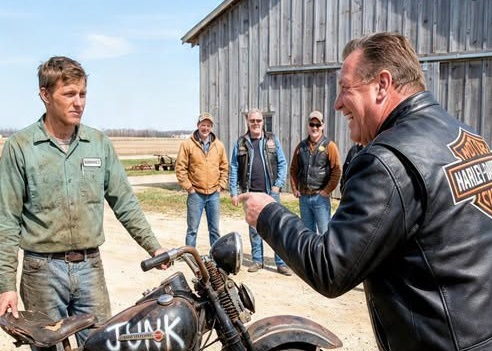
The motorcycle sat at the far end of the row like even the county was embarrassed to own it. The tank was dull and pitted. The exhaust pipes had more orange rust than chrome. The leather seat had split open from rain, sun, and three Milwaukee winters.
And across the tank, in white spray paint, somebody had written one word.
Junk.
I stared at it.
That word should have warned me off.
Instead, it made something in my chest tighten.
The auctioneer tried again. “Come on, people. Twenty-five dollars.”
A voice from the front cut through the cold.
“Parts value on that thing is about what the spray can cost.”
Laughter rolled across the lot.
I knew the man before I knew his voice. Walt Brenner. Owner of Brenner Harley-Davidson on West Oklahoma Avenue. Biggest Harley dealer in Milwaukee. Broad chest. Clean jacket. Bar and shield on the back like a badge.
He had the look of a man who had never doubted a room would listen when he spoke.
“Three Milwaukee winters in an impound yard,” Brenner said, loud enough for everyone. “You know what that does to a Panhead engine that isn’t running? Alloy corrodes. Rings fuse to the cylinders. Whatever oil was in the cases is sludge now.”
He looked around like he was teaching a class.
“That bike is done. Whoever bids on it is buying a parts bike with no good parts.”
The crowd chuckled again.
I did not.
I raised my hand.
“Twenty-five.”
The lot went quiet in that sharp, ugly way people go quiet when they are trying not to laugh too soon.
Brenner turned and looked straight at me.
I was twenty-eight years old, wearing a green work shirt with a machinist patch on the chest and jeans worn thin at the knee from shop floors. My hands were already dark at the creases from machine oil that no soap ever fully removed.
I did not look like a man who had money to waste.
Because I didn’t.
Brenner’s eyes moved over me once.
“Son,” he said, “I’ve been selling Harleys for twenty-two years. That engine seized because the previous owner ran it without oil until something let go. That’s not a seized engine. That’s a destroyed engine.”
I looked at him.
“How much for a new Harley?”
He blinked.
“Loaded out? Twenty-two hundred. Maybe more.”
“I’ve got twenty-five.”
“That’s exactly my point.”
“No, sir,” I said quietly. “That’s mine.”
Then I raised my hand again.
“Fifty.”
A parts dealer from Racine joined in. He thought he saw something he could strip. Maybe wheels. Maybe tins. Maybe enough to make the morning worth his drive.
The bidding climbed in short, tense jumps.
Seventy-five.
Ninety.
One hundred.
My throat got tight.
Every dollar mattered to me.
Every one.
But I kept seeing my father’s hands on a set of handlebars that were no longer there.
“One twenty-five,” I said.
The parts dealer looked at the bike, looked at me, then shook his head.
Brenner turned away like he could not bear to watch.
“Sold,” the auctioneer said. “One hundred twenty-five dollars to the young man in the green shirt.”
I walked to the payment table and counted out the money in fives and tens. My fingers felt stiff, but not from the cold.
That was grocery money.
Rent money.
Emergency money.
Money a smarter man might have kept.
But I had not come there to be smart.
Brenner intercepted me beside the bike.
“I’m not trying to embarrass you,” he said, lower now. “I’ve watched young guys spend everything they had on iron that couldn’t be saved.”
I put my palm flat on the tank, right over the word Junk.
“Mr. Brenner, my father rode a Panhead for eleven years before they took his job. I grew up listening to him describe that engine. I know what it sounds like when it’s right.”
I looked down at the ruined machine.
“Right now, it doesn’t sound like anything at all. That’s the first problem I’m going to fix.”
Brenner studied me.
“What’s the second problem?”
I looked toward the road.
“Getting it home without a truck.”
He walked away.
I do not blame him for thinking I was foolish. Most people would have.
But to understand why I raised my hand that morning, you have to understand where I came from.
My name is Danny Kowalski.
I was born in 1943 on Milwaukee’s South Side, the only son of Stefan and Helen Kowalski. My father worked at Allis-Chalmers for fourteen years. He was a machinist on the heavy equipment line, and for the last six of those years, he was a union steward.
People respected him.
He showed up early.
He worked clean.
He never crossed a picket line.
Then, in the winter of 1953, everything changed.
My father was called before a company review board and told his employment was being terminated. The reason they gave was cold and polished.
“Associations inconsistent with company values.”
He was forty-one.
He had a wife.
A ten-year-old son.
A mortgage.
And suddenly, a union membership that could not protect him.
The “associations” were meetings he had attended in 1949 and 1950. Legal meetings. Union meetings. Meetings where men talked about work, wages, dignity, and ideas that powerful people had decided were dangerous.
An FBI informant had been there.
By 1953, in Milwaukee and everywhere else in America, that was enough.
My father never worked as a machinist again.
He took maintenance jobs. Custodial jobs. Any work he could get. Work that used none of his skill and paid a third of what he had once earned.
He carried it quietly.
That was the cruelest part.
He did not rage at the dinner table. He did not explain the whole thing to me. He did not ask anyone to feel sorry for him.
But he talked about motorcycles.
He talked about the 1948 Panhead he used to ride.
He had bought it used in 1951 and sold it after the firing because my mother needed grocery money more than he needed pride. He described that bike so many times that, by the time I was grown, I felt like I had ridden it myself.
The sound on cold mornings.
The feel of the throttle on Highway 41.
The way the whole machine settled beneath him when it ran right.
So when I saw that Panhead at the county auction, I did not see junk.
I saw a ghost of my father’s life before men in clean offices took it apart.
I borrowed a neighbor’s pickup and hauled the bike back to my garage on South Kinnickinnic Avenue.
That first night, I did not turn a wrench.
I just looked at it.
Brenner had not been wrong about the damage. Three winters had done their work. The engine cases were corroded. The heads had surface cracks. The cylinders were scored. Everything smelled like old oil, rust, and weather.
But the frame was solid.
Better than solid.
I went over it inch by inch with a flashlight. Neck welds. Engine mounts. Gussets. Seat post. Backbone.
Solid.
And that bothered me.
Something about that bike did not match the story being told about it.
A seized engine was one thing.
Three years in an impound yard was another.
But deep inside me, I felt it.
Something other than mechanical failure had put that machine where I found it.
On the third day, I noticed the tubes.
The main frame tubes, the backbone running from the neck to the seat post, had been welded at both ends. Not factory work. I knew factory work. Factory tubes were open or plugged with rubber grommets.
These had been sealed.
Carefully.
Clean beads.
Not rushed.
Not sloppy.
Both tubes.
Both ends.
I tapped the left tube with my knuckle.
The sound came back wrong.
Hollow, yes.
But not empty.
There was something inside.
I did not open it that day.
I told myself the engine came first. That was practical. That was logical. That was what a machinist did.
But every night after work, as I stood in that garage with cold coffee and blackened hands, I felt those sealed tubes staring back at me.
Three weeks passed.
I rebuilt what I could.
Ordered what I could not.
Cleaned corrosion until my fingers cramped.
Then one rainy Sunday afternoon in May, a parts order from Chicago was delayed, and I finally stopped pretending I was not afraid of what I might find.
I got the drill.
I set the bit against the left tube.
My hands were steady.
My heart was not.
When the bit broke through, the frame gave a tiny sigh, like a secret breathing for the first time in nineteen years.
Continue in the comments 👇👇…
Part 2….
I stood there with the drill in my hand and listened to that little hiss fade into the garage.
Rain tapped the roof.
The old Panhead sat in front of me, silent as a witness.
Inside the tube was a metal cylinder wrapped in oilcloth. Silver-gray. Smooth. Heavier than it looked. Whoever put it there had not hidden it for a weekend.
They meant it to survive.
I cut the weld carefully and eased the end open. When the cylinder slid into my palm, my stomach tightened like I had already been warned.
Both caps were sealed with hardened gray compound.
I locked one end in the bench vise and worked the other loose with a strap wrench. It took time. I did not rush. Something told me rushing would be disrespectful.
When it opened, I found three things.
Money first.
Banded bills.
Nothing newer than 1952.
Eight thousand four hundred dollars.
Then documents.
Several pages on thin onion-skin paper. The heading read: Statement of Members, Milwaukee Industrial Workers Local 414, Attendance Records 1949-1952.
Forty-seven names.
Dates.
Notations.
My finger slid down the list, already afraid before I saw it.
Kowalski, Stefan M.
Attendee.
Seven meetings.
No leadership role.
No political affiliation documented.
My father’s name.
I sat down hard on the garage floor.
The third item was a handwritten letter dated March 3, 1952, signed Karl Riemer. He wrote that eleven men had lost their jobs at Allis-Chalmers, Harnischfeger, and Milwaukee Electric because of informant reports. He wrote that these records proved most of them had done nothing beyond attending legal meetings.
He wrote that twenty-two families had lost their livelihoods.
They deserved better.
I read my father’s name again.
Then again.
For years, my family had lived under a shadow nobody would explain and nobody in power wanted corrected.
Now the proof was sitting in my oil-stained hands.
I went inside and called my mother.
SAY “OK” IF YOU WANT TO READ THE FULL STORY ❤️👇 👇
Three estates, including Stefan Kowalski’s, represented by Danny and his mother, received smaller amounts that acknowledged, officially and legally, that what had been done was wrong. Stefan Kowalski’s name appeared in the settlement documents as a man who had been wrongfully terminated based on fraudulent reports. Danny had it framed.
As for Carl Reimann’s $8,400, Danny tracked him down through the Minnesota phone directory in 1972. Carl was 61 years old, retired, living outside St. Paul. Danny drove to Minnesota and sat at Carl’s kitchen table and told him that the motorcycle had been found, that the records had been used, that eight men had received compensation.
Carl sat without speaking for a long time. “I always wondered,” he said finally, “whether anyone would ever find it, whether it would matter by then.” “It mattered,” Danny said. He put the envelope with Carl’s money on the table. “I left that for whoever found it,” Carl said. “I know the men on that list needed it more than either of us.
” Carl used it to fund a small scholarship at a Milwaukee technical school in the names of the locals members. He and Danny stayed in contact until Carl died in 1989. Let me tell you about Walt Breanna. In 1973, two years after the auction, Danny had been riding his rebuilt Panhead long enough to have a reputation in Milwaukee’s motorcycle community.
Word had spread about the restoration, the seized engine rebuilt from scratch, the corroded chrome repolished. One morning in October, he stopped at Breanna’s dealership. Breanna heard the Panhead before he saw it. The sound of a properly rebuilt engine, deep and even, the particular idle of a Panhead that’s been gone through right.
He walked outside. The bike was deep black and clean. The chrome was polished to a mirror. The tank carried the original Harley script. No spray paint, no rust. Brenner walked around it slowly. He checked the frame welds, examined the primary case. “You rebuilt this,” he said. “Yes, sir.” “The engine?” “Complete rebuild.
New rings, reground cams, rebored cylinders. Cases were porous in two places. I welded them and pressure tested.” Brenner looked at Danny for a long moment. “I said some things at that auction,” he said. “You did.” “I was wrong about the bike.” “You weren’t wrong about the damage,” Danny said. “Everything you said was accurate.
You were looking at what you could see. You weren’t accounting for what the bike was worth to someone who had reason to fix it.” Brenner was quiet for a moment. “Then, what do you need?” “Nothing today. Just wanted to show you what the bike became.” Brenner looked at the Panhead for a long time. “Your father rode one of these,” he said. “He did, until they took his job.
” “He ever get it back?” “No,” Danny said, “but we got something else back.” He started the engine. The Panhead settled into its idle, deep and even and unhurried. Danny rode away down West Oklahoma Avenue. Brenner stood in the lot and watched him go. Walt Brenner retired in 1981. Before he closed the dealership, he put a note in the file for every customer who’d bought a used Harley from him.
The note said, “If someone offers to fix something you think is broken beyond repair, let them try. You might be wrong about what broken means.” Danny Kowalski is 81 years old now. The 1948 Panhead is in his garage on South Kinnickinnic Avenue, the same garage where he rebuilt it 50 years ago. His son Michael starts it once a month.
On the left frame tube, where Carl Riemer welded the end cap shut in 1952, Danny had a small brass plate fitted in 1987 after he found what was inside. The plate reads, “Carl Riemer sealed this in 1952. Danny Kowalski opened it in 1987. 11 men were remembered.” His father’s name is first on the list.