Ruthless Stepdad Threw Her Into a Blizzard With One Backpack — Then a Dead Veteran’s Cave Exposed the Secret He Buried
Mark Harlan threw my mother’s wedding ring into the snow and told me to go dig my future out of the ditch.
Then he locked the farmhouse door.
Behind him, my mother stood in the kitchen light with both hands pressed to her mouth, not saying my name, not reaching for the latch, not even looking at the backpack Mark had dumped at my boots like I was trash he had finally gotten around to hauling away.
The blizzard swallowed the porch steps in white sheets.
I was seventeen.
My coat had a broken zipper.
And the last thing Mark said before the deadbolt snapped was, “Your father should’ve taken you with him when he died.”
I did not scream.
That would have pleased him.
I did not pound on the door.
That would have scared my mother and given Mark another story to tell the sheriff.
I bent down, picked up the silver ring, wiped the snow out of the tiny groove where my father’s initials were engraved, and slipped it into the smallest pocket of my backpack.
Then I turned toward the road.
Advertisements
The storm was so thick that the barn disappeared ten yards away. The mailbox was a gray ghost. The pine trees across the frozen pasture bent like old men hiding their faces.
I counted my steps.
That was the first rule my father taught me when I was little and we went hiking in the Bitterroot foothills.
“When panic starts talking,” he’d said, tapping two fingers against my temple, “make your brain count something boring.”
So I counted.
Eight steps to the end of the porch.
Seventeen steps to the gravel path.
Thirty-four steps to the cattle gate.
My boots sank deep. Snow packed around my ankles. Wind slapped my face sideways and stole the heat out of my mouth before I could breathe it back in.
I had twelve dollars in my jeans.
A half-charged phone with no service.
One granola bar.
A pocketknife.
A lighter my dad had carried in Iraq and never used for cigarettes.
And the ring.
That was all Mark left me.
No birth certificate.
No Social Security card.
No truck keys.
No chance to call my Aunt June in Missoula.
Nothing.
He had planned that part.
Mark Harlan was not loud because he was stupid.
He was loud because people mistook loud for careless.
He was never careless.
He waited until the first county plow had already passed.
He waited until the sheriff’s office announced on the radio that Highway 38 was closed.
He waited until my mother took her pain pills for her back and moved through the kitchen like she was underwater.
Then he opened my bedroom door and said, “Pack what you can carry, Ellie.”
I had looked at him from my desk, pencil still in my hand.
“What?”
He had leaned one shoulder against the frame, smiling in that flat way that never reached his eyes.
“You heard me. I’m done feeding another man’s mistake.”
My mother had whispered, “Mark, please.”
He did not even glance at her.
He just tossed my backpack at my feet.
There are moments when life does not break loudly.
There are moments when it breaks with a zipper.
There are moments when it breaks with your mother looking at the floor.
There are moments when it breaks with a man checking his watch.
There are moments when it breaks with snow already covering your footprints before you can decide where to go.
There are moments when it breaks, and the only thing left is whether you break with it.
I did not.
I walked.
The Harlan farmhouse sat four miles outside of Westbridge, Montana, up a county road that people forgot existed unless they needed cheap hay or a place to dump a broken washing machine.
Westbridge had a gas station, a diner, a feed store, a church with a bell that cracked in winter, and one motel with a VACANCY sign that had been lying since 2009.
If I could make it to town, maybe Mrs. Alvarez at the diner would let me sit in the back until morning.
Maybe the night clerk at the gas station would let me use the landline.
Maybe someone would believe me.
Maybe.
But the storm had already erased the road.
After the cattle gate, I followed the fence line, keeping the wire on my left. My father had taught me that too.
“When the sky disappears,” he said, “hold on to something that knows where it’s going.”
The fence knew.
My hands went numb inside my cheap gloves. Snow collected on my eyelashes. Every few minutes, I stopped and turned my back to the wind so I could breathe without choking.
Behind me, the farmhouse vanished.
I did not look back again.
At the first bend, I saw headlights.
For one second, hope lifted hard in my chest.
Then I recognized the engine.
Mark’s blue Dodge.
He rolled slowly along the pasture road on the other side of the fence, tires grinding over frozen ruts. His window came down three inches.
Warm yellow light spilled over his face.
He held up my phone.
My actual phone.
Not the dead prepaid one in my backpack.
The one with Aunt June’s number, my school login, photos of my father, everything.
I had not noticed he took it.
“You forgot something,” he called.
My throat tightened, but my face stayed still.
He smiled.
Then he dropped the phone under his rear tire and backed over it.
The crack was small.
In the storm, it sounded like a bone.
“Now you can stop pretending you’ve got somewhere to call,” he said.
I stared at him through the snow.
He expected tears.
He expected me to run at the fence.
He expected me to beg.
Instead, I lifted one gloved hand, slow and calm, and pointed at the dash camera stuck to his windshield.
His smile thinned.
The window went up.
The truck rolled away.
That was my first small win of the night.
He had forgotten his own camera.
And Mark hated forgetting.
I kept walking.
The fence led past the lower pasture, then down toward the creek bridge. In summer, that creek was ankle-deep and clear enough to see trout hovering under shadow. In winter, it was black water under rotten ice, and the bridge had no rail.
The wind pushed so hard that I crouched low when I crossed. I kept one hand on the frozen plank edge and moved one foot at a time.
Halfway across, I heard a crack.
Not ice.
Wood.
I froze.
The plank under my right boot sagged.
I shifted my weight back.
Another crack.
The bridge groaned like it had been waiting all winter to give up.
I dropped to my stomach and crawled.
Snow filled my collar. My backpack slid sideways. My fingers clawed at splintered boards. The creek rushed below, invisible but loud.
A plank snapped behind me and vanished.
I did not turn my head.
I crawled until my hands hit frozen dirt.
Then I rolled off the bridge and lay there with my cheek in the snow, breathing like someone had punched me.
The bridge collapsed three seconds later.
Not all of it.
Just enough.
Enough to cut off the easy way back.
Enough to cut off Mark if he decided to follow.
Second small win.
I laughed once.
It came out sharp and strange, and the wind tore it away.
By then, my plan had changed.
Town was no longer certain.
The creek road would be worse, and if I missed the turn near Miller’s quarry, I could walk straight into open range and freeze before sunrise.
There was only one place closer than town.
An old fire lookout trail my father used to take me on when I was little.
It led up into the granite ridge west of our pasture.
Nobody used it anymore after the state closed the tower.
But halfway up, tucked under a shelf of rock, there was a hunting blind made of stacked stone and old tin.
It was not much.
It might block the wind.
It might be enough.
I turned away from the road and climbed.
That decision saved my life.
The ridge rose ugly and steep, full of scrub pine, loose shale, and snow-covered rocks waiting to twist an ankle. I used my pocketknife to cut a strip from the bottom of my flannel shirt and tied my backpack strap tighter across my chest so it would not swing.
The cold had moved from my skin into my bones.
It made everything slower.
Thoughts came one at a time.
Lift foot.
Plant foot.
Breathe.
Check fingers.
Look for tree line.
Do not sit.
Never sit.
My father’s voice walked with me.
Not soft.
Not magical.
Just practical.
“Cold makes promises, Ellie. It tells you five minutes won’t hurt. It tells you sleep is mercy. Cold is a liar.”
So I did not sit.
When my legs shook, I leaned against a pine and counted to thirty.
When my teeth chattered so hard my jaw hurt, I bit the inside of my cheek until the pain focused me.
When the trail disappeared, I looked for cuts in the trees where branches had been trimmed years ago.
That was how I found the orange ribbon.
It was tied to a pine branch at shoulder height, faded and stiff with ice.
Not state trail ribbon.
Too new.
I brushed snow off with my glove.
There were black letters written on it.
B.H. — EAST MARKER.
My breath stopped.
B.H.
Benjamin Hayes.
Every kid in Westbridge knew the name because the Veterans Hall had a bronze plaque with his face on it.
Staff Sergeant Benjamin Hayes.
Army Ranger.
Afghanistan.
Died three years ago.
No family left, people said.
No funeral big enough for what he deserved, Mrs. Alvarez said.
He had lived alone in a cabin near Raven Ridge after he came home, and folks mostly left him alone because grief makes people uncomfortable when it does not behave politely.
I remembered seeing him once at the diner.
Tall, quiet, gray at the temples though he could not have been forty. He sat in the last booth with his back to the wall, coffee untouched, eyes on the door.
I was fourteen.
My father had already been gone two years.
Benjamin Hayes had looked at me once, not with pity, but recognition.
Like he knew the exact shape of a child trying not to show what home had become.
Then he paid for our meal and left before my mother could thank him.
Now his initials were on a ribbon in the storm.
I looked uphill.
Another ribbon snapped in the wind twenty yards ahead.
I followed it.
The trail did not lead to the old hunting blind.
It cut north, through a narrow stand of pine where snow fell lighter. The markers were placed just far enough apart to keep someone moving but not enough to be obvious from below.
A hidden route.
My pulse steadied.
Someone had built this for bad weather.
Someone had built this for being followed.
The third ribbon led me behind a boulder split down the middle by frost.
The fourth hung beside a fallen log.
The fifth was tied at the entrance of a crack in the granite.
At first, I thought it was only shadow.
Then the wind shifted, and I felt warm air.
Not warm like a house.
Warm like earth.
The opening was narrow, partly blocked by dead pine branches arranged so naturally that a person would pass within five feet and never see it.
I crouched.
The cave breathed out at me.
Dark.
Dry.
Waiting.
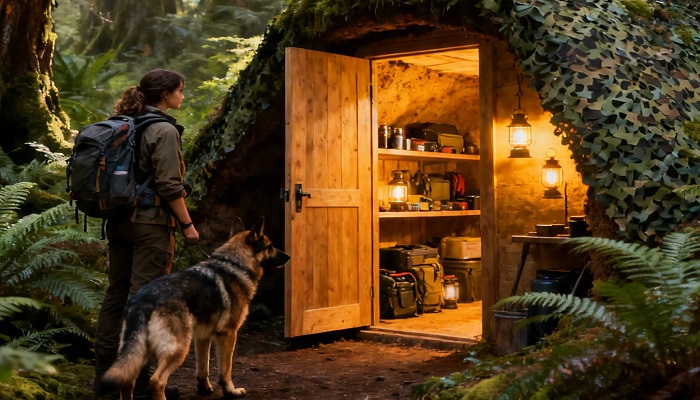
I pulled out my father’s lighter.
My fingers barely worked. It took four tries. On the fifth, flame jumped up, tiny and gold, and showed me scratched stone walls, a dirt floor, and a passage slanting inward.
I ducked inside.
The blizzard disappeared behind me.
The silence was so sudden it felt like stepping underwater.
I moved ten feet in and found a lantern hanging from a nail hammered into a crack.
An old green Coleman lantern.
Beside it, on a flat stone, sat a plastic bin.
Inside the bin were matches sealed in bags, two emergency blankets, a wool cap, water bottles, military rations, a first aid kit, socks, a radio, and a folded note sealed in a freezer bag.
My hands shook when I opened it.
The handwriting was blocky and precise.
IF YOU FOUND THIS BECAUSE YOU’RE LOST, STAY HERE UNTIL DAYLIGHT.
IF YOU FOUND THIS BECAUSE SOMEONE HURT YOU, LOCK THE BRANCH SCREEN FROM INSIDE.
IF YOU FOUND THIS BECAUSE MARK HARLAN SENT YOU INTO THE STORM, READ THE RED NOTEBOOK.
For a while, I did not move.
The cave seemed to tilt.
My breath fogged in front of me.
I read the last line again.
MARK HARLAN.
Not “a man.”
Not “your stepfather.”
His full name.
Written by a dead veteran three years before the night Mark threw me out.
I set the note down carefully because my fingers wanted to crush it.
Then I turned the lantern knob, struck a match, and brought light into the cave.
The passage widened after the entrance. It opened into a low chamber with a stone ceiling, dry enough that old dust still clung to the corners.
Someone had made it livable.
Not comfortable.
Livable.
A cot with a folded sleeping bag.
A crate table.
Two shelves built from scrap lumber.
A metal ammo box.
A five-gallon bucket with a lid.
A small woodstove pipe angled through a natural crack overhead, disguised outside by stone.
I closed the branch screen from inside using a rope loop. Then I stripped off my wet gloves, boots, and socks. My toes were white at the tips but not waxy. I rubbed them until pain returned like sparks.
Pain meant alive.
I changed into the socks from the bin, wrapped the emergency blanket around my shoulders, and ate half a ration pack slowly, even though my stomach wanted all of it.
Only then did I look for the red notebook.
It was on the second shelf, wrapped in oilcloth.
A rubber band held it shut.
On the cover, in black marker, someone had written:
FOR ELLIE WALKER, IF SHE EVER NEEDS THE TRUTH.
My name.
My real last name.
Walker.
Not Harlan.
Mark had tried to make me use his name at school after he married my mother. I refused until the principal called me “difficult” and my mother cried in the parking lot.
But the notebook knew.
I sat on the cot, lantern hissing beside me, and opened it.
The first page was not a confession.
It was a map.
A hand-drawn map of Raven Ridge, our farm, the creek, the old county road, the closed mine entrance, and five hidden trail markers. The cave was labeled Safe Point One.
Below it:
If Ellie comes here, she is in immediate danger. Do not send her back to the Harlan residence.
The second page had dates.
Not many words.
Just dates, times, license plate numbers, and short descriptions.
March 14 — M.H. met Deputy Kline at Miller quarry. Cash envelope.
April 2 — M.H. took Walker file box from Dorothy’s attic.
May 19 — Dorothy bruised left wrist. Claimed horse gate. No horses loose.
June 7 — M.H. asked about guardianship paperwork. Said, “Girl turns eighteen in eleven months.”
June 9 — County records request: Walker land mineral rights.
June 11 — M.H. burned documents behind shop. Recovered partial.
My skin went cold in a new way.
Dorothy was my mother.
Walker land.
Mineral rights.
I turned the page.
There was a photograph taped there.
My father stood in front of our old red barn, younger than I remembered him, one arm around my mother, the other holding baby me. Beside him stood Benjamin Hayes in civilian clothes, unsmiling, one hand resting on a locked metal case.
On the back of the photo, written in my father’s handwriting:
Ben keeps the duplicate until Ellie is old enough. Don’t trust Harlan.
My mouth went dry.
My father died before my mother married Mark.
At least, that was the story.
Car crash on Highway 12.
Black ice.
Instant.
No one’s fault.
That was what the sheriff said.
That was what my mother repeated when she woke crying.
That was what Mark used whenever he wanted to end a conversation.
“Your father died because roads are dangerous. Stop digging up ghosts.”
But my father had written Mark’s name.
Before he died.
My hands were steady now.
That scared me more than shaking would have.
I flipped through the notebook.
Benjamin Hayes had not written like a man telling a dramatic story. He wrote like a soldier building a case for someone who might not survive to explain it.
Names.
Dates.
Receipts.
Descriptions of vehicles.
Locations of hidden copies.
People Mark visited.
Properties Mark tried to buy under other names.
A bank in Idaho.
A storage unit in Missoula.
A county clerk named Evelyn Price who suddenly retired and moved to Arizona.
A deputy named Nolan Kline who bought a fishing boat six weeks after my father’s accident.
And again and again, one phrase appeared.
Walker Ridge Trust.
I had never heard of it.
But Mark had.
That was why I was in the snow.
Not because he was tired of feeding me.
Not because I talked back.
Not because I refused to call him Dad.
He needed me gone before I turned eighteen.
The cave creaked softly as the wind hit the mountain outside.
I closed the notebook and looked at the entrance.
For the first time that night, fear stopped being a weather condition and became a person.
Mark knew what he had done.
But he did not know I was alive.
That gave me one night.
Maybe less.
I slept in pieces.
Twenty minutes.
Maybe thirty.
Each time, I woke with my hand on the pocketknife and my eyes on the branch screen. The lantern burned low. The cave smelled like dust, wool, metal, and old smoke.
Near dawn, the radio crackled.
I had not turned it on.
The sound snapped me upright.
Static hissed.
Then a voice.
“—any unit near Raven Ridge, possible runaway minor, female, seventeen, brown hair, blue coat. Step-father reports emotional disturbance. Last seen leaving residence voluntarily around twenty-one hundred. Blizzard conditions. Approach with caution.”
I stared at the radio.
Approach with caution.
Mark had moved fast.
Another voice answered.
“Copy. Harlan says she took cash and prescription meds?”
My jaw locked.
Prescription meds.
He was not just reporting me missing.
He was making me criminal.
The first voice said, “Affirm. Mother confirms.”
Mother confirms.
I closed my eyes.
For three breaths, I let that hurt.
Then I opened them.
Pain was information.
Not instruction.
Mark had my mother.
Maybe scared.
Maybe drugged.
Maybe broken.
But he had her.
I pulled the emergency blanket tighter and opened the ammo box.
Inside were more papers, a prepaid phone sealed in plastic, a small solar charger, a compact digital camera, two USB drives, and an old flip phone with a sticky note.
CALL JUNE WALKER FIRST. NOT 911.
Aunt June.
My father’s sister.
My mother told me Aunt June stopped calling because she blamed us for my father’s death. Mark said she was unstable. Mark said she threatened him. Mark said family sometimes turned poisonous and the healthiest thing was to close the door.
Mark said many things.
Most of them were keys, if you turned them backward.
I turned on the prepaid phone.
It had two bars.
My thumb hovered over the number written on the note.
Then I stopped.
If Benjamin wrote “not 911,” there was a reason.
If Mark had a deputy in his pocket, the wrong call could put me right back in his truck.
I dialed Aunt June.
She answered on the second ring.
No hello.
Just breathing.
Then, “Who is this?”
My voice came out rough. “It’s Ellie.”
Silence.
Something fell on her end of the line.
“Ellie?”
“Yes.”
“Where are you?”
I looked at the notebook.
“Safe Point One.”
She made a sound I had never heard from an adult before.
Not crying.
Not relief.
A wound opening.
“Ben’s cave,” she whispered.
“You knew about it?”
“Not where it was. Only that he made one.” Her voice changed, sharpened. “Are you hurt?”
“Cold. Not badly.”
“Is Mark there?”
“No.”
“Does he know where you are?”
“I don’t think so.”
“Good. Listen carefully. Do not leave that cave for anyone in uniform unless they say the phrase.”
I sat up straighter.
“What phrase?”
“Your dad’s blue truck had no rust.”
My throat tightened.
That truck had rust everywhere.
It was a family joke.
“What does that mean?”
“It means they knew your father. It means they’re with me.” She inhaled hard. “Ellie, I need you to look for a red notebook.”
“I have it.”
Another silence.
Then Aunt June said, very softly, “Thank God.”
“What is the Walker Ridge Trust?”
She did not answer quickly.
That was when I knew the answer was bigger than money.
“Ellie,” she said, “your father did not only leave you the farm.”
I looked around the cave, at the map, the food, the secret trail, the papers hidden by a dead soldier.
“What did he leave?”
“Land. Water rights. Old mining claims. And evidence.”
“Evidence of what?”
“Of what Mark was hired to find.”
The cave seemed to shrink.
“Hired by who?”
Before she could answer, the line popped with static.
Then another voice cut in.
Male.
Close.
Too clear.
“Ellie Walker,” it said, “this is Deputy Nolan Kline with the Ravalli County Sheriff’s Office. Stay where you are.”
My blood went cold.
Aunt June shouted something, but static swallowed her.
The deputy continued.
“We have your location from the call. Your mother is worried sick. Your stepfather wants to bring you home.”
I did not move.
The prepaid phone had been tracked.
Or the line was compromised.
Or someone was already watching the ridge.
Deputy Kline’s voice softened, almost kind.
“Don’t make this worse than it is, kid.”
I ended the call.
Then I removed the battery.
I sat still for exactly ten seconds.
Not because I had no fear.
Because fear makes bad math if you let it rush.
I had a cave.
I had supplies.
I had a notebook.
I had a storm between me and everyone else.
But now Mark knew I was not dead.
And someone with a badge wanted me found.
I packed quickly.
Notebook first, sealed in my backpack.
Phone, battery separate.
USB drives in my sock.
Photo in my inner pocket.
Food.
Matches.
Water.
The camera.
I was pulling on my boots when I heard the first sound outside.
Not wind.
A branch snapping under weight.
Then a man’s voice, muffled by snow.
“Opening’s here somewhere.”
Another voice said, “Harlan said she wouldn’t make it this far.”
My hand froze on the lace.
Mark.
Not deputies.
Men.
He had sent men.
That was almost a relief.
Men without badges were simpler.
I killed the lantern.
Dark dropped hard.
The cave entrance was a black rectangle behind the branch screen. Snowlight glowed faintly through the gaps.
Boots crunched closer.
One man coughed.
The other said, “Check behind that split rock.”
I moved to the side wall and felt along the stone, remembering the map.
Safe Point One had an exit mark.
A second passage.
I had not noticed it in lantern light.
My fingers found cold air near the back, low to the ground behind stacked crates. I pulled one crate aside inch by inch, careful not to scrape stone.
A narrow crawlspace opened behind it.
Too small for a grown man with winter gear.
Large enough for me.
The branch screen rustled.
A gloved hand pushed through.
I slid into the crawlspace on my stomach.
The rock scraped my shoulders. My backpack caught. I exhaled, flattened, pulled hard, and felt fabric tear.
Behind me, a man whispered, “Got it.”
The screen shifted.
Gray light spilled into the chamber.
I crawled faster.
My elbows hit stone. My knees dragged through dirt. The passage sloped downward, then left. Air moved across my face.
Behind me, a flashlight beam bounced against the cave wall.
“Empty,” one man said.
“She was here.”
“Food’s open.”
“Then where the hell did she go?”
I reached a wooden panel.
For one terrible second, it would not move.
I pressed my shoulder against it.
Nothing.
Behind me, boots entered the cave.
I felt around the edges, found a latch made of wire, lifted it, and the panel swung outward into whiteness.
I rolled through and landed under a fallen pine twenty feet above the cave entrance.
The second exit was hidden in a tangle of roots and rock.
Benjamin Hayes had built it perfectly.
Below, one man stepped outside the cave and looked left.
I stayed flat.
Snow fell between us like a curtain.
The other man came out holding the plastic bin.
“Should we burn it?”
“No. Harlan wants the notebook.”
“It ain’t here.”
“Then she has it.”
My fingers tightened around the knife.
The first man pulled out his phone.
“Call him.”
I did not wait to hear more.
I slid backward under the fallen pine, then crawled behind a ridge of snow-covered stone. Once I was out of sight, I rose into a crouch and moved uphill.
Not down.
Down was expected.
Town was expected.
The road was expected.
So I went toward the old fire lookout.
The storm had weakened near dawn, but the world was still white enough to erase mistakes. I kept to tree cover. Every few minutes, I stopped and listened.
Twice, I heard voices below.
Once, I saw Mark’s blue Dodge crawling along the lower road, headlights yellow in snowfall.
He had come himself.
Good.
The more men he put on the mountain, the fewer watched the house.
The thought came so calmly that I almost did not recognize myself.
But I was my father’s daughter.
And someone had spent years building a way for me to survive this exact day.
By midmorning, I reached the old lookout tower.
It stood at the top of Raven Ridge, a black skeleton against the pale sky, stairs broken halfway up, cabin windows gone, roof sagging under snow.
The state had locked it years ago, but teenagers still came in summer to drink beer and carve initials.
Not in winter.
Never in winter.
I ducked behind the concrete footing and pulled out Benjamin’s map.
There was another mark near the tower.
A triangle.
Supply cache.
I searched the north footing first.
Nothing.
East.
Nothing.
South.
A beer can frozen into snow.
West.
There, tucked under a flat rock, was a metal rod with an orange cap.
I pulled.
A plastic tube came up from under the snow like a buried bone.
Inside was another bag.
Hand warmers.
A compass.
A laminated note.
And a key.
The note read:
IF PURSUED, DO NOT GO TO TOWN.
GO TO THE PLACE WHERE THE BELL CRACKED.
J.W. WILL KNOW WHAT TO DO.
The place where the bell cracked.
Westbridge Community Church.
The bell cracked during a Christmas Eve freeze before I was born. Everyone called it the cracked-bell church.
J.W.
June Walker?
No. Aunt June lived in Missoula.
Someone in Westbridge.
Someone Benjamin trusted.
Someone close enough to help but hidden enough to survive Mark.
A gust of wind ripped over the ridge and nearly took the note from my hand. I shoved everything into my pack and looked down at town.
From the lookout, Westbridge was only a smudge in the valley.
A church steeple.
A water tower.
A few straight roads.
Smoke from chimneys.
And between me and it, Mark’s truck.
He had parked near the old logging switchback. Two men stood beside him. One wore a tan sheriff’s jacket.
Deputy Kline.
I watched through the camera Benjamin left in the cave. It had a zoom lens, not powerful but enough.
Kline was heavier than I expected, with a shaved head and a red face. Mark stood close to him, speaking fast. Even from far away, I could read anger in his shoulders.
He had lost control of the story.
That made him dangerous.
He pulled something from his coat and handed it to Kline.
Not cash.
A folded paper.
Kline opened it, read, and looked up toward the ridge.
I ducked behind the concrete footing.
My breath stayed quiet.
The smart thing would have been to wait until dark.
But smart changes shape when men with vehicles and radios are searching grid patterns below you.
If they reached the tower, I would be trapped.
So I did something my father used to call “using their map against them.”
Mark expected me to avoid him.
Kline expected me to head for town.
Both were true.
So I went down the only route neither of them wanted to take.
The old mine drainage cut.
It ran steep behind Raven Ridge, through boulders and frozen brush, then dropped near the abandoned rail spur half a mile behind the church.
It was miserable in summer and dangerous in winter.
But Mark had bad knees.
And Kline had county boots polished for patrol, not climbing.
I used the compass and moved slowly.
The drainage cut was a white throat between dark rock walls. Snow hid holes between stones. Twice I sank to my hip and had to pull myself out by grabbing frozen roots. Once I slid twenty feet on my side and slammed into a pine hard enough to see stars.
But I kept the notebook dry.
That became the rule.
Hands could bleed.
Knees could bruise.
The notebook stayed dry.
Around noon, the storm thinned to flurries. Gray light spread over the valley.
That was when I heard the dog.
A bark.
Low.
Then another.
I crouched behind a boulder.
Through the trees below, a German shepherd moved along the cut, nose down, handler behind him.
Search dog.
Not Mark’s men.
Sheriff’s search and rescue.
Maybe good.
Maybe not.
The handler called, “Girl! If you’re up there, answer me! We’re here to help!”
I stayed silent.
He came closer.
The dog stopped, lifted his head, and looked directly at my boulder.
His ears pricked.
I touched the ring in my pocket.
The handler was young, maybe twenty-five, with frost in his eyebrows and a bright orange SAR vest over a brown coat. No gun visible. No deputy jacket.
He looked tired and worried.
The dog barked once.
“Easy, Ranger,” the handler said.
Ranger.
Of course the dog was named Ranger.
The handler raised both hands.
“I know you’re there,” he called. “I’m not coming closer.”
I did not answer.
He swallowed, glanced behind him, then said clearly, “Your dad’s blue truck had no rust.”
My chest tightened so hard it hurt.
I stepped out from behind the boulder with the knife hidden against my sleeve.
The handler’s eyes widened.
“Ellie?”
“Who are you?”
“Caleb Price.”
Price.
The retired clerk from Benjamin’s notebook was Evelyn Price.
“Evelyn Price is your mother?”
His face changed.
“My grandmother.”
“Who sent you?”
“June Walker. She called my grandma. Grandma called me.” He looked me over quickly, not like a man staring, like someone checking for injury. “You need to get off this ridge before Kline circles back.”
“You know about Kline?”
Caleb’s mouth tightened.
“Everybody knows enough to keep their heads down.”
“That’s not an answer.”
“No,” he said. “It’s a survival habit.”
I liked that he admitted it.
Ranger pulled gently toward me, then sat down in the snow and whined.
Caleb saw my torn backpack and the blood on my knuckles.
“You can trust the dog before you trust me.”
“That’s the first smart thing anyone has said today.”
He gave a small laugh despite himself.
Then his radio crackled.
“Kline to SAR unit three. Status?”
Caleb’s eyes flicked to mine.
He pressed the button. “Still working the lower drainage. No sign.”
Kline replied, “Harlan says she may be armed and confused.”
Caleb looked at the knife in my hand.
I looked back.
Caleb said into the radio, “Copy. I’ll proceed with caution.”
Then he turned it off.
Not down.
Off.
That was his risk.
Not proof.
But risk.
“Can you walk?” he asked.
“Yes.”
“Good. We take the rail spur. Church basement. Mrs. Whitaker has heat.”
J.W.
“Mrs. Whitaker?”
“Joanne Whitaker. Pastor’s widow. Mean as a shovel. You’ll like her.”
I almost smiled.
Almost.
We moved fast.
Caleb took point, Ranger ranging ahead and returning without being told. He did not ask what was in my backpack. He did not tell me to hurry when my limp got worse. He did not touch me without warning.
Once, when I slipped, he offered his hand palm up and let me choose.
I took it.
His glove was warm.
We reached the abandoned rail spur at 1:10 p.m.
I know because the cracked watch on Caleb’s wrist beeped softly at the hour, and he silenced it like a man who hated unnecessary noise.
The rail spur ran behind the old mill, then curved toward town. Snow lay smooth over the tracks, broken only by deer prints.
Westbridge looked different from the back.
Less like a town.
More like a stage set.
The gas station sign flickered.
The diner windows glowed.
A county plow sat outside the feed store.
And by the church, an old woman in a red coat shoveled snow from the side door with violent precision.
“That her?” I whispered.
Caleb nodded. “Mrs. Whitaker.”
She looked up before we reached the steps.
Her eyes were pale gray and sharp enough to cut string.
“You’re late,” she said.
Caleb said, “Blame the mountain.”
“I usually do.” She looked at me. “Ellie Walker?”
“Yes, ma’am.”
“Good. Get inside before your ears fall off. I don’t have tape strong enough for that.”
The church basement smelled like coffee, old hymnals, candle wax, and tomato soup. A space heater hummed near a folding table. Blankets were stacked on a chair. Someone had already laid out sweatpants, a thermal shirt, and wool socks.
Mrs. Whitaker pointed to a bathroom.
“Change. Leave wet things outside the door. No modesty speeches. Hypothermia does not care.”
I changed.
In the mirror, I barely recognized myself.
Windburned cheeks.
Cracked lips.
Hair tangled with ice.
A scrape along my jaw.
But my eyes looked clear.
That mattered.
When I came out, Caleb had made coffee, and Mrs. Whitaker was spreading peanut butter on toast like she was preparing communion for a soldier.
“Eat,” she said.
I ate.
She watched until I finished two slices.
Then she held out her hand.
“Notebook.”
I did not move.
Her eyebrows rose.
“Smart girl.”
“I need to know who you are first.”
“I am Joanne Whitaker. My husband buried half this town and counseled the other half. I taught English for thirty-nine years and have been underestimated by men with larger belts than brains since 1968.” She pointed at the notebook. “Benjamin Hayes left instructions. I follow instructions when they are written by men who knew where to place commas and ammunition.”
Caleb looked down into his coffee to hide a smile.
I said, “What did Benjamin know?”
Mrs. Whitaker’s face lost all humor.
“Enough to die nervous.”
“Did Mark kill him?”
“No,” she said. “Not directly.”
That was an honest answer.
I gave her the notebook.
She opened it carefully, as if it were a Bible that might explode.
Her fingers paused on the photograph of my father and Benjamin.
For one second, grief crossed her face.
Then she closed it.
“Caleb,” she said, “front windows.”
He stood immediately and went upstairs.
Ranger followed.
Mrs. Whitaker pulled a metal lockbox from under the folding table. She opened it with the key from the lookout cache.
Inside were copies.
More photographs.
A flash drive labeled HAYES FINAL.
And a sealed envelope with my name on it.
Ellie Walker — open only when she has the notebook.
I stared at it.
My hands did not reach.
Mrs. Whitaker saw.
“You don’t have to open it this minute.”
“Yes,” I said. “I do.”
The envelope paper was thick. My name was written in my father’s handwriting.
I opened it carefully along the top seam.
Inside was a letter.
Not long.
My father had always hated long goodbyes.
Ellie,
If you are reading this, then I failed to keep the trouble away from you.
That is not your fault.
Listen to June. Trust Ben. Trust Joanne if she is still terrifying. Do not trust anyone Mark brings to the table.
The farm was never just a farm.
Walker Ridge sits on water, stone, and records certain people have spent twenty years trying to bury. Your grandfather found the first documents. I found the rest.
Mark Harlan is not the top of this.
He is a hired hand with a temper.
That makes him dangerous, but not important.
You are important.
Not because of the land.
Because you are the last legal key to the trust.
They cannot fully take it while you are alive and unwilling.
That is why they will try to make you look unstable, criminal, or dead.
Stay calm.
Document everything.
Make them rush.
Men like Mark do their worst work when they are rushed.
I love you more than fear.
Dad
The last line blurred.
I blinked once.
The tears stayed in my eyes but did not fall.
Mrs. Whitaker pretended not to notice.
“Your father was a precise man,” she said.
“He knew Mark?”
“He suspected Mark. Ben confirmed it later.”
“Why didn’t anyone tell me?”
“Because you were a child in a house we could not legally enter, with a mother who would not testify and a sheriff’s department that leaked like a cracked bucket.”
I folded the letter.
“Then we make them rush.”
Mrs. Whitaker looked at me for a long moment.
Then she smiled.
It was not warm.
It was approval.
“Good.”
Upstairs, the church bell gave one dull, cracked note.
Not rung.
Hit.
Caleb appeared at the basement stairs.
“Kline just pulled up with Mark.”
Mrs. Whitaker closed the lockbox.
“How many?”
“Two deputies. Mark. One unknown male in a black Tahoe.”
At that, her expression changed.
Not fear.
Recognition.
“Describe him.”
“Suit. No hat. Tall. Silver hair. Looks like money pretending not to be money.”
Mrs. Whitaker whispered a name I almost missed.
“Carver.”
The second twist arrived quietly, wearing a suit.
Not Mark.
Carver.
I remembered the notebook.
C. Carver — Idaho bank.
C. Carver — county auction.
C. Carver — Walker Ridge offer refused.
“Who is Carver?” I asked.
Mrs. Whitaker put my father’s letter into my hand.
“The man Mark works for.”
Footsteps sounded overhead.
Heavy.
Official.
The basement door at the top of the stairs opened.
A man called down, “Mrs. Whitaker? Sheriff’s office. We need to speak with you.”
Mrs. Whitaker did not answer right away.
Instead, she reached into the lockbox, pulled out a small recorder, pressed a button, and slipped it into the pocket of her cardigan.
Then she took the notebook from the table and handed it back to me.
“Behind the furnace,” she whispered.
Caleb moved fast, opening a narrow service door hidden by stacked choir robes.
I stepped inside with Ranger before the basement stairs creaked.
The space behind the furnace was hot, cramped, and smelled like dust burning on metal. Through a gap between hanging robes, I could see the basement table.
Mrs. Whitaker stood beside it, small and straight.
Deputy Kline came down first.
Without snow on his face, he looked even redder. His eyes swept the basement too quickly.
Mark followed.
The sight of him hit my body before my mind.
Blue coat.
Work boots.
Jaw clenched.
Snow melting on his shoulders.
The man who had locked the door.
The man who had crushed my phone.
The man who thought the storm should have finished what he started.
I did not move.
Behind Mark came the man in the suit.
Carver.
He was older, maybe sixty, with silver hair and a calm face that belonged in bank commercials. He wore leather gloves and did not look around like the others.
He looked directly at hiding places.
Shelves.
Bathroom.
Back door.
Choir robes.
My hand tightened around the notebook.
Ranger leaned against my leg without making a sound.
“Joanne,” Kline said, putting on a friendly voice that fit him badly. “We’re looking for Ellie Walker.”
Mrs. Whitaker lifted her chin.
“In my day, men removed hats indoors.”
Kline’s face hardened.
Mark took his hat off.
Carver did too, smiling faintly.
“Better,” she said.
Mark stepped forward. “She’s confused, Joanne. She ran off last night. Took Dorothy’s pills. We’re trying to get her help.”
Mrs. Whitaker looked at him over her glasses.
“Dorothy Harlan has not been in my church since you told her grief groups were for women who enjoyed attention.”
Mark’s mouth twitched.
“That’s not relevant.”
“It was to Dorothy.”
Kline placed both hands on the table.
“We have reason to believe Ellie may be carrying stolen documents.”
My heart beat once, hard.
Mrs. Whitaker said, “Stolen from whom?”
Mark said, “From my house.”
“Then they must be very confused documents.”
Carver smiled wider.
His voice was soft when he spoke.
“Mrs. Whitaker, no one wants trouble. A frightened girl could misunderstand old family papers. Return what she brought you, and we can keep this private.”
There it was.
Not “find her.”
Not “save her.”
Return what she brought you.
Mrs. Whitaker heard it too.
“Private,” she said. “What a pretty word for dark.”
Carver’s eyes cooled.
Kline straightened.
“We can get a warrant.”
“For church soup?”
“For the premises.”
“Then get one.”
Mark slammed his palm on the table.
The sound cracked through the basement.
Ranger’s chest vibrated beside my knee, but he did not bark.
“Enough,” Mark snapped. “She is a minor. She belongs in my home.”
Mrs. Whitaker looked at him the way a judge might look at a bad signature.
“No child belongs to the man who throws her into weather.”
Mark went still.
Kline’s gaze shot to him.
Carver’s smile disappeared.
Mrs. Whitaker had drawn blood.
Mark’s voice lowered. “You don’t know what you’re talking about.”
“Oh, I often do. It irritates people.”
Carver stepped closer, calm returning.
“Mrs. Whitaker, emotions are high. Mr. Harlan is worried about his stepdaughter. Deputy Kline is doing his job. You are respected in this town. Do not spend that respect on a misunderstanding.”
Mrs. Whitaker folded her hands.
“Respect spent protecting a child is not spent. It is invested.”
Carver studied her.
Then his eyes moved again to the choir robes.
My spine tightened.
He knew.
Maybe not for sure.
But enough.
He turned to Kline.
“Search.”
Kline hesitated. “We need—”
Carver’s voice stayed soft. “Search.”
That one word told me more than the notebook had.
Kline did not work for Mark.
Kline worked for Carver.
Mrs. Whitaker moved in front of him.
“You touch one robe without a warrant, Nolan Kline, and I will call your mother.”
Kline flushed.
“She’s dead.”
“Yes,” Mrs. Whitaker said. “And still disappointed.”
Caleb coughed upstairs.
It was almost funny.
Almost.
Then Mark grabbed Mrs. Whitaker by the arm.
Not hard enough to bruise maybe.
Hard enough to move her.
That was his mistake.
Caleb came down the stairs so fast the old wood shook.
“Take your hand off her.”
Mark turned.
Kline reached toward his belt.
Carver said, “Careful.”
Everything tightened.
This was how bad things happened.
Too many men.
Too much pride.
One hidden girl with the evidence.
I looked down at Ranger.
He looked at me.
I had spent seventeen years being told when to be quiet.
Quiet had kept me alive.
But quiet would not get me out.
I stepped from behind the choir robes.
“Deputy Kline,” I said, holding Benjamin’s camera up in one hand, “your body cam is off.”
Everyone turned.
Mark’s face went white first.
Then red.
Carver’s face did not change at all.
That was worse.
I kept the camera aimed.
“I’m recording,” I said. “Mrs. Whitaker is recording. Caleb probably is too. Mark kicked me out last night during a blizzard. He destroyed my phone under his truck tire. Two men searched Benjamin Hayes’s cave this morning and said Mark wanted the notebook. You just tried to search a church basement without a warrant.”
Kline’s hand froze near his belt.
Caleb had his phone out.
Mrs. Whitaker slipped one hand into her cardigan pocket and lifted the recorder slightly.
Mark pointed at me.
“See? She’s unstable. Look at her. She’s been out in the cold all night. She doesn’t know what she’s saying.”
I took one step closer.
“I know you told dispatch I stole prescription meds.”
His mouth opened.
“I know Mom confirmed because you made her or because she’s too scared to contradict you.”
His eyes flicked.
Small.
But the camera caught it.
“I know you asked about guardianship paperwork last June. I know you burned documents behind the shop. I know you met Deputy Kline at Miller quarry. I know you needed me gone before my eighteenth birthday.”
Kline said, “That’s enough.”
“No,” I said. “It is not.”
The basement went very still.
I looked at Carver.
“And I know Mark is only a hired hand.”
For the first time, Carver blinked.
Mini-payoff.
Small.
Beautiful.
Mark looked at Carver before he could stop himself.
The camera caught that too.
Carver’s voice was smooth. “Ellie, I understand you have been through a difficult night. Whatever you think you know, we can discuss it with proper counsel.”
“I have counsel.”
His eyebrow lifted.
“Do you?”
The basement door opened upstairs.
A woman’s voice called down, “She does.”
Aunt June descended like a winter storm in a black wool coat.
She had my father’s eyes.
That was the first thing I noticed.
Not similar.
The same hard blue-gray stare that made careless men sit straighter.
Behind her came a state trooper I did not recognize and a woman in a navy suit carrying a leather folder.
Mark whispered, “June.”
She did not look at him.
She looked at me.
For one second, the whole room disappeared.
I was four again, maybe, seeing a woman from a photograph step into real life.
Then she crossed the basement and stopped three feet away, asking permission without saying it.
I nodded.
She hugged me once.
Hard.
Brief.
Then she turned around and became a weapon.
“Deputy Kline,” she said, “Trooper Maddox would like to ask why your unit GPS showed you parked at Miller quarry for forty-one minutes last night before my niece was reported missing.”
Kline’s face drained.
Trooper Maddox, a woman with silver hair tucked under her hat, stepped forward.
“Deputy, step upstairs.”
Kline tried to laugh.
No one helped him.
Mark backed up half a step.
Carver stayed calm.
The woman in the navy suit opened her folder.
“Mr. Carver,” she said, “I’m Naomi Bell, trust attorney for the Walker Ridge Trust. You and I have spoken by certified mail six times.”
Carver smiled politely.
“Ms. Bell. This is unexpected.”
“Not for me.”
Aunt June looked at Mark.
“Where is Dorothy?”
“At home,” Mark said.
“Is she safe?”
“She’s my wife.”
“That was not the question.”
His jaw flexed.
“She’s safe.”
I said, “He took her pills.”
Mark’s head snapped toward me.
“I saw the bottle on the counter last night,” I said. “It was full after dinner. Empty when he packed my bag.”
Aunt June looked at Trooper Maddox.
Maddox spoke into her shoulder radio and moved upstairs.
Mark’s control cracked.
“You little liar.”
I smiled then.
Not because it was funny.
Because he had finally become predictable.
“You said that when I found Dad’s watch in your toolbox.”
The room shifted.
Aunt June turned slowly.
“What?”
I had forgotten that memory until the words came out.
I was thirteen.
Looking for a screwdriver.
Mark’s toolbox.
My father’s watch wrapped in an oily rag.
The cracked face.
The brown leather band.
The same watch the sheriff said was destroyed in the crash.
Mark told me it was a similar one.
Then he called me a liar for two days until I apologized.
I stared at him now.
“You had his watch.”
Mark’s face went blank.
Not angry.
Blank.
Carver closed his eyes for half a second.
There it was.
The mistake under the mistake.
Naomi Bell spoke carefully.
“Ellie, are you certain?”
“Yes.”
“Where is it?”
Mark said, “This is ridiculous.”
“Where is it?” Aunt June asked.
“I don’t keep track of junk.”
But he did.
He kept everything.
Men like Mark kept trophies because trophies made them feel taller.
I looked at Mrs. Whitaker.
“Does the church have a phone book?”
She frowned. “Of course.”
“Mark rents storage?”
Carver’s eyes sharpened.
Mark said, “Shut up.”
I turned to Naomi.
“Benjamin’s notebook mentions an Idaho bank and a storage unit in Missoula. But Mark wouldn’t keep something that personal that far away.”
Aunt June understood first.
“The farmhouse.”
“No,” I said. “Too risky if Mom cleaned.”
Mrs. Whitaker whispered, “The old feed office.”
Mark lunged.
Caleb stepped between us.
Ranger barked once, deep and final.
Mark stopped.
The old feed office sat behind the Harlan barn. It used to belong to my grandfather. Mark kept it padlocked and said the roof was unsafe.
But once, when I was fifteen, I saw light under the door at midnight.
And once, when I asked what was inside, Mark smiled and said, “Things that don’t belong to children.”
Naomi Bell closed her folder.
“We need a warrant.”
Aunt June said, “I have a judge on standby in Missoula.”
Carver laughed softly.
Everyone looked at him.
“June,” he said, “you are still theatrical.”
“And you are still comfortable in rooms where you are not wanted.”
His smile thinned.
“You have no idea what that land is worth.”
“I know exactly what men become when they want it.”
Carver turned his gaze to me.
For the first time, he spoke to me not like a child, not like a problem, but like a locked door.
“Ellie, your father made enemies because he confused stubbornness with morality. Benjamin Hayes died alone because he confused paranoia with loyalty. Do not inherit their mistakes.”
Aunt June stepped forward.
“Do not speak to her.”
Carver ignored her.
“There are ways this can end well. Sell the trust rights when you turn eighteen. Take the money. Leave Montana. Live a life that does not require caves.”
For one second, I saw the shape of the offer.
A clean life.
A warm apartment.
College.
A place where nobody knew Mark Harlan’s truck.
A place where my mother’s silence did not sit beside me at dinner.
Then I remembered my father’s letter.
You are important.
Not because of the land.
Because you are the last legal key.
I said, “You came to a church basement during a blizzard with a crooked deputy and my stepfather because you’re scared of what I have.”
Carver’s face hardened by one degree.
“Careful.”
“There it is,” I said.
“What?”
“The real voice.”
Mrs. Whitaker made a sound like she approved of the sentence structure.
Carver put his gloves back on.
“This conversation is over.”
“No,” Naomi Bell said. “It’s preserved.”
She lifted her own phone.
Recording.
Carver looked at each of us, measuring risk.
Then he walked upstairs.
Mark hesitated.
Aunt June said, “Leave before you make another mistake on camera.”
Mark pointed at me again, but his finger shook this time.
“You think they care about you? They care about that trust. That’s all anyone ever cared about. Your father, Ben, June, all of them. You’re a signature with a pulse.”
That one landed.
Not because I believed it.
Because part of me feared it.
Then Caleb spoke from behind him.
“Funny. You threw her out before she could sign anything.”
Mark turned.
No answer.
Another mini-payoff.
He went upstairs.
The door closed.
For ten seconds, nobody moved.
Then my knees almost gave.
Aunt June caught my elbow.
“Easy.”
“I’m fine.”
“You can be fine sitting down.”
I sat.
Mrs. Whitaker poured more coffee with hands that did not tremble.
Naomi Bell pulled a chair close.
“Ellie, I need to ask this quickly before things move. Do you consent to me representing you regarding the Walker Ridge Trust and any emergency protective filings?”
“Yes.”
“Do you consent to Aunt June pursuing temporary emergency guardianship until your eighteenth birthday?”
I looked at Aunt June.
Her face changed.
“Ellie, you don’t have to—”
“How long until I’m eighteen?”
“Thirty-two days,” Naomi said.
Thirty-two days.
Mark had thrown me out thirty-two days early.
He was rushed.
My father was right.
Rushed men made mistakes.
“Yes,” I said.
Naomi nodded.
“Good.”
Caleb came down from the window.
“Carver’s leaving. Kline’s being detained by Maddox. Mark’s still outside.”
“Doing what?” Aunt June asked.
“Calling someone.”
The basement phone rang.
Everyone looked at it.
One ring.
Two.
Mrs. Whitaker picked it up.
“Westbridge Community Church.”
She listened.
Her face changed.
Not much.
Enough.
She held the receiver out to me.
“It’s your mother.”
I stood.
My legs felt wooden.
I took the phone.
“Mom?”
At first, all I heard was breathing.
Then my mother whispered, “Ellie.”
I closed my eyes.
“Are you hurt?”
“No,” she said. “I woke up. June’s trooper is here. Mark is not.”
“He’s at the church.”
“I know.” Her voice broke, then steadied. “Ellie, listen to me. I’m sorry.”
I said nothing.
There were too many years inside that apology.
Too much silence.
Too many closed doors.
Too many times she looked away.
“I should have stopped him,” she whispered.
“Yes,” I said.
The word was not cruel.
It was true.
She cried once, quietly.
Then she said, “There’s something in the house. Your father left it. I hid it after the funeral because Mark kept asking questions.”
My hand tightened around the receiver.
“What is it?”
“A cassette tape.”
“A what?”
“Your dad’s voice. He recorded it two days before he died. He said if anything happened, I should give it to June. But Mark found the envelope. I told him it was gone. I hid the tape inside your old music box.”
The pink music box with the chipped ballerina.
The one in the attic.
The one Mark said was childish junk.
My mother’s voice dropped.
“Ellie, the tape says who came to the farm that night.”
I looked at Aunt June.
Her face had gone pale.
“Where exactly is it?”
“In the attic, north wall, cedar trunk, false bottom. But Ellie…”
The line crackled.
“What?”
“Mark knows about the music box now.”
My stomach dropped.
“How?”
“He asked me this morning.” Her breath hitched. “He asked while he thought I was still too drugged to remember.”
Upstairs, Caleb shouted.
“Truck’s moving!”
I ran to the basement window.
Mark’s Dodge tore away from the church curb, tires spinning, heading toward the north road.
Toward the farmhouse.
Toward the attic.
Toward my father’s voice.
Aunt June grabbed her coat.
Naomi was already calling the judge.
Trooper Maddox’s cruiser lights flashed outside as she jumped in and followed.
Caleb looked at me.
“You’re staying here.”
“No.”
“Ellie—”
“He’ll burn it.”
Aunt June turned. “She’s right.”
Mrs. Whitaker tossed me a dry coat from the chair.
“Then stop discussing weather and move.”
The next thirty minutes blurred into sirens, snow, and the smell of church coffee still on my hands.
Aunt June drove an old Subaru like she had been personally insulted by every speed limit in Montana. Caleb sat in back with Ranger. I sat up front holding Benjamin’s notebook against my chest.
Naomi followed in her rental SUV.
Trooper Maddox was ahead of us somewhere, lights flashing blue and red through the blowing snow.
The road to the farm was half-plowed, half-buried. We passed the creek bridge where the broken planks hung over black water. Aunt June glanced once but did not slow.
“Did you cross that?”
“Yes.”
Her jaw tightened.
“He threw you out knowing that bridge was bad.”
“Yes.”
No one spoke for a while.
When the farmhouse came into view, smoke was rising behind the barn.
Not chimney smoke.
Black smoke.
Aunt June cursed.
The feed office.
Mark was burning the feed office first.
Trooper Maddox’s cruiser sat sideways in the driveway, door open.
No Mark.
No blue Dodge.
Smoke rolled from behind the barn, thick and oily.
We jumped out before the Subaru fully stopped.
“Stay behind me,” Aunt June said.
I did not argue.
That did not mean I obeyed.
Maddox came around the barn with her hand on her holster.
“He’s gone. Fire’s in the old office. Backup ten minutes out.”
“House?” Aunt June asked.
“Dorothy’s inside with EMS. Shaken, not critical.”
My mother was alive.
That sentence took one stone off my chest.
Only one.
The office burned fast.
Too fast.
Accelerant.
Flames chewed through the old wood and spat sparks into the snow. The padlock hung open, glowing orange.
Mark had not started with the attic.
Why?
Because he thought the most damaging thing was in the office.
Or because the attic was already empty.
I ran toward the house.
Caleb caught up beside me.
“Ellie, wait.”
“No.”
The front door stood open. Warm air rushed out smelling of medicine, smoke, and lemon cleaner.
An EMT I knew from town, Sandra Mills, stood in the kitchen with my mother wrapped in a blanket. Mom’s face was gray, hair stuck to her cheeks, eyes clearer than I had seen them in years.
She reached for me.
I stopped two feet away.
Not punishment.
Not forgiveness.
Just distance my body chose before my heart could vote.
“Attic,” I said.
She nodded, crying silently.
“Pull-down stairs. Hallway.”
I ran.
The attic stairs groaned under my weight. Dust and cold air fell around me. The attic smelled like old insulation and mouse droppings.
North wall.
Cedar trunk.
False bottom.
I found the trunk under a faded quilt and two boxes of Christmas lights. The latch was rusted. My pocketknife slipped once, cutting my thumb. I jammed the blade under the lip and pried.
The trunk opened.
Inside were baby clothes, old quilts, my father’s flannel jacket, and the pink music box.
Its ballerina was still bent sideways.
I lifted it.
Too light.
My heart dropped.
I opened the lid.
The tiny mechanism played three broken notes.
No tape.
The bottom had been ripped out.
Mark had beaten us to it.
I sat back on my heels, staring.
After everything—the cave, the notebook, the church, the chase—he had still gotten there first.
Caleb reached the attic opening.
“Ellie?”
“It’s gone.”
He climbed up, breathing hard.
I handed him the music box.
His face tightened.
Below us, Aunt June called my name.
I closed my eyes and forced myself to think.
Mark had the tape.
Mark had burned the office.
Mark was running.
But Mark was not careful when rushed.
I looked around the attic.
Dust.
Boxes.
Drag marks.
Fresh footprints in old insulation.
One set near the trunk.
One set leading to the small attic window above the porch roof.
Why would he go to the window?
I crawled over.
The latch was open.
Cold air sliced in.
Outside, snow covered the porch roof except for one deep boot print.
He had climbed out.
Why?
To avoid Maddox at the door.
The porch roof sloped toward the side yard, where he could jump near the lilac bushes.
I looked down.
The snow below was churned.
And there, caught on a broken branch of the lilac bush, was a strip of brown leather.
Not tape.
Leather.
I shoved the window open wider.
“Caleb.”
He leaned beside me.
“See that?”
He looked.
“The leather?”
“That’s Dad’s watch band.”
We scrambled down and ran outside.
The fire behind the barn roared. Sirens wailed closer from town. Aunt June shouted after us, but I was already kneeling by the lilac bush.
The leather strip hung from a thorn, stiff with age, torn from something pulled too fast.
Below it, half-buried in snow, was a small round object.
Not the watch.
A button.
Dark metal.
With a raised symbol.
A mountain lion inside a circle.
Caleb sucked in a breath.
“What?” I asked.
He did not answer.
“Caleb.”
He looked toward the road where Mark’s tire tracks cut fresh through snow.
“That’s not Mark’s.”
“How do you know?”
“My grandmother had one.” He swallowed. “County surveyor’s coat button. Old department issue.”
Surveyor.
Land.
Trust.
Mineral rights.
A missing tape.
I turned the button over.
Something was scratched into the back.
Three letters.
Not initials.
A code.
R-19.
Aunt June reached us.
When she saw the button, her face changed.
Naomi arrived behind her and stopped dead.
Nobody spoke.
The barn office collapsed in a burst of sparks.
Then my mother screamed from inside the house.
Not pain.
Recognition.
We ran back through the open front door.
She stood in the kitchen, blanket fallen from her shoulders, staring at the wall beside the pantry.
At first, I saw nothing.
Just yellowed wallpaper.
Then I saw what the heat from the nearby vent had loosened.
A corner had curled.
Behind the wallpaper was a metal panel.
My mother pointed with a shaking hand.
“Your father built that,” she whispered. “Mark never knew.”
Aunt June ripped the wallpaper down.
The metal panel had a combination dial.
No keyhole.
No handle.
Just one engraved line across the top.
BLUE TRUCK. NO RUST.
My fingers went cold.
Not from weather.
From destiny.
Aunt June looked at me.
“Ellie.”
I stepped forward.
My father had taught me the joke when I was six.
Blue truck had no rust.
We laughed because every inch of that truck had rust.
But numbers.
What numbers?
No rust.
Zero rust.
Blue truck.
The truck was a 1978 Ford.
Dad always called it “seventy-eight problems and one good engine.”
I set the dial.
The panel clicked.
Inside was not a cassette tape.
Inside was a small black recorder.
A stack of Polaroids.
A land survey map.
And my father’s watch.
Cracked face.
Brown leather band torn.
Still stopped at 11:47.
Aunt June covered her mouth.
I picked up the recorder.
There was a label in my father’s handwriting.
PLAY ONLY IF MARK RUNS.
My thumb hovered over the button.
Outside, engines approached fast.
Not sirens.
Not one vehicle.
Several.
Caleb moved to the window.
His face went white.
“What is it?” I asked.
He stepped back.
A black Tahoe rolled into the driveway.
Then another.
Then a third.
Men stepped out in dark coats.
Not deputies.
Not search and rescue.
Not neighbors.
The first man opened the back door of the lead Tahoe.
Carver stepped out slowly, brushing snow from his sleeve.
But he was not looking at the house.
He was looking at the ridge behind it.
At the cave trail.
At the land.
At everything he still thought he could take.
The recorder in my hand crackled to life by itself.
My father’s voice filled the kitchen, low and urgent, as if he had been waiting nine years to speak.
“Ellie, if you’re hearing this, don’t trust the sheriff, don’t trust the surveyor, and don’t let Carver reach the mine.”
Then came another sound on the tape.
A gunshot.
My mother screamed.
And from somewhere under the farmhouse floor, something answered.
Three heavy knocks.
Knock.
Knock.
Knock.