Alara felt the world end in two separate motions.
The first was quick.
A low final rattle in Liam’s chest.
A sound so small it should not have been powerful enough to alter the shape of the future, and yet it did.
It emptied the room.
It emptied the bed.
It emptied the chair by the stove where he used to sit with his boots half unlaced and his tired smile trying to make poverty sound temporary.
The second ending was slower.
Crueler.
The kind that grinds rather than strikes.
It came in the days after the burial, when men she barely knew arrived with ledgers and flat expressions and began measuring the remains of her life in market value.
The table went first.
Then Liam’s tools that were worth anything portable.
Then the extra blanket.
Then the mule he had borrowed against and never fully paid off.
A brass lamp.
The clock.
The better cooking pot.
Even the rocking chair that had belonged to Liam’s mother was taken by a creditor who apologized in the same tone a man might use while removing a splinter.
No one shouted.
That was almost worse.
People are easier to hate when they enjoy what they do.
These men treated the stripping of her life as procedure.
Procedure has a way of making mercy look unprofessional.
By the time they were done, Alara stood in the middle of a room that no longer seemed to contain evidence that a marriage had ever existed.
She was left with the clothes on her back, a few small items too personal or too worthless to seize, and one thing no creditor wanted.
A deed.
Ten acres on the far edge of the territory.
Rock, scrub pine, poor soil, bad access, no well, no house, no fence worth naming.
The land had been Liam’s dream once, though in town people used the word dream with the same inflection they reserved for foolishness.
He had spoken of building there.
Of starting over there.
Of making something with his own hands on a piece of ground no one else wanted.
Then debts came.
And illness.
And the grand plan shrank into a private embarrassment nobody mentioned directly in his presence.
Now that embarrassment belonged to Alara.
So did the deed.
The property had one feature everyone in the valley knew.
May you like
Banished in December, the Old Woman and Her Dog Crawled Into a Mine Shaft — Shelves Lined the Walls.
My Rich Daughter-in-Law Tossed My Homemade Baby Gift on Camera—Then My Son Called Crying About What Was Hidden Inside
She Dragged a Wrecked Wagon Into the Ravine—It Became Her Winter Fortress
A giant fallen white pine.
Not merely large.
Monstrous.
A tree old enough to have looked ancient while still alive.
Lightning had struck it a decade earlier and split its pride clean open.
It had fallen across the best patch of soil on the entire tract, tearing up a huge root ball and leaving behind a ragged crater in the earth like a wound that had never healed.
People in town described the place with the same expression every time.
Such a shame.
Such a waste.
As though the land itself had made a moral error by not being useful in a more familiar way.
Alara went there three days after the last creditor left.
The sky was low and metallic.
Late autumn had already begun teaching the world how little warmth it intended to leave behind.
She walked the boundary lines with the deed folded in her pocket and grief packed so tight inside her chest it no longer felt like feeling at all.
It felt structural.
As if sorrow had become the frame holding her upright.
The land met her without apology.
Stone jutted through the soil.
Needled brush clung in stubborn clumps.
The pines on the back acres were thin, wind-bent, and mean-looking.
And there, spanning the middle like the body of some ancient creature that had chosen this exact spot to die, lay the fallen giant.
Its trunk was wider than Alara was tall.
Its bark ran in heavy furrows like the folds of an old scarred face.
A black streak, the old lightning wound, traveled much of its visible length in a jagged dark line.
The root ball stood half upright at one end, a tangled wall of earth, stone, and twisted roots taller than a man.
At its base yawned the crater.
The land’s great ripped-open socket.
Alara stood at the edge of that sight and felt, for one suspended moment, that she had inherited not property but the remains of an argument she had already lost.
The whole tract looked like a monument to collapse.
Liam’s unrealized hope.
Her widowhood.
The valley’s condescension.
All of it lay here in wood and dirt and bad soil under a pewter sky.
She could almost hear what people said in town when she passed.
Poor thing.
What will she do.
There was pity in it, yes.
But also something colder.
A private relief that her ruin belonged to her and not to them.
That was the way with small communities.
They gathered to mourn loudly.
They withdrew to watch quietly.
Alara walked the ten acres in widening loops until her feet hurt and the cold began gnawing properly through her shoes.
She took note of the land out of instinct more than purpose.
The exposed rise that took the wind hardest.
The low places where water would gather in spring.
The rough line of scrub pine on the northern edge.
The creek half a mile off that would at least provide water if not convenience.
When she came back to the fallen tree, late light had turned the bark almost bronze in places.
It was ugly.
Magnificent.
Dead and somehow still imposing.
Liam had once described it to her as wasted timber.
Now she was no longer sure that was the right word.
Wasted implies finished.
This thing still altered the whole landscape merely by existing.
A week later Thomas came.
He drove his wagon to the edge of the property line and stopped there, as if even the ground beyond the wheel ruts offended him.
He did not step onto the tract.
That detail would have seemed ridiculous to Alara if she had not known him so well.
Thomas liked the appearance of practicality more than practicality itself.
Refusing to put his boots on the bad land let him perform judgment without having to say much.
He was thicker than Liam had been.
Better fed.
Better dressed.
A prosperous man in the sort of way that prosperity loves to advertise itself.
His coat was good wool.
His beard neatly trimmed.
His face ruddy from regular meals and the confidence of full barns.
He had Liam’s eyes and none of Liam’s softness.
When he looked at Alara, wrapped in a thin shawl and made leaner by grief and short money, the expression that crossed his face was difficult to name.
Not pity exactly.
Not contempt exactly.
Assessment.
The look a man gives livestock he is deciding whether to keep or cull.
“Alara,” he said, clearing his throat as if the word itself were a small burden. “I’ve come to help you.”
She believed immediately that he had not.
Help rarely arrives wearing calculation that plainly.
Still, she waited.
Thomas swept his gaze over the land.
The rock.
The scrub.
The dead giant pine.
The crater.
Everything about the place offended his sense of proper use.
“This is no place for a woman alone,” he said. “It wasn’t much of a place for Liam either, truth be told. He was always given to visions larger than his purse.”
Alara said nothing.
Thomas mistook silence for invitation and continued.
“I’ll spare you the trouble of trying to make anything of it. I’ll take the deed off your hands. Fifty dollars.”
He let the amount sit between them as though it were generosity solid enough to admire from more than one angle.
“Enough for a room in town through winter. Enough to find some respectable work. A kindness, really. For my brother’s memory.”
He said kindness the way some men say scripture.
As a shield meant to discourage inspection.
Alara turned and looked at the fallen pine.
The trunk lay massive and patient under the dull light.
Fifty dollars.
That was the price Thomas had attached to the last thing in the world that still connected Liam to intention rather than failure.
Fifty dollars to erase the land, the dead tree, the bad dream, and the widow attached to all three.
Thomas wanted the standing timber on the back acres, poor though it was.
He wanted the tract added to his own holdings at a price that insulted both arithmetic and grief.
He wanted to do it under the soft banner of family duty so no one could call him what he was.
Convenient.
“Well?” he asked.
Alara kept looking at the tree.
It was strange what the mind notices at moments like that.
The black seam of the lightning scar.
The sheer breadth of the trunk.
The way the root ball had lifted so much earth that grasses were growing out of vertical dirt.
It struck her with an almost absurd clarity that Thomas was offering not to save her, but to finish the burial.
Liam gone.
Their belongings gone.
The land gone.
And then her, folded back into town life as another widow renting a room and taking in mending until her hands went bad.
No.
The word rose before she quite knew she meant to say it.
“No.”
Thomas blinked.
His face did not change much, but one of his hands tightened on the wagon rail.
“No?”
“No.”
“Alara, be sensible.”
His voice remained level, but irritation showed at the edges.
“The first snow isn’t far off. There is no shelter here. No well. No proper ground for building before freeze. You cannot live on this land.”
She turned to him then.
“I am not selling.”
He stared another moment, as if waiting for the foolishness to announce itself as nerves and correct course.
When it did not, the family concern began peeling off him in visible strips.
“Starve then,” he said sharply. “Freeze. But do not come crawling to my door when the weather turns and your pride gets you hungry.”
The word pride amused her in some distant part of herself.
Men like Thomas always called female refusal pride when greed stopped working.
He climbed back onto the wagon.
The wood groaned under his weight.
He snapped the reins.
Then, because he could not bear to leave without one final wound, he added, “Liam was always weak about you. You’d do well to stop expecting the world to be.”
Then he drove off.
The dust settled slowly in the cold.
Alara remained where she was, facing the dead giant and the ragged earth beneath its roots.
The deal had been refused.
That was all.
No miracle had followed.
No plan had descended from the clouds.
She simply had the land still.
And winter coming.
For the first several days after Thomas left, she did not so much live on the property as endure being present on it.
She had a small canvas tent Liam had once used on a prospecting trip.
It smelled faintly of mildew and old tobacco.
She pitched it in the least exposed corner she could find, near the shoulder of the root ball where the wind seemed fractionally less cruel.
She bought beans, flour, a little lard, and lamp oil with the last of her money and stretched all of it as if hunger itself might be persuaded to adopt better manners.
By daylight she walked.
There was nothing else to do.
She walked the ten acres again and again until the contours began to settle into her body.
Here the wind came down hardest from the north.
There the soil held slightly deeper between stones.
That cluster of scrub pine might be cut for fuel later.
That wash would flood in spring.
This patch of slope thawed a little earlier in morning sun than the others.
She learned the land because fear wanted occupation and because helplessness becomes less total once a place starts having names in your head.
The fallen pine became her anchor point.
No matter where she ranged, her eye returned to it.
A hundred feet of old white pine laid flat through the middle of her future.
At first she hated it for its scale.
It made the land feel doomed by one great accident.
But the more she studied it, the less simple that hatred became.
The bark still clung in thick armored plates.
The trunk had seasoned where it lay.
The wood was dead, yes, but not rotten through.
There was strength in it yet.
Mass.
Presence.
One afternoon the wind rose sharp enough to drive her from the tent.
She made her way to the root crater because it offered the only real break in the gale.
Inside, the air changed immediately.
Not warm.
But different.
The crater wall of packed dirt and roots sheltered her on three sides.
The sound of the wind softened.
The cold lost its blade.
She sat with her back against the damp earth and drew her shawl close, letting the stillness around her settle over the rawness inside.
It was there, tucked in the earthen bowl beneath the upended root mass, that the first idea came.
Not in full shape.
Not yet.
Only as a contrast her body noticed before her mind did.
The cold in the crater was deep and steady.
The cold outside was violent.
There was a difference.
She pressed her hand against the dirt wall beside her.
Chill, yes.
But a held chill.
The earth seemed to maintain an argument with the season on different terms than air did.
The air obeyed the latest cruelty.
The earth did not.
She looked up at the lip of the crater where grasses trembled in the wind.
Then she turned her gaze to the trunk itself.
The giant lay beside the crater like a wall, like a bridge, like a body.
Its side nearest the crater blocked wind entirely.
Its wood was six feet thick in places.
A solid mass of slow-grown fiber that had once stood through storms older than her marriage.
What if, she thought suddenly, it was not obstruction at all.
What if it was structure.
The notion was so ridiculous she almost dismissed it before letting it finish forming.
People built houses above ground.
On sills, on stone, on pilings.
People kept away from the damp and the dirt.
That was what every respectable house in the region insisted.
To go low was to invite cold, rot, misery, fever, grave-thought.
But Alara sat in the crater and felt how calm the air remained there while the wind lashed the open tract.
She imagined the trunk, not as deadfall, but as wall and roof.
Not as something to clear.
As something to enter.
Her grandmother had once told stories from older places and harsher times.
Of families wintering in dugouts.
Of travelers sheltering in hollow trees.
Of homes made not by conquering the land, but by tucking into what the land already offered.
Those stories had always been told half as folklore and half as warning.
Primitives.
Desperate people.
Bygone necessity.
Conventional wisdom did not think much of desperation unless it wore proper carpentry.
Still the thought remained.
The earth holds a steady temperature.
The crater cuts the wind.
The trunk is thick enough to block weather like a house wall.
If there were space inside it.
If there could be.
If she could somehow make one.
Alara did not sleep much that night.
The tent snapped in the wind.
The cold kept testing every seam.
She lay wrapped in two blankets with her hands wedged under her arms and kept seeing the same impossible image.
A doorway cut into the trunk.
A room inside the dead pine.
A floor tucked below the lip of the crater.
Earth outside.
Wood around.
Wind passing overhead without getting its hands on her.
By dawn the plan no longer looked like madness.
Or rather, it still did.
But it looked like a purposeful madness.
Which was better than freezing sensibly in a tent.
Desperation has a way of stripping the sentimental fat from decision.
By full light she stood beside the trunk with Liam’s saw, a dull axe, a shovel, a pry bar, and the thin, electric certainty that there was no longer any time for embarrassment.
She walked the length of the giant several times.
The section nearest the root ball was too twisted and warped by old strain.
Farther down, the trunk lay flatter and wider.
About a third of the way from the roots she found the section that seemed right.
Twenty feet of enormous trunk, relatively sound, thick, and aligned with the crater in a way that might let her make the earth and the log work together.
She set a hand on the bark.
The furrows were deep enough to bury her fingers.
The scale of the task hit her then with full force.
She had no crew.
No team.
No proper auger.
No sawmill.
No money.
Only hand tools, dwindling food, and winter waiting beyond the horizon with all the patience in the world.
For a few long seconds she nearly stepped back from the idea entirely.
Then Thomas’s voice came back to her.
Starve then. Freeze.
The calm refusal that had risen in her at his wagon returned now, sharper.
She raised the axe and brought it into the bark.
The first blows did almost nothing.
White pine bark that old was like armor.
The axe struck and bounced with a heavy, humiliating thud.
She adjusted, swung again, and this time sheared off a strip no wider than two fingers.
That became the measure of the work.
Not progress in hopeful stretches.
Progress in humiliating little increments.
She decided the first goal was simply to open a doorway-sized section through the bark.
Nothing more.
The bark fought her.
She discovered quickly that peeling it would be easier than chopping clean through.
So she used the axe to score, the pry bar to lever, and her body weight to pull at loosened plates like a person skinning a beast much too large for one set of hands.
The work tore at muscles she did not know how to name.
By evening her palms had blisters.
By the next morning those blisters had split.
Her shoulders burned.
Her lower back ached in a way that made bending feel like a private insult.
She kept going.
Two days later a rough patch of wood showed through where the bark had finally been stripped away.
It looked pitiful in relation to the vastness of the trunk.
A bare wound no larger than a door in a wall made for giants.
Still, it was exposed.
Still, it was a beginning.
The wood itself was worse.
The tree had been down for ten years and had dried hard where it lay.
Her sharpened axe bounced off the heartwood with a dull shock that ran clear to her elbows.
She put every bit of her weight behind repeated blows and seemed to gain only flecks.
The saw made insultingly little headway.
Each cut was labor without visible reward.
She sharpened the axe against river stone until she could catch hair on its edge.
It helped almost not at all.
The scale of the thing threatened to break her spirit more effectively than the cold.
It was not simply hard.
It was beyond one person.
It was absurd.
She spent an entire afternoon sitting in the crater with her back against the dirt, staring at the exposed patch of wood and feeling the first honest taste of defeat.
The thought came quietly.
Thomas was right.
The town was right.
You are trying to gnaw through a mountain because grief has made you strange.
That thought might have ended the whole attempt if not for one detail.
The lightning scar.
Even from where she sat she could see the blackened seam running along part of the trunk.
She went to it more to avoid continuing to think than from any formed intention.
The wood there was different.
Brittle in places.
Blackened still under weathering.
When she pressed a thumb to one thin section, it crumbled slightly.
Char.
Not all the way through, certainly.
But altered.
Softened compared with the untouched heartwood.
Alara stood there in the cold light with soot on her fingers and felt another possibility open.
If she could not cut the wood effectively, perhaps she could change it first.
Fire.
The idea was dangerous enough to feel like blasphemy.
She meant to live in this trunk.
Setting fire to it sounded like the sort of beginning old cautionary tales reserve for fools.
And yet lightning itself had shown her a clue.
Fire had weakened what steel could not easily bite.
Not a raging blaze.
Not something wild.
A small controlled burn.
A constant hot mouth applied to one section.
Then water.
Then scraping.
Then chopping.
The next morning she gathered tinder, dry twigs, and the black patience of someone who no longer had the luxury of being afraid of looking ridiculous to absent witnesses.
She built a small fire against the exposed heartwood where she wanted the doorway.
She kept it close.
Fed it slowly.
Never letting it leap beyond what she could control.
She sat beside it for hours, tending it with a concentration so complete the rest of the world ceased to exist.
Smoke blackened her face.
Heat stung her eyes.
The surface of the trunk slowly darkened, cracked, and began to char.
By afternoon she hauled bucket after bucket from the creek and doused the section thoroughly.
Steam hissed.
The smell of wet charcoal and pine rose up heavy and acrid.
She waited until the wood stopped spitting heat.
Then she took up the adze Liam had once bought second-hand for shaping fence posts and struck the blackened area.
The tool bit.
Deep.
A piece the size of her fist came away.
Alara stared at the chunk on the ground as if it had fallen out of another life entirely.
Then she struck again.
Another piece.
Then another.
A fierce, shocking joy went through her.
Not because the work had become easy.
It had not.
Because it had become possible.
That changed everything.
From then on her days fell into a brutal rhythm.
Burn.
Douse.
Scrape.
Chop.
Burn.
Douse.
Scrape.
Chop.
She rose before light, swallowed cold beans or hard bread if she had them, and began.
She learned how long to let the fire work before the char reached the right depth.
Too little and the adze still fought solid timber.
Too much and she risked cracks or dangerous spread.
She learned how the smoke moved around the trunk in different wind conditions.
She learned to recognize the smell of wood just beginning to soften.
The inside of the log became a blackening world of inches won by persistence.
The pile of charcoal and burned chips outside the growing cut expanded into a dark hillock.
The doorway deepened not by clean carpentry but by stubborn subtraction.
She was not building in the usual sense.
She was unmaking material until space appeared.
That distinction mattered to her more with each day.
One afternoon, perhaps a week into the burn-and-scrape labor, Silas from the general store came by on his supply route to the outer homesteads.
His wagon rattled to a stop before he even reached the property line.
“What in God’s name,” he said softly.
Alara emerged from the side of the trunk blackened with soot, hair tied back in a rag, arms streaked with char and sweat.
She knew how she must look.
Not like a widow anymore.
Not like a respectable anything.
Like something newly formed out of fire and dirt.
Silas climbed down.
He was a gentle man by frontier standards.
Not weak.
Just habitually inclined toward concern where others favored conclusion.
He looked at the hole cut into the log.
At the charcoal pile.
At the hand tools scattered around her feet.
At her face.
“Alara,” he said, lowering his voice as though not to startle a wound. “What are you doing?”
She considered lying.
Saying she was only making a temporary shelter, or clearing wood for sale, or some version of the truth that would sound less impossible.
Instead she answered plainly.
“I’m making my home.”
Silas looked from her to the log and back again.
The disbelief in him was immediate and sincere.
“Child,” he said at last, “that’s not a home. That’s a grave.”
He regretted the words the instant they left him.
She could see that.
But regret did not erase them.
They were the same judgment Thomas had made, merely dressed in kindness rather than impatience.
Silas went on, trying to soften the injury.
“Come back to town. Let the reverend find you a room. There’s no shame in taking shelter through winter. You can think clear come spring.”
Think clear.
Meaning stop this.
Stop the desperate widow madness.
Stop trying to make a house out of ruin and dirt.
Alara wiped soot from the back of one wrist and said, “I am thinking clear now, Silas.”
He studied her a long moment.
Then, because he was not cruel even when he was sure she was wrong, he sighed and asked what she needed from the store.
She bought another sack of beans.
A tin of lard.
A small sack of nails.
And a length of stovepipe.
That last purchase seemed to sadden him more than anything else.
Buying food could be explained.
Buying nails suggested persistence.
Buying stovepipe announced intention.
He handed over the goods with the expression of a man watching somebody walk calmly into a storm he could not talk them out of entering.
News traveled faster than freight.
By the time the next week turned, people in town had heard some version of what Alara was doing.
At first she was referred to simply as the widow working herself ragged on the dead pine tract.
Then someone called her the pine woman.
Then, with less charity, the mole.
Children carried such names with special enthusiasm.
Once, while Alara was hauling stones from the creek, she heard shrill voices from the edge of the property.
Two boys from town had dared each other to run close and shout.
“Mole woman!” one yelled.
“Dig deeper!” shouted the other.
They fled laughing before she even straightened.
She said nothing.
The boys were only the honest version of what adults were already saying in cleaner language.
Mad with grief.
Poor soul.
She’s buried herself alive already.
The comments stung less than they should have, which worried her at first.
Then she understood.
The project had narrowed her world.
Opinion belonged to the outside.
The inside was now governed by other measures.
How much char had loosened.
How deep the cavity was.
How many more inches she needed before a human body could stand bent within the trunk.
How much food remained.
How many days until the first real freeze.
Mockery requires an audience within reach.
Her attention had gone elsewhere.
After three weeks the space inside the pine was no longer theoretical.
She could crawl into it.
Then crouch.
Then, in the center, sit upright without her head brushing the inner curve.
The walls were blackened and rough, smelling of ancient resin, smoke, and wet char.
She began to understand the grain of the tree the way one understands a difficult house by living in its inconveniences.
Here a knot would have to be chiseled by hand because fire refused to eat it cleanly.
There the wall could be widened because the burn had softened more deeply than expected.
She widened the chamber toward eight feet in places, then ten feet along the length.
It was not elegant.
It was carved necessity.
But necessity has its own beauty once survival begins depending on it.
Inside that growing cavity she felt something in herself altering too.
Grief was still there.
Liam did not become less dead because she was busy.
But sorrow changed texture under sustained labor.
At first grief had made her hollow.
Now she was making use of hollowness.
Turning emptiness into volume.
Pain into method.
The transformation was not sentimental.
It did not heal her in any easy storybook way.
It simply kept despair from having the whole field to itself.
There were moments of collapse.
One cold morning the wind shifted unexpectedly while she burned and sent smoke directly into her face inside the cavity.
She stumbled out coughing, eyes streaming, and fell to her knees in the dirt, half blinded and furious.
Another day she split a knuckle against the adze handle and had to wrap the hand so awkwardly it ruined her grip for hours.
Once she worked herself past hunger and nearly fainted hauling water.
Each time she sat, breathed, waited, and then started again.
She was no longer choosing between success and failure.
She was choosing between action and the tent.
Between creation and waiting to freeze properly.
That made the choice simple.
When the cavity at last felt like the beginning of a room, she turned her attention to the crater.
This work was different.
Less violent.
More strategic.
If the trunk was to be her wall and roof, the land around it had to stop acting like exposed ground and start acting like shelter.
She began excavating the crater more deliberately, cutting down its floor and widening the front of it into a sunken entrance.
The earth was difficult in its own way.
Root-tangled in places.
Stony in others.
But compared with old white pine heartwood, dirt felt almost conversational.
The shovel bit.
The pry bar levered.
The wheel-less labor of moving soil one load at a time with sackcloth and raw arms became its own rhythm.
She dug the entry below grade, using the excavated earth and rock to build up berms on either side.
Low, thick walls.
Windbreaks.
Extensions of the crater’s original accident into something intentional.
The more she worked, the clearer the whole design became.
She was not simply hiding from the cold.
She was reshaping how cold would be allowed to reach her.
The berms would catch and slow wind.
The sunken entry would sit below its worst force.
The earth itself, once packed and held, would buffer against sudden temperature shifts.
Snow, when it came, might help rather than harm.
That thought would have sounded insane to most people in the valley.
Snow was burden.
Snow was siege.
Snow was the heavy white hand that flattened fences, trapped animals, closed roads, and killed the inattentive.
But Alara had begun to think less in terms of convention and more in terms of behavior.
Snow piled against things.
Snow insulated what it covered.
A structure sunk low and shielded might disappear under weather and be warmer because of it.
The idea thrilled her and frightened her because it felt too clever to trust.
Still, the earth kept answering in ways her body believed before her mind did.
Inside the crater it was calmer.
Inside the trunk it was darker and stiller.
When she crawled into the hollow after a day’s work, even unheated, the space felt different from open air.
Less attacked.
More held.
The floor became the next challenge.
Bare dirt would turn to cold mud.
She needed something better.
So she carried flat stones from the creek bed one by one, sometimes two if she could wedge them into a sling of cloth.
It was hateful labor.
The path from creek to crater was rough and sloping.
By the end of each trip her arms shook with fatigue and her shoulders felt carved out with a spoon.
But slowly the floor of the sunken entry and then the inside threshold of the log took shape in fitted flat stone.
Not a polished surface.
A practical one.
Level enough.
Stable enough.
A barrier between her and direct damp.
These tasks gave her days bones.
Morning fuel.
Midday excavation.
Afternoon scraping.
Evening stone-hauling if she still had strength.
The body adapts faster than despair expects.
At first each night she collapsed in the tent too exhausted to think.
Later she noticed that her hands had changed.
The blisters had become calluses.
The ache in her back no longer screamed.
It sat with her like an old disagreeable companion who had decided to stay.
Her forearms hardened.
Her breath grew steadier on slopes.
Her sleep, when it came, was dreamless and deep.
She had never in her life felt strong.
Useful, yes.
Busy, yes.
Enduring, certainly.
Strong, no.
Now strength was arriving not as pride but as evidence.
She could lift more.
Carry more.
Work longer.
The discovery was strangely quiet.
Almost private.
As if her own body had been waiting for a task that required all of it at once and was only now revealing what it could do.
Thomas returned in mid-November.
The first snow had not yet committed itself, but flurries moved through the air and vanished on the ground like warnings not yet upgraded to fact.
He came on horseback this time, perhaps expecting to make a fast, satisfying inspection of a widow’s failure.
Instead he found Alara fitting a door.
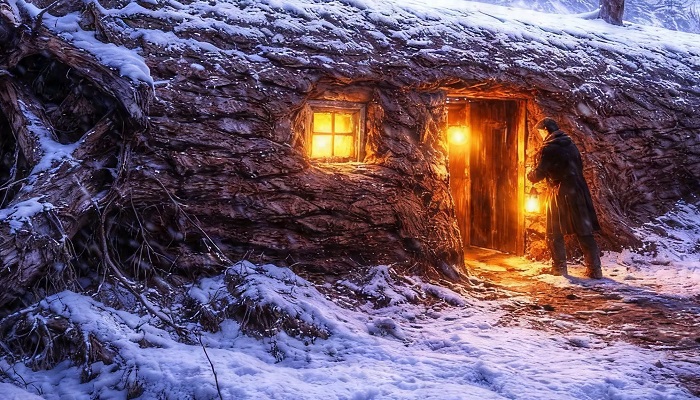
She had built it from salvaged planks and bracing cut from smaller pine.
It was narrow but solid, sized to the opening she had finally won through the trunk.
A thin length of stovepipe protruded up through the top of the log at a slight angle.
On the far side, opposite the door, a small window opening had been cut and fitted with a miraculous little pane of glass she’d found intact at an old dump site behind a half-collapsed mining shed.
The sight of that glass had nearly made her weep when she found it.
Light.
A way for light to live inside the trunk.
Thomas reined in and simply stared.
The sunken entry.
The earthen berms.
The fitted door.
The little stack of split wood against the root ball.
The stovepipe.
Everything about the scene should have looked pathetic by conventional measure.
Instead it looked organized.
Intentional.
That unsettled him more than failure would have.
“What is this foolishness?” he asked finally.
His voice carried anger, yes.
But under it ran something less stable.
Confusion.
Alara kept working the hinge pin into place.
“It is my house.”
“You’ve burrowed into the ground like an animal.”
She looked up then.
“An animal with shelter is wiser than a man with opinions and no plan.”
His face flushed.
“You have shamed my brother’s name with this den.”
The accusation was so revealing she almost smiled.
Men like Thomas believed dignity lived in appearance.
In elevation.
In proper walls and proper methods and the kinds of structures other prosperous men would nod at approvingly.
The possibility that a log sunk into the earth might be more intelligent than a clapboard house on piles was not merely offensive to him.
It was destabilizing.
He needed her experiment to be shameful because if it were sensible, then his certainty about the world had a crack in it.
“I have a home,” Alara said. “It is warm, and it is mine.”
She had not yet truly tested the first claim.
Not through deep winter.
But the words felt right in her mouth and she did not retract them.
Thomas snorted.
“You’ll come begging before the new year.”
His horse sidestepped in the cold.
“I’ll remind you of today when you do.”
Then he turned hard and galloped off, back stiff, anger riding with him.
Alara watched until he vanished beyond the scrub pine.
This time his departure did not leave her feeling smaller.
Something in him had changed.
Not softened.
Nothing so pleasing.
But cracked.
He had come expecting to witness delusion.
He had found method.
The distinction bothered him.
That was enough for now.
After that visit she worked with a kind of final concentration sharpened by weather.
The first true snow was close.
The sky had that dry metallic look which in that country often meant a storm choosing where to unfold.
She built the hearth inside.
Small.
Stone-lined.
Tight enough to fit the space and no larger than efficiency demanded.
She ran the stovepipe carefully through the top curve of the log, packing the surrounding opening with clay, stone, and damp earth to discourage any wandering flame from turning her genius into obituary.
She tested the draw repeatedly with tiny fires and scraps first, watching smoke, adjusting the pipe, scraping soot, learning how air moved inside the cavity.
Ventilation became an obsession.
A beautiful shelter that slowly asphyxiates its owner is only a decorated mistake.
So she studied.
The window opening gave cross-draft when cracked.
The doorway, once fitted tight, could still be eased for starting.
The stovepipe pulled better if she fed the fire slightly off center.
She learned how the curved inner wall reflected heat, how the thick mass of the log warmed slowly and then held warmth long after flame subsided.
She scrubbed loose soot from the interior with a stiff brush until the wood beneath showed a rich dark red-brown sheen.
Not polished.
But alive-looking in a way dead wood has no business being.
Mud and moss sealed the doorframe and window edges.
Clay packed around every suspect seam.
A crude bed frame of saplings rose against the far wall, topped with boughs and blankets.
A small shelf.
A peg line.
A low table made from boards balanced on blocks.
Nothing in the room was accidental.
When poverty builds honestly, ornament becomes impossible but order becomes sacred.
Her final act before the storm committed itself was to drag the old canvas tent over the upper arc of the log, securing it where she could and weighting it with stones and lashings.
It looked absurd.
A ragged skin over the dead pine.
But she knew what she wanted from it.
An extra windbreak.
A surface to catch and hold snow rather than let it scour away.
She was beginning to trust snow as material, not enemy.
That trust felt almost wicked.
Then the weather turned and proved her right.
The first heavy fall came at night.
Alara woke inside the finished pine house to a muted world.
The usual outdoor sounds had changed.
The small groan of branches.
The little scrape of loose things in wind.
The distant hiss of brush.
All of it had been muffled.
She opened the door carefully and found the sunken entry transformed into a white-sided trench.
Snow had piled above the berms and over much of the log’s back.
The whole structure looked smaller, lower, hidden.
She stood in the doorway with cold hitting her face and felt a rising thrill so fierce it bordered on laughter.
It was working already.
Not the heat yet.
Not the full test.
But the shape of the land around her house had changed exactly as she hoped.
The snow lay against the earthworks and the tented curve of the trunk like a blanket being tucked in.
She spent that day cutting a cleaner path from door to yard and then, at dusk, lit the stove properly for the first long trial.
The little room changed by degrees.
At first the fire only glowed and breathed.
Then the pipe warmed.
Then the stone hearth began giving off a grounded, mineral heat.
The inner wall of the log caught the warmth next, not with the immediate blast of a metal stove in an empty room, but with a slower, deeper response.
The space around her softened.
The chill receded from the floor.
The air thickened pleasantly.
By an hour in, the whole cavity held warmth instead of simply containing a fire.
That distinction nearly undid her.
Alara sat on the edge of her bed with both hands wrapped around a tin cup of hot broth and watched the light from the stove move along the curved pine walls.
Outside, snow collected in silence.
Inside, she was warm.
Not tolerably less miserable.
Warm.
The realization came over her in stages, each one harder to trust than the last.
She was not shivering.
She did not need the blanket around her shoulders.
Her feet, which had been cold so long they had become background suffering, were comfortable.
When she banked the fire later and lay down, the heat remained.
The walls held it.
The earth held it.
The little room settled into a kind of deep-bodied comfort unlike any drafty house she’d ever known.
She slept through the night for the first time since Liam died.
Winter arrived not as a season that year but as campaign.
An invasion.
The valley later called it the Great Freeze because ordinary words for bad weather seemed too small to contain what actually happened.
It began with snow.
Not picturesque snowfall.
Not festive white.
A week of relentless accumulation that buried roads, erased fences, and made every building look reduced beneath a single hostile intention.
Drifts rose four feet deep in open places and much higher where wind had room to gather itself.
Then the temperature fell.
Down past zero.
Down past ten below.
Then farther still.
The air itself seemed to acquire edges.
Breathing hurt.
Metal burned skin.
Water froze in buckets set too near a door.
Stables became danger zones.
Animals exhaled crystals.
Trees snapped at night with gunshot reports as sap and fiber surrendered to the cold.
The wind came last, as if waiting for the groundwork to be laid.
Once it arrived, the freeze stopped being severe weather and became siege.
It poured down from the northern peaks with a force that found every weakness in the valley’s proud arrangements.
It shoved snow into every seam.
It stripped warmth from walls faster than fire could replace it.
It taught the region what their houses had never been required to learn before.
How to stay alive under sustained attack.
In town and on outlying farms, people discovered how little protection elevation provided when wind meant murder.
Houses raised proudly on foundations now exposed their undersides to black cold moving constantly beneath them.
Clapboard walls shivered.
Window putty failed.
Attics accumulated fine drifts from snow driven under shingles.
Water barrels froze solid.
Pipes burst.
Livestock died in barns that had always seemed adequate until the season asked them a harsher question.
The wealthy fared better in supplies.
Not always in design.
Two big hearths roaring day and night do little good if the structure around them bleeds heat like a stabbed animal.
Thomas’s farmhouse was among the grandest in the valley.
Two stories.
Proper clapboard.
Stone chimney.
Wide rooms meant to impress.
During the Great Freeze it became a large, expensive icebox.
The wind peeled shingles.
Fine powder snow worked into the attic and sifted down through gaps.
On the fourth day of the deepest cold, the well pump froze so hard the handle had to be beaten free.
On the fifth, a kitchen pipe burst and coated one interior wall in glittering ice while his wife cried from exhaustion and fury.
They retreated to a single room with one hearth and every spare blanket in the house.
Each time Thomas fed more wood into the fire, the room warmed for a little while and then lost the heat again, as if the house itself had been built to betray him in precisely this season.
All across the valley families began burning furniture.
Chairs.
Broken tables.
Crates.
Anything dry enough to answer flame.
Men who had once mocked poor planning with smugness now spoke in clipped voices and chopped at their own bedsteads.
Conventional wisdom, as it turned out, was drafty.
In the ground pine house, Alara was warm.
The snow that had made roads vanish and town people curse into their scarves became her finest ally.
It piled over the tented back of the log and against the earthen berms in thick white drifts, sealing the structure under an insulating blanket.
The wind that attacked every raised wall in the valley passed overhead and broke uselessly over the lip of her sunken entry.
The earth beneath and around the house held its quieter temperature, neither warm like a fire nor murderous like air, but steady.
The massive body of the pine, once heated by the little stove, stored warmth with astonishing fidelity.
The room never flashed hot and then failed.
It eased into comfort and stayed there.
Alara fed the stove with a few good pieces each day and marveled at how little the house demanded in return for the protection it gave.
The temperature inside never dropped low enough to trouble her bones.
She could move with bare hands.
Sleep without wrapping herself like freight.
Read by tallow lamplight.
Mend clothes.
Cook stew.
Listen to the storm as though it belonged to a world one wall farther away than it had any right to be.
At first she distrusted the comfort.
Woke in the night expecting to discover the warmth had only been accident and would vanish now that the serious cold had settled.
But each time she rose and touched the wall, the wood radiated back a deep, low heat like memory stored in matter.
She began to understand with the clarity of direct experience what she had only guessed during construction.
The house did not merely block the cold.
It disrupted its logic.
The earth moderated what air exaggerated.
The snow insulated what wind meant to expose.
The log’s mass held heat long after the fire’s fiercest phase passed.
She had not built a fragile bubble of comfort against winter.
She had built a thermal arrangement more intelligent than most houses in the valley.
That thought would have sounded arrogant once.
Now it felt factual.
Her daily life settled into winter rhythm.
Mornings began with stirring the coals.
Adding a careful log or two.
Melting snow in a pot if the water bucket needed stretching.
She aired the room briefly when weather allowed, then sealed it again.
She mended worn hems.
Read by lamplight.
Resorted food stores.
Checked the stovepipe.
Cleared the entry trench after heavy falls.
She never used much wood.
That was one of the greatest astonishments.
The forest outside lay unreachable under drifts in many places, and yet the little stack she’d prepared against the root ball lasted because the house refused to waste heat.
Sometimes she would sit with one palm on the wall and one hand near the stove and feel how the room had become a conversation between fire, wood, earth, and snow.
Nothing there was working alone.
That may have been the deepest satisfaction of all.
She had done more than shelter herself.
She had learned to recruit the very conditions everyone else cursed.
The valley called the snow oppression.
Her house called it insulation.
The valley called the earth cold.
Her house used it as ballast and buffer.
The valley called the dead pine ruin.
Her house called it wall, roof, and thermal mass.
That reversal pleased her in a quiet, almost intimate way.
She did not gloat.
There was no audience to gloat for.
But sometimes, while stirring the stew or turning a page or laying another stick into the stove, she would think of Thomas’s face when he said den, and a private smile would come and go.
Outside, the Great Freeze tightened its fist.
Inside Thomas’s house, fear did what cold alone had not.
It stripped him.
Not of wealth.
He still owned more than most.
Not of pride entirely.
That sort of man rarely loses it all at once.
But it hollowed out the easy assumption that better money always meant better safety.
On the fifth night of the worst cold, with his wife wrapped in quilts by the fire and one wall of the kitchen sealed in ice, Thomas sat in his best chair wearing two coats and watched the flames lose ground against the room.
The house groaned.
Wind shoved against the clapboards.
The attic whispered with driven snow.
He thought of Alara.
Not because conscience finally flowered in him.
Not at first.
Because desperation seeks comparison.
He pictured her tent flattened, or her body frozen in the burrow she had carved into the pine, and the thought brought with it a sharp ugly emotion that felt almost like relief.
Surely someone must be worse off than he was.
Surely the world still obeyed the logic he had spent his life trusting.
Then another thought followed.
What if she was dead and he had left her to prove him right.
That was when guilt entered.
Not noble guilt.
Not immediately.
A sour, unwelcome thing.
Duty draped itself over it soon enough, because men like Thomas prefer motives that preserve self-respect.
He would go check on her.
He would make an effort, as her last living relation.
If she were dead, he would at least know.
If she were alive, well, then perhaps he could force her back to sense before the weather finished what stubbornness began.
The lie he told himself most successfully was that he was going because it was right.
The harder truth under it was simpler.
He wanted to see somebody more miserable than he was.
He needed evidence that the hierarchy of his beliefs still held.
The morning he left, the storm had not eased.
Visibility came and went in white confusion.
The wind hit like something physical.
He dressed in layers of wool and oilskin until movement felt stiff and slow.
His wife begged him not to go.
He answered with irritation because fear sounds like weakness in some men’s ears, especially when it echoes their own.
The journey of two miles took nearly three hours.
The world between his farm and Alara’s tract had become a churn of white without depth or direction.
Fence lines vanished.
Ditches disappeared.
He navigated by memory and by the barely visible dark line of trees that marked the far edge of her land.
Twice he stumbled nearly to his knees in drifts deeper than they looked.
Once the wind took his breath so completely he had to lean against a buried boulder and wait for his chest to stop spasming.
By the time he reached the property he was half convinced there would be nothing to find.
No tent.
No door.
Just one more drift among many with a widow under it and a story he would hate telling later.
Then he saw the smoke.
So slight he almost mistook it for wind-driven snow.
A thin gray thread rising from what looked at first like nothing but a mound.
He stopped.
Stared.
Looked again.
There.
A stovepipe.
Nearly buried.
A line of smoke steady as prayer.
Her house had disappeared into the landscape so completely that without that one sign he would have walked past it.
The realization struck him strangely.
Even before he reached the door, the shape of the thing insulted everything he believed a house should be.
A buried log.
A sunken entry.
Snow used as roof.
No proud lines.
No proper elevation.
No display of permanence.
And yet it was the only structure he had seen that morning not obviously losing a fight.
He stumbled down the trench to the door with snow up to his thighs and hammered on the wood with a gloved fist.
“Alara!”
The wind shredded the name.
He pounded again.
Part of him expected silence.
Part of him was already preparing to shoulder the door open and confront whatever frozen testimony lay beyond it.
Instead the latch lifted.
The door opened inward.
Warm air rushed out.
Not a weak relative warmth.
A real one.
Deep.
Pine-scented.
Carrying with it the smell of stew and dry wood and human habitation so complete it struck him like a blow.
Alara stood framed in lamplight.
She wore a simple wool dress.
No shawl.
Her cheeks held color.
She was not huddled.
Not shivering.
Not even startled in the way he expected.
Only watchful.
Calm.
Thomas stared at her and then past her.
The room inside glowed.
Curved walls of dark pine.
A small stove radiating steady heat.
A bed.
Pots hanging neatly.
The sort of order found only where a person is not merely surviving, but fully inhabiting.
For a moment his mind refused the evidence.
His own large house was failing.
Her hole in a dead tree was comfortable.
The contradiction was too complete.
He could not fit it anywhere inside the world as he had arranged it.
“How?” he said.
It came out hoarse, almost childlike.
That single word contained all the collapse he could manage at once.
How was there warmth here.
How had she built this.
How had she done what he called madness and made it wiser than his best sense.
How had his proper house become a trap while her buried den became sanctuary.
Alara did not answer immediately.
She stepped aside.
That was all.
No triumph.
No speech about his earlier offer.
No demand for apology before mercy.
She simply made room.
He went in at once.
Any pride he still had could not survive another thirty seconds in that wind.
She closed the heavy door behind him and the storm vanished.
Not completely of course.
Its sound remained, muffled somewhere beyond wood, snow, and earth.
But the direct violence of it ceased.
Silence and heat enclosed him.
Thomas stood in the center of the room while meltwater dripped from his coat hem onto the stone floor.
He began removing gloves, scarf, outer coat, each layer stiff with cold.
His fingers trembled so badly he struggled with one cuff.
Alara said nothing.
She moved a pot slightly closer to the stove and then back again, minding the fire, giving him the dignity of not being stared at while he recovered enough sensation to feel ashamed.
He looked around.
Really looked.
The curved interior walls were scrubbed and warm to the touch.
He found himself placing a palm against one as if needing proof.
The wood radiated back stored heat.
The floor was stone and packed earth, clean and dry.
No draft touched his ankles.
The little window, half shuttered against the storm, admitted a gray-white hint of day without leaking obvious cold.
Everything in the room had been arranged for function.
Nothing superfluous.
Nothing wasteful.
Everything thought through.
His bewilderment deepened into something more difficult.
Recognition.
He had called it a grave because he could not imagine shelter that did not resemble his own idea of status.
He had mistaken unfamiliar intelligence for desperation.
The error was standing around him in warm curved walls.
Alara ladled stew into a bowl and set it before him on the small table.
He took it without knowing what to say.
The smell alone nearly undid him.
Warm broth.
Beans.
A little salt pork.
On the walk over he had thought less about guilt than about getting back before losing toes.
Now, inside the pine house, the immense bodily relief of heat and food made all other considerations rush back behind it.
He ate too quickly at first, then slowed because the motion hurt his thawing hands.
Only after several minutes did he realize Alara had not sat.
She was tending the stove, checking something near the pipe, moving through the room with ease born of knowing every inch of it.
“How did you keep it warm?” he asked again, softer.
This time she answered.
“I stopped fighting the weather the way other houses do.”
He frowned, still thawing, still trying to drag understanding into himself.
She gestured lightly toward the walls.
“The log is thick. Once the stove warms it, it holds heat. The earth around us does the same. The snow on top keeps the wind off and seals in warmth. I sit below the worst of the cold, not above it.”
He looked around again, more carefully.
Below the worst of the cold.
The phrase sounded offensive to his upbringing and undeniable to his skin.
“This should be damp,” he said after a moment.
“It isn’t.”
“The stone floor helps. The venting helps. The fire is small but steady. I let air move where it ought and stop where it should not.”
The simplicity of her explanation somehow deepened the humiliation.
He had expected, perhaps, wild luck.
Some impossible quirk.
Instead what she described sounded like observation applied patiently.
He had not been beaten by miracle.
He had been corrected by thought.
He set the empty bowl down.
For a long moment only the stove crackled.
Then Thomas said, still looking at the wall rather than at her, “I came expecting to find you dead.”
“Yes,” Alara said.
Not angry.
Not forgiving.
Just yes.
The plainness of it struck him harder than accusation.
There it was.
Laid out without fuss.
The exact measure of what he had thought and what it said about him.
He swallowed.
“I was wrong.”
This, from him, was not nothing.
It was also not enough.
Alara knew that.
Thomas knew it too.
The room held that knowledge easily.
At last he managed to look at her directly.
“You should have sold.”
“To you.”
He flinched at how cleanly she answered.
“I was offering what I thought fair.”
“No,” she said. “You were offering what you thought I would accept because I had no better idea.”
He had no defense ready for that, because it was true in a way truth often is when it has not been phrased aloud before.
He tried another path.
“I thought the land ruined.”
“It was ruined for the kind of use you know.”
The sentence stayed with him long after.
Ruined for the kind of use you know.
Not ruined entirely.
Only ruined within the limits of his imagination.
He stayed an hour.
Perhaps two.
Long enough for his hands to stop aching and his thinking to begin again.
Long enough to realize that the room did not overheat either.
The warmth held steady.
The stove demanded little.
No savage feeding.
No frantic battle.
The house behaved less like a besieged structure than like a body at equilibrium.
Before he left, Alara wrapped a bit of bread and a portion of stew in cloth for the walk back.
He tried to refuse.
Some last twitch of pride.
She said only, “Take it or go hungry halfway home.”
He took it.
At the door he paused.
Snow glowed pale outside.
The wind still screamed above the trench.
“Why did you let me in?” he asked.
Alara’s expression did not change.
“Because cold is not corrected by revenge.”
He stood there a second longer, unable to respond in a way that would not diminish him further.
Then he stepped back out into the blizzard and climbed toward the white world above.
The story of his visit did not stay private.
Such things never do.
A man can conceal his shame only until it intersects with somebody else’s survival.
His wife knew.
Then Silas knew.
Then the blacksmith’s wife.
Then the town.
By the time the Great Freeze loosened in late winter, people were no longer laughing about the pine woman or the mole.
They were speaking of Alara of the pine in tones altered by cold, awe, and the specific humiliation of having spent months in proper drafty houses while she remained warm under snow in a dead tree.
When thaw came, it did not feel triumphant.
It felt exhausted.
The valley emerged damaged and chastened.
Collapsed sheds.
Lost animals.
Warped floors.
Split pipes.
Families calculating what winter had cost in furniture, feed, and fear.
Roads returned in mud and slush.
The earth reappeared in patched browns and grays like a body after bandages are removed.
Silas came first.
Not out of pity this time.
With bread under one arm and a jar of honey in the other.
He stood at the edge of the property with his hat in his hands like a man approaching church.
“May I see it?” he asked.
Alara considered him a moment, then nodded.
Inside, Silas moved slowly, taking in the walls, the stove, the vent, the low bed, the way the room held heat even in early spring chill.
He touched the wood.
Studied the pipe seal.
Knelt to inspect the stone floor.
Then he stood again and let out a slow breath.
“I’ll be damned,” he said.
There was no mockery in it.
Only respect strong enough to sound almost reverent.
“You didn’t build on the land. You partnered with it.”
The phrase pleased her because it named the thing better than any technical description she had been carrying in silence.
Partnered with it.
Yes.
That was exactly what the valley had failed to do while trying to dominate every season as if weather were insult that could be shouted down.
Silas became her first convert in earnest.
After that came others.
A widow whose shack had barely survived.
A family with three children and no money for milled lumber.
A man embarrassed enough by his own winter panic to ask practical questions instead of offering advice.
They came first out of curiosity.
Then out of genuine need.
The mockery curdled into attention.
Attention became respect.
Respect became exchange.
People brought Alara food, tools, and cloth not as charity but as payment for what she knew.
That mattered to her more than any apology could have.
She did not want pity revised into admiration if both still left her beneath the exchange.
She wanted recognition that intelligence lived here.
That labor lived here.
That the thing everyone had called madness had been method all along.
Thomas came once in spring, hat in hand.
He did not apologize well.
Men raised to believe authority and manhood are the same thing rarely do.
But he stood at the edge of the berm and said, “I have told people you kept me from freezing.”
It was as close to public correction as he perhaps knew how to make.
Alara answered, “I kept you warm because you were cold. The rest is yours to do.”
He nodded, took the rebuke, and left.
Thereafter he spoke less carelessly around her and never again referred to the house as a den.
Sometimes that is all reform amounts to.
Not repentance.
Constraint.
Still, word spread farther than either of them.
The ground pine house, as Silas named it, became a pattern.
Not for the rich.
Not for the proud.
But for those on bad land, thin money, or the margins of accepted respectability.
Alara taught what she had learned.
How to choose a sound deadfall.
How to test whether wood was too rotten or too split to hold.
How to cut a cavity by controlled burn without turning the whole thing into ash.
How to sink an entry below the wind.
How to use earth berms.
How to vent a stove so smoke left and heat stayed.
How to think of snow not only as enemy but as insulating mass if guided and held.
She taught with the patience of somebody who remembered being dismissed.
That memory made her exact.
Not cruel.
Exact.
If a man asked foolishly, she answered plainly.
If a widow asked fearfully, she demonstrated by hand.
If someone came only to gawk, she sent them away with chores or silence.
The method spread because it worked.
Not universally.
No design fits every terrain.
But in rough country with deadfall, earth, and little money, the principle changed lives.
Use what the land has already offered.
Stop insisting shelter look respectable before it is allowed to save you.
Read wind.
Read ground.
Read snow.
Read material not by habit, but by behavior.
All that knowledge had been available before Alara.
The land had always held it.
She had simply been desperate enough to hear what convention was too proud to notice.
The years after the Great Freeze altered her life without softening it into fantasy.
She did not become wealthy.
The ground pine house did not transform into a manor.
The land remained rocky.
The scrub pines still grew mean and sparse in places.
The creek still required hauling.
Hardship did not disappear because one winter had been won intelligently.
But the nature of her life changed.
She was no longer the widow nearly erased by debt.
She was no longer a local joke attached to a bad tract.
She became a person people sought for counsel.
A builder of strange efficient shelter.
A woman whose eye for land sometimes proved better than the maps and opinions of men with larger acreage.
The ten acres slowly improved under attention.
A better path.
A shed for wood.
A small garden in the patch of best soil beyond the giant’s shadow.
Later a lean-to and smoke rack.
The root ball itself, once only ruin, became support for storage and windbreak.
Moss grew over sections of the log’s back where the tenting had once lain.
Wildflowers later took the berms in spring.
From a distance the house looked less and less like a construction and more like a fold in the land.
A hillock.
A creature asleep.
Something natural enough to be overlooked by people who only recognize homes when they stand where homes are expected to stand.
Children visited in later years.
First cautiously.
Then eagerly.
Grandchildren of the same families who had once let their sons shout mole woman from the road.
They arrived carrying eggs or apples or questions and stared with bright reverence at the curved pine walls and the low warm room where a person could sit through the worst cold in the valley and not feel it.
Alara told them stories sometimes.
Not grand moral tales.
Practical stories.
How to listen for wind before you see it.
How to know when snow is dry enough to insulate well and when it means trouble.
How dead wood can still serve if you understand its condition.
How the earth keeps a steadier bargain than air.
Some of them remembered.
Some did not.
That is the way of quiet knowledge.
It never travels as dramatically as stupidity, but it lasts longer.
She never remarried.
People suggested it in the early years, then with decreasing confidence as it became clear that Alara had built not just a house but a life that did not require being folded under another person’s authority to count as complete.
She had loved Liam.
That remained true.
But widowhood, once it ceased being pure deprivation, revealed other truths too.
Solitude could be full.
Self-sufficiency could become companionship of its own kind.
There was deep peace in belonging to a place because you had learned it, answered it, and been answered by it in return.
The ground pine house aged with her.
The wood darkened and mellowed.
The berms softened under roots and time.
The stovepipe changed more than once.
The little window was replaced after a storm years later cracked the first pane.
The entry trench was improved with better stone.
The inside gained shelves, then a second chair, then a chest.
Nothing grand.
Everything earned.
Visitors increasingly referred to the house not as odd but as wise.
That amused Alara, because wisdom and madness often spend a long while wearing each other’s coats in the eyes of a community.
It takes one good disaster to make people sort the garments correctly.
Thomas grew older too.
Wealth did not spare him from the slow stiffening that takes men who once rode hard and assumed that counted as immortality.
He and Alara never became close.
Some wounds lose heat without ever fully closing.
But in later years he sent people her way when they were poor, desperate, or dismissed.
“Go ask Alara of the pine,” he would say.
If he heard himself in that and winced, it was his own education continuing.
Silas remained a faithful friend.
The first man in town to understand that what she had made was design, not delusion.
He liked to tell newcomers the story in terms that pleased her more than the sensational versions others favored.
Not that she had hidden in the ground like a frightened thing.
That she had seen what the land and dead timber could do if someone stopped trying to turn them into something else.
“You all thought the giant pine was the tragedy,” he would say, standing in his store with his thumbs in his suspenders. “Turned out it was the house waiting to be noticed.”
That line traveled.
People like lines that reveal they were fools as long as they are allowed to enjoy the cleverness of the correction later.
Alara’s life became one of those local stories that start as gossip, pass into weathered anecdote, and then settle into the foundation myths of a place.
The widow who built a home in a fallen pine.
The woman who stayed warm through the Great Freeze while wealthier houses turned to iceboxes.
The stubborn one who proved that the earth whispers better lessons than pride.
Children heard it.
Then their children.
With each telling the story gathered some embroidery, as all stories do.
A few swore her house never dropped below summer warmth no matter the weather.
Others said foxes slept on the berms because the heat from within made the ground sweeter.
One man claimed the giant pine had fallen on purpose in anticipation of her need, which was nonsense but sincere nonsense.
The truth remained enough without embellishment.
A woman with no money, no proper house, and no permission from her community had looked at a crater and a dead tree and seen not failure but architecture.
Then she had worked until the world had to admit she was right.
In old age she still ran a hand over the inner curve of the wall sometimes and remembered the first charred chips coming away under the adze.
The days of raw palms and empty stomach and terrifying little progress.
The cold canvas tent.
The boys shouting from the road.
Silas saying grave.
Thomas saying den.
All of it.
Memory did not make those days easier in retrospect.
It made the present room feel deeper.
As if every inch of the wood around her retained not only heat but labor.
That may have been why the house always felt more alive to her than any conventional room she had ever rented or borrowed.
It had been argued into being.
Not purchased.
Not bestowed.
Argued.
With weather, with material, with poverty, with mockery, with grief.
No wonder it held so firmly.
In the end that was what the valley understood, if only in fragments.
The most profound wisdom had not arrived from books or rich men or approved building plans.
It had come from necessity sharpened by close observation.
From a woman too cornered to afford the vanity of conventional failure.
From listening where other people only looked.
People spoke often about courage when they spoke of Alara, and they were not wrong.
It takes courage to begin work everyone calls insane.
To keep cutting after your hands split.
To keep imagining warmth while wind attacks everything in sight.
But another quality mattered just as much.
Humility.
Not the humility towns like to demand of widows and the poor.
Not bowed-head obedience.
The humility to let the land teach you on its own terms.
To stop insisting it become what you were told it should be.
To accept that a hole, a dead tree, a mound of snow, and a wall of dirt might know more about surviving winter than a man in a big house.
That lesson changed more than one structure in the valley.
It changed the way some people looked at ruin.
What one person discards as failure may only be material waiting for another way of seeing.
A deadfall may be a beam not yet understood.
A crater may be a windbreak with no proper name yet.
A widow may be an engineer the town cannot recognize because her tools are covered in soot instead of credentials.
A quiet refusal may turn out stronger than every booming certainty around it.
Long after Alara was gone, the ground pine house remained part of local memory as more than a curiosity.
It became a standard whispered to those living on thin margins.
You do not always need more money first.
You need to read the place better.
You need to ask what the land is already offering before you insist on what it lacks.
You need to understand which ideas are truly foolish and which only look foolish until the weather tests them.
That was the legacy that mattered.
Not romance.
Not mythology.
Method.
Partnership with place.
The woman herself, if asked late in life what made her trust such an outlandish plan, would sometimes answer with a small smile, “I was too poor to afford the usual mistakes.”
That line always made people laugh.
Then think.
Because beneath the wit lay the whole truth.
She had been denied the luxury of building wrong in an expensive, respectable way.
So she had been forced into accuracy.
Forced to pay attention.
Forced to make every choice answer directly to winter instead of reputation.
That is how wisdom sometimes enters the world.
Not as enlightenment.
As pressure.
As the stripping away of every decorative error until only what works is left.
Her story endured because the reversal was too satisfying to forget.
The thick prosperous brother-in-law offering fifty dollars for “ruined” land.
The town whispering about the widow gone strange.
The children yelling mole from the road.
Then the Great Freeze arriving like judgment.
Big houses cracking.
Proper rooms going bone-cold.
Families burning furniture.
And out there on the mocked tract at the edge of the territory, the woman inside the dead pine reading by lamplight in her shirtsleeves while snow buried the roof and wind flew harmlessly overhead.
Nothing in that valley ever entirely recovered from the humiliation of that comparison.
Nor should it have.
It was useful humiliation.
The kind that loosens arrogance enough for learning to enter.
When the cold became legend, so did the woman who never felt it.
And if the story still traveled in the years after, passed from porch to store to campfire to grandchild’s memory, it was because it carried more than novelty.
It carried instruction.
That the earth is not always the enemy people call it.
That depth can be warmer than height.
That ruins are often only structures waiting for a different question.
And that the quiet courage to look foolish while building something true can outlast every confident man who told you it could not be done.
Alara had stood on ten acres of rock, scrub, and broken hope and seen a fortress in the hole and the deadfall.
Then she had made that vision answer to winter.
The world called it madness right up until the freeze came.
After that, it called it wisdom.
The house remained what it had always been.
A giant fallen pine.
A crater.
Earth, snow, wood, heat, and one woman’s refusal arranged correctly.
But once a community has been saved from its own certainty, it begins naming such arrangements with more respect.
They stopped saying den.
Stopped saying grave.
Stopped saying poor widow’s folly.
They said ground pine house.
They said Alara of the pine.
And when the weather turned cruel in later winters and fear began tapping at people from inside their own walls, many of them thought of the woman who went down instead of up, who burrowed rather than boasted, who partnered with the land instead of trying to stand above it, and who spent the worst freeze anyone remembered in a warm room carved from the body of a dead tree.
That was the true ending.
Not Liam’s death.
Not the creditors.
Not Thomas’s offer.
Not even the blizzard at the door.
The true ending was slower and stronger.
A woman nearly erased by debt and grief refusing to be swept off the map for fifty dollars.
A ruined tract becoming a place of instruction.
A monument to failure becoming the cornerstone of a new kind of shelter.
A valley learning, too late but not entirely too late, that what looks like wreckage to one eye may look like salvation to another.
And beneath snow, in the curved dark-red glow of old pine warmed from within, Alara learned something no creditor, no brother-in-law, and no gossiping town could ever again take from her.
She had not simply survived what was meant to finish her.
She had built the place from which survival became peace.