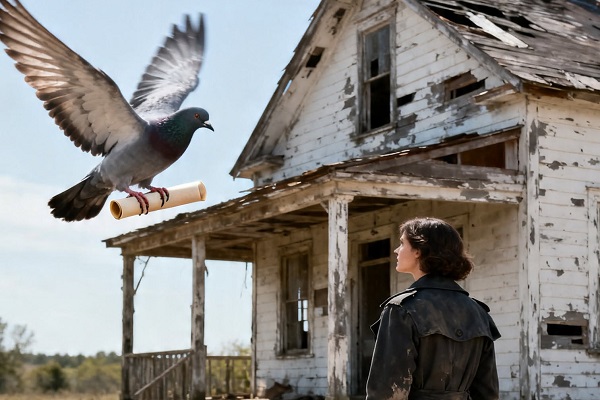
Widowed and Homeless, She Bought an $8 Pigeon Loft — Then the Last Bird Came Home Carrying the Secret That Buried a Town
The first thing Maren Cole’s brother-in-law did after her husband’s funeral was hand her a trash bag and tell her she had until sundown.
Not a suitcase.
Not a cardboard box.
A black kitchen trash bag, the kind with a red plastic drawstring, still smelling faintly of lemon bleach and last night’s coffee grounds.
“Don’t make this ugly,” Grant Cole said, standing in the doorway of the farmhouse Maren had painted, repaired, warmed, and loved for eleven years. “Eli left the property to the family trust. That means not you.”
Maren looked past his shoulder.
The porch light was still on though it was noon. Eli had always forgotten to turn it off.
Behind Grant, his wife Darlene held Maren’s winter coat folded over one arm like she was returning a rental.
Maren did not scream.
She did not drop to her knees.
She did not beg the people who had smiled at her over casserole dishes three days earlier, who had hugged her at the church, who had cried into folded napkins while saying Eli was “the best of all of us.”
She only reached for the trash bag.
Grant’s mouth twitched.
Maybe he expected tears.
Maybe he wanted them.
Maren gave him something else.
She gave him silence.
The kind that made people hear themselves.
She walked through the house once.
Not slowly.
Not dramatically.
Just once.
In the bedroom, she took Eli’s old denim jacket from the chair. The left cuff still had a crescent-shaped grease stain from the tractor repair he never finished.
From the dresser, she took her wedding ring box, though the ring was on her finger. Inside the box was a folded motel receipt from their first trip to Duluth, kept because Eli had written on the back:
We made it this far. We’ll make it farther.
From the kitchen, she took the chipped white mug with the blue heron painted on it.
Darlene cleared her throat behind her.
“The dishes belong to the house.”
Maren turned.
Darlene’s cheeks flushed.
Maren set the mug down in the sink.
Then she opened the junk drawer, took one thing, and slid it into her coat pocket.
A brass key.
Small.
Tarnished.
Tied to a strip of faded green ribbon.
Darlene did not notice.
Grant did.
His eyes flicked to Maren’s pocket for half a second.
Not enough for a stranger to catch.
Enough for a wife who had learned, over eleven years of marriage, that every lie entered a room before the liar did.
“What was that?” Grant asked.
Maren tied the trash bag closed.
“Something Eli gave me.”
Grant stepped closer.
His boots squeaked on the clean kitchen tile.
“Eli’s things stay with Eli’s family.”
Maren looked at his hand.
He had Eli’s watch on his wrist.
Three days after the funeral.
Three days.
The skin around Maren’s wedding ring tightened.
“Then maybe you should take that off,” she said.
Darlene made a soft shocked sound.
Grant’s face hardened.
For the first time since morning, grief cracked open into something cleaner.
Anger.
Grant grabbed the trash bag and shoved it into Maren’s chest.
“Get out.”
Maren caught it.
She did not stumble.
Outside, January wind slid under her collar and bit the back of her neck.
The town of Briar Glen, Pennsylvania, looked exactly as it had the morning Eli died.
The feed store sign still swung over Main Street.
The courthouse clock still ran four minutes slow.
The old water tower still carried the faded blue slogan:
BRIAR GLEN BUILDS TOGETHER.
Maren almost laughed at that.
Together.
Grant followed her onto the porch and tossed Eli’s denim jacket after her. It landed in the frost beside her boots.
The sleeve opened like an arm reaching.
Darlene stepped out with a small cardboard shoebox.
“Wait,” she said.
For one foolish second, Maren thought there might be mercy in her.
Darlene handed her the box.
Inside were three cans of soup, one toothbrush still in plastic, and a church bulletin from the funeral.
“We don’t want people saying we left you with nothing,” Darlene said.
Maren closed the lid.
Across the road, Mrs. Albright’s curtains moved.
On the far side of the drive, Grant’s son Trevor leaned against his truck, filming with his phone.
Maren saw the little red dot.
Recording.
Of course.
A homeless widow.
A family dispute.
A little local entertainment for people who bought pies at church and whispered like prayer was a weapon.
Maren picked up Eli’s jacket.
She carried the trash bag in one hand, the shoebox under her arm, and walked down the long gravel driveway.
The stones crunched under her boots.
Halfway to the road, Grant called after her.
“And don’t come back asking questions.”
Maren stopped.
Just for a moment.
Not long enough to satisfy him.
Then she kept walking.
Because she had heard the warning inside the sentence.
Not don’t come back.
Don’t ask questions.
By nightfall, she was living in her car behind the closed laundromat on Wicklow Road.
By morning, the town had decided she was unstable.
By Wednesday, someone had written Poor Grant in the comments under Trevor’s video.
By Friday, Maren Cole had thirty-six dollars, one black trash bag, one dead husband, one brass key, and no home.
On Saturday, she bought the pigeon loft.
It happened at a county auction behind the old firehouse, where men in seed caps gathered around folding tables and women inspected cracked furniture with the suspicious care of jewelers.
Maren went for warmth.
The firehouse basement had coffee.
That was all.
She stood near the back with her hands around a paper cup and listened while the auctioneer moved through lawn tools, taxidermy, broken bicycles, a slot machine with no cord, and a maple dresser missing two drawers.
Then two men dragged in a strange wooden structure on caster wheels.
Six feet tall.
Eight feet wide.
Gray with weather.
Wire front.
Tiny doors.
Perches.
A slanted roof patched with red metal.
The room groaned.
“What is that thing?” someone asked.
“Pigeon loft,” the auctioneer said. “From the old rail depot. Been in storage since God wore short pants.”
A few people laughed.
Maren did not.
She had seen it before.
Not this exact loft, maybe.
But one like it.
In Eli’s stories.
“My grandfather kept homing pigeons for the rail office,” he had told her once, half asleep, rain ticking on the roof. “Before phones reached every hollow. Before people trusted wires. He said a bird could carry truth faster than a liar could run.”
At the time, she had smiled.
Now the words sat up inside her.
A bird could carry truth.
The auctioneer slapped the roof.
“Who’ll give me twenty?”
Silence.
“Ten?”
A boy near the front snickered. “Eight bucks.”
The auctioneer pointed. “I got eight.”
No one raised a hand.
Maren heard Darlene’s voice in her memory.
The dishes belong to the house.
She heard Grant.
Don’t come back asking questions.
She heard Eli on their last morning, two hours before the crash, standing by the sink with snow in his hair, saying, “If anything happens, don’t trust the first paper they show you.”
She raised her hand.
The auctioneer blinked.
“Eight to the lady. Do I hear nine?”
No one spoke.
Trevor Cole, standing by the tool rack with two friends, lifted his phone again.
Maren looked straight at him.
He lowered it first.
“Sold,” the auctioneer said, “for eight dollars.”
The room laughed harder than before.
Maren paid with a ten and took two singles back.
The auctioneer gave her a paper slip and a look that was almost pity.
“You got a truck?”
“No,” Maren said.
“Place to put it?”
“No.”
He looked at the loft.
Then at her.
“Might be easier to leave it.”
Maren folded the receipt and tucked it beside the brass key.
“I’ve already left too much.”
That night, she slept inside the pigeon loft.
Not comfortably.
Not safely.
But dry.
A mechanic named Roy Decker, who owned the tow yard behind the firehouse, let her roll it under a lean-to by the fence after Maren offered to sweep his office and organize invoices.
Roy was seventy, blunt, and shaped like a refrigerator.
“You planning to live in there?” he asked.
“No,” Maren said.
He stared at the blanket under her arm.
“Good. Because that’d be illegal.”
She stared back.
Roy sighed.
“Don’t run a heater. You’ll burn it down.”
He came back ten minutes later with a wool blanket, a flashlight, and an unopened pack of peanut butter crackers.
“Found these,” he said.
“In your office?”
“In my conscience.”
He left before she could thank him.
Maren crawled inside the loft through the service door and pulled Eli’s jacket around her shoulders.
The wood smelled like dust, feathers, and old rain.
Moonlight crossed the wire in pale squares.
There were names carved into one inside beam.
Not big.
Not proud.
Small names.
Dates.
Coordinates.
Maren ran her fingers over them.
B. HALL — 1943.
J. WICK — 1944.
M. COLE — 1945.
Cole.
Her breath paused.
Eli’s grandfather had been Martin Cole.
She lifted the flashlight.
Near the back wall, behind a row of cracked nesting boxes, one small door was painted shut.
The brass key in her pocket warmed against her thigh like it had been waiting.
She took it out.
Small.
Tarnished.
Green ribbon.
The lock was no bigger than a postage stamp.
The key went in smoothly.
Not like a guess.
Like a memory.
Maren turned it.
The painted door gave a tiny wooden sigh.
Inside was a compartment no larger than a shoebox.
Empty except for one thing.
A pigeon band.
Tiny.
Aluminum.
Stamped with numbers.
BC-17-409.
And one word scratched into the metal by hand.
JUNIPER.
Maren sat back on her heels.
Outside the lean-to, tires hissed on the wet road.
Somewhere across town, Grant Cole was probably sleeping in Eli’s house.
Wearing Eli’s watch.
Telling people he was protecting the family.
Maren held the tiny band under the flashlight and felt the first small click of a locked machine opening.
Not a full answer.
Not yet.
But a piece.
She slept with the band in her palm.
In the morning, there was a pigeon on the roof.
At first Maren thought she had dreamed it.
A soft scratch.
A flutter.
A round shadow blocking the gray light.
She pushed open the service door.
The bird stood on the patched red roof, dark gray with a white face and one missing toe.
It looked down at her as if she were late.
Maren slowly sat up.
The pigeon tilted its head.
On its left leg was an aluminum band.
Maren’s mouth went dry.
BC-17-409.
Juniper.
The last bird.
“Impossible,” she whispered.
The pigeon blinked.
Then it hopped down to the wire front and pushed its head through a gap, bold as a creditor.
Maren laughed once.
It came out broken.
She reached for the peanut butter crackers, crushed one in her palm, and held still.
Juniper ate from her hand.
Not greedily.
Not nervously.
Like it had done this before.
Around noon, Roy found her sitting cross-legged in the loft with the pigeon perched on her knee.
He stood outside the wire and squinted.
“Well,” he said. “That’s either a miracle or a health violation.”
Maren held up the band.
“Do you know anyone who kept records on old rail pigeons?”
Roy’s face changed.
Just slightly.
He looked toward Main Street.
Then back at the bird.
“Why?”
“Because this one came home.”
Roy rubbed his jaw.
“Bird like that shouldn’t still be alive.”
“I know.”
“Bands get reused.”
“I know.”
He pointed at the pigeon.
“But you don’t think this one is reused.”
“No.”
Roy looked at her for a long moment.
Then he unlocked the tow yard gate.
“Get your coat.”
They drove to the Briar Glen Historical Society, which was housed in a former dentist office between the bakery and a nail salon.
A bell jingled when they entered.
Behind the desk sat Agnes Bell, eighty-one, sharp-eyed, with silver hair pinned so tightly it looked engineered.
She was labeling photographs with white cotton gloves.
When she saw Maren, she did not smile.
“Maren Cole,” Agnes said.
“Mrs. Bell.”
“I saw Trevor’s video.”
Roy muttered, “Everybody saw Trevor’s damn video.”
Agnes removed her gloves finger by finger.
“I did not enjoy it.”
Maren stood very still.
Agnes looked at the trash bag in Maren’s hand, because Maren still carried her life with her.
Then she looked at Roy.
“What have you dragged in, Roy?”
“A pigeon problem.”
Agnes’s eyes sharpened.
Maren placed the aluminum band on the desk.
Agnes did not touch it.
She stared.
Then she reached under the desk and locked the front door.
The click sounded louder than it should have.
“Where did you get this?” Agnes asked.
“In the old loft from the rail depot.”
Agnes looked at Roy.
“You let her buy that?”
“I’m not her father.”
“No,” Agnes said. “Lucky for her.”
Maren leaned forward.
“What is Juniper?”
Agnes sat back.
For a second, all the age in her face fell away and left only fear.
“Juniper was not a what,” she said. “Juniper was a route.”
Maren’s fingers tightened around the edge of the desk.
“A pigeon route?”
“A message route,” Agnes said. “During the war, yes. Later, after the mines expanded, some people used the birds when they didn’t trust telephones.”
Roy frowned.
“What people?”
Agnes’s mouth flattened.
“People who disappeared.”
The room went quiet.
Outside, a truck passed, rattling the old windows.
Maren heard Eli again.
If anything happens, don’t trust the first paper they show you.
Agnes opened a file cabinet and pulled out a thin folder.
Inside were brittle photographs.
Men beside the rail depot.
A row of pigeon lofts.
A girl with braids holding a gray bird.
A young man with the Cole jawline and Eli’s serious eyes.
Martin Cole.
Agnes tapped the photo.
“Your husband’s grandfather ran the loft. Officially, it was closed in 1952. Unofficially, it stayed active much longer.”
“How much longer?”
Agnes did not answer at once.
She slid another photo forward.
This one showed the Briar Glen courthouse in 1978.
A crowd stood on the steps.
In the corner, half cut off by the camera frame, was a teenage boy holding a pigeon crate.
Under the photo, someone had written:
JUNIPER RETURN — AUG. 14, 1978.
Maren looked closer.
The teenage boy’s face was grainy.
But she knew him.
Younger.
Thinner.
Smiling.
Grant Cole.
Roy swore under his breath.
Maren did not move.
Agnes closed the folder.
“Your husband came here three weeks before he died.”
The words entered Maren softly.
Then landed hard.
“Eli?”
Agnes nodded.
“He asked about Juniper. Asked whether any route led north of town.”
“To what?”
Agnes looked down.
“To the old limestone quarry.”
Maren had driven past the quarry all her married life.
A fenced-off pit two miles beyond the orchard road.
Danger signs.
Teenage dares.
Black water at the bottom.
Everyone knew the quarry was abandoned.
Everyone knew it was worthless.
Everyone knew it belonged to the town.
Maren had learned to distrust sentences that began with everyone knew.
“Why would Eli ask that?” she said.
Agnes slid the folder back into the cabinet.
“I asked him the same thing.”
“And?”
Agnes met her eyes.
“He said he found proof his father didn’t drown there by accident.”
Maren’s throat closed.
Eli’s father, Thomas Cole, had died in 1989.
That was part of the family story.
A drunk fall.
A cold night.
A quarry no one should have gone near.
Eli rarely talked about it.
When he did, his voice went flat, like a door shutting.
Maren remembered once asking Grant about Thomas.
Grant had smiled without warmth.
“My brother liked trouble,” he said. “Trouble finally liked him back.”
Now Agnes’s hands trembled once before she folded them.
“Eli said his father sent a message by bird the night he died.”
Maren looked down at the aluminum band.
“What message?”
Agnes’s voice dropped.
“The bird never came back.”
At dusk, Juniper vanished.
Maren had set the pigeon inside the loft with a cracked bowl of water and seed Agnes had found in a storage bin.
For six hours, the bird stayed.
It pecked.
Slept.
Watched.
Then, as Maren repaired the wire with pliers Roy lent her, a truck backfired on the road.
Juniper shot through the gap and rose into the pewter sky.
Maren ran into the yard.
“No—”
The bird circled once over the tow yard.
Then turned north.
Toward the quarry.
Roy came out of the office wiping his hands.
“What happened?”
Maren was already moving.
“Keys.”
Roy tossed them.
This time, he did not ask why.
The quarry road was narrow and slick with old leaves.
Pines crowded both sides, their trunks black in the winter dusk.
Maren drove Roy’s pickup with both hands on the wheel, jaw set, eyes scanning the sky through the windshield.
The pigeon was a dark fleck ahead.
Then gone.
The quarry fence appeared between trees.
Rusty chain-link.
PRIVATE PROPERTY signs bolted over old town warning signs.
Maren braked.
“Private property?” Roy said. “Since when?”
Maren stared at the sign.
COLE LAND MANAGEMENT LLC.
Her dead husband’s name.
Her stolen home.
Grant’s company.
She got out.
The cold hit hard.
Roy followed.
“Maybe we come back with a lawyer.”
Maren was already at the gate.
The padlock was new.
The chain was new.
But the post was old, rotten where it entered the ground.
She crouched, braced one boot, and pushed.
The post shifted.
Roy looked at her.
“You done this before?”
“I was married to a man who believed every fence told you where to kick.”
Together, they shoved the post sideways until the chain sagged enough to slip through.
Beyond the fence, the road dropped toward the quarry basin.
The air smelled of wet stone and iron.
At the bottom, black water reflected the first stars.
Juniper sat on a broken concrete block near the edge.
Something was tied to its leg.
Maren slowed.
The pigeon watched her approach.
It did not fly.
Her hands were steady when she knelt.
The object tied to the band was wrapped in oilcloth and fishing line.
Old.
Stiff.
Not something attached today.
Something carried.
Something hidden.
Roy whispered, “Dear God.”
Maren cut the line with her pocketknife.
Inside the oilcloth was a roll of paper no wider than her thumb.
Thin.
Browned.
Protected by wax.
She unrolled it carefully against her palm.
The handwriting was cramped and faded.
But readable.
MARTIN,
IF JUNIPER RETURNS WITHOUT ME, TAKE THIS TO HALL OR BELL.
GRANT SAW THE SURVEY.
THE QUARRY IS NOT EMPTY.
THE TOWN SOLD LAND IT NEVER OWNED.
T.C.
Under the initials was a shape.
Not words.
A map.
A crude drawing of the quarry, the rail spur, the creek, and seven marked lots along the east ridge.
Maren knew those lots.
Everyone in Briar Glen knew those lots.
They were not empty.
They were the new houses.
The mayor’s house.
The police chief’s house.
Grant’s second rental.
The development everyone called Ridgeview Commons.
A half-million-dollar neighborhood sitting above a dead quarry.
Roy’s face had gone pale.
“Maren,” he said quietly. “We need to leave.”
But Maren was staring at the last line on the paper.
A line written smaller than the rest.
Almost squeezed in at the bottom.
ELI’S MOTHER HAS THE DEED.
Maren looked up.
Eli’s mother had been dead for twenty-three years.
Or that was what everyone said.
Behind them, at the top of the quarry road, headlights switched on.
One pair.
Then another.
Then a third.
Trucks rolled through the open gate and stopped across the only road out.
Maren folded the paper once.
Only once.
She slid it into the lining of Eli’s denim jacket, through a torn seam near the cuff.
Roy whispered, “How many?”
Maren counted silhouettes.
Five men.
One woman.
Grant stepped into the glow of his truck headlights.
He was wearing Eli’s watch.
Darlene stood beside him, arms crossed, face tight with something that was not surprise.
Grant looked at the broken gatepost.
Then at Roy.
Then at Maren.
His smile was small.
Tired.
Almost disappointed.
“You should’ve left the bird alone,” he said.
Maren stood with the quarry at her back and the last bird perched on the concrete beside her.
The town was above them.
The water was below.
The proof was hidden in her sleeve.
And for the first time since Eli’s funeral, Grant Cole looked afraid.
Not of Maren.
Of what she might already know.
A phone rang in the dark.
Not Grant’s.
Not Roy’s.
Maren felt the vibration against her ribs.
Eli’s old flip phone.
The one she had found dead in his jacket pocket.
The one with no battery.
The one that had not worked since the crash.
It rang again.
Grant’s face changed.
Maren slowly reached into the inside pocket and pulled it out.
The cracked screen glowed blue.
One text message.
No sender name.
Just three words.
DON’T TRUST AGNES.