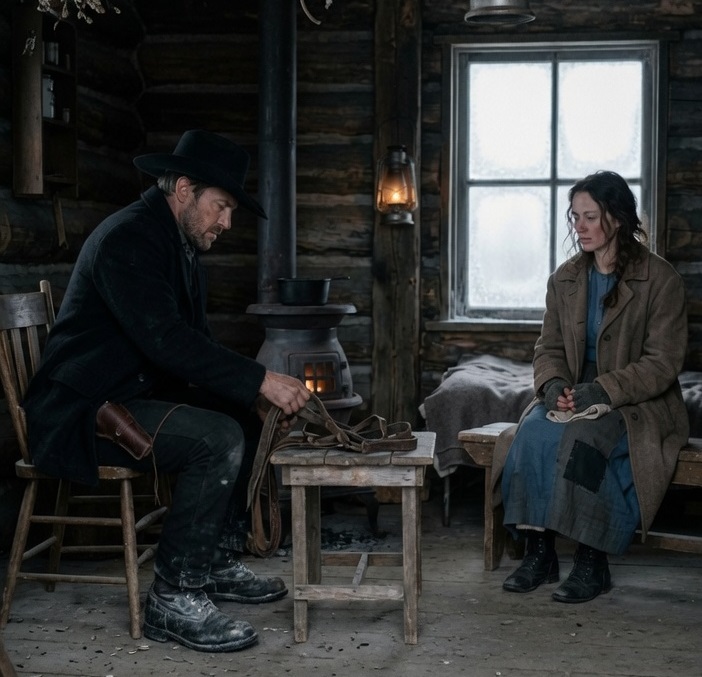
The cowboy didn’t speak when the widow fell into the snow. But the way he reached for his rifle made the whole street go quiet.
Snow hammered the rooftops of Dry Creek as Clara Whitmore struggled to pull her firewood cart through the frozen mud.
One wheel snapped sideways. She hit the ground hard. Her torn glove streaked red against the snow while laughter drifted from the saloon porch.
Then came the metallic click of a Winchester being loaded somewhere behind her. Vernon Whitmore’s smile vanished first.
Mason Reed stood in the storm without a word. Steam rising from his horse as every eye in town turned toward him.
Before we go further, tell me where you’re watching from tonight. The snow had not stopped falling in four days.
By noon the roofs of Dry Creek looked buried alive beneath layers of white ice and drifting powder.
Wind hissed through the narrow streets like something angry moving between the buildings. Horses stood with frost clinging to their mains outside the saloon.
Smoke crawled from chimneys and disappeared into a sky the color of old tin. Then Clara Whitmore leaned her weight against the rope tied to the small wooden sled behind her.
The pile of firewood creaked as she dragged it through the slush-packed street. Her boots were soaked through.
She could no longer feel her toes. Snow gathered on her eyelashes faster than she could blink it away.
People watched her. Nobody spoke. A few turned away the second she looked in their direction.
Near the feed store a little boy stepped off the porch and hurried toward her with both mitten hands stretched out.
Mom, let me help. Before he could reach the rope, his mother grabbed him hard by the collar and yanked him backward.
Don’t! She snapped under her breath. The boy looked confused. Clara just lowered her eyes and kept walking.
The sled caught on a frozen rut. She pulled harder. The wood shifted suddenly. Her boots slipped.
Clara crashed hard onto her knees in the snow beside the sled. A sharp crack of pain shot through her palms.
For a moment she stayed there breathing hard through the cold. Blood slowly soaked through the torn wool gloves wrapped around her hands.
Nobody moved. Across the street the piano inside the saloon kept playing. Clara pushed herself back up and wiped snow from her face with the sleeve of her coat.
The coat had belonged to her husband once. The sleeves hung too long on her arms.
Ethan had been dead six months. Six months since the logging wagon tipped and tipped on Black Ridge Road.
Six months since Vernon Whitmore started telling anyone who would listen that Clara had brought bad luck into the family.
The doors of the saloon swung open. Warm yellow light spilled onto the snow. Vernon stepped outside, laughing with two ranch hands beside him.
Whiskey bottles dangling from their fingers. He spotted Clara immediately. Well now, he called loudly, town’s busiest widow still working herself to death.
A few men standing under the awning chuckled quietly. Clara kept her eyes on the sled.
I ain’t bothering anybody, Vernon. You’re bothering me. He stepped closer, boots crunching through the snow.
That land out near Miller Creek still belongs to my brother’s family. It belonged to Ethan, and Ethan’s gone.
The wind blew hard between them. Clara’s jaw tightened. I’m not signing it over. Vernon grinned, though there was nothing friendly in it.
You can barely feed yourself. What are you planning to do with land buried under six feet of snow?
One of the ranch hands snorted. Clara bent to grab the rope again. Vernon suddenly kicked the sled sideways.
The stack of firewood spilled into the street. Several logs rolled into the slush. Silence fell around them.
Clara stared at the scattered wood for one long second. Then slowly, carefully, she knelt in the snow and began gathering the pieces back into the sled without saying a word.
Vernon watched her. That’s what I thought, he muttered. From the far side of the street, a man stood beneath the overhang outside Mercer’s general store.
Tall, broad shoulders, black wool coat dusted white with snow. Mason reed. He had not spoken once.
Most men in Dry Creek talked too much when they drank. Mason never did. He simply watched Clara kneeling in the snow while the wind pushed loose strands of dark hair across her face.
Then he turned, walked inside the store, and disappeared. Vernon laughed one last time before heading back toward the saloon.
Signed the papers soon, Clara. Winters only getting worse. The saloon doors slammed shut behind them.
Clara finished loading the wood herself. By the time she reached Mercer’s store, her arms trembled from exhaustion.
Old mister. Mercer stood behind the counter, writing figures into a ledger book. The place smelled of lamp oil, coffee beans, and damp wool coats drying near the stove.
Clara carefully placed two small coins onto the counter. Flower, she said softly. Whatever this gets me, Mercer glanced at the coins, then at Clara’s bleeding gloves.
Without a word, he disappeared into the back room. A moment later he returned carrying a sack of flour, coffee, salt, pork wrapped in brown paper, and a small jar of preserves.
Clara blinked. I can’t pay for all that. It’s covered. She frowned slightly. By who?
Mercer shrugged as if it meant nothing. Man already settled the bill. Clara turned instinctively toward the frosted front window.
Outside, through blowing snow, she saw Mason Reed mounting his horse across the street. He never looked toward the store.
A second later he rode off into the storm that night. The wind grew worse.
Clara’s cabin sat alone near the frozen creek outside town. The walls rattled every time the gusts slammed against them.
Melted snow dripped steadily through a crack in the roof into a tin bucket beside the stove.
She sat near the weak fire mending a torn shirt by lantern light. The thread shook slightly in her cold fingers.
Then came the pounding at the door. Three hard bangs. Clara froze. Another bang rattled the hinges.
Open up, Vernon! She closed her eyes briefly. The door burst open before she could move.
Snow swirled inside with Vernon and the two drunk ranch hands behind him. Whiskey and wet leather filled the room instantly.
Vernon looked around the cabin with disgust. Damn, he muttered. You really are living like a stray dog.
Clara stood slowly from the chair. You need to leave. Nah. Vernon pulled folded papers from his coat pocket.
You’re signing tonight. I already told you no. One of the men shut the door behind them.
The cabin suddenly felt very small. Vernon stepped closer. You think anybody in this town’s gonna help you?
He asked quietly. You got no husband, no money, no family. Clara’s hand tightened around the sewing needle still between her fingers.
I said no. Vernon’s face hardened. He grabbed her arm hard enough to make her stumble backward.
You ungrateful little. A metallic click cut through the room. The unmistakable sound of a rifle being cocked.
Everybody froze. The wind howled outside. Then a calm voice came from the open doorway behind them.
Take your hand off her. Snow blew through the doorway around Mason Reed’s dark silhouette.
The barrel of his Winchester rested steady in his hands. And for the first time all winter, Vernon Whitmore looked afraid.
Snow blew through the open doorway behind Mason Reed. The lantern flame trembled against the draft.
Clara could hear the creek ice groaning somewhere out in the dark. Nobody moved. Then Mason spoke again.
Outside, his voice was quiet, calm, that somehow made it worse. Vernon tried to laugh, but it came out thin.
This ain’t your business, Reed. Mason took one slow step into the cabin. Snow melted from the brim of his black hat onto his shoulders.
You came drunk into a woman’s home after midnight. His eyes never left Vernon. Looks like my business now.
One of the ranch hands shifted nervously near the door. Come on, Vernon, he muttered.
Let’s just go. Vernon’s jaw tightened. For a second Clara thought he might actually lay reach for the pistol hanging beneath his coat.
Mason noticed it too. The Winchester lifted barely an inch. That was enough. Vernon slowly removed his hand from Clara’s arm.
You think this changes anything? He said. No, Mason answered. I think it keeps you alive tonight.
Silence settled heavy inside the cabin. Then Vernon spit onto the floorboards and backed toward the door.
This ain’t over. Mason stepped aside without replying. The meds disappeared into the storm one after another.
Their boots crunched through deep snow until the sound faded into the wind. Only then did Mason lower the rifle.
Clara realized her hands were shaking. Not from fear anymore. From exhaustion. Mason closed the cabin door against the storm and slid the wooden latch into place.
The room grew quiet except for the weak crackle of the stove. You hurt? He asked.
Clara rubbed the spot Vernon had grabbed. I’ve had worse. Mason glanced at the bruises forming near her wrist but said nothing.
He leaned the Winchester against the wall beside the door, then looked around the cabin.
At the leaking roof, the empty shelves, the thin blanket folded beside the stove. His expression never changed but Clara saw something tighten behind his eyes.
You can’t stay here tonight, he said. I don’t have anywhere else. You do now.
She frowned slightly. Mason removed his gloves slowly, warming his hands near the stove for a moment before speaking again.
There’s an old horse shed near Miller Pass. Belongs to me, dry roof. Stove still works.
He looked toward her. You stay there till this storm breaks. Clara hesitated. Men in Dry Creek never helped without wanting something afterward.
Everybody knew that. Mason seemed to read the thought on her face. You’ll have a lock on the door, he said flatly, and I’ll stay in the bunk room.
The wind rattled the cabin windows hard enough to shake dust from the ceiling. Clara looked toward the dark outside, then back at Mason.
All right, she said quietly. The ride through town happened near dawn. Most windows in Dry Creek stayed dark beneath the storm, though a few curtains shifted when Mason’s wagon rolled past.
Clara sat stiff beside him, wrapped in two wool blankets that smelled faintly like cedar smoke.
Neither of them spoke much. Snow creaked beneath the wagon wheels. The horse shed stood alone near a stand of pine trees outside town.
It had once been part of a freight stop years ago before the rail line changed routes.
Inside the air smelled of hay, leather, and cold wood smoke. Mason lit the lantern hanging near the wall.
The small room glowed amber. There was a narrow cot, a cast iron stove, a wash basin, and a shelf stacked with old coffee tins and horse tack.
It looked cleaner than any place Clara had slept in months. Mason bent beside the stove and fed kindling beneath the coals.
You hungry? Clara almost said no from habit, but the smell of coffee already warming near the stove betrayed her.
A little. Without another word, Mason opened a saddlebag and pulled out bread wrapped in cloth and a small piece of smoked ham.
Clara stared as he handed it to her. You always carry food around for strangers?
She asked softly. For winter, he answered. That was all. She ate slowly while snow whispered against the roof.
Mason sat across from her, repairing a worn leather rain beneath the lantern light. Big rough hands.
Steady movements. He never once looked at her long enough to make her uncomfortable. Hours passed quietly like that.
Near sunrise, pale gray light crept through the frosted windows. Mason finally set the leather aside.
I need a wife, Clara blinked. For a moment, she honestly thought she had heard him wrong.
What? Mason met her eyes directly for the first time all night. I said I need a wife.
The stove crackled softly between them. Clara stared at him in disbelief. Outside, wind carried loose snow across the empty road.
You don’t even know me. I know enough. That can’t possibly be true. Mason leaned back slightly in the chair.
I know you work harder than most men in Dry Creek. I know you’ve survived six months alone while that town circled you like wolves.
His voice stayed calm. And I know Vernon Whitmore ain’t stopping until he gets your land or your grave.
Clara looked down at the coffee cup, warming her hands. You asking out of pity?
No. Then why? For the first time, Mason hesitated, not long. Just enough for her to notice.
Silver Pine Ranch has been quiet too long, he said finally. House needs somebody living in it again.
His gaze drifted briefly toward the window. I need somebody I can trust to keep the place standing through winter.
And in return, you stay warm. You eat. Nobody touches you again. Simple words, no romance inside them that almost made them feel more honest.
Clara swallowed slowly. You don’t love me, no? The answer came clean and immediate, but I’d treat you decent.
The room fell quiet again. Clara studied the steam curling from her coffee. Outside this shed waited.
Dry Creek, Vernon, the leaking cabin. Another winter alone. Across from her sat a man everybody feared.
And somehow he had been the only one who stepped forward. Mason stood and reached for his coat.
You don’t answer now, he said. Think on it. He moved toward the door, then paused.
One more thing, Clara. She looked up. If you come to Silver Pine, he said quietly.
You’ll never have to beg anybody for flour again. The door opened. Cold morning light flooded the room as Mason stepped out into the falling snow.
A Clara sat alone beside the stove long after he disappeared. The coffee had gone lukewarm in her hands.
Outside, wagon wheels creaked somewhere far down the road. Wind pushed powdery snow against the windows in soft waves.
The whole world sounded buried. She looked at the small loaf of bread Mason had left on the table beside a folded receipt from Harper’s mercantile.
Flour, salt, pork, lamp oil, paid in full, no note, no conditions. That unsettled her more than kindness usually did.
By noon the storm had thinned into drifting snow. Clara wrapped herself in her coat and stepped outside.
Smoke curled from the chimney pipe above the shed. Mason was near the corral tightening a leather harness on one of the horses.
He looked up once. Nothing more. No pressure in his face. No impatience. Just waiting.
Clara slowly walked toward him through the snow. You still asking, she said. Mason pulled the glove tighter around his wrist.
Yes. And if I say no, I’ll take you back to town. No anger. No wounded pride.
That answer stayed with her. She glanced toward the distant outline of Dry Creek barely visible through the White Hills.
Then she looked back at him. When? Mason paused. His breath drifted in the cold air.
You saying yes? Clara swallowed once before nodding. It was small, barely visible, but Mason saw it.
He lowered his eyes for a second like a man absorbing unexpected news. We leave in an hour, he said quietly.
The ride to Silver Pine Ranch took most of the afternoon. They followed a narrow road winding through frozen pines and steep ridges where old wagon tracks had nearly vanished beneath snow.
Mason drove while Clara sat beside him under a buffalo wool blanket. The horses breathed steam into the bitter air.
Neither of them talked much. Now and then Mason pointed silently toward dangerous patches of ice or fallen timber ahead.
Once he stopped to clear snow from the wagon wheels with a shovel hanging beneath the seat.
The mountains rose larger around them as daylight faded. Then Clara finally saw it. Silver Pine Ranch.
The ranch sat deep inside a wide valley. Ringed by dark pine trees and white hills, smoke lifted from two chimneys.
Lantern light glowed softly from the barn windows. Even in winter, the place felt alive.
Cowboys moved between buildings carrying feed buckets and bundles of firewood. Horses stomped inside fenced corrals.
Somewhere nearby, a dog barked once before disappearing behind the stable. The wagon rolled beneath the wooden ranch arch.
Silver Pine burned into the timber overhead. An older cowboy stepped onto the porch as they approached.
Tall, grey-bearded, heavycoat buttoned to the throat. Old Ben Carter. He stared at Clara, then at Mason.
That her? He asked bluntly. Mason climbed down from the wagon. Yes, Ben spat tobacco into the snow.
Hmm, that seemed to be the end of his opinion. The front door opened before Clara could speak.
Warm light spilled onto the porch. A woman near fifty stood there holding a kitchen towel in one hand.
You finally made it, she said. Her voice carried warmth Clara had almost forgotten existed.
June Harper walked straight past Mason and reached for Clara’s frozen hands. Lord above, your fingers are ice cold.
Clara blinked in surprise. June simply pulled her inside before she could answer. The house smelled like beef stew, coffee, and burning cedar logs.
Heat wrapped around Clara so suddenly it almost hurt. Near the stove, wet gloves hung drying beside iron skillets.
A clock ticked softly on the wall. Someone had left half-finished checkerpieces near the fireplace.
It didn’t feel like the house of a feared rancher. It felt lived in. June handed Clara a steaming mug.
Sit before you fall over, Clara obeyed quietly. Across the room, Mason removed his coat near the door.
Snow melted from his boots onto the wooden floorboards. For a brief second his eyes met Clara’s over the rim of her coffee cup.
Still careful, still distant, but softer now. That evening, the small wedding took less than ten minutes.
A traveling preacher trapped by the storm read the vows inside the ranch house parlor while snow tapped against the windows.
No flowers, no music, just firelight. Old Ben stood stiff beside the wall with his hat in his hands.
June quietly dabbed at her eyes with a napkin halfway through the ceremony. Clara wore her plain blue winter dress.
Mason kept glancing toward the fire instead of the preacher. When it ended, the preacher closed the Bible and smiled awkwardly.
Well, he said, I suppose that makes it official. Nobody clapped, nobody celebrated. But when Clara looked down, she realized Mason had carefully moved his coffee cup closer to her side of the table earlier so it would stay warm near the stove.
A small thing, easy to miss. Yet somehow it made the silence feel less lonely.
Later that night, Clara stood alone beside the upstairs bedroom window staring across the snowy valley.
Silver pine rested quiet beneath moonlight. For the first time in months, nobody outside was pounding on her door.
Nobody was demanding landpapers, nobody was calling her cursed. Down below, she spotted Mason crossing the yard alone with a lantern swinging softly beside him.
Halfway to the barn, he stopped. Looked back once toward the house, toward her window, then continued walking into the snow.
Clara stayed there long after his lantern disappeared behind the barn. The room upstairs was simple.
A narrow iron bed, a wash basin beside the dresser. Heavy quilts folded neatly at the foot of the mattress.
Someone had placed fresh pine branches near the stove and the faint scent drifted through the room each time the fire cracked.
It did not feel like a stranger’s house that frightened her more than cold ever had.
The next morning began before sunrise. A ranch bell rang somewhere outside in the dark.
Boots crossed the porch below. Horses snorted in the stable yard while wind rattled the loose corner of a shutter upstairs.
Clara dressed quietly and walked down to the kitchen. June already stood near the stove, stirring oats in a cast iron pot.
You sleep any? She asked. A little. That’s better than most folks their first winter up here.
June slid a chipped coffee mug toward her. The mug had a faded blue line around the rim.
One small crack ran down the side, repaired years ago with glue. Strange how small thinnings told stories.
Clara wrapped both hands around the warmth. A few minutes later, Mason entered through the back door carrying snow on his shoulders.
Cold air rushed into the kitchen with him. He stopped when he saw Clara sitting at the table.
Not surprised. Just careful. Morning, he said. Morning. He removed his gloves slowly near the stove.
His hands looked rough from old rope burns and winter cracks near the knuckles. June glanced between them and hid a small smile behind the kafa oak pot.
Breakfast passed mostly in silence. Spoons against bowls, fire popping softly, wind outside, yet the silence no longer felt sharp.
After sunrise, Clara followed June through the main house and bunkhouse. She learned where extra blankets were kept, where Mason stored account books, which shelf held medicine tins for cuts and fever.
By noon, she found herself repairing a torn coat sleeve for one of the younger cowboys near the kitchen window.
The boy could not have been older than nineteen. Miss Clara, he said awkwardly. Thank you.
She almost looked behind herself. Uncertain the words were meant for her. Outside, silver pine moved with the slow rhythm of winter survival.
Men chopped frozen wood near the shed. A pair of horses dragged feed wagons across packed snow.
Somewhere farther off, axes struck timber in steady echoes through the valley. Near sunset, Clara stepped onto the porch carrying a basket of clean towels.
She stopped when she saw Mason kneeling beside one of the horses near the fence.
The animal favored its front leg. Mason ran a careful hand down the swollen joint while speaking quietly to calm it.
Not once did he yank the reins or raise his voice. The horse trusted him completely.
Clara stood there longer than she meant to. Mason finally looked up. She stepped wrong near the north ridge, he said.
Clara walked closer carefully. My husband used warm salt wraps once. She offered softly, helped swelling.
For a second, Mason only watched her. Then he nodded once. We can try it.
That evening they worked beside each other in the stable beneath lantern light. The storm outside had returned.
Snow tapped against the roof while the horse shifted nervously in the stall. Clara held the cloth steady while Mason wrapped the leg.
Their hands brushed once. Neither pulled away quickly. For a brief moment the stable fell very still.
Then the horse snorted loudly and both of them stepped back at once. Mason cleared his throat.
You should get inside before the cold worsens. Clara nodded. But before she left, she noticed something hanging near the rear wall of the stable.
A small child’s scarf. Blue wool. Old. Carefully folded over a nail. She looked at it only a second before Mason quietly moved between her and the wall.
Not angry. Not harsh. Just closed off again. That night the wind screamed across the valley hard enough to shake the windows.
Clara woke sometime after midnight. At first she thought it was the storm. Then she heard it again.
A man shouting. Downstairs. Raw. Broken. She threw on her coat and hurried toward the hall.
The sound came from Mason’s room. No. His voice cracked hard enough to stop her cold.
Get inside, Hannah. Another sound followed. Like someone struggling to breathe. Clara slowly opened the door.
Mason sat on the edge of the bed drenched in sweat despite the freezing room.
One hand gripped the blanket so tightly. His knuckles looked white. His eyes were still shut.
Lost somewhere years away. There’s too much snow, he muttered hoarsely. I’m trying. Clara stepped closer before thinking.
Mason. He jerked awake instantly. His hand moved toward the revolver beside the bed. Then he recognized her.
Silence filled the room except for the storm outside. Mason looked away first. I’m sorry, he said quietly.
Clara noticed the untouched whiskey bottle near the wash stand. Dust covered the cork. He hadn’t opened it.
Not even after nightmares like this. Without a word she crossed to the stove and added another log to the dying fire.
Orange light slowly returned to the room. Mason sat there breathing hard while snow hissed against the windows.
Neither of them spoke for a long time. But when Clara finally turned to leave, Mason’s voice stopped her.
My wife and son died during a winter storm, he said. Very calm. Too calm.
Clara rested her hand lightly against the doorway. Behind him the fire crackled softly. I know what it feels like, she answered.
Mason lowered his eyes. For the first time since she met him, he looked less like a ranch owner.
And more like a man who had simply gotten tired of carrying grief alone. Mason did not speak again that night.
Neither did Clara. She left quietly and closed the bedroom door behind her, while the storm rolled across the valley outside.
Upstairs she lay awake, listening to the wind scrape snow against the roof. But sometime near dawn, she realized something had changed inside the house.
The silence no longer felt empty. Morning came pale and gray. Thin smoke drifted from the bunkhouse chimney, while cowboys crossed the yard carrying feed sacks through fresh snow.
Clara cried on June’s old kitchen apron and began kneading biscuit dough before sunrise. She was reaching for flour when Mason entered.
For a second both of them paused. The memory of the night before still hung there between them.
Mason removed his gloves slowly. You didn’t have to start breakfast alone. I woke early, he nodded once.
Then quietly reached for the coffee pot before she could lift it herself. A small thing.
But he remembered her bandaged hand from the wood cart rope burns days earlier. Clara noticed.
So did June, who suddenly found the stove very interesting. The days settled into rhythm after that.
Snow still covered the valley deep enough to bury fence posts. But inside Silver Pine warmth slowly returned in pieces.
Clara patched winter coats beside the fire, while old Ben pretended not to appreciate it.
She reorganized the pantry shelves. Started leaving extra biscuits near the stable for the younger ranch hands too shy to ask for more food.
Little by little laughter returned to rooms that had forgotten it. One afternoon Mason came inside carrying broken harness straps over one shoulder.
He stopped short at the sound coming from the kitchen. Clara was laughing, not politely.
Not carefully, real laughter. June had spilled potato peels across the floor while arguing with old Ben over burnt coffee.
Even Ben looked sexins away from smiling. Mason stood there longer than he realized. Clara looked up and caught him watching her.
The laughter softened but did not disappear. Something warm moved across Mason’s face so briefly she almost missed it.
That evening snow began falling again, heavy. This time, the kind that swallowed roads and buried tracks before morning.
Mason and Clara repaired fence markers near the lower pasture before dark settled completely. Wind pushed hard across the valley while horses shifted nervously behind the rails.
You should head back, Mason said. Storms turning worse. Clara brushed snow from her sleeve.
You always say that five minutes too late. A faint grin touched the corner of his mouth.
There it was again, small, careful, but real. Then the sound came. A sharp crack somewhere beyond the trees, both of them froze.
Another horse screamed from the far corral. Mason moved instantly. Stay here. But Clara was already following him through the snow.
They reached the north fence line minutes later. One of the ranch horses lay near the gate, trembling in the snow, blood dark against its pale coat from a gunshot wound to the shoulder.
Not fatal, but deliberate. Mason crouched beside the animal, jaw tightening hard. Then Clara saw it, carved into the wooden fence post beside the trail send.
The widow back. The letters looked fresh. Knife marks still visible beneath the frost. Wind moved through the pine trees with a low hollow sound.
For several seconds, nobody spoke. Then Mason slowly stood. His eyes had gone cold again.
Not angry, worse than angry, certain. He crossed onto my land, he said quietly. Clara stepped closer to the fence.
You think Vernon did this? I know he did. Snow collected on Mason’s coat while he stared toward the dark tree line beyond the ridge road leading back toward Dry Creek.
He’s testing how far he can push. The injured horse struggled weakly behind them. Clara looked again at the carved words.
For months those people in town had spoken about her, like she carried death in her shadow.
Now the shadow had followed her here, a hard knot settled in her chest. I’m sorry, she whispered.
Mason turned sharply toward her. For what, this? He stared at her like he truly did not understand the question.
Then he walked back toward her through the snow until only a few inches remained between them.
You didn’t bring this here, he said. His voice stayed low beneath the wind. He did.
Clara looked down briefly. Mason hesitated, then slowly pulled off one glove and brushed snow from her coat sleeve with rough, careful fingers.
The gesture lasted barely a second, yet it carried more tenderness than either of them knew what to do with.
We go inside, he said softly, storms getting worse. As they walked back toward the ranch house together, Clara glanced once over her shoulder toward the black trees at the edge of the valley.
Somewhere out there, Vernon Whitmore was watching and for the first time since arriving at Silver Pine Ranch, Clara understood the peace she had found there would not last much longer.
Maybe that’s what makes a place feel like home in the first place. Not because it’s safe forever, not because the storms stop coming, but because someone finally stands beside you when they do.
Out there in the Montana winter, surrounded by snow, old grief, and the kind of silence that can swallow a person whole, two broken people slowly began carrying the weight for each other.
Mason thought his life ended the night he lost his family. Clara believed the world had already decided what kind of woman she was, yet somewhere between cold mornings, shared coffee, creaking barn doors, and quiet acts of kindness, they found something neither of them expected to feel again.
If you’ve ever had a season in your life where the nights felt too long, where people judged you before hearing your story, or where you wondered if warmth would ever return after loss, then maybe you understand them more than you realize.
Sometimes healing does not arrive loudly, sometimes it looks like a lantern glowing through snow, a chair pulled closer to the fire, a hand reaching back for yours before you slip, and sometimes love arrives not to erase the past, but to help you survive it.