Elias Granger had lived alone for so many winters that most people in Pine Creek, Montana, assumed he preferred it that way.
The truth was simpler.
After losing his wife, Margaret, to illness fifteen years earlier, he had never found the desire to remarry. His grown son lived hundreds of miles away in Idaho. The old trapper spent his days tending a few cattle, cutting firewood, and maintaining the small homestead that sat at the edge of the mountains.
He was fifty-eight years old, broad-shouldered, bearded, and stubborn enough to survive nearly anything.
Or so the townsfolk liked to say.
But when Elias began building the enormous Russian brick stove inside his log cabin, people stopped calling him stubborn.
They started calling him crazy.
The stove took nearly an entire summer to build.
He hauled thousands of pounds of stone and brick himself. He mixed mortar by hand. He studied old books about Russian masonry heaters that a traveling immigrant had once shown him years earlier.
The structure dominated nearly half the cabin.
It was massive.
A giant rectangular brick tower rose from floor to ceiling. Inside were winding channels that trapped heat from a fire and slowly released it for hours.
Attached to the side was a broad heated sleeping platform large enough for two adults and a child.
The entire thing looked absurd.
When Elias finally finished, curious neighbors came to see it.
Most left laughing.
“What in heaven’s name is that thing?” asked Hank Turner.
“A stove.”
“It looks like a courthouse chimney.”
The men erupted in laughter.
Another neighbor shook his head.
“You could’ve built three normal fireplaces for the cost.”
Elias merely smiled.
“Maybe.”
Hank grinned.
“You planning on hosting a hundred people in here?”
“No.”
“Then why build something that big?”
Elias poked the brick affectionately.
“Because winter always gets a vote.”
The men laughed harder.
For the next several months, the giant stove became a local joke.
Children called it “Elias’s brick mountain.”
Women in town joked that the old widower had finally lost his senses.
Even during church socials, people teased him.
“Elias,” someone called one Sunday, “your stove visible from the moon yet?”
The room burst into laughter.
Elias laughed with them.
But he never doubted his work.
Because unlike many people in Pine Creek, he remembered the Blizzard of 1888.
He had been a boy then.
He remembered cattle frozen standing upright.
He remembered neighbors dying less than a mile from their homes.
He remembered what happened when winter stopped being inconvenient and became deadly.
And every autumn afterward, he prepared accordingly.
That year, the warning signs came early.
The first snow arrived in October.
Then came freezing rain.
Then weeks of bitter cold.
Old-timers noticed unusual patterns.
The birds migrated earlier.
The elk descended from higher elevations sooner than expected.
Even the livestock seemed nervous.
At the general store, conversations turned increasingly serious.
“You think we’re getting a hard winter?”
“Feels like it.”
“Feels worse than that.”
Yet most families believed they were prepared.
After all, they had survived every winter before.
Why should this one be different?
Then December arrived.
And everything changed.
The storm began quietly.
Snow drifted from gray skies on a Thursday morning.
By afternoon, the wind strengthened.
By evening, visibility had nearly vanished.
Families hurried home.
Store owners shuttered windows.
Farmers checked livestock.
Everyone expected a difficult storm.
No one expected a disaster.
The blizzard intensified overnight.
By dawn, winds screamed across the valley like freight trains.
Snow piled against buildings.
Trees snapped.
Temperatures plunged far below zero.
Travel became impossible.
The telegraph lines failed first.
Then power from the small generator station stopped.
The world disappeared behind a wall of white.
Inside his cabin, Elias sat comfortably beside the stove.
The fire itself had burned out hours earlier.
Yet the bricks still radiated warmth.
The entire cabin remained cozy.
He brewed coffee.
Read his Bible.
Fed more wood into the firebox.
And listened to the wind rage outside.
On the second day, concern began creeping into his thoughts.
Many homes around Pine Creek relied on ordinary fireplaces.
Others depended on wood stoves that required constant feeding.
If families ran short on wood…
If chimneys became blocked…
If someone became stranded…
Trouble would come quickly.
Still, there was nothing Elias could do.
No one could travel through the storm.
The blizzard continued.
Day three arrived.
Then day four.
Snow buried fences.
Barn roofs groaned under the weight.
Livestock perished.
Several cabins lost portions of their roofs.
Inside many homes, temperatures dropped dangerously.
People burned furniture for warmth.
Some families crowded into single rooms.
Others slept fully clothed beneath piles of blankets.
And still the storm continued.
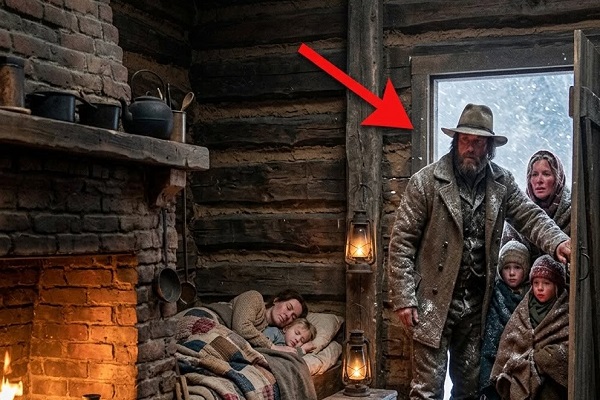
Late on the fourth night, Elias heard something unusual.
A faint sound.
Three slow knocks.
He frowned.
No one should be outside.
The knocking came again.
Barely audible beneath the wind.
Elias grabbed his lantern.
Opened the door.
And stared into the darkness.
At first he saw nothing.
Then a shape emerged.
A man.
Behind him stood a woman.
And two children.
All four were covered in snow.
The youngest girl appeared barely conscious.
The father looked exhausted.
“Elias,” he gasped.
The old trapper recognized him instantly.
Hank Turner.
The very man who had mocked the stove more than anyone.
For a brief moment neither spoke.
Then Elias stepped aside.
“Get inside.”
The family stumbled into the cabin.
Warmth hit them like a physical force.
The children immediately began crying.
Not from fear.
From relief.
Hank’s wife nearly collapsed.
Elias guided her toward the heated brick sleeping platform.
“Lie down.”
She touched the warm bricks beneath the blankets.
Her eyes widened.
“Oh my…”
The children crawled beside her.
Within minutes they were asleep.
Hank remained standing.
Embarrassment covered his face.
“Elias…”
The older man waved him silent.
“You can explain tomorrow.”
“But—”
“Tomorrow.”
Hank’s eyes filled with gratitude.
For the first time in years, he had no argument.
No joke.
No pride.
Only thanks.
The next morning brought another surprise.
More knocking.
This time it was the Peterson family.
Their chimney had collapsed.
By evening, another couple arrived after losing most of their firewood.
The following day, three more people appeared.
Then six.
Then four.
Word spread through the storm.
Elias Granger had heat.
Real heat.
Not just enough to survive.
Enough to shelter others.
The giant brick stove that everyone had mocked became the center of a growing refuge.
Families slept on blankets near its warm sides.
Children sat against the bricks reading books.
Elderly neighbors warmed aching hands.
Mothers cooked soup while kettles simmered atop the stove.
The cabin became crowded.
Then crowded beyond reason.
Yet somehow nobody complained.
Because outside, the storm remained merciless.
Inside, they were alive.
At night, people shared stories.
Some laughed.
Some cried.
Others simply sat quietly, appreciating warmth they had nearly lost forever.
One evening, Hank found himself sitting beside Elias.
The room glowed with lantern light.
Children slept peacefully.
The stove radiated gentle heat.
For several minutes neither man spoke.
Finally Hank cleared his throat.
“I owe you an apology.”
Elias looked up.
“For what?”
“You know what.”
The old trapper smiled.
“The stove?”
Hank nodded.
“The stove.”
The room chuckled.
Several others listened.
Hank shook his head.
“I spent months making fun of that thing.”
“You weren’t alone.”
“Still.”
He looked around the crowded cabin.
His wife slept peacefully nearby.
His children were safe.
His voice softened.
“You probably saved all our lives.”
Silence settled across the room.
Elias stared at the glowing bricks.
Then he spoke quietly.
“No.”
Everyone looked at him.
“The stove saved lives.”
A woman frowned.
“What’s the difference?”
Elias pointed toward the massive structure.
“I built it because I remembered what winter can do.”
He looked around the room.
“Most folks prepare for the weather they expect.”
His eyes moved toward the snow-covered windows.
“I prepare for the weather I hope never comes.”
The words lingered.
Nobody laughed.
Because every person present understood their truth.
The blizzard finally ended two days later.
When the skies cleared, Pine Creek barely recognized itself.
Snowdrifts towered higher than wagons.
Roads vanished.
Barns collapsed.
Trees lay broken across fields.
Several homes suffered severe damage.
Yet remarkably, no one in the valley had died.
The townspeople credited many things.
Luck.
Faith.
Determination.
But they all knew one important fact.
During the worst days of the storm, dozens of people had found shelter in Elias Granger’s cabin.
And around his enormous Russian brick stove.
As life slowly returned to normal, attitudes changed.
The jokes disappeared.
The teasing stopped.
Something else replaced them.
Respect.
One Saturday morning, Elias arrived in town.
The general store fell unusually quiet.
He immediately noticed.
Then Hank Turner stood.
The large rancher removed his hat.
“So.”
Elias raised an eyebrow.
“So?”
Hank grinned.
“How much would you charge to teach me how to build one?”
Laughter filled the store.
But this time it wasn’t mocking laughter.
Others joined in.
“Me too.”
“I want one.”
“My brother needs one.”
“Can you draw plans?”
Within minutes half the town wanted a Russian stove.
Elias shook his head.
“You all think they’re easy?”
“No.”
“Good.”
The laughter returned.
A few months later, construction began throughout Pine Creek.
Several families built masonry heaters inspired by Elias’s design.
Others improved insulation.
Many expanded wood storage.
The storm had taught everyone a lesson.
Preparation wasn’t foolish.
Preparation was wisdom.
Years passed.
The great blizzard became legend.
Children who had sheltered in Elias’s cabin grew into adults.
New families arrived.
Old stories were retold.
And every winter, newcomers eventually heard the tale.
They heard about the stubborn widower.
The giant stove.
The endless storm.
The families who knocked on his door.
And they always laughed at the same part.
The fact that everyone once mocked the stove.
Because from the perspective of later years, the ending seemed obvious.
Of course the stove mattered.
Of course preparation mattered.
Of course winter got a vote.
But Elias understood something deeper.
The true lesson wasn’t about bricks.
Or fire.
Or storms.
It was about caring enough to prepare not only for yourself, but for others.
One evening, many years later, an elderly Elias sat beside the same stove.
Its bricks were worn smooth by countless hands.
Its warmth remained unchanged.
Outside, snow drifted gently beneath moonlight.
A young boy visiting with his parents touched the massive structure.
“Mister Granger?”
“Yes?”
“Why’d you build it so big?”
The old man smiled.
The question never changed.
He glanced toward the sleeping platform where children once rested during the storm.
He remembered frightened faces entering through the blizzard.
He remembered gratitude replacing pride.
And he remembered a cabin filled with life.
Then he answered.
“Because someday,” he said softly, “someone might need a warm place to come home to.”
The boy nodded thoughtfully.
And the old stove continued radiating its steady warmth into the winter night, just as it always had—proof that wisdom often looks foolish until the day it becomes indispensable.