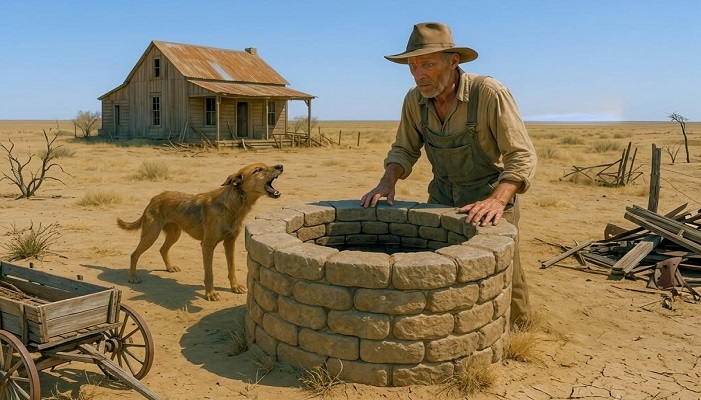
The summer of 1887 was the cruelest anyone in Dry Creek, Arizona Territory, could remember.
For months, not a single meaningful rain had fallen from the cloudless sky. The earth had split open into jagged cracks. Cornfields turned brown before reaching a man’s knee. Wells dried up one after another until entire families abandoned their homesteads and headed east.
Among those struggling to survive was sixty-three-year-old farmer Thomas Whitaker.
Thomas owned a tiny patch of land on the edge of town. Calling it a farm was generous. The property consisted of a weather-beaten farmhouse, a broken wagon that hadn’t rolled in years, a few chickens, and a neglected field where nothing seemed willing to grow.
His wife had died six winters earlier.
His son had left for California and never returned.
Now Thomas lived alone.
Well, almost alone.
His only companion was a scruffy tan dog named Rusty.
Rusty wasn’t much to look at. His ribs showed through his dusty coat, and one ear permanently drooped after a fight with a coyote years before.
But he was loyal.
Every morning he followed Thomas into the fields.
Every evening he slept beside the porch.
And every night he guarded the farm as if it were a palace.
Without Rusty, Thomas often thought, the silence would have swallowed him whole.
One scorching afternoon, after another hopeless attempt to save his dying crops, Thomas returned to the farmhouse exhausted.
Rusty wasn’t waiting on the porch.
That was unusual.
The dog never wandered far.
Thomas called his name.
No answer.
Then he heard barking.
Not from the road.
Not from the barn.
From the old well.
The well sat nearly a hundred yards behind the house.
It was ancient, built long before Thomas purchased the property. Most folks believed it had been dug sometime during the Civil War.
The well had gone dry years ago.
Thomas hadn’t drawn water from it in over a decade.
Rusty’s barking echoed across the dusty landscape.
Sharp.
Relentless.
Almost angry.
“What are you carrying on about now?” Thomas muttered.
He trudged across the cracked earth.
When he reached the well, Rusty was circling it frantically.
The dog barked into the darkness below, then looked at Thomas.
Then barked again.
Thomas peered over the stone edge.
Nothing.
Only shadows.
“There’s nothing down there.”
Rusty continued barking.
Thomas shook his head and returned to the house.
The next morning Rusty was back at the well.
Barking.
The day after that?
Still barking.
Then another day.
And another.
Five straight days.
Neighbors began noticing.
One afternoon, Thomas’s nearest neighbor, Earl Dawson, rode over.
“Your dog gone crazy?”
Thomas laughed weakly.
“Seems like it.”
Earl glanced toward the well.
“Probably smells a dead animal.”
“Maybe.”
“Throw a rock down there.”
Thomas did.
The stone bounced off the wall.
A few seconds later came a dull splash.
Both men froze.
Splash?
Earl frowned.
“I thought you said this well was dry.”
“It is.”
Another rock followed.
Again came the unmistakable sound of water.
Thomas looked at Earl.
Earl looked at Thomas.
Neither spoke.
That night Thomas couldn’t sleep.
The sound haunted him.
Water.
In the middle of the worst drought anyone could remember.
At sunrise he returned with a lantern and a rope.
Rusty danced excitedly around the well.
“All right,” Thomas said. “Let’s see what’s gotten you so worked up.”
He lowered the lantern.
Ten feet.
Twenty.
Thirty.
The light disappeared into darkness.
Then suddenly it reflected off something.
Water.
Far below.
A lot more water than should have existed.
Thomas stared in disbelief.
The old well somehow wasn’t dry.
But that didn’t explain Rusty’s behavior.
The dog wasn’t interested in water.
He was interested in something else.
Something deeper.
For the next several days, Thomas worked to clear years of debris from the shaft.
Branches.
Loose stones.
Rotting wood.
The deeper he examined the well, the stranger things became.
The walls appeared unusually smooth in places.
Almost carved.
As if someone had shaped them intentionally.
Then he discovered something that made his heart race.
A metal ring embedded in the stone.
It wasn’t natural.
Someone had placed it there.
Curiosity took hold.
On the eighth day, Thomas tied a rope around his waist.
Earl insisted on helping.
“You’re too old for this.”
“Maybe.”
“You fall, you’ll break every bone you got.”
“Then don’t let go.”
Earl grumbled but agreed.
Together they rigged a pulley system using the old wagon axle.
Then Thomas began descending.
The stone walls felt cool against his hands.
The air grew colder with every foot.
Sunlight faded above.
Soon only the lantern illuminated the darkness.
Twenty feet.
Thirty.
Forty.
Then Thomas saw it.
A narrow opening cut into the side of the well.
His heart pounded.
A tunnel.
Hidden behind centuries of stone.
“No way…” he whispered.
The opening was just large enough for a man to crawl through.
Thomas squeezed inside.
The tunnel extended several yards before widening into a small chamber.
At first he thought he was imagining things.
The lantern light flickered across wooden beams.
Boxes.
Barrels.
Crates.
Dozens of them.
Perfectly preserved by the dry underground air.
Thomas stood frozen.
Who had hidden these?
And why?
He opened the nearest crate.
Inside lay stacks of sealed glass bottles.
Another contained tools.
Another held blankets.
Another held rifles wrapped in oilcloth.
Then he noticed a rusted metal chest.
Unlike everything else, it was locked.
His hands trembled as he forced it open.
Inside were bundles of documents.
Maps.
Letters.
And beneath them…
Gold.
Actual gold.
Coins.
Bars.
Jewelry.
Enough wealth to change several lifetimes.
Thomas nearly dropped the lantern.
For a moment he simply stared.
His mind refused to believe what his eyes saw.
Gold didn’t belong beneath a dried-up well.
Not on his farm.
Not in his life.
Yet there it was.
Real.
Waiting in darkness.
Waiting for someone to find it.
Waiting for a dog that refused to stop barking.
When Thomas climbed back to the surface, Earl immediately knew something had happened.
The old farmer’s face had turned ghost white.
“What did you find?”
Thomas struggled to answer.
“You’re not going to believe me.”
Earl laughed.
“Try me.”
An hour later, Earl wasn’t laughing.
The two men spent the remainder of the day cataloging the chamber.
News spread quickly.
By evening half the town wanted to see the discovery.
The sheriff arrived.
Then the mayor.
Then a representative from the territorial government.
Experts eventually examined the documents.
What they revealed stunned everyone.
The chamber had once belonged to a secret supply network operating during the Civil War.
According to recovered records, a wealthy mining consortium had hidden emergency reserves beneath remote properties throughout the territory.
Most locations had been forgotten.
This one remained undiscovered for over twenty years.
The gold alone was worth a fortune.
But historians became even more fascinated by the letters and maps.
Several documents described long-lost mining operations that no longer existed on any official record.
Newspapers from Arizona to California covered the story.
People traveled hundreds of miles to see the famous well.
Reporters interviewed Thomas constantly.
Every one of them asked the same question.
“How did you find it?”
Thomas always gave the same answer.
“I didn’t.”
Then he pointed toward Rusty.
“He did.”
The dog became something of a legend.
Children brought him treats.
Visitors asked to take photographs beside him.
Rusty accepted the attention as though he’d earned it.
Which, of course, he had.
When legal ownership was finally determined months later, Thomas received a substantial share of the treasure.
Far more money than he had ever dreamed of possessing.
Enough to rebuild the farm.
Enough to hire workers.
Enough to ensure he would never struggle again.
The transformation was remarkable.
The broken wagon disappeared.
The farmhouse was repaired.
A new roof replaced the old one.
Fresh paint covered the weathered boards.
New fencing stretched across the property.
Most importantly, Thomas drilled additional wells using modern equipment.
The hidden water source beneath his land proved larger than anyone expected.
While neighboring farms continued suffering through drought, Thomas’s fields slowly returned to life.
Green replaced brown.
Corn rose from the soil.
Fruit trees flourished.
The farm that everyone had written off became one of the most productive properties in the county.
Yet wealth changed Thomas far less than people expected.
He still wore overalls.
Still rose before dawn.
Still spent evenings on the porch.
The biggest difference was that he smiled more.
And Rusty never left his side.
One autumn evening, nearly a year after the discovery, Thomas sat watching the sunset paint the desert sky in shades of orange and gold.
Rusty rested beside his chair.
The dog was growing older.
His muzzle had turned gray.
His movements had slowed.
Thomas scratched behind the familiar drooping ear.
“You know,” he said softly, “nobody would’ve listened if it weren’t for you.”
Rusty thumped his tail.
Thomas laughed.
“Guess you knew something was down there.”
The dog simply gazed toward the old well.
The well itself had been preserved as a historical site.
Visitors still came to see it.
Some claimed Rusty had smelled the water.
Others believed he heard echoes from the hidden chamber.
A few insisted divine providence guided him.
Nobody truly knew.
And perhaps nobody ever would.
But Thomas had his own theory.
He believed animals noticed things humans ignored.
While people rushed through life distracted by worries and hardships, creatures like Rusty paid attention.
They listened.
They watched.
They trusted their instincts.
For days the dog had barked.
For days everyone dismissed him.
For days the answer waited beneath their feet.
Sometimes miracles arrived that way.
Not with thunder.
Not with fanfare.
But through a persistent voice refusing to be ignored.
Years later, after Rusty finally passed away peacefully beneath the cottonwood tree near the farmhouse, Thomas placed a small stone marker above the grave.
Visitors often stopped to read the inscription.
It said only:
HERE LIES RUSTY
THE DOG WHO FOUND WHAT NO MAN COULD
Many smiled when they saw it.
Some laughed.
Others shook their heads in disbelief.
Because the story sounded impossible.
A poor farmer.
A forgotten well.
A hidden chamber.
A treasure lost to history.
A dog that barked until someone listened.
Yet every word was true.
And whenever travelers asked Thomas what lesson he had learned from the greatest discovery of his life, the old farmer always answered the same way.
“Don’t ignore the loyal ones.”
Then he’d glance toward the grave beneath the cottonwood tree.
“They sometimes see treasure where the rest of us only see dirt.”