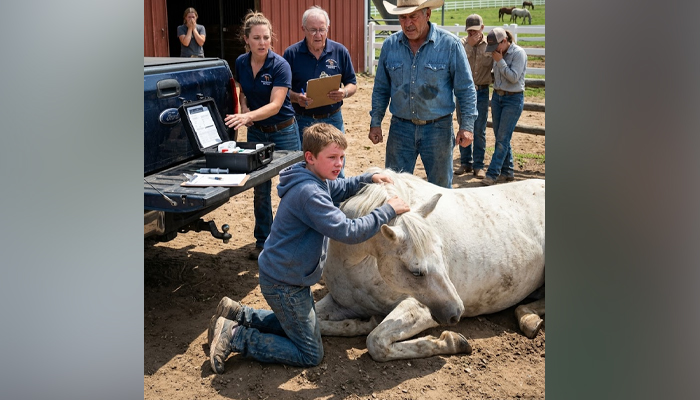
The white stallion lay in the dirt like the whole ranch had gone silent around him.
Heat moved over the pasture in waves, bending the fence line and making the barn roof shine too bright to look at for long.
The air smelled like dust, sweat, dry grass, and the sharp metal tang of the veterinary case sitting open on the back of the pickup.
Image
Noah Ramirez stood beneath the cottonwood tree and watched grown men fail to say what everyone already knew.
Spirit was going to die.
That was what the clipboard said without saying it.
That was what the black medical case said.
That was what the two veterinarians kept saying with their eyes every time Robert Mendoza looked at them and waited for a different answer.
Noah was nine years old, small for his age, with dusty sneakers, a faded hoodie, and a habit of being quiet around adults who mistook quiet for not understanding.
He understood more than they thought.
His mother, Sarah, worked in the ranch kitchen, where the tile stayed hot in summer and the freezer door stuck if you pulled it too fast.
She had taken the job five years earlier, after Noah’s father left and rent became a number she could no longer keep ahead of.
The ranch gave them a room behind the laundry shed, meals, and a kind of safety that did not ask too many questions.
It was not fancy.
The paint peeled near the window.
The heater rattled in winter.
But there was always bread, coffee, clean sheets, and a place for Noah to do homework at the end of the kitchen counter while his mother chopped onions for men who sometimes forgot to thank her.
Spirit had been there before Noah felt brave enough to call the ranch home.
The stallion was white in the way clouds are white right before a storm, bright but never soft.
He was powerful, proud, and known across the ranch as the animal who would tolerate almost nobody unless he chose to.
Robert Mendoza had spent fifteen years building that bloodline.
There were breeding records in binders, foal charts in the office, ribbons in a glass case, and old photos of Spirit in the hallway outside the barn office.
For the ranch hands, Spirit was money, reputation, work, and pride.
For Robert, he was all of that and something harder to explain.
For Noah, he was the first creature on that ranch who made loneliness feel less permanent.
Every morning before school, Noah would sneak out while the sky was still gray and cold.
He carried half an apple in his hoodie pocket.
Spirit always heard him before anyone else did.
The stallion would lift his head, flick one ear, and come to the fence with that slow, royal walk, as if accepting Noah’s visit was a favor granted to the world.
Noah never climbed the fence.
He never tried to show off.
He stood still, held out the apple, and waited.
His grandfather had taught him that.
Grandpa Frank had been dead nearly a year, but his voice still lived in Noah’s head more clearly than most living people.
“There are hurts in a horse that medicine can see,” the old man used to say, sitting on a bucket outside a feed room with his hands folded over the top of his cane.
“And there are hurts a horse only tells the person who has been quiet enough to listen.”
People used to laugh at Frank until a horse nobody else could handle lowered its head into his hands.
He had never talked like a man trying to be mysterious.
He talked like a man who had spent his whole life noticing small truths that louder people missed.
At 6:18 that morning, Jason the foreman found Spirit down in the pasture.
The stallion had not broken through a fence.
He had not fought another horse.
He had not been caught in wire.
He had simply collapsed while grazing.
By 7:02, Robert had called the first veterinarian.
By 9:40, an intake sheet listed suspected spinal trauma.
By 12:05, the second veterinarian had arrived and reached the same conclusion in quieter words.
That was the kind of quiet that made the news worse.
Noah heard pieces of it from the kitchen doorway while his mother pretended not to listen.
“He won’t rise.”
“No response in the hindquarters.”
“Pain markers increasing.”
“We need to think about suffering.”
Noah hated that word.
Suffering sounded gentle when adults said it.
It was not gentle.
It meant the black case.
It meant the syringe.
It meant everyone standing around Spirit and deciding that mercy was something done to him, not with him.
By midafternoon, the ranch was suspended in a strange, breathless heat.
The other horses had been moved away from the pasture fence.
The barn hands spoke in low voices.
A paper coffee cup sat untouched on a fence post, its lid warped from the sun.
Near the barn office, a small American flag snapped once in the dry wind and then hung still.
Noah stood beneath the cottonwood tree and pressed his hands deep into the front pocket of his hoodie.
His mother had told him to stay back.
Her eyes had said more than her mouth.
Do not interfere.
Do not embarrass me.
Do not make powerful people angry when this place is the only roof we have.
Noah understood that too.
Children who grow up watching parents count money learn the shape of danger early.
Sometimes danger is not a raised voice.
Sometimes it is a boss looking annoyed.
Sometimes it is a room you are allowed to sleep in only because everyone agrees not to notice how badly you need it.
Robert Mendoza stood beside Spirit’s head with his hat pushed back and both fists clenched.
He was sixty, broad, weathered, and usually impossible to read.
Now the grief had cracked through him anyway.
“No change?” he asked.
The older vet shook his head.
“I’m sorry.”
Jason, the foreman, wiped his forehead with a faded red handkerchief.
“Both vets agree, boss,” he said.
“If he can’t get up, he’ll only suffer more.”
Robert looked at Spirit.
The stallion’s eye was dull, but not gone.
His breathing came rough.
Every few minutes, one of his legs moved weakly against the dirt.
Noah heard one of the ranch hands curse under his breath and look away.
Robert swallowed.
“When the sun goes down,” he said.
His voice almost held.
Almost.
“We’ll do it then. I don’t want the other horses worked up.”
That was when Noah felt something inside him change.
Not courage exactly.
Courage felt too clean a word for it.
It was more like a door opening in a house he thought had no doors left.
Spirit’s left ear moved.
Not toward Robert.
Not toward the vets.
Toward Noah.
The boy stepped out from the shade.
“Noah,” Sarah whispered from the kitchen doorway.
Her voice carried fear, warning, and a plea all at once.
He kept walking.
The ranch hands turned to look at him.
One of them frowned like a child had wandered into a funeral.
Jason lifted a hand.
“Kid, not now.”
Noah walked past him.
The dirt burned through the thin soles of his sneakers.
His mouth was so dry he could barely swallow.
He could feel every adult eye on him, weighing him, dismissing him, wondering who had failed to teach him his place.
But Spirit breathed again, and the sound was wrong.
Noah had heard horses in pain before.
He had heard panic, colic, fear, rage, and exhaustion.
This was different.
Spirit was not fighting his back end.
He was protecting his front.
Noah stopped beside the stallion’s neck.
Robert looked down at him.
“This isn’t the time, son.”
Noah had always liked that Robert called him son when he forgot himself.
Right then, it hurt.
Because son did not mean equal.
Son did not mean believed.
Son meant small enough to be sent away kindly.
“No,” Noah said.
The word came out small, but it landed.
The younger vet stiffened.
“Excuse me?”
Noah looked at Spirit, not at him.
“It’s not his spine.”
Silence moved through the circle like a rope pulling tight.
Jason’s eyebrows drew together.
“Don’t start that.”
“I’m not starting anything,” Noah said.
He knelt in the dirt.
Spirit’s eye shifted toward him.
The stallion’s nostrils flared once, and Noah reached slowly, just as Grandpa Frank had taught him.
Never grab a frightened horse.
Never rush pain.
Ask with your hand before you ask with your voice.
Noah placed his palm near the base of Spirit’s neck, where the mane was damp and dusty.
The skin jumped.
Not the whole body.
One place.
One locked place.
Noah’s heart began beating so hard it felt like something trapped inside his ribs.
He moved his fingers lower, under the thick fall of white mane.
Spirit shuddered.
The younger vet stepped forward.
“Don’t press there.”
Noah froze but did not remove his hand.
“If that animal kicks, he’ll crush you.”
“He won’t,” Noah whispered.
“You don’t know that.”
Noah looked up then.
“Yes, I do.”
There was no arrogance in it.
That was what made everyone quieter.
He reached into his hoodie pocket with his free hand and pulled out the half apple he had carried that morning.
It was warm now, bruised at the edge, wrapped in a napkin from the kitchen.
Sarah made a soft broken sound.
She knew.
She knew exactly why he had it.
Noah held the apple where Spirit could smell it.
For one long second, nothing happened.
Then the stallion’s ear flicked.
His eye sharpened.
Just a little.
Just enough.
Robert saw it.
The color drained from his face.
“He knows you,” he said.
Noah nodded.
“He trusts me.”
The first vet lowered the clipboard.
The second vet looked at the open medical case as if it had become something shameful.
Jason took off his hat and held it against his chest.
Spirit tried to lift his head.
It was ugly, strained, and weak.
It was also the first thing that had looked like life all day.
Sarah bent forward against the doorframe, one hand over her mouth and the other pressed to her stomach.
Noah slid the apple closer to Spirit’s lips.
“Good boy,” he whispered.
Spirit’s mouth moved.
The stallion took a small piece.
Noah pressed his other hand into the tight knot under the mane and felt the muscle seize beneath his fingers.
“His shoulder is locked,” he said.
The older vet came closer, slower now.
“What do you mean locked?”
Noah wished Grandpa Frank were there to say it better.
He wished he had grown-up words, paper words, clipboard words.
All he had were fence-line words.
“He fell because this hurt,” Noah said.
“Then everyone pulled from the back, and it made him think getting up would hurt worse.”
The younger vet’s face tightened.
“That’s not a diagnosis.”
“No,” Noah said.
Then he looked at Robert.
“But it’s true.”
Truth does not always arrive wearing authority.
Sometimes it comes in dusty sneakers with an apple in one hand and terror in its throat.
Robert stared at the boy for a long moment.
Everything on that ranch seemed to wait with him.
The men.
The horses in the far pen.
The hot wind.
The black case.
Finally, Robert asked, “What do you need?”
The question moved through Noah like breath.
He had expected to be pushed away.
He had expected anger.
He had not expected the most powerful man on the ranch to ask him what to do.
Noah swallowed.
“You have to pull from the front,” he said.
“Not the back. And not hard at first.”
Jason looked at Robert.
The vets looked at each other.
Noah kept going before fear could close his mouth.
“When I press here, he’ll try to move away from the pain. You have to guide him forward when he does.”
The older vet crouched beside Noah and touched the spot carefully.
Spirit flinched.
The vet’s expression changed.
Not fully.
Not into belief.
But away from certainty.
“There is a severe spasm here,” he said quietly.
The younger vet said nothing.
Robert handed his hat to Jason.
“Tell me where.”
Noah looked at him.
“You have to talk to him.”
Robert blinked.
“What?”
“He’s scared,” Noah said.
“He thinks everybody gave up.”
No one laughed.
Not one man.
Robert moved to Spirit’s head and crouched with a heaviness that made his age visible for the first time.
He placed one hand on the stallion’s forehead.
“Hey,” he said.
His voice broke on the small word.
“Hey, old man.”
Spirit’s eye rolled toward him.
Noah set the apple down near the horse’s mouth.
Then he pressed his fingers into the locked muscle with more certainty than he felt.
Spirit jerked.
Sarah cried out.
“Hold,” Noah said.
The word surprised him.
It sounded like his grandfather.
Robert leaned close to Spirit’s head.
“Easy,” he murmured.
Jason moved to the front, ready to help guide the chest and shoulders if the stallion tried to rise.
The older vet positioned himself near the foreleg.
The younger vet, after one hard breath, closed the black case.
The click was loud.
Everyone heard it.
That click changed the pasture.
It did not save Spirit.
Not yet.
But it moved death one step back from the circle.
Noah counted once in his head.
Then again.
Then out loud.
“One.”
Spirit breathed hard.
“Two.”
Robert put his forehead briefly against the horse’s face.
“Three.”
Noah pressed.
Jason guided.
Robert pulled from the front, gentle at first, then steadier when Spirit gathered himself.
For one terrible second, nothing happened.
The stallion’s legs scrambled weakly against the dirt.
His body heaved, failed, and dropped back down.
A ranch hand behind Noah whispered, “No.”
Sarah turned away as if she could not watch the boy break.
Noah did not move his hand.
He felt the knot shift.
Just a little.
Enough.
“Again,” he said.
The younger vet stared at him.
“You can’t keep forcing him.”
“I’m not forcing him,” Noah said.
His voice shook now, but his hand stayed steady.
“I’m showing him where it doesn’t hurt.”
A horse remembers pain fast.
That is why fear can look like stubbornness to people in a hurry.
Noah had learned that from Grandpa Frank too.
He had learned that patience was not softness.
It was work.
It was the hardest work there was.
They tried again.
This time Robert spoke through the whole count.
“Come on, Spirit. Come on, boy. I’m right here.”
Jason braced his boots in the dirt.
The older vet held the foreleg clear.
Noah pressed and released, pressed and released, following the rhythm he could feel beneath the skin.
Spirit pushed.
His front legs folded under him.
His neck rose.
The ranch seemed to inhale.
Then he dropped again.
But not all the way.
His chest stayed higher.
His head stayed up.
Robert made a sound that might have been a laugh if it had not been so close to a sob.
“He’s trying,” Jason said.
Noah nodded fast.
“He knows now.”
Sarah stepped off the kitchen threshold and came closer, even though she looked terrified of what she might see.
Her apron was still on.
Flour dust marked one side of it.
She did not care.
Robert looked at Noah.
“Can he do it?”
Noah looked at Spirit.
He thought of all those mornings at the fence.
The apple breath.
The soft snort.
The way Spirit had let him stand close when other people had to earn it with ropes and fences and rank.
“He can,” Noah said.
Then, because truth mattered, he added, “If he wants to.”
Robert nodded once.
Then he leaned close to Spirit again.
“You hear him?” he said.
The stallion blinked.
“This boy says you can.”
The third try came at 3:27 in the afternoon.
The older vet later wrote that time on the bottom of the intake sheet, though his handwriting shook enough that the numbers slanted.
Noah counted.
Robert pulled from the front.
Jason guided the shoulder.
The vet kept the leg clear.
Spirit surged.
This time, the locked muscle under Noah’s hand rolled, released, and trembled.
The stallion’s front legs caught.
His body came up in one massive, staggering motion that sent dirt flying against Noah’s jeans.
Everybody shouted at once.
Not words.
Just sound.
Fear and hope and disbelief crashing into each other.
Spirit stood on trembling legs.
For three seconds, he looked like he might fall.
Robert held the halter rope with both hands but did not pull.
“Easy,” he said.
“Easy.”
Spirit lowered his head.
His nose touched Noah’s shoulder.
The boy froze.
Then his face crumpled.
He wrapped one arm around the stallion’s muzzle and cried into the dusty white coat, not loudly, not for show, but like a child who had held himself together as long as he could.
Sarah reached him then.
She dropped to her knees and pulled him back just enough to see his face.
“You scared me half to death,” she whispered.
“I’m sorry,” Noah said.
But she was crying too hard to be angry.
Robert stood over them with one hand still on Spirit’s halter.
The ranch owner looked at the boy, then at the closed medical case, then at the vets.
The younger vet removed his hat.
It was not a grand apology.
It was not enough to fix the way he had looked at Noah.
But it was something.
“I was wrong,” he said.
Noah wiped his face with his sleeve.
He did not know what to do with those words.
Most children are not prepared for adults to admit they failed them.
Robert crouched in front of Noah.
At sixty, with dirt on his knees and tears standing openly in his eyes, he no longer looked like a boss.
He looked like a man who had almost signed away a miracle because the paperwork sounded certain.
“What did your grandfather teach you?” he asked.
Noah looked at Spirit.
“He taught me that horses don’t lie,” he said.
Robert nodded slowly.
“No,” he said.
“They don’t.”
The ranch did not return to normal that afternoon.
Normal would have been too small for what had happened.
The vets stayed until evening, checking Spirit’s movement, recording notes, arguing quietly over terms that sounded important but felt less important than the fact that the stallion was standing.
The older vet called it an acute shoulder lock with a severe protective response.
The younger vet called it a rare presentation.
Jason called it a miracle under his breath when he thought nobody heard him.
Robert called the barn office and told them to cancel the evening arrangements.
He did not say euthanasia.
Nobody wanted to say it anymore.
By sunset, Spirit was in a large stall bedded deep with fresh straw.
He was weak.
He was not safe yet.
He needed rest, observation, and a real treatment plan.
But when Noah stood outside the stall with another apple slice, Spirit took it from his palm.
Robert watched from the aisle.
Beside him, Sarah held a dish towel she had forgotten she was carrying.
For once, no one told her to get back to the kitchen.
Robert turned to her.
“Sarah,” he said.
She straightened automatically.
“Yes, sir?”
His face tightened at the sir.
“I owe your son more than thanks.”
Sarah’s eyes moved to Noah.
“He’s a good boy.”
“I know,” Robert said.
Then he looked back at Spirit.
“I should have known sooner.”
The next week, a small change appeared on the ranch office wall.
Not a plaque.
Not a ceremony.
Robert was not that kind of man, and Noah would have hated it.
It was a printed schedule clipped beside the breeding records.
At the bottom, in Robert’s blocky handwriting, he had added one line.
Noah Ramirez: Morning observation with Spirit, 6:30 a.m., supervised.
The older vet came back three times.
Each visit, he asked Noah what he had noticed.
At first, Noah answered in one or two words.
By the third visit, he told him about the way Spirit shifted weight before the spasm returned, and the vet wrote it down.
That mattered more than praise.
Writing it down meant it counted.
Robert bought Noah a proper pair of work boots two sizes too big so he could grow into them.
Sarah tried to refuse because pride is sometimes the only thing poor people can keep polished.
Robert did not argue.
He simply set the box outside their room with a note.
For the boy who listened.
Noah kept that note folded inside his school notebook.
Months later, when Spirit walked the pasture again, slower but alive, the ranch hands still talked about the afternoon the kid stopped the injection.
They told it bigger every time.
Some said Noah whispered to the horse.
Some said Spirit stood the moment the boy touched him.
Some said Robert cried, which was true, though nobody said it when Robert was close enough to hear.
Noah never corrected the story unless someone made it sound easy.
Then he would shake his head.
“It wasn’t magic,” he would say.
“What was it then?” Jason asked him once.
Noah leaned on the pasture fence, watching Spirit graze.
The small American flag near the barn office moved gently in the morning wind.
The ranch smelled like hay, coffee, and damp earth after a rare night rain.
Noah thought about Grandpa Frank.
He thought about the black case.
He thought about Spirit’s ear flicking toward him when everyone else had already decided the ending.
“It was listening,” he said.
Jason looked at him for a long moment.
Then the foreman nodded like that answer was heavier than he expected.
The white stallion lifted his head across the pasture.
Noah raised one hand.
Spirit snorted once and started toward the fence, slow and proud, as if he had never been anything else.
And the boy who had once been too small for anyone to notice stood waiting with an apple in his palm.