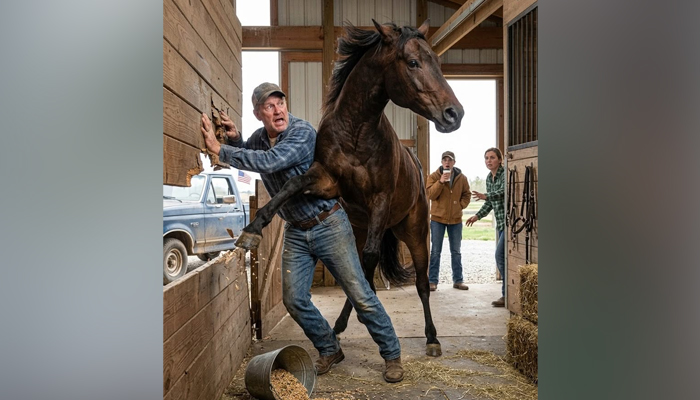
The horse attacked its owner, who had raised him since birth, and nearly left him seriously injured: the man was already convinced that the horse had gone mad until he discovered the real reason behind its strange behavior.
Every morning on Thomas Miller’s small ranch began before the sun had fully lifted over the pasture.
The gravel outside the house would still be damp with dew, the kitchen coffee would still be too hot to drink, and the old wooden barn would sit at the end of the drive with pale light leaking through its boards.
Thomas liked that hour best.
It was the only time the ranch sounded honest.
No trucks coming in.
No shouted instructions.
No feed deliveries backing up with warning beeps.
Just boots on gravel, birds in the fence line, and the low, familiar stir of animals waking up.
At 6:18 every morning, almost without fail, Thomas would pick up the feed bucket from the side room, tug his jacket tighter around his shoulders, and head toward the barn.
Thunder always knew he was coming.
Before Thomas reached the sliding door, the stallion would nicker from inside, soft and deep, the kind of sound that made the old ranch hands smile even when they were tired.
They used to say Thunder had a better clock than anyone in the county.
Thomas never argued.
He had raised that horse from the first hour of his life.
Years earlier, he had been the one kneeling in straw beside Thunder’s mother when the delivery went wrong.
He had wiped the foal down with old towels, held a flashlight while the vet worked, and sat on an overturned bucket until dawn because the little animal was too weak to stand.
The vet told him then not to get attached too quickly.
Thomas got attached before the sentence was finished.
For weeks, he bottle-fed the foal when sickness kept him from nursing properly.
For months, he checked him before sunrise and after dark, one hand on the small trembling neck, waiting for strength to settle into bone.
Thunder grew into a powerful stallion, but Thomas still remembered the newborn who had once tucked his head against his jacket as if the whole world could be trusted if Thomas was standing nearby.
That kind of history does something to a man.
It makes an animal feel less like property and more like a witness to your life.
Thunder had watched Thomas age.
He had watched him bury his father, repair the same barn roof three different summers, and keep the ranch running through bad seasons when the bills piled up on the kitchen counter.
On quiet evenings, Thomas would lean against the stall door and talk to Thunder in a low voice while the horse chewed and listened.
Maybe the animal understood none of it.
Maybe he understood more than anyone wanted to admit.
Either way, Thunder had never hurt him.
Not once.
That was why Thomas suspected nothing on the morning everything changed.
The air was cool enough to bite his hands.
The feed bucket scraped against his jeans as he walked.
Near the driveway, a faded American flag sticker clung to the back window of his old pickup, its edges peeling from too many summers in the sun.
Thomas noticed it only because the first light hit it as he passed.
Then he reached the barn.
“Morning, old friend,” he called.
Usually Thunder answered before the latch lifted.
This time, silence met him first.
Then came a scream.
It was not a neigh the way horses greet people.
It was sharp, high, and wrong.
Thomas stopped with one hand on the door.
Inside, Thunder was pacing in his stall, not in circles but in frantic half-turns, as though he could not decide whether to run or fight.
His ears were pinned flat.
His nostrils flared wide.
His eyes had gone white at the edges.
Thomas frowned.
“What’s gotten into you?” he asked softly.
The stallion struck the floor with one hoof.
Dust jumped from the boards.
Thomas had seen horses spook before.
A loose tarp could do it.
A coyote near the fence could do it.
Thunder had once startled at a metal rake falling over outside the tack room, then spent the rest of the afternoon pretending he had meant to leap sideways like that.
But this was different.
There was no quick startle and recovery.
There was no simple fear passing through the body and out again.
Thunder looked trapped inside his own panic.
Thomas set the feed bucket down carefully.
“Easy,” he said.
He took one step forward.
Thunder reared.
The movement was so sudden that Thomas did not even lift his arms in time.
The stallion’s front hooves shot upward, striking the boards near Thomas’s shoulder with a crack that echoed through the barn.
Before Thomas could throw himself back, Thunder came down and shoved into him with his chest.
Thomas hit the wall hard.
The breath left his lungs in one brutal rush.
The feed bucket tipped and rolled, spilling grain across the floor in a pale fan.
“Thunder!” Thomas shouted.
The horse pressed harder.
For a stunned second, Thomas could not make sense of it.
This was the same animal who let him clean his hooves.
The same animal who lowered his head when Thomas rubbed the white mark between his eyes.
The same animal who would follow him across the paddock without a lead rope because trust had been built so slowly it no longer needed tools.
Now that animal had him pinned against the wall.
Thomas tried to shift left.
Thunder blocked him.
Thomas tried to duck under the stall rail.
Thunder slammed one hoof down, not on him, but close enough that the floor shook beneath his boots.
Splinters broke loose from the old wall.
Dust filled the stripe of daylight coming through the boards.
Thomas could feel wood digging into his back through his shirt.
One wrong movement could end him.
He understood that with a cold, clean certainty.
Fear changes the shape of familiar things.
A barn becomes a cage.
A friend becomes a threat.
A heartbeat becomes a countdown.
For one ugly second, Thomas wanted to fight back.
His hand found a loose piece of broken board near his hip.
He could have swung it.
He could have screamed until the ranch hands came running.
He could have done anything a frightened man does when he believes he is about to die.
But then he saw Thunder’s eyes.
They were not mean.
They were terrified.
That small difference held Thomas still long enough to think.
He dropped the board.
“Easy, boy,” he gasped.
Thunder threw his head and screamed again.
The sound brought movement outside.
Thomas heard boots on gravel, a voice calling his name, and the frantic scrape of someone trying to pull the barn door wider.
Thunder shifted toward the sound.
That was the gap.
Thomas twisted sideways, scraping his shoulder against the wall, and forced himself between the stall rail and the cracked boards.
His boot slipped in spilled feed.
His ribs screamed.
But he moved.
Thunder lunged after him, not cleanly enough to strike, but violently enough to make Thomas throw himself through the doorway and into the yard.
He slammed the barn door shut behind him.
For several seconds, nobody spoke.
Thomas bent forward with both hands on his knees, dragging air back into his lungs.
One ranch hand, Chris, stood ten feet away holding a paper coffee cup he had clearly forgotten was in his hand.
Another, Daniel, stared at the closed door like it might explode outward.
“What happened?” Chris asked.
Thomas tried to answer.
Nothing came out at first.
Inside the barn, Thunder struck the floor again.
The sound made all three men flinch.
“He pinned me,” Thomas finally said.
Chris blinked.
“Thunder?”
Thomas looked at the door.
“Thunder.”
By 9:40 a.m., the veterinarian arrived.
Dr. Emily Harris had been treating animals on the ranch for years, and she knew Thunder well enough to approach with confidence.
That confidence lasted until she reached the door.
Thunder screamed as soon as the latch moved.
The door jumped against its track.
Dr. Harris stepped back slowly, both hands visible, her face tight with concern.
“That is not normal fear,” she said.
“No,” Thomas answered.
They worked from the outside as much as they could.
They checked the feed bin.
They checked the water.
They reviewed Thunder’s vaccination folder, last exam notes, and the feed receipt from the previous delivery.
Dr. Harris took down the time of the first incident, the description of the pinning, the repeated striking, and the fact that Thunder seemed fixed on the rear portion of the barn.
The written assessment did not say what Thomas feared most.
No obvious rabies symptoms.
No visible injury.
No fever observed.
No clear cause.
That last line felt worse than a diagnosis.
A clear cause gives you something to fight.
A mystery makes every choice feel cruel.
The rest of that day, Thunder refused to let anyone near the barn.
If a worker crossed the yard, the stallion hammered the floor.
If Thomas touched the latch, Thunder threw himself toward the door.
By nightfall, the whole ranch had gone quiet in that uneasy way places go quiet when everyone is pretending not to think the same thing.
Chris was the first to say it out loud.
“Could be his mind,” he said.
Thomas did not answer.
Daniel shifted his weight near the truck.
“Could be something neurological.”
Dr. Harris had not ruled that out.
Nobody wanted to say what came next, but the thought sat there among them anyway.
A dangerous stallion could not remain loose in a working barn.
The ranch had people coming in and out.
Feed deliveries.
Fence repairs.
A neighbor’s teenager who sometimes helped on weekends.
Thomas could not risk someone else being pinned the way he had been.
That night, he sat at the kitchen table with Thunder’s folder open in front of him.
The house smelled faintly of coffee and dust.
His ribs ached every time he breathed too deeply.
On the back of a feed receipt, he wrote a note because he wanted the facts in order.
11:36 p.m. Still pacing.
11:52 p.m. Struck rear wall twice.
12:07 a.m. Screamed when I crossed yard.
He hated how official the notes looked.
He hated that love could become a file.
The next morning, Thunder had barely eaten.
His water was disturbed, but not much had been taken.
He stood near the same rear corner, head low, ears shifting, every muscle alert.
When Thomas spoke through the door, Thunder did not soften.
But he did not charge either.
He turned his head toward the rear wall and pawed once.
Thomas noticed it.
He noticed, then dismissed it, because grief was already making noise in his chest.
By the second day, the decision had come close enough to touch.
Dr. Harris returned with a more serious expression and a quieter voice.
“If he charges again,” she said, “somebody may not get out.”
Thomas nodded.
He knew.
That was the worst part.
He knew.
At 4:13 p.m., he stood in the driveway with the vet’s written assessment folded in his hand.
Chris and Daniel waited near the pickup.
Nobody hurried him.
Nobody told him it was just a horse.
They knew better.
Thomas looked toward the barn and remembered a newborn foal with shaky knees.
He remembered a sick little head resting against his jacket.
He remembered teaching Thunder to accept a halter, then a saddle, then the sound of trucks, storms, and gates.
He remembered trust so old it had become invisible.
Then he walked to the barn door.
“Open it slowly,” Dr. Harris said.
Thomas lifted the latch.
The door rolled back on its track.
Thunder stood inside, chest heaving, head low.
He did not charge.
He did not rear.
He stared at Thomas, then turned toward the rear corner and pawed the floor once.
Hard.
Thomas froze.
The sound was not random.
It was placed.
Thunder pawed again.
Same spot.
Dr. Harris stepped closer, staying behind Thomas.
“What is he looking at?” she whispered.
Thomas followed the stallion’s gaze.
At the back of the barn, near an old stack of tack, loose boards leaned against the wall.
Behind them sat a dark gap where a section of lower siding had warped from years of weather.
Thomas had meant to repair it before winter.
He had meant to do a lot of things before winter.
A thin sound came from that corner.
Not a horse.
Not the wind.
A dry rustle.
Chris heard it too.
He lowered his coffee cup slowly.
“What was that?” he asked.
Thunder stomped between Thomas and the sound.
The truth landed in pieces.
The rearing.
The shoving.
The refusal to let anyone near the barn.
The constant striking in the same place.
The way Thunder had blocked Thomas every time he moved toward the wrong part of the room.
He had not been trying to kill him.
He had been trying to keep him away.
Dr. Harris raised one hand.
“Thomas,” she said carefully, “do not step any closer until we know what’s under there.”
Daniel ran to the truck for a long-handled rake and a heavy flashlight.
Chris moved to the side door and pushed it open to flood the back of the barn with more daylight.
Thunder trembled in place.
Thomas kept talking to him in a low voice.
“Good boy,” he said.
The words nearly broke in his throat.
“Good boy. I see it now.”
Daniel used the rake to pull the first loose board aside.
Nothing happened.
He pulled the second.
The rustling came again, sharper now.
Chris stepped backward.
Dr. Harris swore under her breath.
Behind the warped siding, in the dark pocket between the wall and stacked debris, something moved.
A large snake slid partly into view, dark and thick against the dusty floor.
Nobody needed a lecture to understand the danger.
The barn went utterly still.
Thunder struck the ground once more, then held himself between Thomas and the corner like he had been holding himself there for two days.
Dr. Harris backed everyone out.
Animal control was called.
The county line on the phone log later showed 4:29 p.m., dispatch notified.
By 5:06 p.m., trained responders had arrived with hooks, a container, and the calm manner of people who know panic only makes dangerous work worse.
Thomas stood outside the barn with one hand on the doorframe, watching through the opening as the snake was safely removed from the wall cavity.
It had likely come in through the warped siding and stayed hidden in the cool, dark space near the tack and feed.
Thunder had sensed it.
Maybe he had heard it.
Maybe he had smelled it.
Maybe he had seen it move before any human had.
Whatever the reason, he had understood one thing clearly.
Thomas was walking into danger.
And Thunder had done the only thing a terrified, powerful animal could think to do.
He stopped him.
Badly.
Violently.
Almost fatally.
But he stopped him.
After the responders left, nobody rushed back into the barn.
The sun was low by then, laying gold across the driveway and the hood of the old pickup.
Chris picked up the spilled coffee cup from the dirt.
Daniel leaned against the fence with both hands over his face.
Dr. Harris wrote an addendum to her assessment, her pen moving slowly across the paper.
Behavior consistent with defensive blocking response to hidden threat.
Thomas read the line three times.
A few hours earlier, he had been preparing to end Thunder’s life because he believed the horse had become dangerous without reason.
Now the reason was sitting in black ink on a veterinary form.
The next morning, Thomas did not carry the feed bucket first.
He carried tools.
He repaired the warped siding, cleared the old debris, and moved every stack away from the rear wall.
He checked every corner with a flashlight.
He installed new boards where the old ones had softened.
Only after that did he bring Thunder fresh feed.
The stallion stood watching him.
His body was exhausted.
His eyes were still alert, but the wild edge had gone.
Thomas opened the stall door slowly.
For a moment, neither of them moved.
Then Thunder lowered his head.
Thomas stepped closer.
The horse breathed against his chest, warm and heavy.
Thomas put one hand on the white mark between Thunder’s eyes and left it there.
“I’m sorry,” he whispered.
The stallion closed his eyes.
There was no grand miracle after that.
Thunder did not suddenly become a storybook hero who understood English and forgave everything in a perfect scene.
He was still an animal.
Thomas was still a man with bruised ribs, a scraped shoulder, and a lesson he would carry longer than the pain.
Trust does not mean an animal will always behave gently.
Sometimes trust means looking again before you condemn what you do not understand.
In the weeks that followed, Thomas changed the way the ranch handled strange behavior.
No one dismissed panic as craziness.
No one approached a distressed animal alone.
Every incident was logged with time, place, and what the animal seemed to be watching.
Dr. Harris told him later that many people would have made the final decision before they ever thought to search the barn.
Thomas did not take comfort in that.
He came too close.
That was what stayed with him.
He came too close to losing the horse that had been trying, in the only way he knew how, to save him.
At 6:18 on the first quiet morning after the barn was repaired, Thomas picked up the feed bucket again.
The air smelled of fresh boards, hay, and cold coffee from the cup he had left on the fence post.
His ribs still ached.
His shoulder still pulled when he lifted the latch.
Inside, Thunder heard his footsteps.
This time, the stallion nickered.
Soft.
Deep.
Familiar.
Thomas stopped in the doorway and let the sound settle into him.
The barn no longer felt like a cage.
The friend he thought had become a threat had been a warning all along.
And when Thunder stretched his muzzle toward Thomas’s shoulder, Thomas did not move away.
He set the bucket down, reached up with one careful hand, and touched the horse’s face the way he had done since Thunder was small enough to fit against his jacket.
“Morning, old friend,” he said.
This time, Thunder answered like he always had.