The first time anyone noticed the trapdoor beneath the old red barn, it was already too late for judgment—and just in time for survival.
But years earlier, when Emily Carter first began digging into the frozen ground behind her farmhouse, the neighbors thought she had finally lost her mind.
“Storm shelter?” old Mr. Wilkins had asked, leaning against the fence with a crooked grin. “Out here? We barely get more than a dusting each winter.”
Emily hadn’t argued. She just nodded, brushed the dirt from her hands, and kept digging.
Because she wasn’t building a storm shelter.
She was building a secret.
Emily had moved to the ranch just outside of Silver Creek, Montana, after her husband, Daniel, passed away unexpectedly. A heart attack at thirty-eight—quick, cruel, and without warning. One day he was fixing the fence, the next she was standing in a hospital hallway trying to explain death to two children who still believed in bedtime stories and magic.
After the funeral, the silence in the house became unbearable.
Every creak in the wood, every gust of wind through the cracks—it all sounded like absence.
So Emily made a decision.
If the world could take everything from her in an instant, she would spend the rest of her life making sure her children were never unprotected again.
The idea came to her one sleepless night.
A place no one would think to look.
A place warm, hidden, and safe.
A place that belonged only to them.
The barn was perfect.
It stood about fifty yards from the house, sturdy and old, built by Daniel’s grandfather decades ago. Beneath it, the ground was solid but workable—packed earth that could be carved out slowly, quietly, over time.
Emily didn’t hire anyone.
Didn’t tell a soul.
Every day after the kids—eight-year-old Lily and five-year-old Noah—went to school, she picked up a shovel and got to work.
At first, it was just a shallow pit.
Then a crawlspace.
Then, as weeks turned into months, it became something else entirely.
A hidden room.
She reinforced the walls with salvaged wood from an old shed. Installed insulation she bought in small batches to avoid suspicion. Ran a discreet electrical line from the barn’s lighting system, careful to keep everything concealed behind false panels.
It wasn’t luxurious.
But it was warm.
Safe.
And most importantly, invisible.
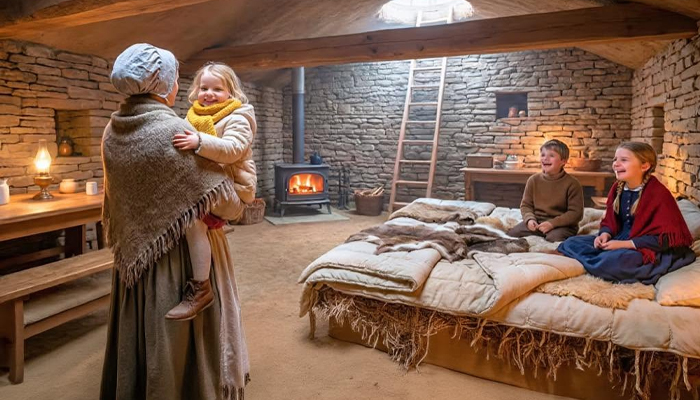
Emily added two small beds, a stack of blankets, a shelf of canned food, bottled water, and a battery-powered radio. She even painted the walls a soft pale blue, the same color Lily had once said reminded her of “quiet skies.”
When it was done, she showed the children.
“This,” she told them gently, kneeling at the entrance beneath the loose wooden planks, “is our special place. You don’t tell anyone about it. Not your friends, not your teachers. No one.”
Noah’s eyes lit up. “Like a secret base?”
Emily smiled faintly. “Exactly like that.”
Lily, older and more observant, studied her mother’s face. “Why do we need it?”
Emily hesitated.
Because the world is unpredictable. Because safety can disappear overnight. Because I’m afraid of losing you too.
But she only said, “Just in case.”
She reinforced the walls with salvaged wood from an old shed. Installed insulation she bought in small batches to avoid suspicion. Ran a discreet electrical line from the barn’s lighting system, careful to keep everything concealed behind false panels.
It wasn’t luxurious.
But it was warm.
Safe.
And most importantly, invisible.
Emily added two small beds, a stack of blankets, a shelf of canned food, bottled water, and a battery-powered radio. She even painted the walls a soft pale blue, the same color Lily had once said reminded her of “quiet skies.”
When it was done, she showed the children.
“This,” she told them gently, kneeling at the entrance beneath the loose wooden planks, “is our special place. You don’t tell anyone about it. Not your friends, not your teachers. No one.”
Noah’s eyes lit up. “Like a secret base?”
Emily smiled faintly. “Exactly like that.”
Lily, older and more observant, studied her mother’s face. “Why do we need it?”
Emily hesitated.
Because the world is unpredictable. Because safety can disappear overnight. Because I’m afraid of losing you too.
But she only said, “Just in case.”
The winter it happened started like any other.
Cold, yes—but manageable.
By early December, snow had begun to dust the fields, painting the land in soft white layers. The weather reports mentioned a storm system forming further north, but no one in Silver Creek paid much attention.
Storms came and went.
This was Montana.
Three days before Christmas, everything changed.
The forecast shifted suddenly.
What had been a mild winter front turned into something far more dangerous—a massive blizzard sweeping down with record-breaking winds and plunging temperatures.
The warnings came fast.
“Stay indoors.”
“Stock supplies.”
“Travel not advised.”
Emily listened carefully.
She filled the pantry, checked the generator, and—almost instinctively—restocked the hidden room under the barn.
Just in case.
The storm hit at night.
At first, it was just wind.
A low howl across the fields.
Then came the snow—thick, relentless, swallowing everything in sight.
By midnight, visibility was gone.
By 2 a.m., the power flickered.
By 3 a.m., it failed completely.
Emily woke to silence.
No hum of electricity.
No ticking clock.
Just the distant roar of the storm.
She grabbed a flashlight and checked on the kids. Lily and Noah were asleep, curled under heavy blankets.
“Mom?” Lily murmured as the light brushed her face.
“It’s okay,” Emily whispered. “Just a storm.”
But deep down, she knew this was more than that.
By morning, the house had begun to lose heat.
The generator refused to start—the fuel line likely frozen.
Snow had piled high against the doors, sealing them shut.
The temperature inside dropped steadily.
Emily wrapped the children in layers, lighting candles for warmth, but it wasn’t enough.
Hours passed.
The wind grew stronger.
The house began to groan under the pressure.
By afternoon, a sharp cracking sound echoed through the walls.
Emily froze.
Another crack—louder this time.
The roof.
Snow accumulation was too heavy.
If it collapsed—
She didn’t let herself finish the thought.
“Lily. Noah.” Her voice was calm, but urgent. “We need to go outside.”
Noah’s eyes widened. “In the storm?”
“Yes,” Emily said firmly. “Right now.”
She bundled them tightly—coats, scarves, gloves, everything they had.
When she forced the back door open, a wall of wind and snow slammed into them.
It was like stepping into a different world.
White.
Endless.
Blinding.
The barn was barely visible.
Just a dark shape in the distance, half-swallowed by the storm.
“Hold my hand,” Emily shouted over the wind.
Step by step, they pushed forward.
The snow was knee-deep—then waist-deep.
The cold bit through every layer.
Noah stumbled once, then again.
Emily lifted him, her arms burning, and kept moving.
When they finally reached the barn, Emily nearly cried with relief.
She dragged them inside, slamming the door shut against the storm.
It was quieter there.
Still cold—but bearable.
“Stay close,” she said, breathless.
She moved quickly, pulling aside the loose planks hidden beneath a pile of hay.
The trapdoor.
Still intact.
“Down,” she urged.
Lily climbed first, then Noah.
Emily followed, sealing the entrance behind them.
And just like that—
The storm disappeared.
The hidden room glowed softly under the small overhead light.
Warm.
Still.
Safe.
Noah looked around, wide-eyed. “Our secret base…”
Emily exhaled, her body trembling—not just from cold, but from relief.
“Yes,” she whispered. “Our secret base.”
They stayed there for two days.
The storm raged above them, but inside, time slowed.
They rationed food, listened to the radio, told stories to pass the hours.
At night, the wind howled so loudly it felt like the world was tearing itself apart.
But the room held.
Solid.
Unshaken.
On the third day, the storm finally passed.
The silence that followed was almost as overwhelming as the noise before it.
Emily climbed out carefully, pushing aside the trapdoor.
The barn stood—but barely.
Outside, the landscape was unrecognizable.
Snowdrifts reached as high as the windows.
And the house—
Emily’s breath caught.
Half of the roof had collapsed.
If they had stayed…
She didn’t finish the thought.
She didn’t need to.
Rescue teams arrived later that day, moving through the area to check on isolated homes.
When they found Emily and the children, they were stunned.
“You survived in there?” one of them asked, glancing at the barn.
Emily nodded.
She didn’t explain.
Didn’t mention the months of digging, the whispers of doubt from neighbors, the quiet determination that had driven her to build something no one understood.
She just held her children close.
Weeks later, when life began to return to normal, the story spread through Silver Creek.
People talked.
About the storm.
About the collapse.
About the hidden room beneath the barn.
Some called it strange.
Others called it brilliant.
But Emily didn’t care what they called it.
Because when the world had turned white and wild and unforgiving—
When the storm had taken everything else—
That hidden place had given her children something no one could take away.
Safety.
Warmth.
Life.
And sometimes, late at night, when the wind whispered across the fields again, Emily would sit quietly by the window and look toward the barn.
Not with fear.
But with quiet gratitude.
Because she had built more than just a shelter beneath the earth.
She had built a promise.
And when it mattered most—
It had kept.
She Hid Her Children’s Bedroom Under the Barn — Then the Blizzard Made It Their Only Shelter (Part 2)
The town didn’t look at Emily Carter the same way after the storm.
Before, she had been “the widow out on the edge of Silver Creek.” The quiet one. The one who kept to herself. The one who, some said, never quite came back after Daniel died.
But now?
Now people lowered their voices when they spoke about her—not out of pity, but something closer to respect.
Or disbelief.
Because while other homes had frozen, collapsed, or barely held together, Emily and her children had survived three days inside a hidden room no one even knew existed.
And that changed things.
The house, however, was another story.
The damage was worse than it had looked from the outside. Half the roof had caved in, and the interior had been exposed to snow and freezing temperatures for days. Pipes burst. Walls cracked. What had once been a home now felt like a fragile shell barely standing.
“You can’t stay here,” the county inspector said firmly, shaking his head. “Not with kids. It’s not safe.”
Emily already knew that.
So for the first time in years, she packed up what little they could salvage and moved into town—into a small, temporary rental above a hardware store.
It was warm.
It had electricity.
It had neighbors close enough to hear if something went wrong.
But it didn’t feel like home.
The first night there, Noah refused to sleep in his bed.
“I don’t like it,” he whispered, clutching his blanket. “It’s too… open.”
Emily understood immediately.
There was no thick earth around them.
No hidden walls.
No quiet hum of safety.
Just thin drywall and unfamiliar sounds.
So she pulled both kids into her bed that night, holding them close as the building creaked softly in the winter air.
“We’re okay,” she murmured.
But for the first time in a long time, she wasn’t entirely sure she believed it.
Days turned into weeks.
The snow slowly melted, revealing the scars the blizzard had left behind—broken fences, uprooted trees, roofs torn apart like paper.
Silver Creek began rebuilding.
So did Emily.
She visited the ranch often, even while they stayed in town.
At first, it was just to check on things. To see what could be repaired, what had to be replaced.
But every visit pulled her closer to something she couldn’t ignore.
The barn.
It still stood.
Weathered, damaged—but standing.
And beneath it, hidden and untouched, was the one place that had done exactly what it was meant to do.
The room.
The first time Emily climbed back down after the storm, she stood there in silence.
The beds were still made.
The blankets folded.
The small blue walls unchanged.
It was like stepping into a moment frozen in time.
Noah’s small flashlight still sat on the shelf.
Lily’s favorite book lay open, face-down where she had left it.
Emily ran her fingers along the wall, her throat tightening.
This place had saved them.
But now, it also held something else.
A question.
“What now?”
“Are we going back?” Lily asked one evening, her voice careful.
Emily looked at her daughter across the small kitchen table.
Lily had changed since the storm.
She didn’t say it out loud—but Emily could see it. In the way she watched the windows when the wind picked up. In how she stayed closer than before. In how she asked quiet questions that sounded older than her years.
“Back to the ranch?” Emily asked gently.
Lily nodded.
Emily hesitated.
The truth was… she didn’t know.
The ranch had been their home. Their life. The last place Daniel had ever stood.
But it had also nearly become the place they died.
“We could rebuild,” Emily said slowly. “It would take time. But we could.”
Noah looked up. “And the secret room?”
Emily managed a small smile. “That stays.”
But the idea didn’t leave her.
In the days that followed, Emily found herself thinking about the hidden room—not just as a shelter, but as something more.
Because during the storm, when everything else had failed… that room hadn’t.
And not just for her.
It started with a conversation at the hardware store downstairs.
“I heard about what you built,” said a man named Carl, one of the town’s volunteer firefighters. “Under your barn.”
Emily stiffened slightly. She hadn’t intended for details to spread.
“It’s nothing special,” she said quietly.
Carl shook his head. “That’s where you’re wrong.”
He leaned on the counter, lowering his voice.
“We lost two families during that storm,” he said. “Not because they didn’t prepare—but because they didn’t have anywhere safe enough when things got bad.”
Emily swallowed.
“I’ve been thinking,” Carl continued. “What you built… it could help people. If more folks had something like that…”
He didn’t finish the sentence.
He didn’t need to.
That night, Emily couldn’t sleep.
She lay awake, staring at the ceiling, listening to the faint sounds of the town settling into silence.
Help people.
The words echoed in her mind.
For so long, everything she had done was about one thing—protecting her children.
Building walls.
Creating distance.
Preparing for the worst.
But what if…
What if that wasn’t the only way forward?
The next morning, she made a decision.
Rebuilding the ranch would take months.
Reimagining it would take longer.
But Emily wasn’t thinking about just a house anymore.
She was thinking about something bigger.
The first step was the barn.
With help from Carl and a few others in town, Emily began reinforcing the structure—stronger beams, better insulation, a more secure foundation.
Then came the room beneath it.
They expanded it.
Carefully.
Methodically.
What had once been a single hidden space became something larger—multiple sections, better ventilation, reinforced walls designed to withstand not just storms, but time.
Word spread quickly.
At first, people were curious.
Then interested.
Then invested.
“I want one,” a woman named Teresa said one afternoon, watching the work take shape. “Something like this. For my kids.”
“You’re not the only one,” Carl added.
Within weeks, Emily found herself doing something she had never imagined.
Teaching.
She showed people how to reinforce underground spaces.
How to conceal entrances.
How to stock supplies that could last.
How to think not just about surviving—but enduring.
She didn’t call it a business.
Didn’t put up signs or advertisements.
But people came anyway.
From nearby towns.
From counties over.
All asking the same thing.
“How do we build something that keeps our families safe?”
For the first time since Daniel died, Emily felt something shift inside her.
Not fear.
Not grief.
Something steadier.
Purpose.
Months later, when spring finally settled over Silver Creek, the ranch looked different.
The house was still under repair.
The fields were slowly coming back to life.
And the barn…
The barn had become something else entirely.
On a warm afternoon, Emily stood outside with Lily and Noah, watching as Carl finished installing a reinforced door near the base of the structure.
“You’ve built a whole bunker,” he said with a half-smile.
Emily shook her head.
“No,” she said quietly. “Not a bunker.”
She glanced down at her children.
Then back at the barn.
“It’s a place people don’t have to be afraid anymore.”
That night, for the first time since the storm, they stayed on the ranch.
Not in the house.
But in the room beneath the barn.
Lily lay on her bed, staring at the pale blue walls.
“It feels different,” she said softly.
Emily sat beside her. “How?”
Lily thought for a moment.
“Before… it felt like we were hiding,” she said. “Now it feels like… we’re ready.”
Emily smiled faintly.
“Yes,” she whispered. “That’s exactly it.”
Outside, the wind moved gently through the fields.
No longer a threat.
Just a reminder.
Emily lay awake for a while, listening—not for danger, but for peace.
And as her children slept safely beside her, she realized something she hadn’t understood before.
The room beneath the barn had never just been about fear.
It had been about love.
The kind that prepares.
The kind that protects.
The kind that builds something strong enough to stand when everything else falls apart.
And this time—
It wasn’t hidden anymore.