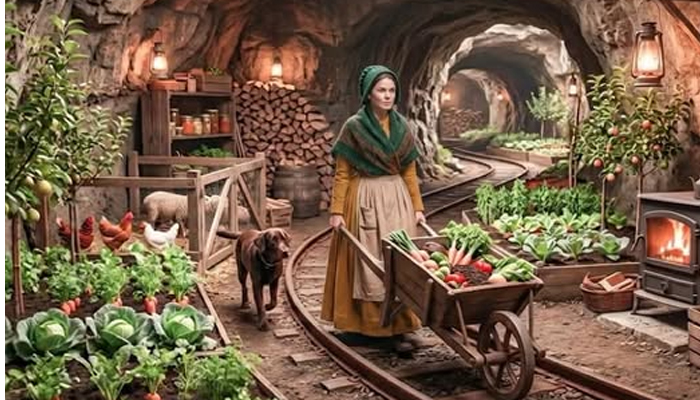
They Laughed at the Woman Hauling Soil Into a Mine — Then the Snow Never Stopped
In the winter of 1873, the people of Silverton believed they understood hardship.
They knew avalanches.
They knew hunger.
They knew what it meant when the mountain winds screamed through the timber walls at midnight and the mercury in the thermometer sank so low it looked as if the glass itself might crack.
But they did not know Eleanor Whitaker.
And that would prove to be their greatest mistake.Eleanor arrived in Silverton in late September, just before the first frost.
She came alone in a creaking wagon pulled by a gray mule named Samson, with a brown cattle dog trotting faithfully beside the wheels. The dog’s name was Rusty, and unlike most men in town, he never doubted her for a second.
She was thirty-two—too old, some whispered, to still be unmarried.
Too quiet.
Too educated.
Too stubborn.
She wore a plain white bonnet, sturdy leather boots, and a brown work apron over her dress. Her hands were rough with calluses, her shoulders broad from years of labor, and her green eyes had the unsettling habit of looking at a thing as though she could already see what it might become.
Silverton was filled with miners, drifters, widowers, gamblers, and men who believed mountains existed to be conquered.
Eleanor believed mountains existed to be understood.
That alone made people uneasy.
She purchased a worthless abandoned mining claim on the outskirts of town—an old silver tunnel that had collapsed in two sections and produced nothing profitable in over a decade.
The townspeople laughed.
Especially when they saw what she did next.
Instead of hauling ore out of the mountain…
She hauled soil in.
Wheelbarrow after wheelbarrow.
Day after day.
Rich black earth.
Compost.
Bundles of seed.
Crates of saplings.
Barrels of manure.
One chilly morning, a group of miners leaned against the saloon railing and watched her push another overloaded barrow toward the mine entrance.
One of them, a broad-shouldered man named Hank Morrison, spat tobacco into the dirt.
“Well I’ll be damned,” he said.
“She thinks she’s feeding rocks.”
The men roared with laughter.
Another called out.
“Miss Whitaker! Planning to grow potatoes for ghosts?”
Even Eleanor smiled.
She stopped, wiped sweat from her brow, and answered calmly.
“No.”
She looked up at the mountain.
“I’m planning to outlive winter.”
That made them laugh even harder.
Eleanor had learned things most frontier women never had.
Her father had been a soil scientist back east near Boston, and her mother had been the daughter of Appalachian homesteaders who could grow vegetables from stone and clay.
By the age of ten, Eleanor understood root systems.
By twelve, she understood underground temperature stability.
By sixteen, she understood people hated what they didn’t understand.
By thirty-two…
She understood mountains.
And she understood snow.
Silverton’s elevation meant winters could arrive early and stay long.
Some years, roads closed for weeks.
Livestock starved.
Coal ran short.
Families burned furniture to survive.
Children went hungry.
But Eleanor had spent months studying abandoned mines throughout the Rockies.
She had noticed something.
Even in January, deep tunnels stayed near fifty degrees.
Never freezing.
Never truly warm.
Stable.
Reliable.
Alive.
So while the town mocked her…
She transformed the abandoned mine.
She reinforced tunnels with cedar beams.
She laid narrow gauge rails through the central cavern.
She dug drainage trenches.
She built raised beds from timber.
She installed oil lanterns from every support post.
She carved ventilation shafts.
She diverted spring water through stone channels.
She planted herbs.
Lettuce.
Cabbage.
Carrots.
Beans.
Tomatoes.
Apple saplings.
Even dwarf pear trees.
Rusty followed her everywhere, his paws kicking dust over newly laid soil.
And when townspeople passed by, they always heard the same sounds from deep within the mountain:
Hammering.
Water.
Animals.
And Eleanor singing old frontier hymns.
By October, the gossip became crueler.
“She’s gone mad.”
“She’s burying herself alive.”
“She should’ve married instead.”
“She’s building a grave.”
Even the preacher questioned her.
Reverend Samuel Pierce visited one afternoon as Eleanor stacked sacks of compost near the mine entrance.
“My child,” he said gently, “God gave us sunlight for a reason.”
Eleanor looked up from her work.
“And He gave us mountains for one too.”
The preacher had no answer.
Then November came.
And with it…
Snow.
At first, it was ordinary.
A few inches.
Then a foot.
Then three.
By Thanksgiving, drifts stood taller than wagon wheels.
By December, supply trains stopped.
No one panicked.
Not yet.
Silverton had seen bad winters before.
But then Christmas came.
And the snow never stopped.
Storm after storm rolled down from the peaks.
Entire cabins disappeared.
Barn roofs collapsed.
Woodpiles vanished under white hills.
Livestock froze standing upright.
Avalanches blocked every mountain pass.
No one came in.
No one got out.
By January, flour cost ten times its usual price.
Beans disappeared.
Salt pork ran out.
Children cried from hunger.
Men stopped laughing.
Then the coal shortage began.
Families burned chairs.
Tables.
Fence posts.
Picture frames.
Anything that would catch flame.
And still…
The snow kept falling.
One morning, Hank Morrison stood outside his cabin, staring at his empty woodpile.
His beard was stiff with ice.
His youngest daughter coughed inside.
His wife hadn’t eaten in nearly two days.
And across the valley…
Smoke rose from Eleanor Whitaker’s mine.
Warm.
Steady.
Golden.
He stared for a long time.
Then he swallowed his pride.
And walked there.
By the time Hank reached the entrance, he could barely feel his fingers.
Rusty barked once, then wagged his tail.
Eleanor emerged carrying a basket of carrots.
She didn’t seem surprised.
She never did.
Hank removed his hat.
Couldn’t quite meet her eyes.
“Miss Whitaker…”
He hesitated.
Then forced the words out.
“I was wrong.”
Eleanor waited.
“My family’s hungry.”
For the first time in months…
She smiled.
“Then come inside.”
Hank stepped into the mountain.
And stopped breathing.
The cavern glowed like another world.
Lanterns cast golden light over rows of green vegetables.
Herbs hung drying from cedar beams.
Tomatoes ripened on vines.
Apple trees stretched toward shafts of filtered daylight.
Chickens clucked in wooden pens.
Goats bleated softly.
A sheep slept near a stove where black iron radiated comforting heat.
And Eleanor…
Eleanor pushed a wooden wheelbarrow overflowing with fresh vegetables along the rail tracks, Rusty trotting proudly beside her.
It looked less like a mine.
And more like Eden.
Hank whispered.
“Sweet Lord…”
Eleanor shrugged.
“Turns out rocks are excellent neighbors.”
By nightfall, word spread through Silverton.
The same people who mocked her.
The same people who laughed.
The same people who called her mad.
Now stood outside her mine in silence.
Men.
Women.
Children.
Widows.
Miners.
Preachers.
Farmers.
Even gamblers.
All waiting.
All humbled.
Eleanor stepped outside with lantern light behind her.
Snow swirled around her bonnet like ash.
No one spoke.
Finally, Reverend Pierce removed his hat.
“Miss Whitaker…”
His voice cracked.
“Can you save us?”
Eleanor looked at the faces.
Proud faces.
Hungry faces.
Scared faces.
Human faces.
Then she answered.
“I can’t save you.”
The crowd fell silent.
Then she smiled.
“But we can save each other.”
The next morning, the town moved underground.
Not all at once.
But enough.
Men brought lumber.
Women brought blankets.
Children carried seed.
Blacksmiths repaired tools.
Carpenters built bunks.
Miners expanded tunnels.
Farmers learned irrigation.
And Eleanor taught everyone.
How roots breathed.
How warmth rose.
How soil lived.
How darkness could grow light.
Weeks passed.
Then months.
Outside, blizzards buried rooftops.
Wolves crossed frozen streets.
Trees split under ice.
But underground…
Silverton lived.
Children laughed.
Bread baked.
Animals thrived.
Vegetables grew.
Songs echoed from stone walls.
And for the first time in memory…
No one went hungry.
By April, when the snow finally began to melt, people emerged from the mountain like survivors from another age.
Travelers arriving in town could hardly believe what they saw.
A mining settlement that should have been dead…
Was alive.
Healthier than before.
Stronger than before.
And at the center of it all…
Was a woman pushing a wooden wheelbarrow beside her dog.
Covered in soil.
Smiling.
Unbothered.
Unapologetic.
That summer, the town council offered Eleanor the highest civic honor Silverton had ever given.
A bronze plaque.
A speech.
A ceremony.
A title.
She declined all of it.
Instead, she asked for only one thing.
A sign above the mine entrance.
Simple.
Hand-carved.
Eight words.
And every child in Silverton would grow up reading them.
WHEN THEY LAUGH, BUILD ANYWAY.
And for the next fifty years…
No one in Silverton ever laughed at a woman hauling soil again.