May Boone had ten dollars folded inside her left boot.
She kept it there because pockets could be picked, backpacks could be stolen, and sleeping with money in your hand only made it easier to lose when exhaustion finally dragged you under. The bill was soft from sweat and rain and being unfolded too many times in gas station bathrooms when hunger tried to talk her into spending it.
Ten dollars was not enough to save a person.
May knew that.
It was not enough for a motel room. Not enough for a bus ticket out of West Virginia. Not enough for a week of food. It was barely enough for coffee, crackers, and one of those sad sandwiches wrapped in plastic under fluorescent lights.
But it was hers.
At twenty-two, that mattered.
She had been homeless for two months by then, though she still hated the word. Homeless sounded like a condition other people had, people with shopping carts and cardboard signs and stories strangers looked away from. May still had a backpack. She still washed her face in restroom sinks. She still brushed her hair. She still tried to sit upright in bus stations like she was waiting for someone who was coming.
No one was coming.
She had learned that slowly, then all at once.
Her mother, Darlene Boone, had worked as a waitress at the Mountain Star truck stop outside Charleston until her feet swelled so badly she had to sit between orders. She had worn white sneakers with cracked soles, carried a pencil behind one ear, and could balance six plates along her forearm without spilling gravy. When her back gave out, she switched to mornings only. Then weekends. Then nothing.
May’s father, Robert, drove a delivery truck until the company shut down and the men were told to come collect their last checks from a locked office with a note taped to the door. After that, he took odd jobs, then fewer jobs, then slipped into long silences no one in the trailer could cross.
They lived off Route 60 in a trailer park with gravel lots, chain-link fences, plastic lawn chairs, and a laundromat at the entrance that had two washers, one of which had been broken since May was twelve. May shared a room with her little sister, Lacey, until Lacey went to live with an aunt in Ohio. May stayed because somebody had to.
Somebody had to pay the electric when her mother couldn’t stand long enough to work doubles.
Somebody had to keep food in the cabinets.
Somebody had to tell the landlord the rent would be there Friday, then make Friday true.
So May left school at seventeen and worked wherever anyone would take her. First washing dishes at the truck stop, her hands split from hot water and bleach. Then bussing tables. Then stocking shelves at a convenience store on the edge of town from two in the afternoon until ten at night. She was good at work in a way that did not get praised. She showed up early. She learned where everything went. She did not complain unless complaint could fix something.
It rarely could.
Her mother died when May was twenty.
Heart failure, the doctor said, standing in a hallway with a clipboard. May heard the words and thought they sounded too clean. Heart failure made it seem as though Darlene’s heart had simply failed at a task, like a car battery or a water heater. It did not say anything about twenty years of hard floors, cheap food, unpaid bills, and getting up before sunrise because rest was not something poor women were allowed to need.
May borrowed money from Hal, the truck stop owner, to bury her.
“Pay me back when you can,” Hal said.
So she did. Twenty dollars every month, sometimes forty if she picked up extra shifts. She paid for her mother’s grave in nine months.
On the day she made the last payment, Hal wrote paid in full across the ledger and gave her a tired smile.
“You did right by her,” he said.
May nodded.
She expected relief.
Instead, she felt as if someone had cut the last rope holding her to the ground.
The trailer was repossessed two months later.
She came home from a shift and found the notice taped to the door. Three days to vacate. No warning that mattered. No mercy hidden in the language. She packed clothes, a photograph of her mother, a pocketknife her father had left behind, two books, a toothbrush, and a cracked blue mug she could not explain wanting.
The rest stayed.
She walked to the Greyhound station in Charleston with thirty-eight dollars and no real plan.
For a while, motion became her plan.
She rode buses because buses were warm, because station benches were safer than alleys, because moving gave the illusion that she was headed toward something. Huntington. Beckley. Charleston again. Hinton. Towns blurred through dirty windows: gas stations, pawn shops, churches, rivers, hills, dollar stores, abandoned factories with broken windows staring at the highway like blind eyes.
She learned how to be invisible.
Sit near a wall. Keep the backpack looped around one arm. Never sleep too deeply. Never look scared. Look tired instead. Tired people are everywhere. Scared people attract attention.
She ate vending machine crackers, gas station hot dogs, and coffee that tasted like burnt plastic. She washed in sinks under fluorescent lights that made her face look hollow and older than it was. Her stomach shrank. Her pride shrank faster. Still, every time she touched the folded ten-dollar bill in her boot, she felt one small part of herself remain private.
It was on a bus from Huntington toward Hinton that May overheard the conversation that changed her life.
Two men sat in front of her, both wearing work boots and flannel jackets stiff with old dirt. They smelled faintly of motor oil and wintergreen tobacco. May had taken the seat behind them because it was near the heater vent and because they seemed more interested in each other than in her.
They were talking about salvage.
Old rail equipment. Scrap steel. Auction lots.
“Railroad’s still trying to clear that dead spur outside Talcott,” one said.
“Nobody wants that mess.”
“They got one Pullman sleeper listed for ten bucks now.”
“Ten?”
“Ten. Been sitting there since God was young. Built in the forties, I heard.”
“Rusted through, I bet.”
“Probably full of raccoons.”
The men laughed.
May looked up from the paperback she had not been reading.
The first man continued. “Whoever buys it gets the car and use of the two hundred feet of track. Some defunct rail company still holds the strip on paper, but nobody’s claimed it in decades. County just wants it off the books.”
“Not worth the gas to see it.”
“Scrap would cost more to haul than it’s worth.”
They moved on to football.
May stayed still.
A railroad car.
She pictured it before she meant to: walls, roof, windows, a door. Something that sat in one place. Something too heavy to be pushed out by a landlord’s notice. Something that did not need rent if no one wanted it. Something abandoned enough that maybe it could understand her.
Ten dollars.
Her foot shifted inside her boot.
When the bus pulled into Hinton, May got off.
The town sat along the New River, tucked between green hills and old railroad bones. The air smelled of water, wet stone, and wood smoke. She found the county clerk’s office in a brick building that smelled of old paper and lemon cleaner. Behind the counter, a woman with curly brown hair and reading glasses looked up.
“Can I help you?”
“I’m asking about a railroad salvage listing,” May said, aware of her dirty backpack, her worn boots, the way her jacket hung loose. “Old Pullman sleeper near Talcott.”
The clerk typed. Her eyebrows lifted slightly.
“That one’s been listed eight months.”
“I heard it was ten dollars.”
“That’s the minimum bid, yes.”
“I want to bid.”
The clerk looked at her with careful eyes. Not cruel. Not mocking. But concerned in the way adults looked at children near traffic.
“You understand this thing has no utilities. No road access. It sits about a mile off the paved road on an abandoned spur. No electric, no water, no septic, no guarantee of condition. Sold strictly as is.”
“I understand.”
“Do you have somewhere else to live?”
May held the woman’s gaze.
“No.”
That quieted the office more than May intended.
The clerk’s face softened.
“Honey, this isn’t a house.”
“I know.”
“It may not even be safe.”
“Then I’ll find out.”
The clerk studied her for a moment longer, then printed a form.
“Name?”
“May Boone.”
“Boone?” The woman paused. “There used to be Boones over around Talcott.”
“My father was Robert Boone.”
“I don’t know that name.” She slid the form across. “Sign here.”
May took off her boot under the counter, pulled out the folded ten-dollar bill, smoothed it flat, and placed it on the desk.
The clerk looked at the money.
Then at May.
Then she stamped the form.
“God help you,” she said quietly.
May folded the receipt and put it in her backpack.
She walked to Talcott that afternoon.
It took nearly two hours along Route 3, with the New River running beside her, wide and green and alive. Trucks passed now and then, pushing air against her coat. The hills rose steep on either side, crowded with oak, hickory, pine, and laurel. Hawks circled above the ridgeline. Somewhere far off, a train horn blew, lonely and long, though May could not see the tracks.
She stopped on a bridge and looked down at the river.
The water moved fast over smooth stone, dark in the shadows and silver where sunlight touched it. The bridge hummed faintly beneath her boots.
For the first time in weeks, she felt something steadier than fear.
The river had no opinion of her. It did not know she had slept in stations or eaten crackers for dinner. It did not care that she had ten dollars less than nothing now. It had been moving before her and would keep moving after her. There was comfort in that indifference.
Talcott was barely a town.
A post office. A church. A volunteer fire station. A few houses spread along the road. A faded historical marker mentioned John Henry and the Big Bend Tunnel, the steel-driving man who raced a steam drill through the mountain and died with his hammer in his hand. May passed it without stopping, though the name stuck in her mind.
A man who worked himself to death to prove he was stronger than a machine.
West Virginia knew how to make legends out of exhaustion.
A mile past town, she found the gravel road. It curved into trees and ended at a rusted gate with a loose chain and a broken lock. Beyond it, the old rail bed disappeared into the woods.
The rails were still there, half-buried in dirt and leaves. Rotten ties held their shape beneath moss. Ferns grew between steel. Branches crossed the path, brushing May’s arms and face as she pushed through. The air under the trees cooled by ten degrees. Birds called above her. Something small moved in the leaves.
Then she saw it.
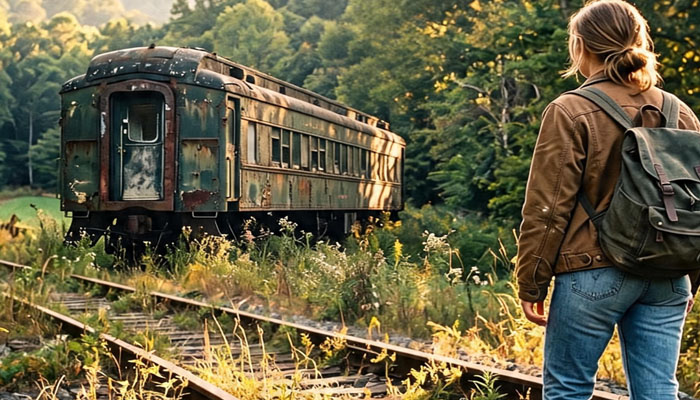
The railroad car sat at the end of the dead track in a clearing surrounded by trees.
It was enormous.
Longer than she expected, about eighty feet, with a rounded roof, riveted steel sides, and a row of grimy windows. Its paint had once been deep green, but time had stripped most of it away, leaving rust, bare metal, and faded patches of old dignity. Kudzu climbed near the rear bumper. Weeds swallowed the steps. One vestibule door hung slightly open.
May stood in the clearing, backpack heavy on her shoulders, and looked at the thing she had bought.
Ten dollars.
All she had left in the world.
A rusted Pullman sleeper at the end of a dead track.
People would laugh if they saw her.
Maybe they were right to.
Then the wind moved through the trees, and the old car creaked softly on its steel wheels.
It sounded almost like an invitation.
May climbed the narrow steps and pushed open the door.
Part 2
Inside, the railroad car was dim and cold.
Not dirty in the way May expected. Not ruined. Just sealed away. The air held the stale breath of old wood, dust, metal, and decades without footsteps. A narrow corridor ran along one side, stretching into shadow. Sleeping compartments opened off it, six on each side, their sliding doors half-open or stuck in place.
May stood in the vestibule until her eyes adjusted.
The walls were paneled in dark wood, dulled almost black by grime. Brass fixtures lined the arched ceiling, green with tarnish. The carpet in the corridor was worn to threads, but beneath torn sections she saw what looked like hardwood. The compartments held old bench seats with faded upholstery, some split open, horsehair stuffing showing like wounds.
She walked slowly.
Every step stirred dust.
In the first compartment, she found a cracked mirror and an old coat hook. In the second, a stack of yellowed newspapers from the 1970s. In the third, an empty glass soda bottle wedged under the bench. The windows were clouded but mostly intact. Thin light filtered through them, turning the interior the color of weak tea.
It was not a home.
Not yet.
But it was shelter.
The thought hit her so hard she had to sit down.
Shelter.
Walls. Roof. Door.
No station guard telling her to move along. No landlord’s notice. No bus driver watching her too closely. No fluorescent lights. No strangers stepping over her backpack. The car smelled old and lonely, but it did not feel hostile.
At the far end, past the last sleeping compartment, she found the locked door.
It looked wrong.
All the other doors were wood. This one was steel, set into a welded frame, with a heavy brass handle and an old deadbolt. Its surface had been painted the same dark color as the paneling, but poorly, as if someone wanted it ignored more than hidden.
May tried the handle.
Locked.
She leaned her shoulder against it.
Nothing.
She went back outside and walked around to the rear of the car. The windows at that end were covered from inside with dark plates. She tried to peer through cracks but saw nothing.
The hidden space bothered her.
Not because she expected treasure. People like May did not expect treasure. They expected mold, rats, unpaid fees, and reasons hope had been foolish.
But the door meant someone had cared enough to lock something away.
She searched the weeds and found a length of rusted rebar. Back inside, she studied the hinges. The pins were accessible. Heavy, painted over, but not impossible. Her father had once taught her how to tap out hinge pins when a trailer door swelled in summer humidity.
She braced the rebar beneath the first pin and tapped with a loose piece of metal she found near the vestibule.
The sound rang down the corridor.
She froze, listening.
Nothing answered.
It took nearly an hour. Her hands cramped. Sweat gathered under her coat despite the cool air. Twice the rebar slipped and scraped her knuckles raw. But the first pin rose, then the second, then the third. When the final hinge loosened, the door sagged.
May pulled it carefully away and leaned it against the wall.
Behind it was a room she did not understand at first.
The rear fifteen feet of the car had been sealed completely. Steel plates covered the windows from inside. Shelves lined both walls from floor to ceiling. Dust lay thick on everything, but beneath it was order. Care. Rows and rows of cigar boxes, each one facing outward, labels visible, stacked neatly by size and color.
Dozens of them.
Maybe a hundred.
May stood in the doorway, breathing shallowly.
The room felt different from the rest of the car. Not abandoned. Waiting.
She picked up the nearest cigar box.
The cardboard lid resisted, then opened with a soft crackle.
Inside were bundles of paper money held by rubber bands gone dry and brittle.
May stared.
She did not move.
Then she laughed once, sharp and disbelieving.
“No.”
She opened another box.
More money.
Another.
Silver coins.
Another.
Gold coins in small felt pouches.
Another.
Folded papers with ornate borders: stock certificates.
May backed up until she hit the opposite shelf and slid down to the floor.
Light from the corridor lay across the dusty boards. Her own breathing sounded too loud. She expected someone to appear behind her and say there had been a mistake. That she had trespassed. That poor girls did not find rooms full of money in railroad cars they bought with the last ten dollars in their boots.
But no one came.
Only the trees outside moved in the wind.
May began counting.
She counted because counting was something real to do with hands that had started shaking. She made stacks on the floor. Tens. Twenties. Fifties. Some bills were old, some newer, none later than the 1990s. The rubber bands crumbled. Dust stuck to her fingers. She opened every box, one by one.
Some held a few hundred.
Some held thousands.
Coins clinked heavily in her palm. Silver dollars worn smooth. Gold pieces with edges that caught the dim light. She did not know their value, but she knew enough to handle them carefully.
Three hours passed.
By the time she finished the paper money, the sum written in pencil on the back of an envelope was $38,400.
May stared at the number.
Thirty-eight thousand four hundred dollars.
That was more money than she had ever seen. More than her mother made in a year some years. More than the trailer had been worth. More than all her emergency imaginings put together.
At the bottom of the last shelf, behind three empty cigar boxes, she found an old metal lunch pail.
Blue once, now scratched gray. The clasp stuck, then popped open.
Inside was a black-and-white photograph and a folded letter.
The photograph showed a man standing beside the railroad car when it was still freshly painted and proud. He wore overalls, a railroad cap, and a smile so restrained it looked almost embarrassed. He was lean, weathered, maybe sixty, with one hand resting on the car’s side as if touching an old friend.
May unfolded the letter.
The handwriting was blocky and careful, written by a man who formed each word as if it deserved respect.
My name is Earl Boone.
I worked for the C&O Railroad for thirty-seven years. Brakeman, conductor, yard supervisor. When the line shut down in 1978, I bought this car with my severance pay. They sold it cheap because nobody wanted old things once they stop earning.
I have been saving money in this car since then. I do not trust banks. My father lost everything in 1933 and I never forgot it.
If anyone from my family finds this, know that I never forgot you.
I had a son named Robert. He left home in 1972. I do not know where he went. If Robert has children, they are my blood. This belongs to them.
Earl Boone
Talcott, West Virginia
March 1998
May read the name again.
Robert.
Her father’s name was Robert Boone.
She read the letter three times. Then again. The words did not change.
I had a son named Robert.
She thought of her father standing outside the trailer smoking in the dark, his face turned toward the highway. She thought of how little he had said about his past. No childhood stories. No grandparents. No hometown. When May asked once where he grew up, he had said, “Up river,” and gone quiet.
Up river had a name.
Talcott.
Earl Boone was her grandfather.
The sealed room blurred.
May pressed the letter against her chest and began to cry.
She cried for her mother, who had worked herself down to bone and never known there was money hidden in the hills. She cried for her father, who had run from a man who never stopped waiting. She cried for the trailer, the bus stations, the nights pretending not to be afraid. She cried for Earl Boone, saving cigar box after cigar box for blood he did not know would ever come.
Most of all, she cried because, for the first time in her life, something had been left for her.
Not a bill.
Not a grave.
Not a warning taped to a door.
A legacy.
Rough, hidden, dusty, and nearly lost.
But hers.
As evening darkened the corridor, May carried the lunch pail to the vestibule and sat on the steps. The woods smelled of damp leaves and river air. The rails stretched away beneath weeds, going nowhere.
She held the photograph in one hand and the letter in the other.
“Grandpa,” she whispered, the word strange on her tongue.
The old railroad car settled beneath her with a faint metallic sigh.
Part 3
May did not sleep inside the hidden room that night.
She wanted to. She wanted to close the door, curl around the lunch pail, and let the steel walls guard her from every hungry thing in the world. But fear had kept her alive too long to be dismissed by sudden fortune.
She packed the money back into the cigar boxes, stacked them as she had found them, and carried only the letter, photograph, and two hundred dollars in cash. Then she set the steel door back loosely in place, dragged an old bench against it, and slept in the vestibule with her backpack under her head and the pocketknife open beside her hand.
Every sound woke her.
Owls. Wind. Branches. The metal frame ticking as the night cooled. Once, something rustled outside, and May sat upright for twenty minutes gripping the knife until a possum waddled past the steps and vanished into weeds.
At dawn, pale light seeped through dirty windows.
May washed her face in the river, cold water shocking her skin awake. Then she walked back to Hinton with the lunch pail in her backpack and the cash tucked under her shirt.
The bank teller counted the money twice.
May stood at the counter, trying not to look suspicious, which probably made her look more suspicious. The teller, a young woman with pink nail polish, stacked bills into the machine and frowned when the total appeared.
“Would you like to deposit the full amount?”
“Yes.”
“Do you currently have an account with us?”
“No.”
The teller’s eyes flicked over May’s backpack, worn jacket, muddy cuffs.
May lifted her chin.
“I’d like to open one.”
A manager came over. Forms appeared. Questions were asked. May answered carefully. She did not mention cigar boxes, gold coins, or a sealed railroad room. She said she had found family savings in inherited property. That was true. The truth, she was learning, sometimes needed a fence around it until you knew who was safe.
When she walked out, she had a checking account, a savings account, a temporary debit card, and $38,200 she had not spent.
The sunlight outside looked different.
Not brighter exactly.
Less accusing.
By noon, she had bought a used truck.
A 2001 Ford F-150 with a camper shell, faded red paint, 152,000 miles, and a tape deck that still worked. The seller was an old man from Hinton whose knees hurt too badly to climb into it anymore.
“She ain’t pretty,” he said, patting the hood.
“Neither am I,” May replied.
He laughed and knocked three hundred dollars off the price.
She bought groceries next. Real groceries. Eggs, bread, coffee, beans, potatoes, apples, peanut butter, a cast-iron skillet from a thrift store, soap, gloves, trash bags, a flashlight, batteries, a broom, a pry bar, a hammer, nails, and a tarp.
At the hardware store, a man behind the counter watched her pile supplies onto the counter.
“Big project?”
“Railroad car.”
He blinked.
“You the one bought that old Pullman?”
May braced herself.
“Yes.”
He grinned. “Lord. Folks been joking about that thing for months.”
“They still can.”
“You living in it?”
“That’s the idea.”
The grin faded into something between concern and respect.
“You got tools?”
“Some now.”
“You got power?”
“No.”
“Water?”
“No.”
“Experience?”
May looked him dead in the eye.
“I’ve been poor my whole life.”
The man leaned back.
“Well,” he said after a moment, “that counts for more than folks admit.”
He told her which cleaning supplies to use on old wood, which gloves would last, which respirator was cheap but decent, and where to find a welder who would not cheat her.
For two weeks, May lived in the truck.
She parked near the rusted gate and walked the old rail bed every morning carrying supplies. The first thing she did was open the car to air. She forced windows loose one by one. Some resisted. One cracked. She cursed, taped it, and kept going. She propped the vestibule doors at both ends and let mountain air move through the corridor for the first time in decades.
Dust lifted and spun in sunlight.
The car breathed.
She cleaned from front to back.
She swept out leaves, dead insects, mouse droppings, and the fine gray powder of old upholstery. She tore up rotted carpet and found oak flooring underneath, scarred but solid. She scrubbed the floors on her knees until the water in the bucket turned black. She cleaned mahogany panels with oil soap, watching grain appear from beneath grime like memory rising through sorrow.
The work was exhausting in a way that felt different from survival.
Bus station exhaustion left her emptier.
This work filled something as it drained her.
At night, she cooked beans on a camp stove beside the truck and ate from the cast-iron skillet. She kept Earl’s letter folded in a plastic bag under her pillow. Sometimes she read it by flashlight.
If Robert has children, they are my blood.
No one had ever called May blood like that. Not as claim. Not as promise.
The people of Talcott noticed her slowly.
First the postmistress, who processed her change of address to “Pullman Car Spur, Talcott Road,” stared for a full ten seconds, then said, “Well, I guess that’ll do.”
Then the volunteer fire chief drove out after seeing smoke from a burn barrel.
He was a square man named Curtis Hale with a gray mustache and a suspicious squint. He found May burning rotted carpet scraps in a cleared patch, a bucket of water nearby.
“You got a permit for that?”
“No.”
“You know you need one?”
“No.”
He looked at the burn pile, the bucket, the railroad car, May’s filthy clothes, and the broom in her hand.
“You Earl Boone’s kin?”
May straightened.
“Granddaughter.”
Curtis removed his cap.
“Well, I’ll be.”
“You knew him?”
“Knew of him. Quiet man. Railroad through and through.” He put the cap back on. “Don’t burn carpet. Stinks and it’s probably toxic. Bring that mess to the transfer station. I’ll write you the address.”
He did not fine her.
Two days later, he returned with a fire extinguisher.
“Every home needs one,” he said gruffly.
May looked at the old car.
“Is that what this is?”
Curtis shrugged.
“Looks more like one every day.”
The first month was for making the car safe.
The welder from Hinton was named Dennis Ward, and he arrived in a white truck full of tools, chewing gum and looking skeptical.
“Bought this for ten dollars?”
“Yes.”
“Overpaid by nine.”
May said nothing.
He inspected the frame, undercarriage, steps, couplers, and steel shell. He tapped rust with a hammer, crawled beneath with a flashlight, muttered to himself, and emerged with dirt on his shirt.
“Well?”
Dennis spat into the weeds.
“Ugly ain’t the same as unsound.”
May felt her chest loosen.
“The frame’s good. Heavy Pullman construction. Built back when steel meant steel. Got some floor spots need patching and those steps will kill you if you trust them, but she’s not going anywhere.”
“How much?”
“For inspection, patches, steps?” He looked at her. “Nine hundred.”
May swallowed. “Do it.”
He did.
While sparks flew beneath the car, Dennis asked, “You got family around?”
“No.”
“Then don’t tell everybody your business.”
May looked at him.
He kept welding.
“Folks hear young woman alone has money, they start remembering all kinds of reasons to visit.”
It was the closest thing to kindness some men could manage.
May listened.
She took the gold and silver coins to a reputable dealer in Charleston recommended by the bank manager, not by anyone in Talcott. She sold only enough to fund repairs, keeping most in a safe deposit box. The dealer valued the coins at more than fourteen thousand dollars. May nodded as if numbers like that did not make the floor tilt beneath her.
The old stock certificates were mostly worthless as investments, though some collectors might want them.
She kept those.
They belonged to Earl’s story.
By the second month, May had a plan drawn in a spiral notebook.
Kitchen in the center compartments. Sleeping space near the rear. Wood stove forward. Storage in the hidden room, but no longer hidden from herself. Spring water if she could manage it. Solar power eventually. Composting toilet first, proper plumbing later.
The work became a rhythm.
Measure. Cut. Carry. Clean. Learn. Fail. Try again.
She insulated the walls with rigid foam board, cutting each piece to fit the curved steel shell. She glued panels in place with construction adhesive, hands aching from pressing overhead. Over that, she mounted thin plywood stained dark to match the original wood. It was imperfect. Some seams showed. A few panels bowed slightly. But when she finished the first section, the temperature difference stunned her.
The car no longer felt like a steel cave.
It held warmth.
In the evenings, she sat on the vestibule steps and watched the woods darken. The New River moved somewhere beyond the trees, unseen but constant. Trains still passed on active tracks far off, their horns carrying through the valley like voices from another life.
Sometimes loneliness came hard.
She missed her mother most at ordinary moments. Opening coffee. Folding a blanket. Burning toast. She missed the version of her father who had once lifted her onto his shoulders to watch fireworks over a Walmart parking lot. She wondered what had happened between Robert and Earl, what kind of hurt had been strong enough to split father from son and quiet enough to follow them both into death.
One evening, she spoke aloud into the car.
“Why didn’t you come back, Dad?”
Only the steel answered, ticking as it cooled.
Part 4
By the fourth month, the railroad car had become something people slowed down to see.
Not that it was visible from the main road. It still sat hidden in its clearing at the end of the old spur, but word had traveled through Talcott, Hinton, and half the county. The girl living in Earl Boone’s old Pullman. The homeless one. The one who bought it for ten dollars. The one fixing it herself.
Some stories added raccoons. Some added ghosts. One version had May inheriting a gold mine. Another had her running from the law. West Virginia towns had a way of making myth from a shortage of facts.
May let people talk.
She was too busy to correct them.
She found the spring in early summer.
She had followed deer tracks uphill behind the car, cutting through laurel and hemlock, when she heard water over stone. At the base of a limestone ledge, clear water poured into a shallow pool and ran downhill through moss.
May knelt and cupped it in both hands.
Cold. Clean. Strong.
She laughed so suddenly a crow startled from a branch above her.
Running water changed everything.
Running water meant washing dishes without hauling jugs. It meant bathing properly. It meant a sink. It meant roots going deeper into the place.
She bought PVC pipe, fittings, a filter, and a small storage tank. Curtis Hale helped her mark a safe path. Dennis loaned her a trenching shovel but did not offer to dig.
“Your home,” he said. “Your trench.”
So she dug.
Four hundred yards through root, clay, stone, and slope. Five days of work. Her palms blistered under gloves. Her shoulders burned. Mud caked her jeans. Twice rain filled sections she had already opened. She cried once, sitting in the trench with clay on her face, then got up because the trench did not care about tears.
When water finally flowed from the spring-fed tank into the small kitchen sink she had installed in the old smoking compartment, May turned the faucet on and off six times just to watch it happen.
The first time she washed her face in her own sink, she sobbed into both hands.
Electric came slower.
A generator first, bought used. Then four solar panels mounted on a rack beside the car, angled toward the clearing’s best light. A man named Preacher Collins, who was not a preacher but had been called that since childhood for reasons no one explained, helped wire the battery bank in exchange for cash and three dinners.
“Won’t run a mansion,” he said.
“I don’t have a mansion.”
“Run lights, phone, little fridge, maybe a fan.”
“That’s a kingdom.”
He grinned. “You got low standards.”
“No,” May said, looking down the length of the car, now glowing in lamplight. “I got specific standards.”
The sleeping compartments became rooms one by one.
She rebuilt berths with pine lumber, canvas, and foam. She kept one for herself near the rear, where the window looked into trees. She hung a curtain across the doorway, set Earl’s photograph and letter on a small shelf, and placed her mother’s picture beside them.
Three generations watched over the narrow bed.
The hidden room became storage and memory. May removed the steel plates from the windows, letting in light for the first time since Earl had sealed them. She cleaned every cigar box, repaired the cracked ones, and arranged them on shelves above the kitchen counter. Some held tea bags, matches, screws, seeds, spare keys. Three she left empty.
Empty boxes had started to mean something to her.
Space waiting for what came next.
Opal Whitaker arrived on a hot afternoon in July carrying a casserole and a photograph.
She was eighty-seven, small as a bird, with white hair braided around her head and eyes that had missed nothing since the Truman administration. She climbed the vestibule steps slowly, refusing May’s hand until the last step.
“You Earl’s granddaughter?”
“Yes, ma’am.”
“Don’t ma’am me too hard. Makes me feel fossilized.”
May smiled and opened the door.
Opal stepped inside and stopped.
“Well,” she said softly. “Look at this.”
The car had not become fancy. May could not afford fancy and did not trust it. But it was clean, warm, and alive. Sunlight moved across polished wood. Brass fixtures glowed above. A small wood stove sat in the forward section, black and sturdy. The kitchen counter was cherry wood, sanded smooth by May’s hands. Curtains made from old flour sacks hung at the windows. A braided rug from a Hinton thrift store lay in the living space.
Opal touched the wall.
“Earl would sit right down and cry if he saw this.”
May looked away.
“I didn’t know him.”
“I know.”
Opal set the casserole on the counter and removed a photograph from her purse.
“I did.”
The photograph was black-and-white with scalloped edges and a crease down the middle. It showed Earl Boone standing by railroad tracks near the Big Bend Tunnel. He was younger than in the lunch pail photo, still lean and work-worn, wearing his railroad cap. Beside him stood a little boy of maybe five, holding Earl’s hand with both of his.
The boy had dark hair, serious eyes, and a familiar set to his mouth.
May’s breath caught.
“Robert,” Opal said. “Your daddy. I took that picture in 1970 or ’71.”
May touched the boy’s face with one finger.
“Earl loved that child,” Opal continued. “Carried him everywhere. Bought him licorice at the store. Let him sit in the yard office when he wasn’t supposed to. After Robert left, Earl went quiet in a way that scared people. Not angry. Just gone behind the eyes.”
“Why did Dad leave?”
Opal sighed and sat carefully on one of the rebuilt berths.
“Pride. Hurt. Men.” She shook her head. “Robert wanted out. Said the railroad would eat him like it ate every Boone man. Earl wanted him to stay. They said things. Bad things. The kind fathers and sons say when both are scared and neither knows how to admit love without making it sound like control.”
May sat across from her.
“My dad never mentioned him.”
“Hurt makes its own religion,” Opal said. “Some folks worship silence the rest of their lives.”
The words stayed with May.
That night, she placed Opal’s photograph beside Earl’s letter and her mother’s picture. The shelf became an altar of almosts: people who had loved, failed, left, waited, worked, and died without knowing how close they had come to one another.
In August, a storm tested the car.
It came down the valley fast, black clouds swallowing the ridge by late afternoon. Wind thrashed the trees. Rain hammered the steel roof so loudly May could barely hear herself think. Water ran hard down the old rail bed. Lightning cracked over the hills, flashing white through every window.
May moved through the car with a flashlight, checking seals, buckets, stove pipe, door latches. One window leaked. She stuffed it with towels. The spring line held. The solar rack shook but stayed fixed. Then, near midnight, a tree came down across the path with a crash so violent the whole car trembled.
May froze.
For a second, she was back in bus stations and trailer bedrooms, waiting for the next bad thing to enter.
Then she remembered.
This was her place.
Bad things could come, but she was allowed to fight for it.
At dawn, the clearing steamed under gray light. The fallen tree blocked the path completely. Curtis arrived with a chainsaw before she finished breakfast.
“Figured you’d need cutting out.”
“I was going to handle it.”
“Sure,” he said. “You got a chainsaw?”
“No.”
“Then you were going to stare it into pieces?”
She laughed.
They cut the tree together. Curtis ran the saw. May hauled limbs until her arms shook. By noon, the path was open.
“Storm scare you?” he asked.
“Yes.”
“Good. Only fools ain’t scared of trees and weather.”
He looked at the car.
“She hold?”
May followed his gaze.
The old Pullman sat wet and streaked with leaves, but solid.
“She held.”
Curtis nodded.
“Then I reckon she’s yours now.”
In September, May took a job three mornings a week at the general store in Talcott. Not because she was desperate anymore, but because cash needed to come from somewhere besides Earl’s boxes. The money he left had saved her, but she understood savings differently now. Savings was not something to spend until empty. Savings was faith turned into a tool.
She opened a small account for repairs, one for taxes, one for emergencies, one she named future though she did not yet know what future meant.
People at the store asked questions.
Some kindly. Some nosy.
“Is it true there was money hidden in that car?”
“Is it true Earl left it all to you?”
“Is it true you’re turning it into some kind of tourist place?”
May learned to answer without giving away what belonged only to her.
“Earl left me enough to start.”
“I’m making it a home.”
“Not everything needs to be turned into business.”
But the idea of sharing the car did begin to grow.
Not as spectacle.
As refuge.
There were other girls like her. Other people moving without a place to stop. People one bad month away from a station bench. She could not save all of them. She was not foolish enough to think a railroad car and a dead man’s savings could mend the world.
But maybe one compartment could hold someone for a week.
Maybe two.
Maybe the empty boxes were not the only things waiting to be filled.
Part 5
October came like fire.
The hills around Talcott turned orange, red, gold, and deep brown, colors so bright they made the valley look briefly rich beyond money. The air sharpened. Mornings smelled of smoke, wet leaves, and iron rails. The New River ran green and cold beneath mist.
May sat on the vestibule steps with coffee in the cracked blue mug she had carried from the trailer.
Her mug.
Her steps.
Her door.
The words still surprised her.
The Pullman was not finished. A home never was. The roof needed another coat of sealant. One compartment still stored tools. The bathroom drain line was temperamental. The woodpile was smaller than it should be for winter. A mouse had gotten into the tea box the week before, causing language Earl might not have approved of.
But it was home.
Inside, the stove waited for evening. The bed was made. Clean jars lined the shelf. Earl’s cigar boxes looked down from above the kitchen counter, bright labels facing outward like little banners of persistence. The hidden room held records now: Earl’s letter, photographs, the old stock certificates, May’s notebooks, repair receipts, maps of the spring line, bank papers, and a new folder labeled Boone Railcar Refuge.
She had filed the paperwork in September.
Nothing grand. Nothing official enough to impress people who liked impressive things. Just the beginning of a small nonprofit fund that would eventually, if she could manage it, help young people without housing get temporary shelter, transportation, work clothes, application fees, and one thing May believed mattered more than people admitted: an address.
“You can’t rebuild a life out of nowhere,” she told Janice at the county office.
Janice was the clerk who had sold her the car for ten dollars. She had become something like a witness to May’s second life.
“No,” Janice said, signing as notary. “But apparently you can rebuild one out of a railroad car.”
The first person May helped was a nineteen-year-old named Riley who showed up at the general store asking if anyone knew where she could sleep without police moving her along. She had left a bad house in Beckley, had one duffel bag, and kept saying she was fine in the exact tone May used when she was not fine.
May gave her the forward compartment for four nights.
Riley slept eighteen hours the first day.
When she woke, she cried because May had folded clean clothes at the foot of the berth and left soup warming on the stove.
“I can’t pay you,” Riley said.
“I know.”
“Why are you doing this?”
May looked toward Earl’s photograph.
“Someone saved a place for me before he knew my name.”
The story of Earl Boone became known properly that fall.
Not the exaggerated version. The real one, or as much of it as May could piece together. Opal brought more memories. Curtis found an old railroad newsletter mentioning Earl’s retirement. The historical society in Hinton located employment records. A man from the C&O retirees’ group remembered Earl as “steady as a spike and twice as quiet.”
On the anniversary of Earl’s death, May invited the town to the clearing.
She almost regretted it when thirty people showed up.
They came walking the old rail bed carrying covered dishes, folding chairs, coffee thermoses, and the awkward tenderness of people trying not to stare too hard at something meaningful. Curtis cleared a fire ring. Opal wore a blue coat and insisted on sitting where she could see the car’s nameplate. Dennis brought biscuits. Preacher Collins brought a guitar but thankfully did not play until after everyone had eaten.
May had painted the car by then.
Not perfectly. Not professionally. But the rust had been sanded, patched, and primed. The sides were deep green again, close to the original color in Earl’s photograph. Along the side, in cream letters, she had painted:
BOONE
Under it, smaller:
C&O Pullman Sleeper, 1946
People walked around it softly, as if visiting a church built from steel.
At dusk, May stood on the vestibule steps with Earl’s letter in her hand.
Her voice shook at first.
“My name is May Boone,” she began, then smiled because everyone there already knew that. “Most of you know I bought this car for ten dollars because I had nowhere else to go. What you may not know is that my grandfather, Earl Boone, bought it first. He worked the railroad thirty-seven years. He saved here. He waited here. He left something for family he wasn’t sure would ever find him.”
The crowd was quiet.
“My father was Robert Boone. He left Talcott young. He never came back. I don’t know all the reasons. Maybe I never will. But I know this. Earl did not stop loving him. He did not stop hoping. And because he kept hoping, I am standing here with a home.”
Opal wiped her eyes.
May looked down at the letter.
“I used to think inheritance meant money, land, things rich people fought over. But sometimes inheritance is a locked room no one else bothered to open. Sometimes it’s a letter from a man you never met saying you belong to somebody. Sometimes it’s enough money to stop running and enough work to become yourself.”
Her throat tightened.
“This car saved me. I’m going to use it to help save somebody else if I can.”
No one clapped right away.
The woods held the silence. The rails gleamed faintly in firelight. Somewhere beyond the trees, the river moved over stone.
Then Curtis removed his cap.
One by one, others did too.
That winter was hard.
West Virginia winters in the hills do not care about sentimental speeches. Cold settled into the valley. Snow blocked the rail bed twice. The spring line froze once where May had failed to bury it deep enough near a rock shelf. She spent a brutal morning thawing pipe with warm towels and language that would have made Opal pray for her. Firewood vanished faster than expected. Condensation formed near one rear window until she corrected the insulation gap.
But the car held.
Riley returned in January with a job at the diner and a room rented above a garage. She brought May a houseplant in a cracked pot.
“For the refuge,” she said.
“It’s one plant.”
“Everything starts as one something.”
May placed it in the window.
By spring, Boone Railcar Refuge had helped five people in small ways. A bus ticket. A week of shelter. Work boots. Phone minutes. A mailing address. Nothing dramatic enough for headlines. Everything practical enough to matter.
A regional paper eventually ran a story.
Homeless Woman Buys $10 Railcar, Finds Family Legacy, Builds Mountain Refuge.
May hated the headline but accepted the attention because donations followed. Not huge money. Fifty dollars here. Twenty there. A retired railroad worker mailed a check for five hundred with a note that said, Earl was a good man. Glad his car is working again.
That note made May cry harder than the check.
Years passed, as years do once a person has stopped running long enough to notice them.
The old spur became a path people respected. Volunteers helped maintain it. Curtis installed a proper emergency access gate. Dennis taught May basic welding. Preacher improved the solar array. Opal, before she died at ninety, gave May a box of photographs, including one of Earl holding Robert as a baby, both of them squinting in bright sun.
May framed it.
The Pullman became famous in a quiet way. Not tourist famous. Not the kind of famous that ruins a place by making it perform itself. People in trouble heard about it. Social workers called. Churches called. Sometimes police called, careful now because Curtis had educated them firmly on the difference between vagrancy and survival.
May never took more people than the car could hold safely. Two guests at a time. Sometimes three in emergency weather. Everyone had chores because shelter without dignity becomes charity, and May had never trusted charity that needed people small.
Guests split wood, cooked, cleaned, helped in the garden, painted, repaired, learned bank forms, job applications, bus routes, boundaries. Some stayed a week. Some stayed a month. Some left badly. Some came back to apologize. Some disappeared. Some sent postcards years later from places where they had finally unpacked.
May kept every postcard in an Earl cigar box labeled Proof.
On the tenth anniversary of the day she bought the Pullman, May woke before dawn and walked to the bridge over the New River.
She was thirty-two now.
Her hands were stronger. Her hair had a streak of gray near one temple she blamed on plumbing. She wore good boots, not new but well cared for, and a wool coat bought full price because she could afford it and because warmth had become one of her firm beliefs.
The river below moved green-black in morning shadow.
She remembered standing there at twenty-two, empty except for fear, watching water and trying to borrow steadiness from it.
She had not known then that she was walking toward blood. Toward Earl. Toward a locked room. Toward work. Toward herself.
Back at the car, the first light touched the green steel sides.
The name BOONE glowed softly.
Inside, coffee waited. The stove held coals. A young woman named Tasha slept in the forward compartment after arriving two nights earlier with a busted lip, a trash bag of clothes, and a silence May did not push. The houseplant Riley had given her years ago had grown huge in the window. Earl’s photograph stood beside Darlene’s, Robert’s, and Opal’s.
May took Earl’s letter from its protective sleeve and read it again.
If anyone from my family finds this, know that I never forgot you.
“I found it,” she said softly.
The car creaked as sunlight warmed its steel.
May smiled.
For a long time, she had believed being poor meant living with what disappeared. Paychecks. Homes. Parents. Promises. Sleep. Safety. Hope.
Earl had taught her another kind of poverty existed too: the poverty of not knowing you were loved somewhere, by someone, even imperfectly, even too late.
And he had taught her a kind of wealth no bank statement could fully measure.
A place to stay.
A name to carry.
A door that opened.
An empty box waiting for what came next.
May stepped outside onto the vestibule platform. The woods smelled of spring mud and river mist. Birds moved in the branches. The rails beneath the car, once dead and forgotten, shone faintly where years of footsteps had polished them clean.
At the edge of the clearing, the old track still ended at the rusted bumper stop.
But May no longer saw it as the end of anything.
She saw it as the place where running stopped.
And where a life, against all odds, began.