She Squeezed Into a 30-Foot Crack to Escape the Storm—What She Found Inside Saved Her Life
The wind began howling before sunrise.
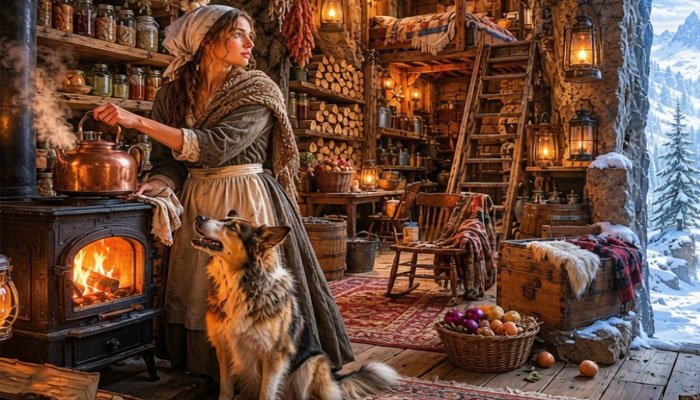
Martha Collins stood on the porch of her small cabin high in the Rocky Mountains of Colorado, one hand gripping the wooden railing and the other resting on the head of her faithful dog, Scout.
Dark clouds rolled over the peaks like a living thing.
The old mountain men used to say that storms had personalities. Some arrived loudly and left quickly. Others came quietly and stayed for days.
This one looked angry.
Martha was thirty-four years old and had spent most of her life proving people wrong.
When her husband died in a logging accident six years earlier, neighbors assumed she would sell the mountain property and move into town.
Instead, she stayed.
She learned to repair fences, split firewood, hunt deer, preserve vegetables, and survive winters that buried entire buildings beneath snow.
Now she lived alone with Scout, a brown-and-white shepherd mix that rarely left her side.
Inside the cabin, warm light flickered from lanterns hanging on the walls.
Shelves were packed with jars of peaches, beans, venison, and preserves.
Bundles of dried herbs hung from rafters.
A wood-burning stove glowed red in the corner.
Martha poured hot water from a copper kettle into a black metal pot while Scout watched hopefully for scraps.
The cabin felt safe.
Permanent.
But mountains had a way of reminding people who truly held power.
By noon, snow began falling.
By two o’clock, the wind had become violent.
By four, visibility dropped to almost nothing.
Martha checked the door twice and added more wood to the stove.
Scout paced nervously.
“What is it, boy?” she asked.
The dog whined.
His ears flattened.
Then came a sound she had never heard before.
A deep crack.
Not thunder.
Not wind.
Something larger.
Something worse.
The entire cabin trembled.
Martha froze.
Another crack echoed through the mountains.
Then a distant roar.
Her blood turned cold.
Avalanche.
The realization hit instantly.
She rushed to the doorway and pulled it open.
A wall of white thundered down the mountainside.
Not toward the cabin.
Toward the ridge directly above it.
Years of living in the mountains taught her what happened next.
When enough snow shifted, secondary slides often followed.
And her cabin sat directly beneath a narrow chute.
“Scout!”
The dog sprinted toward her.
There was no time to gather supplies.
No time to think.
Only time to run.
Martha grabbed a lantern, her heavy coat, and a small satchel hanging beside the door.
Then she and Scout disappeared into the storm.
Snow blasted her face like needles.
The world became white chaos.
She fought forward through drifts while the wind tried to push her backward.
Scout stayed close.
Several times she nearly lost sight of him.
The nearest shelter she knew lay almost half a mile away: a rocky section of mountain containing several narrow crevices and caves.
Reaching it in this weather seemed nearly impossible.
Yet staying near the cabin seemed worse.
The mountain roared again.
Louder this time.
Martha didn’t look back.
She ran.
For nearly forty minutes she fought through snow and wind.
Her legs burned.
Her lungs ached.
The temperature dropped rapidly.
Then she saw the rocks.
Dark shapes emerging through the blizzard.
Relief flooded her chest.
Until another avalanche thundered somewhere nearby.
The ground vibrated.
Scout barked frantically.
Martha scanned the cliff face.
Most openings were too small.
Others were completely blocked by snow.
Then she spotted it.
A vertical crack splitting the rock.
Narrow.
Extremely narrow.
Perhaps thirty feet deep.
Maybe deeper.
She squeezed closer.
The opening looked barely wide enough for a person.
Scout sniffed at it.
The dog whined.
Snow blasted around them.
Another roar echoed across the mountains.
No choice.
Martha turned sideways and pushed herself into the crack.
Rock scraped against her coat.
Her shoulders barely fit.
For several terrifying seconds she became stuck.
Panic surged.
She forced herself to stay calm.
Breathe.
Move slowly.
One inch at a time.
Finally she slipped farther inside.
Scout followed behind.
The crack narrowed again.
Then unexpectedly widened.
Martha stumbled forward and nearly fell.
The passage opened into darkness.
She lifted her lantern.
The light revealed something impossible.
A room.
Not a cave.
A room.
Rough stone walls surrounded a surprisingly large chamber hidden deep inside the mountain.
Someone had been here before.
Many years ago.
Perhaps decades.
Perhaps longer.
Martha stared in disbelief.
There was an old wooden table.
Shelves carved directly into stone.
A rusted stove pipe extending upward through a natural chimney.
Blankets.
Tools.
Boxes.
The place looked abandoned, yet remarkably preserved.
“What in the world…”
Signature: XdGDYgpCjqcBDd5UdHAi2eW2OiSwBw4gBeeISOJtwxaO31+l62uzicxbZrTV+Y8pc1alPUjJqxS9OjCWV/FQ3nHSDXXsA9MubY/9if+utbg7Pb/IiqcEbsaC9JWrU920WPAZjHwYzCbGZ4WHrnBIs7gflOU4qzXplrHNUZs2sSW8IzbAK5Zi81010x3Ha2sbehs7WDpPuiZGoDgeaaSyLJTbISaSCVBTHD7wwwKmSOJcfmjjBB227E2aJ28Z7bhU88WWAEdgHSxM5CozbO4LzffgEjA+xrqLKuEULqw0hd4p3TYxFNL8WDl5+JT1AVMy
Scout barked once.
His tail wagged.
For the first time since leaving the cabin, Martha felt hope.
Outside, the storm screamed.
Inside, silence reigned.
She set the lantern on the table and began exploring.
Most supplies were ancient and unusable.
Yet not everything had been destroyed by time.
One corner contained neatly stacked firewood.
Dry firewood.
Protected from moisture for years.
Nearby sat a cast-iron stove.
Old but intact.
Martha examined it carefully.
The chimney still appeared functional.
Could it work?
There was only one way to find out.
Within minutes she built a small fire.
Smoke disappeared up the chimney.
No blockage.
No problem.
Amazement washed over her.
Soon warmth spread through the hidden room.
Scout curled beside the stove.
Martha laughed softly.
The sound echoed through the chamber.
Hours earlier she had been running for her life.
Now she sat inside a secret mountain refuge.
But the surprises weren’t finished.
While gathering additional wood, she discovered a metal box hidden beneath a shelf.
Its lid resisted at first.
Then opened.
Inside lay several notebooks wrapped in oilcloth.
The pages remained dry.
Carefully, Martha opened the first journal.
A name appeared on the inside cover.
Walter Bennett.
Her eyes widened.
The journals belonged to a miner.
As she read, a remarkable story emerged.
Walter Bennett had discovered this hidden chamber nearly fifty years before state maps even showed the region accurately.
After a mining accident trapped him during a blizzard, he transformed the chamber into a survival shelter.
Over decades he expanded it.
Improved it.
Stocked it.
Eventually he used it to rescue stranded travelers crossing the mountains.
One journal recorded the names of people whose lives had been saved there.
Another contained maps.
Another held personal reflections.
The final entry stopped Martha cold.
“If you are reading this years from now, then perhaps the mountain has guided you here as it guided me.
This place does not belong to any man.
It belongs to whoever needs it most.”
Martha stared at the words.
Outside, the storm raged.
Inside, she felt strangely connected to a man who had died generations earlier.
The mountain had guided him.
And now, somehow, it had guided her.
Night fell.
Then another day arrived.
The storm continued.
Snow piled outside the hidden entrance.
Martha remained safe.
The shelter contained enough wood for several days.
A small spring trickled through one wall, providing fresh water.
She rationed food from her satchel.
Scout seemed perfectly content.
On the second night, another discovery changed everything.
While examining Walter’s maps, she noticed markings indicating a second exit.
Curious, she followed a narrow tunnel behind the main chamber.
The passage wound deeper into the mountain.
After nearly one hundred yards, it opened onto a sheltered overlook.
The storm had partially cleared.
Moonlight illuminated the valley below.
Martha gasped.
Her cabin was gone.
Completely buried.
An avalanche had swept directly across the property.
The roof wasn’t visible.
Neither were the fences.
Nothing remained but a smooth white field.
Had she stayed, she would almost certainly have died.
Her knees weakened.
She sat on a rock.
Scout pressed against her side.
For several minutes she simply stared.
The realization felt overwhelming.
The crack.
The hidden chamber.
The journals.
The stove.
Every unlikely detail had combined to save her life.
By the third day, skies cleared.
Martha and Scout finally emerged.
Digging through deep snow, they carefully made their way home.
The damage was devastating.
Part of the cabin had collapsed beneath avalanche debris.
Repairs would take months.
Yet Martha couldn’t stop smiling.
Because she was alive.
Weeks later, after telling authorities about the hidden chamber, historians became fascinated.
Research revealed that Walter Bennett had been a real person.
Several missing records suddenly made sense.
The mountain refuge became a local legend.
Newspaper reporters arrived.
Researchers visited.
People wanted to see the place that had remained hidden for generations.
But Martha rarely spoke about fame.
When reporters asked what she thought about surviving the avalanche, her answer remained simple.
“I was lucky.”
Yet deep down she knew luck wasn’t the whole story.
One autumn afternoon, months later, she returned to the chamber alone.
The mountain air smelled of pine and cold stone.
Scout trotted ahead.
The crack remained exactly as she remembered.
Thirty feet of narrow rock that had seemed terrifying during the storm.
Now it felt almost welcoming.
Inside, sunlight filtered through the hidden overlook.
Dust danced in golden beams.
Martha placed fresh blankets near the stove.
New firewood beside the wall.
Additional supplies for any future traveler.
Then she opened Walter Bennett’s final journal.
For a long time she stared at the last entry.
“This place belongs to whoever needs it most.”
She smiled.
Perhaps that was why the shelter existed.
Not as a treasure.
Not as a secret.
But as a gift passed from one stranger to another across generations.
Before leaving, she added a note of her own.
She tucked it inside the journal.
The message was short.
“To whoever finds this next:
I arrived here during the worst storm of my life.
I believed I was running from death.
Instead, I found hope.
If you’re reading this, remember that sometimes the narrowest path leads to the safest place.
Keep the fire burning for the next traveler.
— Martha Collins, 1938.”
She closed the journal.
Scout barked from the entrance.
Snowflakes drifted outside.
Winter would return soon.
Storms would come again.
The mountains would remain powerful and unpredictable.
But hidden within them, behind a narrow thirty-foot crack in the rock, stood a refuge built by kindness and preserved by time.
A place that had saved one life after another.
And somewhere in the silence of that ancient chamber, Martha imagined Walter Bennett smiling.
The fire crackled softly.
The mountain stood watch.
And the shelter waited patiently for whoever might need it next.