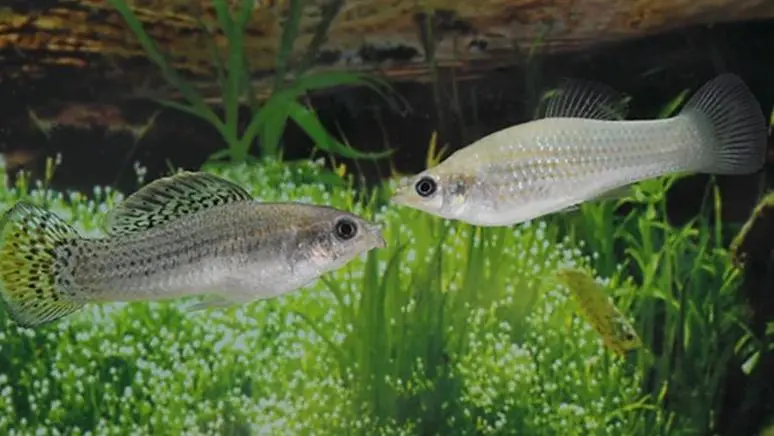
In the rivers of Mexico and southern Texas, there exists a species of fish whose very existence should, in theory, be impossible.
In warm, slow-flowing waters, large schools made entirely of females are often seen swimming together. While moving through the rivers, these silver, shimmering-finned females occasionally come into contact with males of another closely related species. During this simple interaction, the females appear to “select” a mate.
However, as an extraordinary evolutionary phenomenon, the male’s genes play no role in the offspring that are produced.
This unusual biological process is known as gynogenesis. In this system, the female uses the male’s sperm only to trigger the development of her eggs. Immediately afterward, she discards the male’s DNA entirely. As a result, only female offspring are born, and each new fish is essentially a genetic clone of its mother.
This fish is known as the Amazon molly, named after the mythical all-female warrior tribe of Greek legend. For nearly a century, it has remained a scientific mystery.
According to evolutionary theory, species that reproduce asexually should eventually go extinct. Without sexual reproduction, harmful genetic mutations are expected to accumulate over time, weakening the genome generation after generation.
Yet despite this, this all-female species has survived for nearly 100,000 years. Contrary to traditional scientific expectations, this small and seemingly ordinary fish is not only surviving—it is thriving.
This raises a key question: if evolutionary theory suggests the species should have died out, how has the Amazon molly managed to survive for so long? New research is now attempting to solve this mystery, and scientists are beginning to believe that asexual species may be far more resilient than previously thought. This challenges the long-standing assumption that life cannot persist without sexual reproduction.
Why is sex important?
To understand the survival of the Amazon molly, it is important to first understand why sexual reproduction exists at all.
Edward Reismeier, a computational biologist at Ludwig Maximilian University in Germany and co-author of the study, explains that sexual reproduction is a complex and costly strategy.
He notes that organisms must find and compete for mates. In addition, each parent passes on only 50% of their DNA to the next generation. Reproduction is also often unequal, with females in many species investing far more energy into producing eggs, giving birth, and raising offspring.
In contrast, asexual reproduction appears much simpler and more efficient: no need to find a mate, no competition, and 100% of genetic material is passed to offspring.
Despite this, sexual reproduction dominates life on Earth. According to evolutionary biologist Dave Spijer of the University of Amsterdam, about 99.9% of life reproduces sexually.
He explains that sexual reproduction allows organisms to explore genetic “possibilities” more effectively. During reproduction, DNA from two parents is reshuffled through a process called recombination, producing unique genetic combinations in each generation. This is like shuffling a deck of cards repeatedly—each new arrangement creates new evolutionary possibilities.
This genetic diversity is usually beneficial for survival, as it increases the chances of adaptation in changing environments.
Sex also provides another important advantage: protection against genetic decay. Without genetic mixing, a process known as Muller’s ratchet can occur.
Spijer explains that DNA copying errors naturally occur during replication. In sexual species, these errors can be corrected or diluted through recombination. But in asexual species, such mutations accumulate generation after generation, gradually damaging the genome and potentially leading to extinction.
According to this theory, asexual species should be short-lived.
However, reality tells a different story. Species like the Amazon molly continue to survive and even thrive.
Rethinking evolutionary theory
Spijer suggests that the issue may lie in how Muller’s ratchet is interpreted. It does not necessarily mean that asexual species must inevitably collapse, but rather that all life must have mechanisms to control genetic errors.
From this perspective, long-lived asexual species are not breaking evolutionary rules—they may simply be using alternative solutions.
He explains that there are always biological processes that regulate mutation rates, even if we do not yet fully understand them.
The Amazon molly is not alone. Many asexual organisms exist in nature—from insects living in shrubs to jelly-like microscopic animals—that have survived far longer than expected.
These cases differ from temporary forms of asexual reproduction seen in animals like some snakes or sharks in captivity, where reproduction without mates is reversible. In contrast, the Amazon molly is part of a permanent all-female lineage.
The mysterious case of Bdelloid rotifers
Another remarkable example is the bdelloid rotifer, described by scientists as an “evolutionary scandal.”
These microscopic, jelly-like organisms live in freshwater environments worldwide and have survived without sexual reproduction for millions of years.
According to zoologist Chiara Boschetti from the University of Plymouth, scientists still do not fully understand how they persist for so long.
One major clue is their ability to absorb DNA from their environment through horizontal gene transfer. Unlike most animals, which inherit genes only from parents, bdelloid rotifers can incorporate genetic material from unrelated organisms—something usually seen in bacteria.
Even more surprisingly, these foreign genes actively help them survive. Some provide resistance to dehydration, while others protect against disease. These organisms are so resilient that they can survive extreme conditions, including being frozen for 24,000 years or exposed to space-like environments.
However, scientists are still unsure whether this “DNA borrowing” fully replaces the benefits of sexual reproduction.
Boschetti suggests that multiple mechanisms may be working together, but the full picture remains unclear.
New insights into the Amazon molly
Until recently, the Amazon molly’s survival remained equally mysterious. New research, however, is beginning to reveal how it avoids genetic collapse.
The study identifies a key missing piece: gene conversion.
Gene conversion is a DNA repair mechanism found in many organisms, including humans. When DNA is damaged, one gene copy can be used as a template to repair another—similar to a copy-and-paste system.
In sexually reproducing organisms, this process helps maintain genetic stability. But in the Amazon molly, it appears to play a far more central role.
Researchers used full genome sequencing to compare different generations of Amazon mollies. They found that parts of the genome are repeatedly overwritten—not through sexual mixing, but through highly active gene conversion.
In essence, gene conversion appears to perform a role similar to sexual reproduction by preventing the buildup of harmful mutations.
The origin of the Amazon molly
Scientists believe the Amazon molly originated around 100,000 years ago, when a female Atlantic molly and a male sailfin molly interbred.
Normally, such hybrid offspring (like mules) are sterile. But in this case, the hybrid lineage became capable of asexual reproduction.
As a result, every Amazon molly carries genetic material from two ancestral species. This initial genetic diversity likely helped the species avoid early extinction by counteracting Muller’s ratchet.
This dual ancestry may also explain the strong gene conversion system seen today.
Interestingly, gene conversion does not occur evenly across the genome. The most harmful mutations are found in regions where gene conversion is most active, effectively repairing the most critical genetic damage.
Despite reproducing without sex for over 100,000 years, the species remains genetically healthy.
Why this matters for humans
This discovery is not only important for understanding fish—it may also have implications for human biology.
Genetic mutations are not limited to asexual species. They also occur in humans and are linked to diseases such as cancer.
Understanding alternative mechanisms of DNA repair, such as gene conversion, could eventually help in medical research and treatment strategies.
As Reismeier notes, cancer is fundamentally a disease of genetic mutations. Studying how nature controls these mutations could provide valuable insights in the long term.
He suggests that gene conversion may also play a role in other asexual species, meaning this may not be a unique case.
A challenge to evolutionary assumptions
It is still not fully clear whether the Amazon molly has developed a complete, stable alternative to sexual reproduction.
Scientists continue to investigate how long gene conversion alone can prevent genetic deterioration.
What was once thought impossible—a species surviving indefinitely without sex—now appears genetically stable and successful.
As Reismeier puts it: “We used to think sexual reproduction was the only way to keep a genome healthy, but now we know that is not true. There is another path.”
This discovery challenges traditional ideas of evolution and suggests that nature may reach the same goal through multiple strategies.