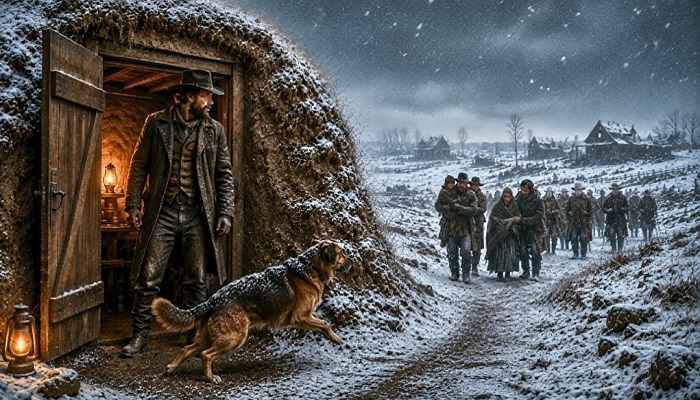
The winter of 1887 arrived early in the Wyoming Territory.
By the middle of November, snow had already buried fences, swallowed wagon trails, and turned the rolling prairie into an endless white desert.
Most people in the small settlement of Cold Creek were preparing to leave.
They had good reason.
The previous winter had killed dozens of cattle and nearly starved half the town. This year promised to be even worse.
“Come with us, Ethan.”
The words followed Ethan Walker everywhere he went.
At the general store.
At the church.
Even at the well.
“You can’t survive here alone.”
But Ethan always gave the same answer.
“I’ve got nowhere else to go.”
It wasn’t entirely true.
He could have joined relatives in Montana.
He could have worked on a ranch farther south.
But after losing his wife, Clara, to illness three years earlier, Cold Creek was the only place that still felt like home.
Home wasn’t much.
Just a small turf cabin built into the side of a hill.
The roof leaked.
The windows rattled.
The chimney smoked when the wind changed direction.
But Clara had helped build it.
Every wall held a memory.
So Ethan stayed.
By early December, nearly everyone else had left.
The little town became a ghost settlement buried beneath snowdrifts.
Only a handful of stubborn souls remained.
Ethan.
Old Mrs. Harper.
The blacksmith, Thomas Reed.
And a few others scattered across the valley.
His closest companion was a large shepherd mix named Scout.
The dog had been a gift from Clara shortly before she died.
For three years Scout rarely left Ethan’s side.
They worked together.
Hunted together.
Survived together.
And as winter tightened its grip on Cold Creek, Ethan became increasingly grateful for the animal’s company.
One evening a fierce storm swept across the valley.
The wind screamed like a living thing.
Snow hammered the cabin walls.
The temperature plunged far below freezing.
Ethan sat beside the stove, feeding small pieces of firewood into the flames.
His supply was shrinking faster than he expected.
If the storms continued, he might not have enough fuel to last until spring.
Scout suddenly lifted his head.
The dog stared toward the door.
His ears twitched.
Then he let out a low bark.
“What is it, boy?”
Scout barked again.
Moments later he pushed through the cabin door and disappeared into the darkness.
Ethan sighed.
“Not tonight.”
But Scout was already gone.
Nearly twenty minutes passed before Ethan became concerned.
He grabbed a lantern and stepped outside.
Snow struck his face immediately.
The wind nearly extinguished the flame.
“Scout!”
Nothing.
Then he heard barking.
Faint.
Somewhere beyond the cabin.
Ethan followed the sound through knee-deep snow.
The lantern swung wildly.
Visibility was terrible.
Several times he nearly fell.
Finally he spotted Scout.
The dog stood beside a frozen hill roughly fifty yards from the cabin.
He wasn’t barking anymore.
He was digging.
Furiously.
Snow flew behind him.
Chunks of frozen earth scattered in every direction.
“What are you doing?”
Scout ignored him.
He continued digging.
Ethan approached and raised the lantern.
At first he saw nothing unusual.
Then he noticed a small opening in the hillside.
A dark crack hidden beneath layers of snow.
Scout widened the hole with his paws.
Cold air rushed outward.
Not the sharp freezing air of the storm.
Different air.
Still.
Dry.
Almost warm by comparison.
Ethan crouched.
The crack appeared to continue into the hill.
Curious, he pushed aside more snow.
The opening grew larger.
Large enough to reveal a narrow tunnel.
He held the lantern closer.
The passage extended several feet before vanishing into darkness.
An old animal den perhaps.
Or a natural cave.
The discovery fascinated him.
But the storm worsened.
Exploration would have to wait.
“Come on, Scout.”
The dog reluctantly followed him home.
Yet all night Ethan thought about the tunnel.
The next morning the storm finally passed.
A pale sun appeared behind gray clouds.
Ethan returned to the hill with a shovel.
Scout raced ahead excitedly.
For several hours they cleared snow and frozen dirt.
The opening gradually widened.
By afternoon Ethan managed to crawl inside.
What he found changed everything.
The tunnel opened into a surprisingly large chamber.
Not huge.
Perhaps fifteen feet across.
But dry.
Sheltered.
Protected from the wind.
Most importantly, the temperature remained noticeably warmer than outside.
Ethan sat quietly inside the chamber.
Listening.
There was no howl of wind.
No rattling walls.
No drifting snow.
Only silence.
An idea began forming in his mind.
A crazy idea.
The kind of idea people laughed at.
But the more he considered it, the more sense it made.
His cabin was constantly losing heat.
Every winter he burned enormous amounts of wood simply to keep from freezing.
Yet underground temperatures remained relatively stable.
What if he expanded the chamber?
What if he turned it into a shelter?
What if he lived beneath the hill?
Over the next week Ethan worked harder than he had in years.
Using little more than a shovel, a pickaxe, and determination, he enlarged the natural cave.
The work was exhausting.
Frozen earth fought him every step.
His hands blistered.
His back ached.
But gradually the chamber grew.
He reinforced weak sections using timber scavenged from abandoned buildings.
He created a sleeping area.
A storage nook.
A ventilation shaft.
The project cost almost nothing.
A few nails.
Some scrap lumber.
A small metal pipe.
In total he spent twelve dollars.
Every cent mattered.
Every purchase had a purpose.
When Thomas Reed visited and saw what Ethan was doing, he laughed.
“You’ve finally gone crazy.”
“Maybe.”
“You’re building a home underground?”
“Looks that way.”
Thomas shook his head.
“You’ll be back in the cabin within a week.”
Ethan smiled.
“We’ll see.”
By Christmas he moved in.
The cave wasn’t luxurious.
Far from it.
The walls were rough earth.
The ceiling remained low in places.
Moisture occasionally seeped through cracks.
Yet it possessed one remarkable advantage.
Warmth.
Not true warmth.
But stability.
While temperatures outside plunged below zero, the cave remained comparatively mild.
His tiny stove required far less wood.
The wind no longer stole heat.
Snow could pile twenty feet high overhead without affecting him.
For the first time in years, Ethan wasn’t constantly worried about freezing.
Then January arrived.
Along with the worst blizzard Cold Creek had ever experienced.
The storm lasted six days.
Six endless days of relentless snow and wind.
Entire buildings vanished beneath drifts.
Fences disappeared completely.
Travel became impossible.
Inside his underground shelter, Ethan listened to the storm rage above him.
Scout slept comfortably nearby.
The stove burned steadily.
Food supplies remained dry.
Water didn’t freeze.
For once, winter felt distant.
Almost harmless.
On the seventh day, silence returned.
Ethan climbed through the entrance tunnel and emerged into a transformed world.
Snowdrifts towered higher than horses.
Several abandoned houses had partially collapsed.
Even his old turf cabin suffered severe damage.
One section of roof had caved inward.
Had he remained there during the storm, survival would have been uncertain.
Word of Ethan’s underground shelter soon spread among the remaining residents.
At first they dismissed it.
Then curiosity replaced skepticism.
Mrs. Harper visited.
Thomas visited.
Others followed.
Each arrived expecting to see some foolish experiment.
Instead they discovered a practical refuge.
A place noticeably safer than many surface structures.
“You actually did it,” Thomas admitted.
Ethan grinned.
“Told you.”
By February another storm struck.
This time several neighbors sought temporary shelter in the cave.
The chamber became crowded.
People shared meals.
Told stories.
Played cards.
Laughed.
Something unexpected happened during those evenings underground.
The loneliness that had haunted Ethan since Clara’s death began to fade.
Not disappear.
Never disappear.
But soften.
For years he had isolated himself.
Grief had convinced him that life ended the day Clara died.
Yet here he was.
Helping people.
Talking.
Laughing again.
Living.
One night Mrs. Harper sat beside the stove.
“You know,” she said, “Clara would be proud.”
Ethan stared into the flames.
For a moment he couldn’t speak.
Finally he nodded.
“I hope so.”
Outside, snow tapped softly against the hillside.
Inside, warmth filled the chamber.
Not just physical warmth.
Human warmth.
Community.
Hope.
The things he thought he had lost forever.
Spring eventually arrived.
Slowly.
Reluctantly.
The snow melted.
Grass returned.
Birds reappeared.
Families who had fled Cold Creek began coming home.
Many were astonished to discover Ethan alive and healthy.
Even more surprising, he had become something of a local legend.
The man who survived winter underground.
The man who built a cave for twelve dollars.
The man whose dog found the hill.
When people asked how he came up with the idea, Ethan always pointed toward Scout.
The dog would wag his tail proudly.
“He deserves the credit.”
Years later, long after new houses replaced old ones and Cold Creek grew into a thriving town, people still told the story.
Visitors often expected some grand tale of engineering genius.
Instead they learned the truth.
A lonely man.
A faithful dog.
A hidden cave beneath a frozen hill.
Sometimes survival doesn’t come from strength.
Sometimes it comes from paying attention.
From following an unexpected clue.
From trusting a companion who sees something you don’t.
On quiet evenings Ethan often sat outside the cave entrance with Scout beside him.
The sunset painted the valley gold.
Children played in the distance.
Smoke curled from chimneys.
Life moved forward.
One evening he looked toward the hill that had changed everything.
The same hill where a determined dog had once dug through snow during a storm.
A small discovery.
A simple moment.
Yet it had saved his life.
Ethan reached down and scratched Scout behind the ears.
The old dog leaned against him contentedly.
“Best twelve dollars I ever spent,” Ethan said.
Scout wagged his tail.
And together they watched the last light fade across the Wyoming prairie.