The first snow of November fell on the same day Eleanor Whitmore lost everything.
Not her wealth.
Not her elegant gowns.
Not even the sprawling mansion overlooking Boston Harbor.
She lost something far more valuable.
Her place in society.
For twenty-nine years, Eleanor had lived exactly as she was expected to. Born into one of Massachusetts’ oldest families, she attended the finest schools, hosted charity galas, and smiled politely through endless social gatherings.
People admired her beauty.
They admired her manners.
But very few ever bothered to know her.
The scandal arrived like a lightning strike.
Her father, Charles Whitmore, died unexpectedly of a heart attack, leaving behind a business empire worth millions.
Within weeks, distant relatives appeared like vultures.
Among them was her cousin Theodore.
Smooth-talking and ambitious, Theodore convinced influential businessmen that Eleanor was incapable of managing the family holdings.
Then came the rumors.
Whispers spread through drawing rooms and banquet halls.
Eleanor was unstable.
Eleanor was emotional.
Eleanor had become impossible since her father’s death.
The lies multiplied faster than she could defend herself.
One evening, during the prestigious Winter Society Ball, everything collapsed.
As Eleanor entered the grand ballroom, conversations stopped.
Women who had once embraced her turned away.
Men who had courted her avoided eye contact.
The silence was worse than insults.
Then Theodore stepped forward.
“I believe,” he announced loudly enough for everyone to hear, “that Miss Whitmore should refrain from attending future society events until certain questions regarding her conduct are resolved.”
The room erupted in murmurs.
Nobody defended her.
Not one person.
The people she had known her entire life simply watched.
Eleanor felt humiliation burn through her chest.
Without a word, she turned and walked away.
That night she packed a single trunk.
By morning, she was gone.
The train carried her westward for three days.
She had no destination.
Only distance.
The farther she traveled from Boston, the lighter she felt.
Yet freedom came with fear.
She had never lived alone.
Never chopped wood.
Never hunted.
Never even cooked a proper meal.
By the fourth day, she found herself in a tiny mountain settlement nestled deep within the Rockies.
The town consisted of little more than a general store, a church, and a handful of cabins.
Snow-covered peaks towered overhead like silent guardians.
The beauty was breathtaking.
And intimidating.
Inside the general store, Eleanor purchased supplies with trembling hands.
The elderly shopkeeper studied her expensive coat and polished boots.
“You’re not from around here.”
“No.”
“You got family nearby?”
“No.”
The old man frowned.
“Then where you headed?”
Eleanor hesitated.
“I don’t know.”
The shopkeeper exchanged glances with another customer.
A large trapper standing near the stove.
The man looked enormous.
At least six foot four.
Broad shoulders.
Thick beard.
Scar across one cheek.
His fur vest appeared handmade.
His hands looked capable of splitting trees in half.
The entire store seemed smaller because he occupied it.
Eleanor immediately looked away.
The trapper returned to examining a sack of flour.
“You’re headed into the mountains alone?” the shopkeeper asked.
“I suppose so.”
“Bad idea.”
Eleanor stiffened.
“I can manage.”
The trapper finally spoke.
His voice was deep and rough.
“No, you can’t.”
She turned sharply.
The bluntness shocked her.
“I beg your pardon?”
“You won’t survive a week.”
The words weren’t cruel.
Just matter-of-fact.
As if he were discussing weather.
Anger flared inside her.
For years men had told her what she could and couldn’t do.
She was tired of it.
“I assure you, sir, I am perfectly capable.”
The trapper shrugged.
“Suit yourself.”
Then he lifted his supplies and walked out.
The bell above the door jingled.
The shopkeeper sighed.
“That’s Caleb.”
“Charming man.”
A faint smile appeared on the old man’s face.
“Actually, he’s the best man in these mountains.”
Eleanor doubted that very much.
Three days later, she discovered how wrong she had been.
The abandoned cabin she’d rented sat deep in a valley surrounded by pine forests.
At first it seemed peaceful.
Then reality arrived.
The roof leaked.
The chimney barely worked.
The firewood pile was nearly gone.
Worse still, a winter storm was approaching.
By sunset, snow fell heavily.
By midnight, the wind screamed through cracks in the walls.
Eleanor huddled beneath blankets, shivering.
The temperature continued dropping.
When she woke the next morning, the fire had died.
Her water bucket was frozen.
Panic settled over her.
She tried chopping wood.
The axe bounced uselessly.
She tried relighting the stove.
Smoke filled the cabin.
She coughed and stumbled outside.
The storm had transformed the world.
Snowdrifts reached her knees.
The path back to town had disappeared.
For the first time in her life, Eleanor felt genuinely helpless.
Tears stung her eyes.
Not because of the cold.
Because she finally understood.
The society people who abandoned her had been cruel.
But nature was indifferent.
The mountains didn’t care who her father had been.
They didn’t care about family names.
Or social status.
Out here, survival was all that mattered.
A distant sound interrupted her thoughts.
Hoofbeats.
She squinted through falling snow.
A rider emerged from the storm.
Massive horse.
Massive man.
Caleb.
He stopped beside the cabin.
Took one look at the smoke pouring from the chimney.
Then looked at her.
“You still alive?”
Eleanor wanted to be offended.
Instead she burst into tears.
An hour later, Caleb had fixed the stove.
Another hour and he’d repaired part of the roof.
By evening, the cabin felt warmer than it ever had.
Eleanor sat beside the fire while Caleb sharpened a knife near the doorway.
Neither spoke much.
Silence seemed natural around him.
Finally she asked, “Why did you help me?”
He continued sharpening.
“Because you needed help.”
“Most people expect something in return.”
Caleb glanced up.
His blue eyes were surprisingly gentle.
“That’s a sad thing to believe.”
The simple statement struck her harder than any insult.
Because it was true.
For years every friendship, every relationship, every invitation among Boston’s elite had come with expectations.
Status.
Influence.
Advantage.
Nothing had been freely given.
Yet this mountain man had spent an entire day helping a stranger.
When darkness fell, Caleb stood.
“Storm’ll last another two days.”
“What should I do?”
“Stay inside.”
Then he paused.
“If food runs low, my cabin’s three miles north.”
Eleanor nodded.
“Thank you.”
He moved toward the door.
“Don’t thank me yet.”
“Why not?”
A rare grin appeared beneath his beard.
“Winter’s just getting started.”
The following weeks brought challenge after challenge.
But Caleb kept appearing.
Sometimes carrying supplies.
Sometimes repairing fences.
Sometimes simply checking whether she was alive.
The townspeople treated him with enormous respect.
Yet they also seemed wary.
Children admired him from a distance.
Men lowered their voices when he entered buildings.
Women whispered.
One afternoon Eleanor finally asked the shopkeeper.
“Why is everyone afraid of Caleb?”
The old man chuckled.
“Because they don’t know him.”
“That’s all?”
“Partly.”
He leaned forward.
“Twenty years ago, three outlaws tried robbing a family during a blizzard.”
Eleanor listened carefully.
“Caleb found them.”
“What happened?”
“Nobody knows exactly.”
The shopkeeper smiled.
“But all three surrendered to the sheriff the next morning.”
“What did Caleb do?”
The old man shrugged.
“Whatever it was, they were terrified.”
Eleanor couldn’t help laughing.
The image seemed impossible.
The man she knew spent his afternoons repairing chicken coops and rescuing stranded livestock.
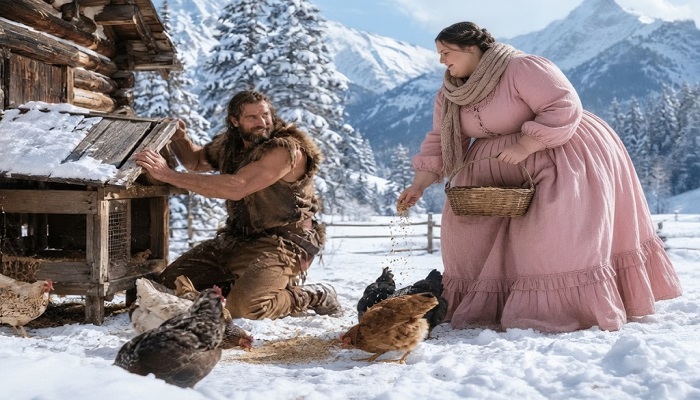
In fact, at that very moment, Caleb was helping her feed chickens behind her cabin.
Snow sparkled across the valley.
Mountains rose brilliantly against the winter sky.
Caleb knelt beside the weathered coop, lifting its heavy roof with one hand as though it weighed nothing.
Nearby, Eleanor scattered grain from a wicker basket.
The chickens hurried across the snow.
For a moment she stopped and watched him.
The powerful shoulders.
The rough hands.
The quiet patience.
A strange warmth settled inside her chest.
Not excitement.
Not infatuation.
Something deeper.
Something safer.
For the first time since leaving Boston, she felt she belonged somewhere.
She didn’t yet realize that danger was already climbing the mountain.
And that the people who had destroyed her life had finally discovered where she was hiding.
Banished From High Society, She Found Refuge in the Arms of a Feared Mountain Man
Part 2
The first sign of trouble arrived three days later.
Eleanor was sweeping snow from the front porch when she heard unfamiliar voices coming from the road below.
A pair of riders were making their way toward town.
Both wore expensive wool coats more suitable for Boston than the Rockies.
Even from a distance, something about them felt wrong.
Her stomach tightened.
That evening, she walked to the general store for supplies.
The moment she entered, conversation stopped.
The shopkeeper looked uneasy.
“So they found you.”
Eleanor froze.
“Who?”
The old man sighed.
“Two men came asking questions this morning.”
Fear crept into her chest.
“What kind of questions?”
“Questions about a woman from Boston.”
Eleanor’s fingers tightened around her basket.
“Theodore.”
The shopkeeper nodded grimly.
“He didn’t come himself. Sent others.”
A cold sensation spread through her body.
She had hoped her former life was hundreds of miles behind her.
Apparently, Theodore had other plans.
Before she could ask more, the store door opened.
A gust of snow blew inside.
Caleb entered carrying a sack of grain.
One look at Eleanor’s face told him something was wrong.
“What happened?”
The shopkeeper answered for her.
Caleb’s expression darkened instantly.
“How many men?”
“Two.”
“Armed?”
“Probably.”
Caleb nodded once.
Then he turned to Eleanor.
“You’re not staying alone tonight.”
“I don’t want to cause trouble.”
“Too late.”
His voice left no room for argument.
Caleb’s cabin sat high above the valley.
Unlike Eleanor’s small home, this one was built like a fortress.
Massive pine logs formed thick walls.
The stone fireplace could have heated a church.
Everything inside was simple, sturdy, and practical.
The cabin reflected its owner perfectly.
That night, wind rattled the windows while snow drifted across the mountains.
Eleanor sat near the fire wrapped in a blanket.
Caleb repaired a leather harness across the room.
For a long time neither spoke.
Finally Eleanor broke the silence.
“I never thanked you properly.”
“You’ve thanked me plenty.”
“No. Not really.”
He looked up.
She stared into the flames.
“Back in Boston, everyone admired me because of my name.”
Her voice grew quieter.
“When I lost that, I discovered nobody cared about me at all.”
Caleb remained silent.
Listening.
Not interrupting.
Not judging.
“Do you know what hurt most?”
She swallowed hard.
“They never even asked if the rumors were true.”
The fire crackled softly.
After a moment Caleb spoke.
“People believe what benefits them.”
Eleanor looked at him.
“You sound like you’ve learned that from experience.”
A shadow crossed his face.
For the first time, she saw pain there.
Real pain.
Years old.
“My father was accused of stealing cattle.”
“What happened?”
“He didn’t.”
The answer came instantly.
Certain.
Without hesitation.
“How do you know?”
“Because I was there.”
Caleb stared into the flames.
“The real thief was wealthy.”
Understanding dawned on Eleanor.
“And your father took the blame.”
Caleb nodded.
“The town believed the rich man.”
Neither spoke for several seconds.
Then Eleanor whispered,
“I’m sorry.”
His gaze met hers.
For the first time, they weren’t a society woman and a mountain man.
They were simply two people who understood betrayal.
Something changed between them that night.
Neither acknowledged it.
Neither needed to.
The next morning brought bad news.
Theodore’s men had reached town.
They weren’t hiding their intentions.
They offered money for information.
Asked questions about Eleanor.
Insisted she needed to return east immediately.
Most of the townspeople refused to cooperate.
But money had a way of tempting people.
By afternoon, one of the men discovered the location of her cabin.
Caleb returned from town furious.
“They know where you live.”
Eleanor’s heart sank.
“What do they want?”
“You.”
“I won’t go.”
“I know.”
The mountain man stood and moved toward the window.
Snow clouds gathered across the peaks.
A storm was coming.
A big one.
Then an idea struck Eleanor.
“They can’t force me.”
Caleb looked back at her.
“Depends.”
“On what?”
“How desperate Theodore is.”
Those words lingered heavily in the room.
The storm arrived after midnight.
By dawn, snow covered everything.
Roads disappeared.
Trails vanished.
Visibility dropped to almost nothing.
Most people stayed indoors.
Theodore’s men did not.
They reached Eleanor’s cabin shortly before noon.
Fortunately, she wasn’t there.
Caleb had insisted she remain at his place until things settled down.
When the men discovered the empty cabin, they became angry.
And angry men made mistakes.
One attempted to cross a frozen mountain creek.
The ice broke beneath him.
Within minutes he was trapped in freezing water.
His companion raced back toward town seeking help.
The irony wasn’t lost on anyone.
The very men hunting Eleanor now needed rescuing.
A search party formed immediately.
Caleb joined without hesitation.
Eleanor watched him prepare.
“They came here to hurt me.”
“Maybe.”
“And you’re still helping them.”
He pulled on his coat.
“They’re human.”
She had no response.
Because once again, Caleb revealed a kind of strength she had rarely encountered.
Not physical strength.
Character.
The rescue lasted hours.
The storm worsened.
Temperatures plummeted.
By sunset, concern spread through town.
Nobody had returned.
Then the church bell rang.
Once.
Twice.
Three times.
People rushed outside.
Through the swirling snow emerged a line of figures.
At the front walked Caleb.
Behind him stumbled the rescued man.
Several townspeople followed carrying supplies.
Cheers erupted.
The trapped stranger had survived.
Barely.
When the group reached shelter, Theodore’s employee stared at Caleb in disbelief.
“You saved me.”
Caleb simply nodded.
The man shook his head.
“I don’t understand.”
“You don’t have to.”
The stranger lowered his eyes.
For the first time, shame appeared on his face.
Two days later, the storm finally ended.
Bright sunlight illuminated the mountains.
The world looked freshly made.
That afternoon, a horse-drawn sleigh arrived from Denver.
A lawyer stepped out carrying documents.
Official documents.
He asked for Eleanor Whitmore.
Confused, she invited him inside.
The lawyer smiled politely.
“Miss Whitmore, I’ve spent months searching for you.”
“What for?”
He opened a leather case.
“Evidence.”
Over the next hour, Eleanor learned the truth.
Before his death, her father had suspected Theodore of financial fraud.
Secret records existed.
Records proving Theodore had stolen enormous sums from the family business.
The evidence had recently been discovered.
Authorities were preparing charges.
Theodore’s entire scheme was collapsing.
Eleanor sat speechless.
The lawyer continued.
“You remain the lawful heir.”
Everything she had lost was suddenly within reach.
Her fortune.
Her properties.
Her position.
Her old life.
The very things she once believed mattered most.
Yet as the lawyer spoke, she found herself looking through the cabin window.
Toward the mountains.
Toward the chicken coop where Caleb was repairing a fence.
Toward the simple life she had built here.
When the lawyer finished, he asked the obvious question.
“When would you like to return to Boston?”
Eleanor surprised everyone.
Including herself.
“I’m not sure I do.”
Several weeks later, Theodore was arrested.
The newspapers celebrated the scandal.
Society turned against him almost overnight.
The same people who once shunned Eleanor suddenly sent letters.
Apologies.
Invitations.
Requests for reconciliation.
She burned most of them.
Some things were not worth recovering.
Spring arrived slowly in the mountains.
Snow melted from the valleys.
Wildflowers emerged.
Streams flowed freely once more.
Life returned.
One evening, Eleanor stood beside the fence watching the sunset paint the peaks gold.
Footsteps approached behind her.
Caleb.
For several moments they simply watched the mountains.
Then he spoke.
“Boston’s probably beautiful this time of year.”
She smiled.
“So are these mountains.”
A faint grin appeared beneath his beard.
“True.”
Silence settled comfortably between them.
Not awkward.
Not empty.
Comfortable.
The kind shared by people who trust each other completely.
Finally Caleb cleared his throat.
Something that seemed strangely nervous for such a formidable man.
“If you decide to stay…”
He stopped.
Eleanor turned toward him.
“If I decide to stay?”
His gaze met hers.
Steady.
Honest.
“If you stay, I’d like that.”
The simplest words imaginable.
Yet they carried more sincerity than all the grand declarations she had heard in Boston ballrooms.
Eleanor felt tears gathering unexpectedly.
Not from sadness.
From gratitude.
For everything she had lost.
And everything she had found.
She reached for his hand.
The enormous hand that had repaired her roof.
Saved strangers.
Protected her without asking for anything in return.
The hand of the man everyone feared.
And the man she trusted most.
“I think,” she said softly, “I’ve already decided.”
The smile that appeared on Caleb’s face transformed him completely.
For the first time, the feared mountain man looked genuinely happy.
Above them, the setting sun illuminated the mountains in gold and crimson.
Ahead lay uncertainty.
Hard work.
Long winters.
Challenges.
But none of it frightened Eleanor anymore.
Because she finally understood something society had never taught her.
A person’s worth is not measured by wealth, status, or reputation.
It is measured by the kindness they show when nobody is watching.
And in all the world, she had never met a richer man than Caleb.
The End.