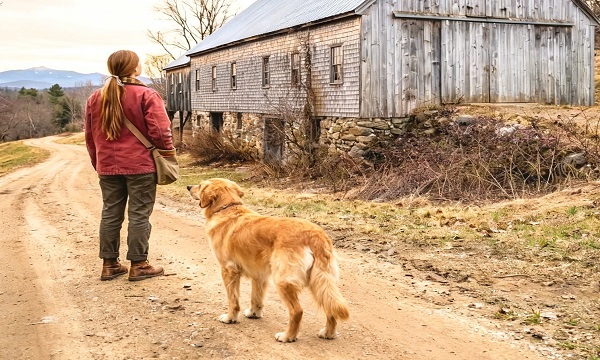
Blythe stood in the silent room for a long time, listening to the mill breathe around her.
It no longer felt like abandonment.
It felt like responsibility.
Outside, the wind pressed harder against the siding, and for the first time she noticed something she had missed before—the land around the mill was not just empty forest. It was old orchard ground. Rows, now overgrown, but still faintly structured if you knew how to look.
Her grandmother had always said orchards don’t die quickly. They disappear in layers.
That night, Blythe did not leave.
She slept on the mill floor beside the crates, the applewood screw resting beside her like a sleeping tool waiting for a hand that understood it.
And for the first time in weeks, she did not dream of losing things.
She dreamed of planting.
By morning, the cider in the demijohn had changed color—lighter, clearer, as if the air itself inside the mill had begun to move differently.
Blythe broke the seal on the seed crate marked PREWITT again, just to be sure she hadn’t imagined it.
One seed.
Still there.
Still real.
She wrapped it carefully in cloth and placed it inside her pocket where the ten dollars used to be.
Then she stepped outside.
The orchard revealed itself fully in daylight.
Dozens of old apple trees stood scattered across the slope behind the mill, half-wild, half-forgotten. Most were tangled in vines. Some were hollowed out. But a few—just a few—still carried stubborn green shoots.
She walked between them slowly.
“Still here,” she whispered. “You’re still here.”
The first problem arrived three days later.
A white truck.
Then another.
Surveyors.
Developers.
The same people who had taken everything else she’d ever known.
They didn’t knock. They never did.
A man in a pressed jacket stepped out and looked at the mill like it was already gone.
“You’re trespassing,” he called.
Blythe stood in the doorway.
“No,” she said calmly. “I own it.”
He laughed, holding up a folder. “This property was acquired. It’s scheduled for clearance. There’s nothing here worth—”
He stopped.
Because behind her, through the open mill door, the scent of cider drifted out.
Not old.
Not spoiled.
Alive.
He noticed it immediately.
Everyone did, eventually.
“What are you brewing in there?” he asked, suspicion replacing certainty.
Blythe didn’t answer.
She simply stepped aside.
Inside, the demijohn sat on the table.
The man followed despite himself.
One sip was all it took.
His expression changed in a way paperwork never could.
“This… this is impossible,” he said.
Blythe watched him carefully.
“It’s not,” she replied. “It’s just been waiting longer than your records go back.”
By the end of the week, the story spread faster than she could stop it.
A dead cider mill making cider that tasted like memory.
A lost apple variety returned.
A seed vault no one had documented.
People came. Not just developers.
Growers. Botanists. Farmers who still believed in stubborn fruit.
And among them, an old woman arrived with shaking hands and a scarf tied too tightly under her chin.
She looked at Blythe for a long time.
Then said, “Ardith Prewitt was my sister.”
Blythe froze.
The woman stepped closer.
“That apple,” she whispered, pointing toward the orchard, “should have died in 1972.”
Blythe shook her head. “It didn’t.”
The woman smiled faintly, but there was grief in it.
“No,” she said. “It waited.”
The legal fight came next.
Ownership. Heritage claims. Preservation rights.
But something strange happened.
Every expert who entered the mill left with the same problem: they could not explain what they were tasting.
The cider did not fit classification.
It didn’t behave like commodity.
It behaved like memory made physical.
And slowly, the world stopped asking who owned the mill.
And started asking what it could become.
Winter arrived early that year.
Blythe stayed.
She repaired the roof with salvaged wood. She cleared the old orchard row by row. She planted the Prewitt seed in the center of the land, where the soil was darkest and richest.
The press screw was returned to its place, and when she turned it for the first time, the entire mill answered—not with collapse, but with structure.
As if it had been waiting to be used again.
Years later, people would say the Felton Mill became something unusual.
Not a farm.
Not a museum.
Not a business in the usual sense.
But a living archive of fruit that refused to vanish.
And at its center stood Blythe Prewitt, who once had ten dollars and nowhere to sleep.
Now she had something else entirely.
Rows of orchards returning from silence.
A legacy rebuilt not from ownership—but from memory, patience, and soil that remembered what people forgot.
And sometimes, when the wind moved through the trees just right, it sounded like the mill itself was still breathing.
Not as a ruin.
But as something finally, fully alive.