The first time the neighbors saw Eleanor Whitaker hauling wagonloads of clay behind her barn, they assumed she had finally lost her mind.
“Maybe she’s digging for gold,” old Mr. Harper joked from across the fence line.
“No,” another man laughed while adjusting his suspenders, “she’s probably building herself a grave.”
The laughter carried through the frozen November wind, sharp and cruel.
Eleanor heard every word.
But she kept digging anyway.
Because while the rest of the town spent their evenings gossiping around warm stoves, Eleanor spent hers staring at unpaid bills and listening to the wind push through the cracks in her farmhouse walls like icy fingers.
Her husband, Thomas, had died two winters earlier when pneumonia took him in less than a week. Since then, Eleanor had been left alone with her eight-year-old son Caleb, a collapsing farm, and a mountain of debt she could barely understand.
The winter after Thomas died had nearly killed them too.
The upstairs bedroom froze solid some nights. Ice formed inside the windows. Eleanor would wake to find Caleb shivering beneath three blankets, his tiny hands blue from cold.
They burned nearly all the furniture trying to stay warm by February.
The second winter threatened to be worse.
Coal prices had doubled.
Firewood was scarce.
And the old farmhouse leaked heat like a cracked kettle.
One night, after Caleb had fallen asleep beside the stove, Eleanor sat reading an old magazine Thomas once bought from a traveling merchant. Most of the pages were ruined, but one article remained readable.
It showed photographs of underground homes built by settlers long ago.
Earth shelters.
Dugouts.
Homes insulated naturally by the ground itself.
The article claimed that even during brutal winters, the temperature underground stayed surprisingly stable.
Eleanor read the pages three times.
Then four.
By morning, she had made up her mind.
If she couldn’t afford enough fuel to heat the house…
Then she would build a place that didn’t need much heat at all.
That afternoon, she walked behind the barn carrying a shovel.
And the town laughed.
At first, even Caleb didn’t understand.
“You’re making a hole?” he asked.
“A home,” Eleanor corrected gently.
“A home underground?”
“For winter,” she said.
Caleb blinked uncertainly.
“Like rabbits?”
Eleanor smiled for the first time in weeks.
“Yes,” she whispered. “Exactly like rabbits.”
The digging nearly broke her body.
The ground behind the barn was frozen hard as stone. Her hands blistered and bled through worn gloves. Some mornings she woke barely able to stand upright.
But every day after feeding the animals, she dug.
Slowly the pit deepened.
Then widened.
She reinforced the walls with reclaimed timber from an abandoned shed. She shaped curved supports overhead using bent branches Thomas once stored behind the barn.
At night she studied old library books borrowed from town, learning how settlers insulated underground structures with clay, straw, and packed earth.
The neighbors mocked her openly now.
“She’s building herself a dirt cave.”
“Boy’s gonna suffocate down there.”
“Crazy widow woman.”
One afternoon, Mrs. Porter rode by in a carriage and stopped long enough to stare into the growing dugout.
“You really intend to live in there?” she asked.
“For the winter,” Eleanor replied.
Mrs. Porter looked horrified.
“My dear, people live in houses. Not holes.”
Eleanor wiped mud from her cheek.
“People live where they survive.”
Mrs. Porter had no answer for that.
By early December, snow blanketed the valley.
The dugout was nearly finished.
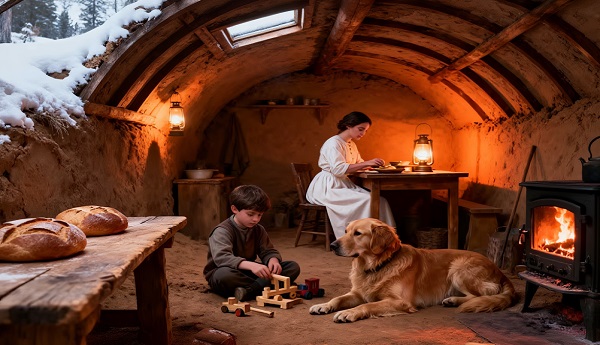
From above, almost nothing could be seen except a hidden wooden door built carefully into the hillside behind the barn. Eleanor covered the roof with packed earth and snow so thoroughly that it blended naturally into the landscape.
Inside, however, the shelter felt almost magical.
The curved earthen ceiling held warmth beautifully. Wooden beams arched overhead like the ribs of a ship. Eleanor installed a salvaged iron stove in one corner with a narrow chimney hidden beside the barn wall.
A small skylight near the ceiling let in pale winter sunlight during the day.
She built shelves into the dirt walls.
A wooden table stood at the center beneath a lantern.
Caleb laid a small rug on the packed earth floor and arranged his wooden toy trucks beside it proudly.
Even the dog, Rusty, seemed to understand immediately.
The old golden retriever curled beside the stove the first night and refused to leave.
Still, Eleanor worried.
What if the neighbors were right?
What if the roof collapsed?
What if smoke filled the chamber?
What if Caleb got sick underground?
The first true winter storm arrived three days before Christmas.
The wind screamed across the plains at nearly sixty miles an hour. Snow hammered the farmhouse so violently it sounded like handfuls of gravel striking the walls.
Inside the dugout, Eleanor sat awake listening nervously.
But something strange happened.
The storm sounded distant underground.
Muted.
Softened.
And while the world above froze, the little earthen shelter remained warm.
Not hot.
Just steady.
Comfortable.
The stove required only a few pieces of wood every several hours because the surrounding earth trapped the heat instead of letting it escape.
Caleb sat cross-legged on the floor playing with his toy trucks while Rusty snored nearby.
“Mom?” Caleb said quietly.
“Yes?”
“I can’t hear the wind anymore.”
Eleanor looked around the warm little room glowing gold beneath lantern light.
Neither could she.
That night, for the first time since Thomas died, she slept without fear.
By January, the winter became one of the harshest the town had seen in decades.
Blizzards buried roads for days.
Livestock froze in barns.
Three families temporarily abandoned their homes after running out of firewood entirely.
Meanwhile, rumors spread about Eleanor Whitaker.
“She’s still alive somehow.”
“Boy too.”
“They barely use any firewood.”
“They say it’s warm down there.”
At first nobody believed it.
Until Mr. Harper himself came to see.
He arrived one bitter afternoon carrying an armload of chopped wood.
“I figured you might need this,” he grumbled awkwardly.
Eleanor invited him inside the hidden dugout.
The old man stepped down cautiously through the narrow entrance.
Then stopped cold.
Or rather…
Warm.
His eyes widened slowly.
The underground room glowed with firelight and lanterns. Bread cooled on the table. Caleb played happily on the floor beside Rusty while soup simmered gently atop the stove.
It smelled like cedarwood and fresh bread.
Not dirt.
Not dampness.
Home.
Mr. Harper removed his gloves slowly.
“Well I’ll be damned,” he whispered.
Eleanor poured him coffee without saying a word.
The old man sat near the stove for almost an hour.
Before leaving, he paused at the doorway.
“You know,” he admitted quietly, “I laughed at you.”
“I know.”
“But this…” He looked back at the shelter. “This is smarter than half the houses in town.”
Word spread fast after that.
Soon other neighbors arrived pretending to “check on” Eleanor while secretly wanting to see the dugout for themselves.
Some stood speechless.
Others asked questions.
“How deep is it?”
“Does water leak in?”
“How much wood do you burn?”
“Is it really warmer underground?”
Eleanor answered politely, though part of her remembered every cruel laugh from earlier that autumn.
Still, she understood something important:
Most people mocked things they didn’t understand because they were afraid of looking foolish themselves.
Then February came.
And with it, the coldest week anyone could remember.
Temperatures plunged far below zero.
The Porter family’s pipes burst.
Mrs. Jenkins suffered frostbite carrying water from her well.
One elderly man nearly froze to death after his chimney collapsed during a storm.
Throughout it all, Eleanor’s dugout remained warm.
Steady.
Safe.
One evening during the worst of the cold snap, frantic knocking echoed above the hidden entrance.
Eleanor opened the door to find Mrs. Porter standing there clutching her young daughter beneath layers of blankets.
Their furnace had failed.
The house was freezing.
“We have nowhere else,” Mrs. Porter whispered, tears freezing on her cheeks. “Please.”
Without hesitation, Eleanor stepped aside.
That night, four extra people slept safely inside the underground shelter.
Then six the next evening.
Soon neighbors rotated through during storms, warming themselves beside the stove while snow buried the countryside above them.
The very people who once laughed now called it “the miracle beneath the barn.”
Caleb loved hearing that.
One evening he sat beside his mother watching firelight dance across the curved earthen ceiling.
“You built all this yourself,” he said softly.
Eleanor brushed his hair gently.
“We built it.”
“No,” Caleb insisted. “You did.”
She looked around the shelter quietly.
The wooden beams.
The lanterns.
The smell of soup and bread.
The warm dirt walls holding back the deadly winter outside.
Maybe Caleb was right.
For the first time in years, Eleanor felt proud of herself.
Not because she had impressed the town.
Not because the neighbors finally respected her.
But because when fear came for her family…
She refused to surrender.
Spring finally arrived in March.
Snow melted slowly from the hillsides, revealing muddy roads and exhausted farms.
People emerged pale and weary after surviving the brutal winter.
But Eleanor’s small family looked stronger than before.
Healthier.
Caleb had not suffered a single illness all season.
The dugout remained dry and solid.
And something else had changed too.
The town no longer laughed when Eleanor Whitaker spoke.
In fact, people listened now.
By April, two neighboring farmers had started building partially earth-sheltered root cellars and storm shelters of their own.
Mr. Harper even asked Eleanor to help design one beneath his tool shed.
“You’ve got the brains for it,” he admitted sheepishly.
Eleanor smiled.
“Funny,” she said, “that’s not what you called me before winter.”
The old man turned red while Caleb burst into laughter nearby.
That summer, Eleanor planted wildflowers above the hidden roof of the dugout. From a distance, nobody would ever guess an entire warm shelter existed beneath the hillside.
Sometimes during hot afternoons, she and Caleb still sat underground where the earth stayed cool and peaceful.
Rusty always followed.
One evening Caleb asked the question Eleanor knew would come eventually.
“Do you think Dad would’ve liked it?”
Eleanor looked around slowly.
The curved beams.
The sturdy walls.
The table where they now ate together every night.
The shelter that had saved them.
Then she smiled softly toward the lantern glow.
“I think,” she whispered, “your father would’ve been proud that we survived.”
Above them, summer wind rustled gently through the barn.
But underground, inside the little earthen home everyone once mocked, warmth still lingered in the walls.
And Eleanor finally understood something the entire town had learned too late:
Sometimes the people brave enough to look foolish are the very ones who discover how to survive.