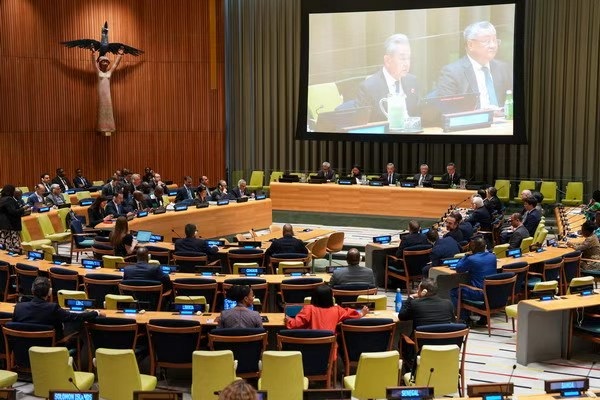
At the United Nations: Chinese Foreign Minister Wang Yi Reaffirms Equal Rights in Global Development Paths
New York (United Nations Headquarters): Chinese Foreign Minister Wang Yi participated in the meeting of the “Friends Group on Global Governance” held at the United Nations Headquarters in New York.
On Friday, Wang Yi stated that since the establishment of the group, member countries have engaged in extensive discussions on reforming and improving global governance, resulting in five major points of consensus.
He emphasized, first, that all members support the promotion of democracy in international relations. He said that all countries—whether large or small, strong or weak, rich or poor—have the right to independently choose their own social system and development path. He also stressed that all should enjoy equal participation, equal decision-making power, and equal benefits in global governance.
Second, he called for the protection of the purposes and principles of the United Nations Charter, ensuring the uniform and fair application of international law and global rules. He rejected double standards and opposition to imposing one-sided policies on others.
Third, Wang Yi highlighted the importance of safeguarding the central role of the United Nations, promoting multilateralism, and strengthening multilateral institutions, while opposing unilateral actions and power politics.
Fourth, he said that global governance reforms should gradually narrow the gap between the Global North and South, ensure that the benefits of development reach all people, and guarantee that no country is left behind in the development process.
Fifth, he stressed that the international community should focus on solving the most pressing practical global issues, and take concrete and effective actions that produce visible results, so that the global governance system can meet the tests of both time and the people.
He concluded that every country must have the freedom to choose its own development path, and global governance should be based on fairness, equality, and shared progress.