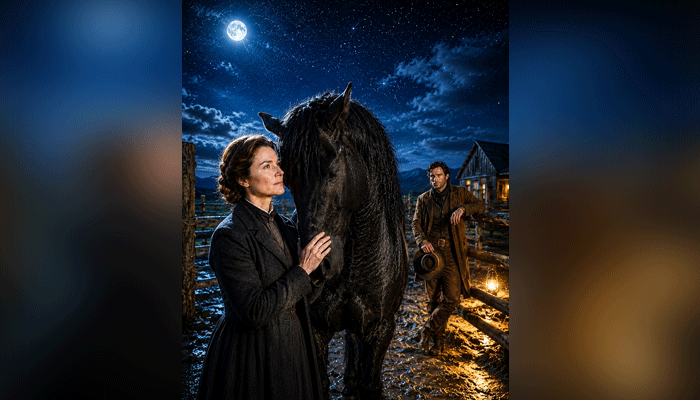
“Woman like Margaret Hale ought to be grateful if any man puts a ring on her hand.”
Cal Hargreeve said it outside the church on a Sunday morning, loud enough for the congregation to hear and soft enough to pretend he had meant no harm.
The bell had just finished tolling. Its final note hung in the winter air over the town of Mercy Ridge, Wyoming Territory, thin and cold as wire. Frost clung to the church steps. Women pulled shawls tighter around their shoulders. Men stamped mud from their boots and spoke of cattle, fencing, and the weather with that solemn Sunday restraint that never lasted past noon.
Margaret Hale descended the steps last.
She always did.
At thirty-eight, she had long ago learned to let other people pass ahead of her. Young wives with babies. Girls with ribbons in their hair. Men who smiled at every unmarried woman under twenty-five and looked through the rest like furniture left too long in the sun.
Her dress was dark brown wool, clean but mended at the cuff. Her gloves were plain. Her hair, once chestnut, was pinned so tightly beneath her hat that no stray softness escaped. She carried a worn prayer book against her chest and kept her chin level.Apparel
She had heard worse.
That did not mean it did not hurt.
A few men laughed near the hitching rail.
Not cruelly enough to be called cruel.
That was the talent of small towns. They knew how to wound without leaving anything worth accusing.
Cal leaned against the fence, one boot crossed over the other, his hat tipped back. His family owned the largest spread west of the river. His coat was too clean for a man who claimed to work land. He wore money the way some men wore spurs: not because he needed it, but because he liked the sound it made when he moved.
Margaret reached the bottom step.Headwear
She did not look at him.
Cal’s grin widened.
“Seventeen years teaching other folks’ children,” he said. “No husband. No babies. Just chalk dust and books. Seems a lonely way to grow old.”
A woman near the gate lowered her eyes.
A younger wife hid a smile behind her gloved hand.Books & Literature
Margaret stopped.
That was enough to unsettle them.
She turned, not sharply, not dramatically, but with the measured patience she used when one of her students gave an answer loud enough to cover ignorance.
“Mr. Hargreeve,” she said, “loneliness is not always the absence of company. Sometimes it is what happens when a person has too much of the wrong kind.”
The laughter thinned.
Cal’s smile stayed, but something under it hardened.
“Didn’t mean offense, Miss Hale.”
“No,” Margaret said. “Men rarely do when they have an audience to enjoy it.”
She walked away before anyone could decide whether to laugh again.
Her boots touched the frozen dirt road with quiet precision. Her hands stayed folded. Her spine remained straight. Only when she passed the mercantile window did she see her reflection: plain hat, plain dress, steady mouth, eyes too watchful for a woman everyone had decided was harmless.Headwear
For one breath, the longing inside her rose like a hand against glass.
Then a scream split the air.
Not human.
Horse.
The sound came from the Bennett corral down the road, high and furious, followed by the splintering crack of wood and men shouting over one another.Apparel
The town turned as one body.
Discover more
automaty
Spiele
Automatenspiele
Cal’s head snapped toward the sound.
Margaret did not hurry. She stepped off the road and walked toward the noise with the same calm she had carried down the church steps, though something in her chest had changed.
She knew that sound.
Not wildness.
Fear.
The stallion in Luke Bennett’s corral moved like black weather trapped inside a fence. His coat shone with sweat. His mane lashed against his neck. His eyes rolled white as two men scrambled away from him, pride bruised, bones spared by luck alone.
Luke Bennett stood near the gate, one hand pressed against his ribs, hat lost somewhere in the churned mud.
He was younger than most men who owned land outright. Twenty-nine, lean from labor rather than hunger, with serious eyes and a jaw that looked carved by weather. His ranch sat on good grass near the creek, good enough land to make enemies smile politely and investors arrive with conditions.
Today, one of those investors stood by the rail.
Mr. Silas Whitcomb from Cheyenne. Fine coat. Polished boots. Gloves too soft for rope. His expression held the cool disappointment of a man who had already found a way to profit from another man’s failure.
“If you can’t manage your own stock,” Whitcomb said, “I can’t trust you to manage my money.”
Luke wiped blood from the corner of his mouth.
“The horse will settle.”
“The horse will kill someone.”
The stallion screamed again and struck the fence so hard the rails shuddered.
Men stepped back.
Margaret did not.
She stood beyond the crowd with her schoolbooks pressed to her body and watched the animal, not the spectacle.
Where others saw danger, she saw the rhythm of panic. The way the stallion’s breath hitched before each lunge. The way his ears flicked toward voices and away from raised hands. The way his hooves searched for space that men kept stealing.
Her father had taught her horses before letters.
Force sharpens fear, Maggie. Remember that. A creature fights hardest when it believes everything is being taken.
Without thinking, she took one step closer.
The stallion’s head turned.
Only a fraction.
But Luke saw it.
So did Whitcomb.
The horse’s breathing changed.
For one fragile heartbeat, the corral went still.
Then one of Cal’s men laughed.
“Careful, schoolmarm. He ain’t one of your readers.”
The stallion exploded again, slamming sideways, mud flying beneath his hooves.
The moment shattered.
Margaret stepped back.
Cal’s voice floated from behind her.
“Schoolmarms ought to mind chalk, not horses.”
A few men chuckled.
Luke Bennett said nothing.
That silence struck deeper than Cal’s insult.
Margaret turned her eyes toward Luke.
He looked away first.
There are wounds a woman can survive from enemies because she expects them. The ones delivered by decent men through cowardice are harder to dress.Apparel
Silas Whitcomb dusted his gloves together.
“You have one week, Bennett. One week to prove you can master that animal and secure the agreement. Otherwise, I walk.”
He paused, then let his gaze move deliberately toward Margaret.
“And if you need to settle public talk around your household, the town has a respectable unmarried woman standing right there. A schoolteacher would make a useful wife. Quiet. Proper. Old enough not to cause trouble.”
The air changed.
Margaret felt every eye turn.
Not to admire.
To measure.
A business problem had just been offered a woman as a solution.
Luke’s face darkened.
But still, he said nothing.
Margaret lifted her chin.
Her voice, when it came, was low enough that people had to quiet themselves to hear it.
“I am not part of Mr. Bennett’s fence line, Mr. Whitcomb. I do not come with the land.”
Whitcomb smiled.
“Of course not, Miss Hale. No offense intended.”
“There rarely is,” she said.
Then she walked away.
Behind her, the stallion screamed again.
Luke watched her go, one hand pressed to his ribs, mud on his shirt and shame in his mouth.
That night, long after lamps dimmed across Mercy Ridge and the town settled into the kind of silence that kept secrets warm, Luke heard a voice at the corral.
Not loud.
Not commanding.
Soft as snowfall.
“No one is here to take anything from you.”
He stepped from the barn, pain flashing through his side.
Margaret Hale stood outside the fence in moonlight, one gloved hand resting on the rail.
The stallion was standing still.
PART 2
Luke did not speak.
For once in his life, he had sense enough not to ruin a miracle with a man’s need to explain it.
The yard lay silver beneath the moon. Frost glittered along the broken rails. The stallion stood near the far side of the corral, black body tense, nostrils wide, steam rising from him in white bursts.
Margaret did not face the horse directly. She angled her shoulder away, loose and unthreatening, the way a person might stand beside grief if they understood grief had teeth.
“You’ve had men climbing onto your back all week,” she murmured. “Pulling your mouth. Digging heels into your ribs. Shouting as if volume could become wisdom.”
The stallion’s ears flicked.
Luke held his breath.
Margaret moved one step along the fence.
Slow as dawn.
The stallion followed.
Not much.
Half a step.
Enough.
Luke felt the truth of what he was seeing settle inside him like weight.
This was not luck.
This was knowledge.
Margaret Hale, the woman Mercy Ridge had laughed at for years, understood the most dangerous animal in town better than every man who had tried to dominate him.
A board creaked beneath Luke’s boot.
The stallion reared back, panic returning.
Margaret stepped away instantly.
She did not turn to Luke. Did not ask whether he had seen. Did not wait for thanks.
She simply gathered her shawl tighter around her shoulders and walked toward the road.
“Miss Hale,” Luke called.
She stopped but did not face him.
“I saw,” he said.
Her answer came through the cold.
“That is not the same as understanding.”
Then she disappeared into the dark.
By morning, Luke Bennett knew what he had to do and dreaded it more than any fall from any horse.
He found her outside the schoolhouse after lessons, locking the door while the last children ran home beneath a pale autumn sun. Chalk dust faintly marked the sleeve of her dress. A stack of primers rested in the crook of one arm. She looked exactly as the town described her: plain, controlled, useful.Apparel
Except now Luke saw the lie in that description.
“Miss Hale.”
She turned the key and checked the lock before facing him.
“Mr. Bennett.”
“I came to ask for your help.”
“No,” she said.
No hesitation.
No apology.
Luke absorbed it.
“I haven’t asked yet.”
“You did last night by watching and saying nothing afterward.”
He looked down.
The schoolyard dirt was marked with children’s footprints already fading in the wind.
“I should have spoken yesterday,” he said.
“Yes.”
“When Cal laughed.”
“Yes.”
“When Whitcomb spoke of you like a convenience.”
Her eyes stayed on his.
“Yes.”
Luke swallowed.
The truth had never felt so simple or so heavy.
“I was ashamed,” he said. “Of being thrown. Of needing help. Of losing the deal. That doesn’t excuse it.”
“No,” Margaret said. “It explains it.”
He nodded once.
“I am asking now.”
She adjusted the books in her arm.Books & Literature
“I will not be laughed at twice by men who think silence costs nothing.”
Luke felt the sentence land where it belonged.
“I understand.”
“Do you?”
“I’m beginning to.”
That was honest enough to make her look at him a little longer.
The wind moved between them, carrying the smell of coal smoke and dry grass.
“I will not help you,” she said, “if you intend to use what I know and then let this town return me to the corner it prefers me in.”
Luke took his hat from his head.Headwear
“I wouldn’t ask that.”
“Men ask that without words all the time.”
He had no answer.
She seemed to prefer that to a poor one.
“I won’t help the ranch,” she said at last.
Luke’s shoulders lowered.
“But I may help the horse.”
He looked up.
“There will be conditions,” Margaret continued. “No crowd. No jokes. No man stepping forward because he cannot bear that a woman’s method requires patience. We begin before sunrise. You do what I say, and if you fail to respect the animal, I leave.”
Luke nodded.
“Anything else?”
“Yes.” Her voice softened, but the softness made it sharper. “Do not mistake needing me for wanting me.”
Luke did not understand the full wound beneath those words then.
But he heard enough to know it deserved care.
“I won’t,” he said.
Margaret studied him.
Then she walked past him toward the road.
“Tomorrow. Before first light.”
They began in darkness.
Each morning, before Mercy Ridge opened its curtains and started sharpening its opinions, Margaret came to the Bennett corral with her hair tucked beneath a wool hat and her gloved hands smelling faintly of chalk, lavender, and leather. Luke stood at a distance until she told him otherwise.
The stallion, whose name was Blackjack, had been bought cheap from a ruined ranch farther north. The man who sold him claimed he was mean. Margaret doubted that.
Mean horses enjoyed hurting.
Blackjack expected it.
That was different.
For three mornings, she did not touch him. She stood near the rail and spoke in low tones until his breathing changed. On the fourth, she placed one palm on the fence and let him come close enough to smell her sleeve. On the sixth, he accepted an apple slice from the flat of her hand.
Luke watched, humbled into silence.
He learned that stillness could be work.
He learned that patience was not waiting because nothing could be done. Patience was doing the invisible thing long enough for fear to loosen its jaw.
On the ninth morning, Margaret allowed Luke inside the corral.
“Do not look him straight in the eye.”
“He’s a horse.”
“And you are a man. He has suffered from both.”
Luke looked at her.
She did not smile.
He obeyed.
The town noticed the change before Whitcomb did.
A dangerous animal becoming quiet was more difficult to gossip about than a woman being laughed at, but Mercy Ridge managed. Men leaned on fences and pretended to discuss prices while watching Margaret’s early walks. Women in the mercantile murmured that Miss Hale had found a strange way to catch a man’s attention. Cal Hargreeve declared that any horse could be softened by foolishness and apples, though he did not step inside the corral to prove it.
Margaret heard enough.
She always did.
At the mercantile, a newly married woman with yellow ribbons at her throat said, “Imagine thinking a man like Luke Bennett would notice you because his horse did.”
Margaret set two coins on the counter for thread and lamp oil.
The store went quiet.
She could have answered.
She did not.
Some insults only wanted to drag dignity down to their level. Margaret had spent too many years climbing back up to make the trip for free.
But that night, in her small rented room behind the schoolhouse, she sat at the foot of her bed and removed her gloves slowly.
Her hands trembled.
Not much.
Enough.
She was not ashamed of wanting to be wanted. That was the private battle. She had spent years pretending she did not care because the town had made longing undignified in women who had outlived their first bloom.
But longing did not die because others mocked it.
It simply learned to live quietly.
By the third week, Blackjack accepted the saddle.
By the fourth, Luke could lead him without a fight.
The first time Luke brushed the horse’s neck and Blackjack did not flinch, Luke looked at Margaret with something close to wonder.
She turned away.
Wonder was dangerous.
So was gratitude.
Both could trick a hungry heart into calling crumbs a meal.
Then Silas Whitcomb returned.
He arrived on a gray afternoon with two men from Cheyenne, his polished boots untouched by mud. Blackjack stood calm near the rail while Margaret watched from the far side of the yard.
Whitcomb’s eyes moved from the horse to Luke.
“You made progress.”
Luke said, “Yes.”
“But progress is not certainty.”
Luke’s jaw tightened.
Whitcomb walked the fence line slowly.
“There is talk,” he said. “About you and the schoolteacher.”
Margaret’s hands folded.
Luke glanced at her, then back to Whitcomb.
“There is always talk.”
“I don’t invest where talk unsettles ownership.” Whitcomb smiled faintly. “A bachelor rancher depending on an unmarried schoolteacher raises questions. Make it proper, Bennett, or I walk.”
The meaning entered the yard like rot.
Luke said nothing.
Whitcomb continued, as if discussing fence repairs.
“Marriage would settle the matter. She gains position. You gain respectability. I gain confidence that my money is not attached to scandal.”
Margaret’s face stayed calm.
Inside, something old and tired opened its eyes.
There it was again.
A woman offered as structure.
A woman used to quiet talk.
A woman converted into paperwork.
Whitcomb’s gaze slid toward her.
“You are a practical woman, Miss Hale. I imagine you understand practical arrangements.”
Margaret looked at him.
“I understand them very well. That is why I distrust them.”
Whitcomb’s smile cooled.
That night, Luke came to her door.
The wind had risen. The lamp behind her cast a narrow gold line across the threshold when she opened it. He stood on the step with his hat in his hands and his words arranged too carefully.Headwear
“I can’t lose the ranch,” he said.
Margaret waited.
“A marriage would settle things,” he continued. “Protect us both from talk. Give you security. Give me—”
“A solution.”
He stopped.
The silence was answer enough.
Margaret looked at him, and for the first time since he had known her, he saw not composure but the wound composure had been built around.
“You are asking for a wife the way a man asks for a stronger hinge on a gate.”
His face tightened.
“That is not what I mean.”
“It is what you are doing.”
“I would be kind.”
She laughed once.
Softly.
Terribly.
“Kindness is not the same as choosing.”
Luke looked down at the hat in his hands.
Rain tapped the porch roof.
Margaret’s voice steadied.
“I will not be traded like land, Mr. Bennett. Not for money. Not for respectability. Not because the town finds a married woman easier to excuse than an unmarried one.”
He looked at her then.
Really looked.
And she saw shame arrive too late to prevent the wound but not too late to matter.
“I’m sorry,” he said.
She nodded once.
“Good night.”
She closed the door gently.
Outside, Luke remained on the step long after he should have left, holding his hat as if it were the last useless thing in a life full of them.Headwear
Inside, Margaret pressed both palms flat against the door and breathed through the ache.Headwear
A woman could refuse humiliation and still grieve the tenderness it had disguised itself as.
The deal began to collapse quietly.
Whitcomb stopped coming in person. Letters arrived instead, each one polite, legal, and increasingly distant. Luke read them under lamplight at his kitchen table, ribs still aching, future narrowing with every clean sentence.
By week’s end, he began preparing to unwind the agreement.
He did not ask Margaret again.
That was the first proof of respect.
The second came on a Friday morning when Cal Hargreeve rode to the Bennett ranch with two men, smiling as if he were bringing condolences and not a knife.
“I hear Whitcomb’s cooling,” Cal said.
Luke kept working a strip of leather through his hands.
“You hear a lot.”
“I could buy that south pasture before the bank smells trouble.”
“I am not selling.”
“You will.”
Margaret stood near the corral with Blackjack, pretending not to hear.
Cal saw her and smiled.
“Unless the schoolteacher has another miracle tucked in her apron.”
Luke stood.
This time, he did not stay silent.
“You will speak of my ranch with respect,” he said, “and Miss Hale with more.”
Cal’s smile faded.
Margaret’s hand stilled on Blackjack’s neck.
Luke’s voice remained even.
“I have been slow to learn some things. I’m not slow now.”
The yard went quiet.
Cal looked between them and laughed, but it did not land.
“Careful, Bennett. Pride is expensive.”
Luke said, “So is cowardice.”
Cal rode away angry.
Margaret did not thank Luke.
Not then.
Thanks would have made his decency feel like a favor.
But that evening, she came to the ranch after school and found him mending a harness by the barn.
“I won’t marry to save you,” she said.
Luke stood slowly.
“I know.”
“I won’t marry because I am useful.”
“I know that too.”
“I won’t marry because the town finds it easier to respect a woman with a man’s name attached to her.”
He did not interrupt.
Margaret stepped closer.
“But I will marry as a partner, if the offer is made honestly.” Her hands remained folded, but her voice did not tremble. “My work remains mine. My voice carries weight. My knowledge is not borrowed. Whatever affection comes must come cleanly, or not at all.”
Luke looked at her.
The sun was lowering beyond the barn, painting the yard in amber light. Blackjack stood at the rail, calm and watchful.
“I can promise that,” Luke said.
Margaret’s eyes searched his face.
“No need in your voice this time.”
“No,” he said. “There is want.”
She looked away.
That was the first moment she allowed herself to be afraid not of insult, but of hope.
They were married two days later.
No crowd gathered. No music played. The minister spoke plainly in the small church with only two witnesses close enough to hear the vows and far enough away not to intrude.
Luke did not grip her hand as if claiming property. He held it lightly, waiting for her fingers to settle into his.
When the minister nodded, Luke looked to Margaret before leaning close.
The kiss was brief.
Careful.
A single gentle meeting of lips, more promise than possession.
That night, they took separate rooms.
The town did not know what to do with that, so it invented things.
Some said Margaret had finally trapped him. Some said Luke had sacrificed himself for his ranch. Some said Whitcomb would return now that the matter was proper. Some said Cal Hargreeve had made an offer on the Bennett land twice its worth just to spite them.
Margaret heard enough.
Luke heard more.
Neither corrected anyone.
A marriage, like a horse, could not be gentled by shouting over fear.
It had to learn safety in its own time.
For weeks, they lived in careful nearness. Margaret continued teaching. Luke continued ranch work. They ate supper at the same table. He asked about her students. She asked about the herd. He learned she liked coffee strong enough to make weaker men repent. She learned he read poetry badly but with sincere concentration when he thought no one heard.
Affection did not arrive like lightning.
It gathered like weather.
Then the storm came.
It came down from the hills at dusk, carrying sleet sharp enough to sting through wool. The horses sensed it first. Hooves struck the ground. Heads tossed. The wind shook the barn doors until iron hinges screamed.
Blackjack panicked when thunder cracked over the ridge.
Luke ran for the corral half dressed, rain already soaking through his shirt. Margaret followed with her coat unbuttoned and her hair coming loose beneath her scarf.
The stallion threw himself against the rail.
“Easy!” Luke shouted.
The wind swallowed the word.
Lightning split the sky.
The gate gave.
Blackjack burst through, wild with terror, and the other horses erupted behind him.
Luke moved too fast.
A shoulder struck him hard.
He hit the mud with a sound that stopped Margaret’s breath.
For one second, all the world became noise—thunder, screaming horses, splintering wood, Luke trying and failing to rise.
Then Margaret stepped into the yard.
Not running.
Not shouting.
Stepping.
“Stand,” she called.
Her voice cut through the storm.
Blackjack faltered.
Rain plastered her dress to her legs. Mud swallowed her boots. Her hair came free in gray-brown strands around her face. She looked nothing like the careful schoolteacher descending church steps.Apparel
She looked like command.
“Stand and listen.”
The stallion trembled.
Margaret moved closer, one hand lifted, palm down.
“No one is taking anything from you.”
Luke watched from the mud, pain bright in his ribs, as the horse lowered his head.
One step.
Then another.
Margaret caught the halter.
The yard went still around her.
The storm raged on.
But the horse stood.
Morning came pale and raw.
The corral leaned but remained. The yard was torn open with hoof prints. Luke’s ribs were bound. His left arm hung stiff. Margaret’s dress was stained beyond saving, mud dried along the hem in dark crusts.
By midmorning, half the town had gathered.
Some came to help mend fence.
Some came to stare.
Most came because fear had been public and survival made better conversation than kindness.
A man clapped Luke on the shoulder.
“Looks like you finally mastered him.”
Luke lifted his head.
“No.”
The word cut through the murmurs.
Men turned.
Luke stepped toward Margaret, who stood a little behind him with her hands folded and her face unreadable.
“I didn’t master him,” Luke said. “And he didn’t master himself.”
He looked at the crowd.
“She did.”
Every eye moved to Margaret.
She did not lower hers.
“She saved the horse,” Luke said. “She saved me. And if she had not walked into that storm, some of you would have lost more than fence boards last night. Horses would have bolted clear to town.”
The silence that followed was heavy with discomfort.
Cal Hargreeve stood near the back, arms crossed, usual smirk gone.
Luke turned toward him.
“And any man who laughed at her knowledge owes her more apology than he has courage to give.”
Cal’s jaw tightened.
He said nothing.
That was admission enough for a coward.
Then a small voice rose near the fence.
“She is the bravest one here.”
It was Thomas Miller, one of Margaret’s students, cap clutched in both hands.
The words landed without polish.
That made them powerful.
One by one, men removed their hats.Headwear
No grand speeches. No theatrical remorse. Just eyes lowered, throats cleared, bodies shifting under the weight of having been wrong in public.
The younger wife from the mercantile stepped forward first.
“Mrs. Bennett,” she said, voice small. “I spoke poorly. I am sorry.”
Margaret looked at her.
The woman seemed almost relieved not to be spared.
“See that you speak better next time,” Margaret said.
A few men coughed to hide surprise.
Luke almost smiled.
Silas Whitcomb returned that afternoon, because men like him always appeared when weather changed.
He surveyed the repaired corral, the quiet stallion, the gathered town, and Margaret standing beside Luke with dried mud still marking her dress like proof.Apparel
“Bennett,” he said, “I may have been hasty.”
Luke said nothing.
Whitcomb adjusted his gloves.
“The agreement can proceed under revised terms. More oversight from my office, naturally. Given the uncertainty.”
Margaret saw Luke’s face change.
Once, he would have swallowed the insult for land.
Now he looked at Whitcomb as if seeing the man clearly for the first time.
“No.”
Whitcomb blinked.
“I beg your pardon?”
“No deal.”
The yard stilled.
Luke’s voice remained steady.
“I won’t have men from Cheyenne deciding how this ranch is run, who gets credit for work, or what kind of wife makes an investment respectable.”
Whitcomb’s mouth tightened.
“You are making an emotional decision.”
“Maybe.” Luke looked at Margaret. “Or maybe I am done calling fear practical because a rich man dressed it well.”
Whitcomb’s eyes cooled.
“You will regret this.”
Luke nodded once.
“Perhaps. But regret is cleaner than being owned.”
Whitcomb left in anger.
Cal watched him go with an expression that suggested a door had closed somewhere he had hoped to enter.
That evening, Margaret found Luke at the corral.
Blackjack stood between them, head lowered, calm as dark water.
“You turned down the money,” she said.
“Yes.”
“You might lose the ranch.”
“I might.”
“You did not owe me that.”
Luke looked at her.
“I know. That is why it mattered.”
The wind moved gently through the yard, carrying the smell of wet earth, hay, and new wood.
“I married you because I saw who you were,” Luke said. “But I think I am only now beginning to understand the cost of what this town refused to see.”
Margaret’s throat tightened.
She had waited years for someone to admire her usefulness. She had not known how deeply she wanted someone to honor what usefulness had cost.
Luke stepped closer, then stopped.
Waiting.
Always waiting now.
She bridged the last distance herself.
The kiss was not careful this time.
It was not desperate either.
It was the meeting of two people who had both chosen to arrive honestly.
From the road beyond the yard came children’s voices.
“Mrs. Bennett!”
Margaret turned.
Several of her students stood near the fence, holding slates and pretending they had not come only to see the stallion. Thomas waved.
The name landed differently now.
Not borrowed.
Not provisional.
Not a label granted by a man.
A life she had agreed to inhabit.
She smiled.
A real smile. Unpracticed. Almost startling in its softness.
PART 3
The winter of 1887 did not spare Mercy Ridge.
Snow came early and stayed mean. It piled against doors, buried fence posts, and turned the road to Cheyenne into a white scar no wagon crossed without prayer. Cattle froze in low places if a rancher grew careless. Wells crusted over. Children arrived at school red-cheeked and shivering, and Margaret kept a kettle warming on the stove so little hands could wrap around tin cups before lessons began.
The Bennett ranch survived on work and stubbornness.
Without Whitcomb’s investment, there was no easy money for repairs, no hired crew from Cheyenne, no elegant solution. Luke sold six head of cattle he had hoped to keep and used the money to strengthen the barn. Margaret took on evening bookkeeping for two neighboring ranches and insisted every dollar be entered twice, once for accuracy and once for the men who doubted women could count beyond attendance sheets.
They worked.
Not romantically.
Truly.
Marriage became fence wire, shared ledgers, coffee before dawn, silence that did not punish, and a lamp left burning in the kitchen when one of them came home late.
Blackjack became the ranch’s living legend.
Children dared one another to touch the rail near him until Margaret caught them and assigned extra copywork about common sense. Men who once laughed now asked her advice without meeting her eyes at first. Over time, some managed to look directly at her when they spoke.
That was progress.
Small, imperfect, but real.
Cal Hargreeve did not progress.
He became polite in public, which was not the same as decent. His resentment only learned cleaner clothing. He had expected Luke’s ranch to fail after the Whitcomb deal collapsed. When it did not, he shifted tactics.
First came rumors that Margaret had bewitched the horse.
Then whispers that Luke had married beneath himself out of pride.
Then, in January, a notice appeared on the board outside the mercantile.
PUBLIC REVIEW OF SCHOOLHOUSE MANAGEMENT AND MORAL FITNESS
Margaret stood before the board at dusk, reading the words while snow collected on her shoulders.
Moral fitness.
She knew the handwriting beneath the official language. Not the clerk’s ink. The intention.
Cal.
By the following week, the town council assembled in the church hall. Men sat at the front table. Women filled the benches behind them. Margaret stood alone near the stove, her hands folded over her worn gloves.
Luke sat in the first row.
She had told him not to stand beside her.
“This is my work,” she said. “Not yours to defend unless I ask.”
He had hated that.
He had respected it anyway.
Cal rose with a paper in hand.
His expression was grave, righteous, and faintly pleased.
“No one questions Miss Hale’s years of service,” he began.
Margaret almost smiled.
Men preparing to question a woman always began by praising the years they were about to use against her.
“Mrs. Bennett,” Luke said quietly from the bench.
Cal paused.
A few people turned.
Margaret’s mouth softened despite herself.
Cal cleared his throat.
“Mrs. Bennett’s service. But recent events have drawn attention. Night visits to a bachelor’s ranch before marriage. Improper conduct around livestock. A rushed wedding. The influence of a woman upon business dealings that affect the whole town.”
Margaret looked at him steadily.
The injustice had finally shown its institutional teeth.
It was no longer whispers at church.
It was a table of men deciding whether dignity required permission.
Councilman Pike, old and tired, rubbed his forehead.
“Mrs. Bennett, do you wish to respond?”
Margaret stepped forward.
“Yes.”
Her voice carried cleanly.
“I visited Mr. Bennett’s ranch before dawn to assist a frightened animal and avoid the spectacle of men laughing while I worked. If that is improper, then the impropriety belongs first to the laughter.”
A murmur moved through the room.
Cal’s jaw tightened.
“As for the rushed wedding,” she continued, “I married with witnesses, vows, and legal record. If the council considers that suspicious, I wonder how long a woman must stand unwanted before a lawful choice becomes acceptable.”
A woman in the back made a small sound.
Not quite a laugh.
Not quite a sob.
Margaret looked at the council table.
“But I believe this hearing is not about morality. It is about discomfort. Mercy Ridge has tolerated my usefulness for seventeen years because I remained where it placed me. The moment my usefulness became visible in a man’s world, it became dangerous.”
Cal stood.
“That is a fine speech, but it does not answer concerns about judgment.”
Margaret turned to him.
“No, Mr. Hargreeve. It names the concern precisely.”
Luke’s hands tightened on his knees.
He remained seated.
That restraint cost him.
Margaret loved him for it.
Then Thomas Miller, the boy who had called her brave, stood at the back of the hall.
His mother grabbed for his sleeve, but he stepped into the aisle with a folded slate paper in his hand.
“Councilman Pike,” he said, voice shaking, “may I read something?”
Pike frowned.
“This is not a school recitation.”
“No, sir. It is accounts.”
The word changed the room.
Thomas walked forward and handed the paper to Margaret first.
She looked at the numbers.
Her heart went still.
“Where did you get this?”
“From my pa,” Thomas said. “He works freight sometimes for Mr. Hargreeve. He said I wasn’t to talk, but lying is worse.”
Cal’s face drained.
Margaret handed the paper to Pike.
The room waited.
Pike read.
Then read again.
His eyes lifted to Cal.
“What is this?”
Thomas answered because truth, once started by a child, often outruns adult caution.
“Mr. Hargreeve paid two men to loosen the Bennett corral boards before the storm. Not to hurt anybody, he said. Just to scare the investor off for good and make Mr. Bennett sell cheap.”
The church hall froze.
Luke stood now.
Slowly.
Cal pointed at the boy.
“That is a lie.”
Thomas trembled but did not step back.
“No, sir. My pa delivered the money. I saw the ledger.”
Margaret felt the room tilt.
Not with surprise.
With recognition.
All along, the town had judged her closeness to the ranch as scandal, while the true corruption had worn a clean coat and sat near the front of church.
Councilman Pike’s face hardened with the first real authority he had shown all evening.
“Mr. Hargreeve,” he said, “sit down.”
Cal did not.
He looked at Luke.
Then at Margaret.
His control broke—not into violence, but into contempt.
“You think this changes what she is?” he snapped. “A schoolteacher past her prime playing ranch wife because one desperate man needed help with a horse.”
The words echoed against the hall walls.
For a moment, no one moved.
Then Luke stepped into the aisle.
Margaret lifted one hand.
He stopped.
She faced Cal herself.
There was no anger in her expression now.
Only clarity.
“You still believe worth is granted by men who notice it,” she said. “That is why you cannot understand me. I was not made valuable when Luke saw me. I was valuable when you laughed. I was valuable when this town ignored me. I was valuable before usefulness gave anyone an excuse to admit it.”
Cal’s mouth opened.
Nothing came.
Councilman Pike folded the paper.
“This hearing is suspended. Mr. Hargreeve, you will remain available for inquiry regarding property damage, conspiracy, and fraud.”
There were no gasps.
Not at first.
The town was too busy understanding that the story it had told itself had been wrong from the beginning.
The consequences came in the slow, grinding way consequences came to men protected by land and habit.
Cal was not dragged through the street. No one struck him. No mob formed. Mercy Ridge was not that kind of town, and Margaret did not want that kind of justice.
Legal papers traveled to the county seat. Witnesses were called. Thomas’s father confessed under oath to delivering money. The two men who had loosened the corral boards admitted they had been paid to cause “a fright,” not a death, as if intention could soften what panic nearly did.
Cal paid damages.
Then more.
Then, when the fraud threatened his land credit, he sold the east pasture to cover debt.
Luke bought part of it at a fair price—not from spite, but because the grass connected cleanly to his creek line.
Margaret signed the purchase ledger beside him.
Not as witness.
As partner.
Silas Whitcomb returned once more in March.
He found Luke and Margaret in the barn, standing over a table covered with figures, seed orders, and a plan for expanding the horse training operation Margaret had quietly designed.
Whitcomb removed his hat.Headwear
“Mrs. Bennett,” he said carefully.
“Mr. Whitcomb.”
“I understand congratulations are in order.”
“For what?”
He glanced at Luke.
“The recovery of your standing. The Hargreeve matter. The ranch.”
Margaret dipped her pen in ink.
“My standing did not require recovery. Only recognition.”
Whitcomb accepted the correction with the stiff discomfort of a man unaccustomed to receiving lessons from women in work aprons.
“I came to offer investment.”
Luke looked at Margaret.
Whitcomb noticed.
That alone was victory.
Margaret closed the ledger.
“Terms?”
Whitcomb laid out a proposal. It was better than the first one. Less oversight. More respect. Still too much control hidden under phrases like advisory rights and protective review.
Margaret read every line.
“No,” she said.
Whitcomb blinked.
Luke said nothing.
Margaret handed the paper back.
“We will accept financing only if ownership remains local, training methods remain under my authority, and profits are split according to labor and risk, not outside pressure.”
Whitcomb stared at her.
“That is unusually firm.”
“Yes.”
“You may find fewer investors willing.”
“Then we will grow slower.”
Luke smiled.
Whitcomb looked between them.
For the first time, he seemed to understand he was not negotiating with a lonely schoolteacher who had married into relevance.
He was negotiating with the woman who had saved the ranch from men like him.
He left without a deal.
A month later, a better one came.
Not from Cheyenne.
From three ranch families who had watched Margaret handle Blackjack and wanted their own dangerous horses trained without breaking them. They had no grand capital, but they had animals, grazing rights, and trust earned by proximity.
The Bennett place became known first quietly, then widely, as the ranch where ruined horses were not ruined further.
Men came from two counties over.
Some expected Luke.
He brought them to Margaret.
Every time.
Some objected.
They left.
Others stayed and learned.
Summer changed the land.
Grass came up thick along the creek. The barn roof was repaired. The schoolhouse received new slates paid for by the training fees Margaret insisted be partly set aside for the children. Blackjack grew glossy and steady, though still proud enough to remind careless men that peace was not surrender.
Margaret changed too, but not in the ways Mercy Ridge expected.
She did not become girlish. She did not soften into a decorative wife. She did not abandon the schoolhouse for the kitchen or the corral for the parlor. She remained exacting, restrained, and honest enough to unsettle people who preferred warmth without truth.
But she laughed more.
Luke learned that her laugh was rare not because she lacked humor, but because few people had earned the right to hear it unguarded.
He made it his private ambition to earn it often.
One evening in July, after the day’s heat had loosened and the sky turned copper over the hills, Margaret stood at the corral rail watching Luke work with a bay mare who had been beaten by a previous owner.
He did not rush.
He did not force.
He waited, hat low, hands open.Headwear
Margaret felt something inside her settle.
Not excitement.
Not relief.
Belonging.
Luke came to the fence, dust on his shirt and sweat at his temples.
“How’d I do?”
“Better.”
He grinned.
“High praise from Mrs. Bennett.”
“You still moved too quickly when she lowered her head.”
His grin widened.
“There she is.”
Margaret looked at him sharply, but he only leaned on the rail beside her.
“I like when you correct me,” he said.
“No man likes correction.”
“I like yours.”
“Because you think it makes you noble to listen?”
“No.” His voice turned quiet. “Because your mind is the safest place I know to set my pride down.”
The words entered her slowly.
She looked away toward the pasture.
“You say things like that too plainly.”
“I spent too long saying nothing when plain words were needed.”
She turned back.
He was not smiling now.
“I have loved you for months,” he said. “I have been trying not to say it in a way that asks anything of you.”
Her throat tightened.
“Luke.”
“I know.” He nodded. “No pressure. No performance. No expecting you to be grateful.”
Margaret studied his face, this man who had once stayed silent while others laughed and had since spent every day learning not to be that man again.
Love, she was beginning to understand, was not the absence of failure.
It was the refusal to make another person live forever inside your worst one.
“I love you too,” she said.
His breath caught.
Blackjack, standing nearby, huffed as if unimpressed by the timing.
Margaret laughed then, full and startled.
Luke looked at her like a man seeing sunrise after believing the world might stay dark.
In September, Mercy Ridge held the harvest fair.
The same town that had once laughed at Margaret on church steps now gathered around the fairground corral to watch her demonstrate gentling methods with three horses and a patience that made old ranchers shift their feet like schoolboys.
Margaret wore a blue dress Luke had bought in town and she had altered herself because she trusted no seamstress with fit. Her hair was pinned back, but not as tightly as before. A few strands moved in the wind. She let them.Apparel
Cal Hargreeve attended from a distance.
He looked thinner, older, his coat less immaculate.
Margaret saw him.
She felt no triumph.
That surprised her.
For years, she had imagined vindication as heat. Instead, it came cool and clean, like water after a fever. The point had never been to make Cal feel small.
It had been to stop living in the size he assigned her.
Thomas Miller, now taller by an inch and proud of it, helped carry brushes.
The formerly young wife from the mercantile brought her little sister to watch.
“That’s Mrs. Bennett,” she whispered. “Best horsewoman in the territory.”
Margaret heard.
She pretended not to.
Luke stood near the gate, arms crossed, eyes bright with quiet pride.
When the demonstration ended, applause rose.
Not wild.
Not loud.
Real.
Margaret removed her gloves and looked at the crowd.
“I will say only one thing,” she told them. “Fear is not stubbornness. It is memory. That is true of horses. It is true of people. If you want trust, stop mistaking silence for emptiness and obedience for peace.”
No one laughed.
That mattered.
That night, after the fair, Luke and Margaret walked home beside the wagon while Blackjack followed on a lead rope, calm beneath a sky crowded with stars.
The town lights faded behind them.
For a while, neither spoke.
Then Luke said, “Do you ever miss being Miss Hale?”
Margaret considered.
“I am still her.”
“I know.”
“She survived things Mrs. Bennett benefits from.”
Luke nodded.
“I’m grateful to her.”
“So am I.”
They walked on.
The prairie opened around them, wide and dark and breathing. Coyotes called somewhere beyond the ridge. The air smelled of hay, cold dust, and the faint smoke of town chimneys.
At the ranch gate, Margaret stopped.
The house stood ahead with lamplight in the windows. Not large. Not grand. Not safe because the world had become gentle, but safe because they had built truth into its walls.
Luke looked at her.
“What is it?”
Margaret touched the gatepost, rough beneath her fingertips.
“I used to think being chosen would heal what being overlooked had done.”
“And now?”
She looked toward the corral, where the repaired rails stood strong in moonlight.
“Now I think I was whole before anyone knew what to call me.”
Luke took her hand.
He did not squeeze too tightly.
He had learned.
Years later, people in Mercy Ridge would tell the story of the winter stallion. They would polish it until it shone. They would say Margaret Bennett had walked into a storm and commanded a horse no man could master. They would say Luke Bennett had risked his ranch for her dignity. They would say Cal Hargreeve had fallen because truth has a way of finding cracks in proud men.
All of that was true.
But it was not the whole truth.
The whole truth was quieter.
A woman had been laughed at for growing older without being claimed. A town had mistaken loneliness for failure, usefulness for surrender, and silence for permission. A man had failed to speak, then learned that love without courage was only admiration watching from a safe distance.
And a horse, frightened beyond reason, had recognized in Margaret Hale what people had missed for seventeen years.
A steady hand.
A patient heart.
A soul no mockery had managed to cheapen.
In the end, Margaret did not become worthy because a cowboy chose her.
He chose her because she had always been worthy.
The town was simply the last to learn.
Adapted from the uploaded source plot.