“Then where does the dark go?”
Clara swallowed, because that was the sort of question adults dismissed and children asked honestly.
“It goes outside,” she said. “And it stays there.”
He nodded as if she had explained the whole world.
But Briar Creek did not nod.
Briar Creek watched.
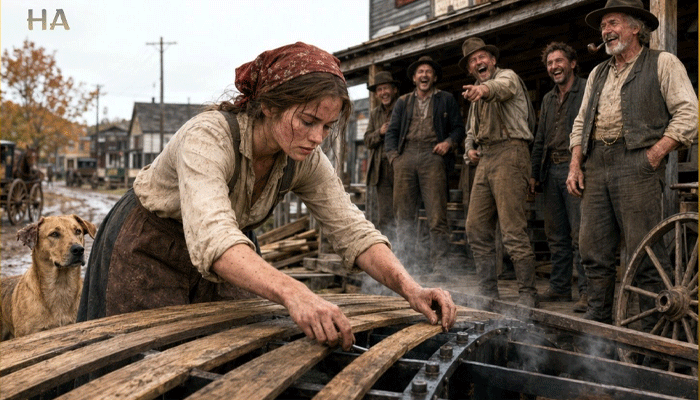
The town was small enough that nothing stayed private and large enough that nobody felt responsible for the cruelty they shared. Men came by after work and stood with arms folded, offering advice Clara had not requested. Women watched from wagons and murmured that grief had turned the Wren girl odd. Boys dared one another to run circles around the foundation while Clara worked. Someone painted a crooked sign on an old board and stuck it in the mud one night.
WREN’S WHEELHOUSE: ROLL AWAY BEFORE WINTER
Noah found it before Clara did.
He tried to pull it out, but it was driven too deep. His face turned red from effort, then from humiliation.
Clara walked over, gripped the board with both hands, and yanked until it came free. She stared at the words, then at the mercantile porch where three young men suddenly found the sky interesting.
Noah whispered, “Are we going to leave it?”
“No,” Clara said.
She carried the board to her workbench, flipped it over, and used the clean side to sketch a better roof angle.
That bothered the town more than anger would have.
Anger could be mocked. Tears could be pitied. But Clara’s refusal to perform shame unsettled them. A person who kept working after humiliation made spectators feel less like judges and more like cowards.
Silas Boone came by that afternoon.
He did not come to help. He came because the sign had made him uncomfortable in a way he did not want to name, and discomfort often disguised itself as authority.
“Girl,” he said, stopping just beyond the foundation, “this has gone far enough.”
Clara was smoothing a curved plank. She did not stop.
“My name is Clara.”
“I knew you when you were in diapers. Don’t start correcting me now.”
“You knew my father too. He called me Clara.”
Silas’s jaw tightened.
“You’re wasting lumber,” he said.
“It’s my lumber.”
“Some of it came from folks who gave it out of pity.”
“Then their pity has better use than their opinions.”
His eyes narrowed. Behind him, Hank Miller had stepped out of the mercantile to watch. So had several others. Briar Creek could smell confrontation like dogs smelled meat.
Silas lowered his voice, but not enough.
“You think because you found some old drawings, you know better than men who have built homes their whole lives?”
Clara set down the plane. Slowly, she turned.
“No,” she said. “I think because I watched one of those homes kill my parents, I am allowed to ask whether men have built wrong their whole lives.”
The porch went quiet.
Silas’s face darkened. For one second, Clara thought he might slap her. Not because he was cruel in that particular way, but because truth sometimes made men reach for violence when language failed them.
Instead, he pointed a crooked finger at the curved foundation.
“That cabin did not kill Jacob and Ellen. A storm did.”
“The storm found the bad corner.”
“There was no bad corner.”
Clara held his gaze.
“You touched it after they died.”
Silas went still.
The words landed between them with the weight of a hammer laid on a coffin lid.
“I saw you,” Clara said. “You touched the northwest corner, and you knew.”
Silas’s lips parted. No sound came.
Then Hank Miller cleared his throat from the porch, and Silas seemed to remember he had an audience. His shame hardened into anger.
“You are building a coffin,” he said. “And when winter comes, when that foolish round roof leaks and that crooked door jams and that chimney smokes you out, don’t come crawling to me to fix what sense would have prevented.”
Clara picked up the plane again.
“I won’t.”
Silas turned and walked away, but his steps were not as steady as when he had arrived.
That night, Noah asked if Silas was right.
The shed was cold. Rain tapped the tin roof. Rusty slept against the door, one ear twitching.
Clara was mending Noah’s coat by lantern light.
“About what?” she asked.
“About the cabin being a coffin.”
She pushed the needle through wool and drew the thread tight. A careless answer would have been easy. An honest answer took longer.
“A coffin is built for someone who has already stopped fighting,” she said. “That cabin is the opposite.”
Noah considered this.
“What if it doesn’t work?”
“Then we learn why, and we build better.”
“What if people laugh?”
“They already do.”
“What if they never stop?”
Clara looked up at him. Rain shivered down the window behind his head.
“Then we learn to live without their permission.”
He held that answer carefully, like something warm.
The next weeks were the hardest.
The walls rose slowly, ring by ring, each curved plank fitted into the next with joints Clara had invented from her grandfather’s sketches and her own stubborn experiments. Instead of four walls meeting at corners, the cabin formed one continuous circle, every piece bracing the pieces beside it. The roof was not flat or sharply peaked like the cabins Briar Creek knew. It climbed in a shallow cone toward a central vent above the fire pit, steep enough to shed rain, smooth enough to give wind no edge to seize.
The door nearly defeated her.
A square door would have been easier. Silas had said so. Everyone had said so. Even Clara’s own aching hands said so by the end of the fourth failure, when another frame warped overnight and refused to close.
Noah found her sitting on the ground beside the ruined door, her face in her hands.
He stood there for a while, unsure whether to comfort her or pretend not to see. Children who survived disaster often became experts in adult silence.
Finally he said, “Could we have one square thing?”
Clara lifted her head.
His voice was gentle, not critical. That made it hurt more.
“The door is where fear enters,” she said.
Noah sat beside her.
“Then make fear go around too.”
She looked at him.
He shrugged, embarrassed. “Like the wind.”
That was when Clara solved it.
Not with a perfect calculation, not with a revelation from her grandfather’s notebooks, but with her little brother’s frightened logic. She stopped trying to force a standard door into a curved wall and built the entrance as a round hatch set into a reinforced circular frame. It opened inward on a central iron pivot she forged with help from an old blacksmith named Eli Mercer, who had quietly admired her work for months without saying so in public.
When the door finally swung smoothly, Noah laughed.
It was the first real laugh Clara had heard from him in three years.
Rusty barked once, approving.
From the road, Silas Boone saw the round door move and felt something cold shift under his ribs.
He told himself it was irritation.
By late November, the cabin was livable.
Briar Creek had expected smoke to pour through the roof, rain to seep through every joint, heat to vanish into the round walls, and Clara to come begging for help. None of those things happened.
The central fire warmed the entire room evenly. There were no cold corners because there were no corners at all. The curved walls sent heat circulating in a slow, steady pattern Clara could feel when she stood near the door. The roof vent drew smoke upward cleanly. Rain slid down the cone and away from the foundation.
On the first night inside, Noah placed his bedroll exactly in the center of the cabin.
“Not near the wall?” Clara asked.
He shook his head.
“Don’t need to hide from anything.”
Clara turned away before he saw her cry.
That night, while Rusty snored softly at Noah’s feet and the fire breathed orange light over the curved walls, Clara lay awake and listened to the wind. It moved differently around the cabin. Instead of striking, rattling, pressing, and prying, it seemed to pass with a long, low whisper, as if searching for the old weaknesses and finding none.
For the first time since her parents died, Clara slept until morning.
The town noticed, though nobody admitted it.
They noticed that Clara and Noah stopped looking hollow-eyed. They noticed that Rusty no longer barked at every gust. They noticed that on freezing mornings, the round cabin’s roof shed frost first. They noticed that Clara used less firewood than other households. They noticed all of this and still called it foolish because admitting a thing worked meant admitting they had not understood why.
Then December came.
December in Briar Creek usually meant frozen mud, gray skies, church suppers, and men exaggerating the size of hogs they had butchered. It did not mean tornado weather. Tornadoes belonged to spring and summer, to warm air and green skies, to distant counties flatter than their own.
So when the first warning signs appeared, most people explained them away.
The birds disappeared on December 18.
Clara noticed at dawn. The woods behind the cabin were never quiet. Even in winter, there were crows, sparrows, woodpeckers, squirrels rattling dry leaves. That morning, nothing moved. The trees stood black and still against a sky too low for comfort.
Rusty refused breakfast.
That frightened Clara more than the silence.
Noah stood in the doorway, wearing his coat over his nightshirt.
“Something’s wrong,” he said.
“Yes.”
“Storm?”
“I don’t know.”
But she did know. Not in the way a scientist knew. Not in the way a preacher claimed to know. She knew the way scars knew weather before skin did.
By noon, the air had turned strangely warm. Snowmelt ran in thin lines through the yard. Clouds stacked in long, twisted bands from west to east. The sun appeared once, pale and sickly, then vanished behind a greenish haze.
Clara walked to town because she needed kerosene and because fear became worse when she sat still.
Rusty tried to block the door.
“Stay with Noah,” she told him.
He whined.
“Please.”
The dog looked from Clara to Noah, torn between old loyalty and new duty.
Noah knelt and wrapped his arms around Rusty’s neck.
“I’ll keep him,” he said, but his voice shook.
Clara crouched in front of him.
“If the wind comes hard, you shut the door. You stay in the center. You do not open for anyone unless you hear my voice. Understand?”
“What if someone needs help?”
That question pierced her because it meant Noah was healing enough to think beyond survival.
“You open only if it is safe,” Clara said. “A dead rescuer saves no one.”
He nodded, though she could see he hated the answer.
At Miller’s Mercantile, the mood was wrong. Men who usually loitered on the porch stood in the road, looking west. Women hurried through purchases without gossiping. Hank Miller kept wiping the same spot on the counter.
Silas Boone was there, buying nails.
He looked at Clara and then away.
She picked up kerosene, coffee, salt, and a small bag of peppermint sticks for Noah because Christmas was a week away and childhood should have at least one sweet thing in it.
When she reached the counter, Hank said, “You hear anything about weather?”
“Only what I see.”
Preacher Bell, standing near the stove, forced a chuckle.
“December storms are just rain with a bad temper.”
Nobody laughed.
Then the door flew open.
A boy named Tommy Voss stumbled in, breathless, cap gone, eyes wide.
“Cloud’s on the ground,” he gasped.
For a heartbeat, nobody moved.
Hank said, “What?”
Tommy pointed west.
“Cloud’s on the ground by the Miller pasture, and it’s spinning.”
The mercantile emptied like a kicked anthill.
Clara left her peppermint sticks on the counter.
Outside, the sky had turned the color of old bruises. Beyond the fields, a dark funnel hung from the clouds, fat at the top, narrowing as it touched earth. It moved with terrible purpose, gathering hay, branches, fence rails, and pieces of someone’s barn into its body.
A sound came with it.
Not thunder.
Not wind.
A roaring, grinding, living sound.
Clara’s blood turned cold.
“Noah,” she whispered.
Then she ran.
Behind her, people shouted. Some ran toward storm cellars. Some ran toward homes. Some stood frozen, minds refusing what eyes confirmed.
Silas Boone grabbed Clara’s arm as she passed.
“Girl, don’t be stupid! Get in the cellar under the store!”
She tore free.
“My brother is in that cabin.”
“That cabin won’t save you!”
Clara looked at him once.
“Then nothing will.”
She ran harder.
The road to her cabin had never seemed long before. Now every yard stretched like punishment. Mud sucked at her boots. The kerosene tin banged against her leg until she threw it aside. Her lungs burned. The roar grew behind her, swallowing shouts, splintering thought.
She saw Briar Creek breaking in pieces around her.
A barn roof lifted, twisted, and vanished. Fence posts snapped in sequence like matchsticks. The steeple of Preacher Bell’s church leaned, held for one impossible second, then tore away and spun into the sky.
Clara did not slow.
She had to reach Noah before curiosity or compassion made him open the door.
Fifty yards from the cabin, she saw him.
His face was in the small round window.
Rusty’s head appeared beside him.
The tornado was behind her now, close enough that the air pulled at her dress, close enough that dust and leaves whipped past her face. The round cabin stood ahead, low and strange and beautiful, its curved walls glowing in the green light.
Thirty yards.
A piece of tin flashed past and buried itself in the ground ahead of her.
Twenty yards.
The world tilted. Clara stumbled, caught herself, and kept going.
Ten yards.
The round door opened.
“No!” she screamed, though the wind stole the word.
Noah stood in the doorway, reaching for her.
Rusty bolted past him.
The dog slammed into Clara’s legs, not knocking her down but bracing against her as a violent gust tore at her body. Clara grabbed his collar with one hand and Noah’s outstretched wrist with the other.
For one awful second, all three of them were caught between shelter and storm.
Then Noah pulled.
Clara fell inside.
Rusty lunged after her.
The round door swung shut.
The tornado arrived.
Later, people would ask Clara what it sounded like inside the cabin. She would never find the right answer. It was like trains, yes, but trains had direction. It was like thunder, but thunder ended. It was like standing inside the throat of some enormous animal while it tried to swallow the world.
The cabin shuddered.
Noah clung to Clara. Rusty pressed against them both. The fire had been banked low, but sparks leapt as pressure changed above the vent. The round door trembled in its frame. Something struck the outer wall with a crack like a rifle shot and glanced away.
Clara closed her eyes and felt the structure through her body.
It was not still. It was not untouched. It was working.
Every curved plank passed force to the next. Every joint held because no single corner bore the storm’s rage alone. The roof groaned, but the wind slid over it instead of lifting under an edge. The walls vibrated, but they did not buckle.
Outside, the tornado hunted for a weakness.
It found none.
Noah was sobbing into Clara’s coat.
“You said it would go around,” he cried.
“It is,” Clara said, though she was crying too. “It is, Noah. It is.”
The roar grew louder, then impossibly louder, until Clara thought her ears would burst. A log smashed against the cabin and rolled away. The door pivot screamed. The floor shifted beneath them.
For one second, Clara saw her mother’s face in memory, framed by rain and fear. She saw her father under the falling beam. She saw Silas touching the failed corner and saying storms take what storms want.
No, Clara thought.
Storms take what pride leaves undefended.
The cabin held.
After forty-seven seconds, the sound moved on.
Not stopped. Moved.
It passed over them and away, still roaring east, still tearing at whatever lay in its path. In the sudden space it left behind, the silence was so deep that Clara could hear Noah’s heartbeat against her arm.
Nobody moved.
Rusty was the first to rise. He shook himself, sneezed dust from his nose, and gave one uncertain wag of his tail.
Noah laughed and cried at the same time.
Clara touched the floor, then the wall, then the door.
All solid.
All real.
She stood slowly and looked through the window.
Briar Creek was gone.
Not all of it. Not every house, not every tree, not every life. But the part of town in the tornado’s path had been scraped open. The church was a foundation. Miller’s Mercantile had lost its roof and half its walls. Silas Boone’s workshop had vanished so completely that only the anvil remained, sitting in mud like a grave marker. Wagons lay upside down. Trees had been stripped bare. A cow wandered through the road, bleeding from one ear and lowing in confusion.
And in the middle of it stood Clara’s round cabin.
Scratched. Mud-spattered. Dented.
Standing.
Noah whispered, “It couldn’t grab us.”
Clara put her arm around him.
“No.”
Outside, people began to emerge.
Some crawled from cellars. Some limped from ditches. Some called names with voices already breaking because they feared the answer. Clara opened the round door and stepped into the wrecked afternoon.
The first person she saw was Silas Boone.
He came from the direction of the mercantile, hat gone, coat torn, blood running down one side of his face. He walked like a man moving through a dream he did not want to understand. His eyes were fixed on the round cabin.
He stopped ten feet away.
For a long time, he said nothing.
Then he looked at Clara, at Noah, at Rusty, at the curved walls behind them.
“How?” he asked.
It was not accusation now.
It was surrender.
Clara could have hated him in that moment. Part of her wanted to. Part of her wanted to recite every laugh, every insult, every time he called her work a coffin. Part of her wanted to point toward the ruins of his shop and say, Storms take what storms want.
But Noah was beside her, alive because she had built something better than bitterness. And Rusty leaned against her leg, alive because once she had chosen mercy over convenience. The cabin itself seemed to answer before she did.
“A circle shares the burden,” Clara said.
Silas stared at the wall.
“I built your father’s cabin.”
“Yes.”
“I knew about the corner.”
The words came out so quietly Clara almost missed them.
Noah stiffened.
Silas swallowed. His old hands opened and closed at his sides.
“I saw the gap before I sold it to Jacob. Told myself it was nothing. Told myself every cabin has a flaw. Told myself a man with my experience knew what mattered.” His voice cracked. “After the storm, I saw where it failed.”
Clara’s breath caught.
For three years, she had suspected. Suspicion had been a coal she carried in her chest. Hearing it spoken aloud did not cool it. It flared.
“You let us think it was only God’s will.”
Silas flinched.
“I was ashamed.”
“My parents were dead.”
“I know.”
“My brother stopped speaking for months.”
“I know.”
“You watched this town laugh at me for trying to fix what you were too proud to admit.”
Silas lowered his head.
“I know.”
Clara’s hands trembled. Noah was crying silently beside her now, not from fear but from the strange pain of having an old wound named in daylight.
Silas looked at the ground.
“I don’t ask forgiveness,” he said. “I got no right. But people will need homes now. If I build them the old way, I’ll be burying more families with my own hands.”
He looked up.
“Teach me.”
Clara stared at him.
The tornado had taken less than a minute to break Briar Creek. This moment, somehow, felt larger. Because destruction was simple. Change was harder.
Noah whispered, “Clara.”
She looked down at him.
His face was pale, but his eyes were clear.
“Don’t let him build bad houses anymore,” he said.
That was the answer.
Not forgiveness. Not revenge.
Responsibility.
Clara turned back to Silas.
“You will tell everyone the truth about my parents’ cabin.”
He nodded.
“In church. In town meeting. Anywhere I ask.”
“Yes.”
“You will not call this my design. You will say you learned it from a girl you mocked.”
His face tightened, but he nodded again.
“Yes.”
“And when we rebuild, the widows and families with children get homes first.”
Silas looked at the ruined road, the broken town, the people gathering with shock in their faces.
“Yes,” he said. “They do.”
Only then did Clara step aside and place her hand on the curved wall.
“Then come learn why it stood.”
By nightfall, twenty-nine people sheltered in the round cabin.
It had been built for two and a dog, but grief makes people fit where pride never could. Children slept near the fire. Injured men leaned against curved walls. Women wrapped blankets around strangers. Hank Miller sat with his arm in a sling, staring at Clara as if seeing her for the first time. Preacher Bell, whose church had collapsed over the storm cellar and trapped him until two boys dug him out, warmed his hands near the fire and said nothing about sacred corners.
Noah moved among them with cups of water.
He did not hide.
That night, the wind continued to gust outside, but each time it slid around the cabin, people listened differently. Before, they had heard weather. Now they heard a lesson.
Near midnight, Silas stood.
Every eye turned toward him.
He had washed the blood from his face, but the cut remained. Shame did too.
“I owe the Wren children truth,” he said. “And I owe this town truth.”
Clara sat beside Noah and said nothing.
Silas gripped the back of a chair.
“Three years ago, I built Jacob and Ellen Wren a cabin with a bad northwest corner. I knew it before they moved in. I told myself it was sound enough. It wasn’t. After the storm killed them, I saw the break started there. I said nothing because I was proud and afraid.”
The room seemed to stop breathing.
Preacher Bell closed his eyes.
Hank Miller muttered, “Silas…”
“No,” Silas said sharply. “Let it stand. I’ve spent forty years making myself the measure of what was proper. Today, a girl I called foolish built the only house that survived. If Briar Creek has sense left, we’ll stop laughing long enough to learn.”
Nobody applauded.
It was not that kind of moment.
But Mrs. Voss, whose youngest boy had brought the warning, began to cry. Hank Miller looked at Clara and lowered his head. Preacher Bell whispered, “Lord have mercy,” and for once it sounded less like performance than prayer.
Clara felt Noah’s hand find hers.
He squeezed once.
Spring came late to Briar Creek.
The tornado scar remained, a raw brown path across fields and woods. For weeks, people found pieces of their lives in strange places: a Bible page wrapped around a fence wire, a tin cup wedged high in an oak, a wedding photograph half-buried near the creek. Funerals were held. Names were carved. The town mourned because survival did not erase loss.
But rebuilding began.
The first new round cabin belonged to the Voss family, who had lost everything except each other. Silas Boone worked under Clara’s direction. That alone drew crowds. The old carpenter, once the loudest man on any job, now asked questions before touching wood.
“How much steam for hickory?”
“Until it bends without pleading,” Clara said.
He blinked, then nodded as if that made perfect sense.
“How tight on the outer joint?”
“Tight enough to share force. Not so tight it cracks when the wood swells.”
He wrote that down.
The second round cabin was for Mrs. Patterson, who was eighty and declared she had waited long enough to live in a house that looked sensible. The third was for Preacher Bell and his wife, though Clara insisted the church itself should be rebuilt last.
“God can hear us outdoors,” she said. “Children need roofs first.”
No one argued.
By summer, Briar Creek looked different from every other town in the county. Round cabins dotted the hillside like wooden lanterns. Curved roofs caught morning light. Children invented games running around them. Women discovered they were easier to heat. Men discovered they were harder to build and therefore more satisfying when done right.
Reporters came from Springfield.
One asked Clara if she considered herself an inventor.
“No,” she said. “I consider myself someone who listened after loss.”
He tried to make that into a headline and failed.
Another asked Silas Boone how it felt to be taught carpentry by a nineteen-year-old girl.
Silas looked at Clara, then at the reporter.
“Like being rescued from drowning by someone I had called too young to swim.”
That line made the paper.
By the next year, farmers from three counties had come to study the cabins. Dr. Whitcomb from the state college visited with instruments and notebooks, measuring wind resistance and load distribution. He used words Clara’s grandfather would have enjoyed and Silas pretended not to resent. The professor offered Clara a place in a lecture hall.
She declined.
“At least visit,” he said. “You could learn formal engineering.”
Clara smiled faintly.
“I’m not against formal learning. But right now, I have a town to finish rebuilding.”
Noah, who was listening from the doorway, said, “She’ll go later.”
Clara looked at him.
He looked back with the stubbornness he had learned from her.
“You will,” he said. “You built me a safe house. I’m not letting you use me as a corner to get stuck in.”
Silas laughed so hard he had to sit down.
Clara did go, eventually.
Not that year. Not the next. But when Noah turned sixteen and could run the workshop as well as any grown man, Clara traveled to St. Louis to study architecture and structural design. She hated the city at first. Too loud. Too crowded. Too square. But she loved the libraries, the drafting rooms, the language for things she had known with her hands before she knew them in equations.
Some professors dismissed her until they saw her drawings.
Some students laughed until she corrected their calculations.
One instructor asked why all her designs began with circles.
Clara answered, “Because I know what corners cost.”
Years later, Briar Creek became known for its round houses. Not every building was circular. Clara was not a zealot. She built square when square was enough, curved when curved was wiser, and taught that tradition was not evil unless it refused evidence.
Silas lived long enough to build twenty-three round cabins.
On his last winter morning, when his hands were too weak to hold tools but his mind remained sharp, Clara visited him. He lived in the second round cabin he had ever built, the one he had made for himself after admitting he could no longer sleep inside corners.
He sat by the fire, wrapped in a quilt, looking smaller than the man who had once filled whole porches with certainty.
“Do you forgive me?” he asked.
Clara had known the question was coming for years.
She sat across from him and listened to the wind pass softly around the walls.
“I don’t forgive you all at once,” she said. “Some days I do. Some days I don’t. But I stopped letting what you did decide what I build.”
Silas closed his eyes.
“That may be more mercy than I deserve.”
“It’s the only kind I have.”
He nodded.
After a while, he said, “Your father would have liked this house.”
Clara looked into the fire.
“Yes,” she said. “He would have asked why I didn’t build it bigger.”
Silas smiled, and the old grief between them loosened one final notch.
When Clara returned home that evening, Noah was waiting outside with Rusty’s grandson, a golden pup with two good ears and one bad habit of stealing gloves. The original Rusty had been gone three years by then, buried beneath a round stone behind the first cabin. Noah had carved the words himself:
HE HELD THE DOOR AGAINST THE WIND.
The first round cabin still stood.
Clara never replaced it, though she built finer ones. Its walls bore dents from debris. Its door still had a scar where the tornado had thrown something sharp against it. The roof had been repaired twice. The floor creaked near the fire pit. But every December 18, people gathered there.
Not to celebrate the tornado.
To remember what it taught.
Children sat in the center while elders told the story. The story changed a little every year, as stories do. In some versions, the tornado split in two before reaching Clara’s cabin. In others, Rusty barked so fiercely the storm lost courage. Noah’s favorite version claimed the wind ran around the house seven times, got dizzy, and stumbled into the next county.
Clara always rolled her eyes at that part.
But she never corrected the children too harshly.
Facts mattered. So did wonder.
On the twentieth anniversary, a little girl asked Clara, now known across Missouri as Miss Wren, why people had laughed at the first round cabin.
Clara looked around at the curved walls glowing in firelight. She saw Noah, grown tall and steady, standing with his wife and children. She saw families whose homes existed because one strange idea had survived ridicule long enough to become shelter. She saw Silas Boone’s empty chair, kept by the fire because memory deserved a seat too.
“People laugh when they see something they don’t understand,” Clara said.
The little girl frowned.
“Why don’t they just ask?”
Clara smiled.
“That is the question, isn’t it?”
Outside, winter wind moved down from the hills. It crossed the fields, rattled bare branches, and swept through Briar Creek with enough force to remind everyone that nature did not become gentle simply because people became wiser.
The children grew quiet.
Some old fear passed through the room.
Then the wind reached the round cabin.
It did not strike.
It did not grip.
It curved around the walls with a long, low sigh and went on into the dark.
The little girl listened, eyes wide.
“It sounds like the house is teaching the storm manners,” she whispered.
Clara laughed softly.
Noah put another log on the fire.
And the cabin, the barrel, the coffin, the foolish wheelhouse that had once made a whole town laugh, held its warmth around them all.
THE END