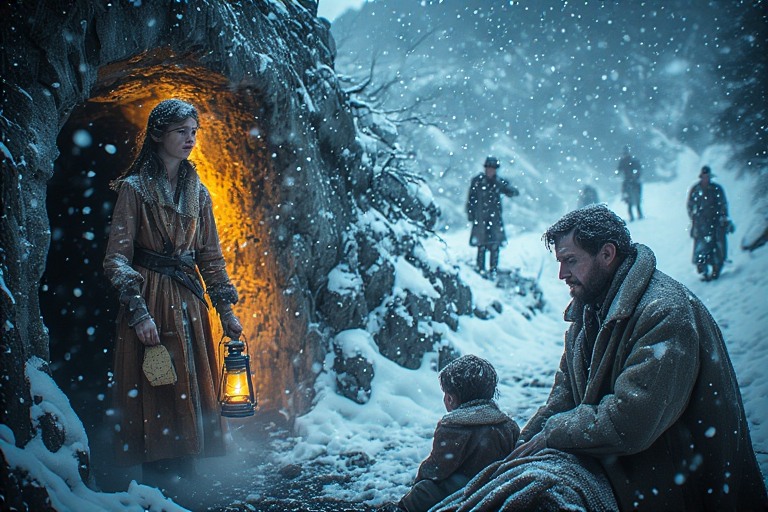
The next morning, she ate the last of the bread, licked the crumbs from the cloth, and began again.
Days took on a brutal rhythm. Dig. Drag. Breathe. Rest. Dig again.
She learned the language of the hillside. Stone that rang under pressure would not move. Stone that thudded might be loosened. Roots meant old water paths. Dry clay meant safer ground. Warmth meant she was moving in the right direction.
Hunger taught her its own arithmetic. A handful of walnuts was not food; it was two hours of digging. A trout trapped under a creek stone was not supper; it was one more day. Berries were sweetness, but sweetness alone was a liar.
At night, she read by the smallest flame she could make.
Her father had drawn a plan on the page after the map.
The Earth Hearth, he called it.
A narrow entrance tunnel to hold warmth. A main chamber dug where the vent widened. A sleeping niche raised off the floor. A cooking alcove near the entrance where smoke could be pulled outward by the draft. Drainage cut down and away. No large fire inside. Do not fight the mountain. Shape the breath.
Elara touched the drawing until the ink smudged beneath her thumb.
“I don’t have your tools,” she whispered.
But she had his idea.
Two weeks later, Silas Blackwood found her.
He had been tracking a buck along North Ridge when he noticed the fresh earth. It lay in a growing pile against the snowless ground, dark and raw, entirely wrong against the November woods. He followed it to the granite face and stopped.
Elara backed out of the tunnel on her hands and knees, coughing dirt. Her hair was tied with a strip of cloth. Her dress was torn at the sleeve. Her face and arms were gray-brown with clay.
Silas stared at her as if he had found a corpse walking.
“Elara Whitcomb.”
She looked up, blinking against daylight.
“What in God’s name are you doing?”
“Working,” she said.
He stepped closer and peered into the hole. Warm air touched his face. He jerked back, frowning.
“That’s cave damp.”
“It’s warm.”
“Warm rot is still rot.” He crouched, grabbed a handful of loose earth, and let it fall through his fingers. “You’ll bring the cliff down on your head.”
“It’s not the cliff. It’s an old fissure. The granite holds. The fill inside is softer.”
He stared at her. “You hear yourself? You sound like him.”
She lifted her chin. “Good.”
“Elara, your father was a decent man, but decent men can be wrong. He filled your head with city science and mountain fairy tales. A girl cannot live in a hole.”
“This girl can.”
His mouth tightened. “You think pride will keep you warm?”
“No. The vent will.”
“There is no vent that will save you when January comes.”
“It’s already saving me.”
Silas stood, anger rising because her certainty insulted his. “I build homes. I know what stands and what falls. I know what keeps out winter.”
Elara wiped clay from her cheek. “Then why does everyone spend winter feeding stoves like they’re starving animals?”
“Because heat costs work.”
“Maybe only the kind of heat you sell.”
The words landed before she fully understood their danger.
Silas’s eyes went cold.
He owned the timber. He owned the mill. He sold cordwood, stove lengths, shingles, and sometimes the stoves themselves on credit. Winter made him important. Winter made men come to him humble.
“You best take care,” he said quietly. “A sharp tongue won’t make this foolishness less deadly.”
Elara’s stomach twisted, but she did not look away. “Neither will a loud man make warmth disappear.”
For a moment, there was no sound except the breath from the mountain.
Then Silas turned.
“When the ground freezes around you,” he said, “don’t expect the hollow to risk itself digging out what you chose.”
“I won’t.”
He left her there.
By supper, the whole hollow knew.
The story grew as it traveled. Elara was not building shelter; she was tunneling into a grave. She was not following her father’s notes; she was bewitched by them. She was not brave; she was proud. Silas Blackwood had seen it himself, and Silas Blackwood did not exaggerate.
At Pritchard’s Store, men shook their heads.
At church, women murmured that grief had turned the girl simple.
Aunt May said nothing at first, which made people lean in harder. Finally, after Sunday service, someone asked if she planned to fetch her niece back.
May adjusted her shawl. “A body can only help those who want helping.”
That satisfied the hollow because it sounded like morality and cost nothing.
But alone that night, May opened the trunk beneath her bed and stared at the packet of papers tied with twine.
Nathaniel Whitcomb’s name was on the top sheet.
North Ridge Claim, forty acres.
May had found it after the fever, tucked behind a loose board with the journal missing. She had meant to take it to the county clerk. Then winter came. Then hunger. Then Silas Blackwood mentioned, in passing, that ridge land was useless except perhaps for timber access one day.
May told herself that a fifteen-year-old girl could not manage land. She told herself papers were not food. She told herself many things, and each one was easier to believe than the truth.
The truth was that Elara had not been a burden.
She had been an heir.
May put the papers back and shut the trunk.
On North Ridge, Elara kept digging.
By late November, the tunnel reached nearly sixty feet into the hillside, though no one in Hemlock Hollow would have believed it. It did not run straight. It curved slightly where old stone demanded respect. The entrance remained narrow enough to keep wind out. The chamber widened at the back into a round room where Elara could stand in the center without bowing her head.
The vent sighed from a crack in the rear wall.
There, the warmth was constant.
It did not roar. It did not flicker. It did not ask for wood.
It simply remained.
Elara learned that a fire was dramatic but unreliable. It made promises in orange light and abandoned you at dawn. The mountain’s warmth had no drama, but it never left.
She lined the sleeping niche with dried grass and cured hides from a dead doe she found half-buried near the creek. She shaped a small clay oven near the entrance and learned to cook with little smoke. She carved a shallow drain along one wall after a hard rain taught her humility. She stored walnuts, dried berries, smoked trout, and hard biscuits in a niche where the air stayed cool enough but never froze.
She became leaner. Stronger. Quieter.
Sometimes she missed people so badly it felt like thirst. She missed voices most at night. Not May’s voice, not the hollow’s whispering voice, but her mother humming while mending socks, her father saying, “Look closer, Ellie. The answer is rarely where people point first.”
So she talked to the journal.
“You said shape the breath,” she murmured one evening, smoothing wet clay around the oven mouth. “I’m trying.”
The vent breathed.
“I know. I made the tunnel too narrow near the bend. That’s why smoke turned back.”
The vent breathed.
She smiled faintly. “No need to scold.”
On the first Tuesday of December, the sky fell.
It began with stillness.
Every animal seemed to know before the people did. Birds vanished from the low branches. The creek went silent under a skin of ice. Dogs refused to leave porches. By noon, clouds gathered over the mountains in bruised layers, green-gray at the bottom, purple above.
In Hemlock Hollow, men stacked extra wood beside their doors. Women filled buckets and brought in laundry stiff from the line. Children were called inside early, irritated at first, then frightened by the way their parents kept looking toward the ridge.
Snow began after dark.
Not flakes, at first, but a white pressure in the air, thick and vertical. By morning, fences were gone beneath it. By the second day, sheds looked like rounded stones. By the third, no one could see the road.
The wind arrived with a voice like metal being torn.
In the Blackwood cabin, Silas fed the stove until its iron belly glowed dull red. His wife, Mary, kept their children close beneath quilts. Their youngest boy, Daniel, seven years old and bright-eyed, tried to make a game of watching his breath puff in the room.
“Papa,” he said through chattering teeth, “why’s the smoke warm but the floor cold?”
Silas forced a smile. “Heat rises.”
“Can’t you tell it to stay down?”
Mary gave a tired laugh, but Silas heard the fear beneath it.
By the fourth day, frost crawled along the inside walls.
By the fifth, the woodpile had shrunk more than Silas admitted aloud.
By the sixth, Daniel began to cough.
It was small at first. A dry tickle. Mary gave him warm water with molasses and wrapped him closer to the stove. But the cough deepened by nightfall. It rattled in his chest, wet and ugly. His skin burned beneath Silas’s palm, but the boy shook so violently his teeth clicked.
“Lung fever,” Mary whispered.
Silas snapped, “Don’t name it.”
“Not naming it won’t spare him.”
The words cut because they were true.
Silas opened the stove and threw in another split of oak. Sparks rushed upward like frantic insects. The fire roared. Heat blasted his face, but when he turned, the far side of the room remained cold enough to turn breath white.
All his life, Silas had believed in effort.
Cut more wood. Build thicker walls. Work harder than the cold.
But the storm did not respect effort. It found every seam. It moved through chinking and under doors. It crept along floorboards and settled in blankets. His fine cabin, the best in Hemlock Hollow, was not defeating winter.
It was only arguing with it.
Near dawn on the eighth day, Daniel’s breathing became a struggle.
Mary knelt beside him, her hair loose and her face hollow with exhaustion. “Silas.”
He heard everything in that one word.
Do something.
He looked at the stove. At the last stacks of wood. At the frost. At his son’s small chest pulling hard for air.
Then, against every habit of his mind, he thought of Elara Whitcomb.
The thought angered him first. A foolish girl in a hole could not help a dying child. If she was alive at all, she was barely alive. He would likely find her frozen, and then he would have to carry one dead child in his mind while trying to save his own.
But the memory returned.
Warm air on his face.
Not smoke. Not rot.
Warmth.
“Where are you going?” Mary asked when he pulled on his coat.
“To see whether a fool survived,” he said.
Mary stared at him. “Silas.”
His voice broke around the edges. “And if she did, maybe she ain’t the fool.”
The journey to North Ridge nearly killed him.
Snow reached his waist in open places and his chest where the wind had piled it. His beard froze. His lungs burned. More than once, he fell and had to crawl until he found a sapling strong enough to pull himself upright.
He cursed Elara. Then he cursed himself for cursing her.
He cursed the storm, the ridge, the pride that had kept him from looking closer when he first felt the warm air.
By the time he reached the granite face, his legs shook so badly he nearly missed what lay before him.
A dark patch in the snow.
At the base of the cliff, an oval of ground stood bare. Around it, snow thinned into slush. From the center, vapor rose steadily, white against the brutal blue morning.
Silas stopped breathing.
The entrance was covered by stiff hides, rimmed with frost on the outside but clear of snow. He staggered forward and pulled one aside.
Warm, damp air touched his face.
It was not a blast. It did not strike him like a stove. It received him.
Silas ducked inside.
The tunnel bent, and light faded. He followed the warmth, one hand against the wall. The stone was not cold beneath his glove. At the end, the passage opened.
Elara Whitcomb sat on the floor grinding herbs with a smooth stone.
She was barefoot.
Barefoot, in December, while the valley lay buried beneath killing snow.
A tallow lamp glowed beside her. The walls of the chamber shone with a faint moisture. A loaf of dark bread rested near the clay oven. Hides lined a sleeping niche. Bundles of dried plants hung from pegs driven into cracks in the stone.
It was not a grave.
It was a home.
Elara looked up. Her expression held surprise, but not triumph. That made it worse for Silas. If she had gloated, he could have defended himself. Her calm mercy left him with nowhere to hide.
He pulled off one glove and pressed his palm to the wall.
Warm.
Deeply, impossibly warm.
His certainty collapsed without sound.
“How?” he asked.
Elara stood and took a fur from the sleeping niche. “Come away from the entrance. You’re bringing the cold with you.”
He obeyed.
The fact that he obeyed a fifteen-year-old girl would have astonished him on any other day.
She draped the fur over his shoulders. Then she broke a piece from the warm loaf and handed it to him.
He stared at it.
“I came here to find your grave,” he said.
“I know.”
“I told people you were digging one.”
“I know that too.”
His face twisted. “My boy is dying.”
Elara’s expression changed at once. Not into panic. Into attention.
“How old?”
“Seven.”
“Fever?”
“Yes.”
“Cough?”
“Bad. Rattling.”
“How long?”
“Two days. Worse since night.”
Elara crossed the chamber and took down a bundle of dried leaves. “Bring him here.”
Silas blinked. “What?”
“The air is warm and wet. It will ease his breathing. Your cabin is too dry near the stove and too cold away from it.”
He stared at her as if she had performed a second miracle by speaking plainly.
“Can you help him?”
“I’m not a doctor,” Elara said. “But I know he has a better chance here than beside a stove that heats the rafters and freezes the floor.”
Silas flinched because she had described his home exactly.
“I’ll carry him,” he said.
“You’ll need help.”
“There is no help. The path is buried.”
“Then take my rope.”
“You have a rope?”
“I made one from hide strips.”
For the first time in days, something like hope moved through Silas. It was painful because it had to pass through shame.
He looked at the chamber again. “Elara, I was wrong.”
“Yes,” she said.
The simplicity of it struck harder than accusation.
“I was wrong,” he repeated. “And cruel in the way men are cruel when they think they are only being sensible.”
Elara’s eyes softened, but she did not rescue him from the truth. “Bring Daniel.”
Silas did.
The trip back to the cabin took less time because terror pulled him. The return took longer because he carried his son against his chest, wrapped in quilts, while Mary followed with a bundle of blankets and a face white with fear. Twice she stumbled. Twice Silas nearly dropped to his knees. Elara met them halfway with the hide rope tied around her waist and guided them through the deepest drifts.
Mary did not speak when she entered the Earth Hearth.
She simply stopped.
Her eyes moved from the warm walls to Elara’s bare feet to the small bed already prepared near the vent. Then she began to cry, silently, like a woman too tired to afford sound.
They laid Daniel in the sleeping niche. His breathing rasped. Elara placed warm stones wrapped in cloth near his feet and gave Mary a cup of steeped herbs.
“What is it?” Mary asked.
“Willow bark for fever. Mullein for his chest. Not too much.”
Mary took it with shaking hands. “You learned this from your mother?”
“Some. Some from my father’s notes. Some from being alone and needing to pay attention.”
Silas lowered himself onto the floor near the entrance. The warmth soaked slowly into his clothes. For the first time in over a week, his body stopped bracing against cold.
Daniel slept within an hour.
Not easily. Not safely yet. But he slept.
For three days, the Blackwoods lived inside the mountain.
Silas learned the humiliation of being sheltered by the girl he had mocked. He also learned that humiliation, if a man did not run from it, could become instruction.
Elara showed him the drain cut along the floor. The narrow entrance that slowed air exchange. The smoke draft near the oven. The way the chamber’s warmth came not only from the vent but from the stone itself, which held heat the way memory held pain.
“A stove shouts,” she said one evening while Daniel breathed easier beside them. “The mountain tells a story.”
Silas watched the lamp flame quiver in the soft current of air. “Your father said that?”
“He said most human contraptions are arguments. The best ones are agreements.”
Mary, sitting beside Daniel, looked up. “Agreement with what?”
“With what’s already true,” Elara said.
Silas closed his eyes.
He had spent his life selling arguments against winter. More wood. More fire. More labor. The hollow respected him for it. But a child with a journal had found an agreement he never thought to seek.
On the fourth morning, Daniel’s fever broke.
Mary pressed her forehead to Elara’s hands and sobbed.
Elara froze, unsure what to do with gratitude so intimate. Then she placed one awkward hand on Mary’s hair.
“He fought hard,” she said.
Mary lifted her face. “So did you.”
When the paths became passable again, Silas Blackwood returned to Hemlock Hollow changed, and because he was Silas Blackwood, the hollow had to reckon with that change.
He did not tell the story quietly.
He stood outside Pritchard’s Store with Daniel beside him, pale but breathing, and Mary wrapped in a shawl at his shoulder. Men gathered because Silas had called them. Women came because Mary was crying. Children pressed close because children always know when adults are about to become interesting.
Silas removed his hat.
“I said Elara Whitcomb was digging her grave,” he began.
No one moved.
“I was wrong.”
The words fell into the street like a dropped axe.
“I said her father’s learning was foolishness. I was wrong about that too. My son is alive because that girl listened when the rest of us laughed.”
A murmur moved through the crowd.
Old Mrs. Creed whispered, “Lord have mercy.”
Silas turned toward her. “Mercy would have been feeding the child before the storm. We did not show mercy. We showed judgment and called it sense.”
That silenced them.
Then Aunt May stepped forward.
Her face was pale, but her voice was sharp enough to cut cloth. “That girl is fifteen. Whatever she has made up there, she has no right keeping it from the family that took her in.”Family
Elara, standing at the edge of the crowd, went still.
Silas turned slowly. “May.”
“She is a minor,” May continued. “If there is shelter, stores, land, or anything of value on that ridge, it falls under family care until she comes of age.”
The crowd shifted. Gratitude was young in them; greed was older.
Someone muttered, “Could save all our children.”
Another said, “No one girl ought to hold a whole warm hill.”
Elara felt the ground tilt beneath her.
This was the twist she had not foreseen. The hollow had mocked the grave when they thought it useless. Now that it was warmth, they wanted law.
May looked directly at Elara. “Your father left you nothing but confusion. Don’t stand there like a queen over what you cannot manage.”
Elara’s throat closed.
For one terrible moment, she was back on the porch with a burlap sack, being measured and dismissed.
Then Silas spoke.
“Your father left more than confusion.”
May’s eyes flicked toward him.
Silas saw it, and shame opened another door in his memory.
Years earlier, Nathaniel Whitcomb had come to the mill office with papers in his hand. Silas had signed as witness because Nathaniel needed a respectable local name on the filing and because Silas had not yet learned to resent the man’s strange brilliance. North Ridge, forty acres. A worthless claim, everyone thought. Stone, laurel, and old bear trails.
Worthless until it breathed.
Silas looked at May. “You had the deed.”
The crowd stirred.
May’s mouth tightened. “I don’t know what you mean.”
But Elara did.
The journal. The missing references. The way May had said papers were not food.
Elara stepped forward. “Aunt May.”
May’s gaze flashed with something like panic, quickly buried under anger. “Do not take that tone with me.”
“My father filed the claim?”
Silas answered because May would not. “Yes.”
“Did my mother know?”
“Yes.”
Elara’s voice grew quieter. “And after they died?”
Silas looked at May.
The whole hollow looked at May.
May’s face crumpled for half a second, and in that half second everyone saw the truth before she rebuilt herself.
“I had children hungry,” she said. “I had debts. I had a roof leaking and winter coming. What was I supposed to do with a ridge full of rocks?”
“Tell me it was mine,” Elara said.
“You were a child.”
“I was a child when you put me out.”
That sentence changed the air.
May flinched as if struck.
Elara expected satisfaction, but none came. She saw her aunt not as a monster but as a woman who had allowed fear to make one selfish choice, then another, until selfishness felt like survival.
Silas faced the crowd. “No one will take that ridge from her.”
A man near the back said, “And if the rest of us freeze?”
Elara turned toward him.
“You won’t,” she said.
The crowd quieted.
Her knees trembled, but her voice did not. “My father’s journal has more drawings. The vent I found is not the only warm seam. The ridge has smaller fissures along the east slope. Some may be useful. Some may be dangerous. No one digs without learning the stone first. No blasting. No greedy cutting. No forcing children out of homes and calling it necessity.”
Her gaze moved to May, then to Silas.
“I will help,” Elara said. “But not because you own me. Not because you pity me. Not because you got frightened after you got cold. I will help because Daniel lived, and other children should live too.”
Mary Blackwood began crying again.
Silas bowed his head before Elara in the middle of the road.
The richest man in Hemlock Hollow bowed to the orphan girl he had condemned.
That winter did not become easy. Nothing true ever does.
Two old men died before the thaw. A roof collapsed under snow on the far side of the creek. Food ran thin. Fear returned often, and with it old habits of blame.
But Silas kept his word.
He came to North Ridge not as a master builder but as an apprentice. He brought tools, men, and humility, though the last one fit him awkwardly at first. Elara made him slow down. She made him place his hands against stone and feel before striking. She made him watch how vapor moved in cold air. She made him understand that a hillside was not a pile of material waiting to be conquered but a structure already built by time.
With her father’s journal open on a flat rock, they mapped smaller vents.
Some were useless. Some were too wet. One smelled wrong, sharp and metallic, and Elara marked it with charcoal.
“Leave that one sealed,” she said.
Silas did not argue.
By January, the first hollow hearth besides Elara’s own was finished behind the Blackwood cabin. It was not as deep, and it did not have the same strong vent, but its earth-packed walls and stone chamber held warmth far better than the cabin alone. Other families followed. They dug short winter rooms into safe hillsides, lined entrances, cut drains, and used small cooking fires only when necessary.
The stoves did not vanish. Pride rarely dies all at once.
But the hollow no longer worshiped them.
Children slept warmer. Woodpiles lasted longer. Mothers stopped waking every hour to feed iron bellies of fire. Men who had once laughed at Nathaniel Whitcomb’s rock hammer began asking Elara where the stone changed color and what dampness meant.
She answered when they asked respectfully.
When they did not, she waited until they learned to.
Aunt May came last.
She arrived one afternoon in early spring, when snowmelt ran silver down the ridge and the first green tips pushed through the leaf rot. Elara was outside her entrance, sharpening a tool Silas had made for her.
May looked smaller than Elara remembered.
“I found the papers,” May said.
Elara kept sharpening.
“I should have brought them sooner.”
“Yes.”
May swallowed. “I was afraid.”
“So was I.”
“That ain’t the same.”
“No,” Elara said. “It isn’t.”
May held out the packet.
Elara took it. Her father’s name was there. Her mother’s too. And beneath them, in legal ink that had survived fever, grief, hunger, and cowardice, was Elara’s future.
May’s eyes filled. “I told myself I was protecting something until I knew what to do.”
Elara looked at her aunt’s rough hands, chapped from work, trembling now.
“Were you?”
May closed her eyes. “No.”
The honesty surprised them both.
“I put you out because every time I looked at you, I saw what your mother had and what I lost. I saw your father’s papers and thought the world had given you a door while giving me debts. That is an ugly thing to say.”
“It is.”
“I am sorry.”
Elara waited for anger to rise strong enough to warm her.
It did rise, but it was not alone. Beneath it lay the memory of May’s children guarding their bowls. The leaking roof. The way winter turned decent people into accountants of survival.
Forgiveness, Elara realized, was not pretending the wound had never happened. It was deciding the wound would not become the only truth.
“I won’t come back to your cabin,” Elara said.
May nodded, tears falling freely. “I know.”
“But when we build the next hearth, your children can help haul clay.”
May pressed a hand to her mouth.
“And they can eat supper here that day,” Elara added.
May bent as if the words had taken strength from her knees. “Your mother would have been proud.”
Elara looked toward the ridge, where warm vapor lifted faintly from the entrance of her home.
“My father too,” she said.
Years passed, and Hemlock Hollow changed so gradually that travelers called it sudden.
They came expecting the usual Appalachian hardship: smoke-black cabins, endless wood chopping, children blue-lipped by March. Instead, they found houses tucked into hillsides, root cellars that stayed warm enough to protect stores, winter rooms with stone benches and dry floors, and people who spoke of the earth not as enemy but as elder.
They still worked. They still suffered losses. No invention ended grief. No warm chamber made life fair.
But the hollow stopped treating misery as proof of wisdom.
Silas Blackwood grew old with a limp from the storm journey he never regretted. Whenever someone called him the man who saved Hemlock Hollow, he corrected them sharply.
“No,” he would say. “I was the last fool to learn.”
Daniel Blackwood grew tall and became a doctor. He carried in his medical bag a smooth warm stone from Elara’s chamber, not because it had magic in it, but because his first memory after fever was waking in a mountain’s breath while a girl everyone had mocked gave him water.
Aunt May lived long enough to see her children build a hollow hearth of their own. She never became soft. Some people do not. But she became honest, which was rarer and harder.
As for Elara Whitcomb, she stayed on North Ridge.
Not because she hated the hollow.
Because the mountain had opened for her when people would not.
In later years, visitors found her there, a woman with steady hands and silver beginning in her dark hair, teaching children how to read stone layers, how to notice warm air in winter, how to respect what they did not yet understand.
On the last page of her father’s journal, beneath his old note about the breathing mountain, Elara wrote in a hand more elegant than the girl’s who had first opened it with frozen fingers:
A stove shouts its heat and demands to be fed.
The earth tells its warmth slowly and asks only that we listen.
People are much the same.
The loudest wisdom may still leave you cold.
The quiet truth may be waiting inside the very hillside everyone told you was barren.
And below that, she added one final line:
I was not digging my grave. I was opening my door.
THE END