The next morning, Sterling noticed the repair.
He noticed everything.
At breakfast, while the children ate thin oatmeal in silence, his cane tapped across the floor. Tap. Tap. Tap. The sound stopped behind Rowan’s bench.
“Miss Bell,” he said, “my office.”
No one looked at her. That was one of Sterling’s lessons too. Witnessing trouble could make trouble contagious.
His office smelled of leather, ink, and polished wood. Ledgers lined one wall, each spine labeled in his precise hand. He sat behind his desk and folded his long fingers together.
“You are industrious,” he said.
Rowan kept her eyes on the brass inkwell. “Yes, sir.”
“You show initiative.”
“Yes, sir.”
“That can be admirable when properly directed.” He opened a drawer and removed a small strip of black fur caught on a bramble thorn. Rowan felt the blood leave her face. “But initiative without discipline becomes disorder.”
She said nothing.
Sterling watched her in the patient way a cat might watch a mouse it had no need to hurry toward. “It has come to my attention that you are harboring an animal. A stray. A drain on resources. Unhygienic. Sentimental.”
The word sounded worse than filthy in his mouth.
“He doesn’t take anything,” Rowan said before she could stop herself. “I feed him scraps from my own plate.”
“Then he steals from your strength, which belongs to this institution until your term of service is complete.”
“My term?” She looked up. “I turned eighteen last month.”
Sterling smiled.
It was a small smile. Bloodless. Legal.
“You turned eighteen with debts attached to your name. Food, lodging, clothing, medical attention, moral instruction. You are not a prisoner, Rowan. You are an investment not yet matured.”
A slow cold moved through her.
“I never signed anything.”
“Your mother did.”
That struck harder than if he had slapped her. Rowan’s mother had died when she was three. All Rowan had of her was a blue ribbon, a cracked comb, and half a memory of a woman singing while rain hit a window.
Sterling slid a paper across the desk. She saw a signature at the bottom, the ink faded but the name clear.
Maeve Bell.
Rowan could barely breathe.
“What is this?”
“An agreement. Your mother placed you in my care before her death. In exchange, she accepted certain obligations on your behalf.” His eyes sharpened. “You will work them off properly, as others have done.”
Rowan stared at the signature. Something about it tugged at her, but fear made thinking difficult.
“And Bramble?” she asked.
“The dog will be removed by noon.”
Her hands curled into fists under the desk. “Removed where?”
“Do not ask questions for which kindness would require me to lie.”
The room went quiet.
Sterling leaned back. “Consider it a lesson. Affection is not evil, but unmanaged affection makes people weak, impulsive, and disobedient. You repaired a child’s trousers last night because you felt pity. You hid an animal because you felt attachment. Those feelings led you to steal institutional supplies and break institutional rules. Therefore the feelings must be corrected.”
Rowan understood then. He was not just taking her dog. He was trying to prove that love itself belonged under his authority.
She lowered her gaze.
“Yes, sir,” she whispered.
Sterling mistook surrender for obedience, because powerful men often do.
That night, Rowan ran.
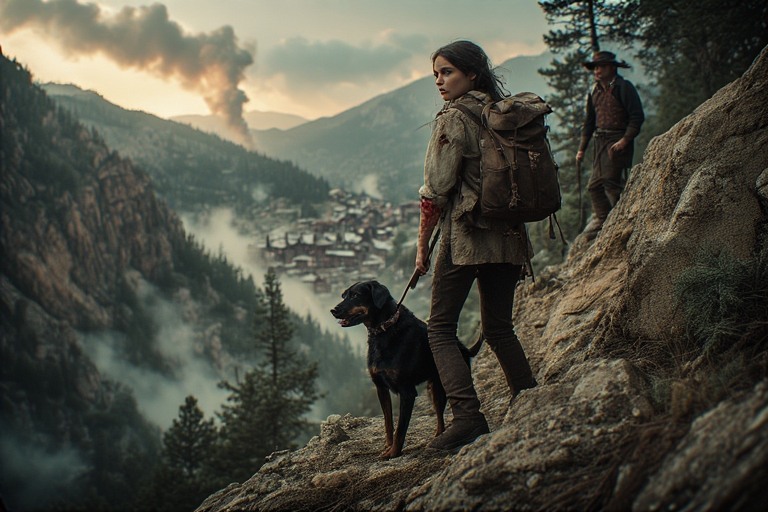
She took a stale loaf of bread, a tin cup, two matches sealed in wax paper, the old blanket from her bed, and the reinforced canvas knapsack she had sewn in secret months earlier in case she ever found the courage to leave. Bramble climbed in without a sound, as though he had been waiting for this moment longer than she had.
At the back fence, Micah appeared in the shadows.
Rowan almost cried out.
The little boy held up a dented water tin. “You’ll need it,” he whispered.
“Micah, go back.”
“Mr. Sterling said you’re bad.”
“Maybe I am.”
“No,” he said fiercely. “Bad people don’t sew knees.”
She knelt and gripped his thin shoulders. “Listen to me. Don’t tell anyone you saw me.”
His eyes filled. “Will you come back?”
Rowan looked toward the dark shape of the mountains. “I don’t know.”
Micah pressed the tin into her hands. “Then don’t die.”
That was the last command she accepted from the foundling home.
Discover more
clothing
dress
Romance
The first days in the ravine stripped life down to its bones.
Water mattered. Shelter mattered. Food mattered. Everything else became memory.
Rowan discovered quickly that freedom did not soften the world. It simply changed the terms of the fight. The ravine was beautiful, but beauty did not feed her. The mist made her clothes damp. The cold bit through her blanket. Roots that looked edible tasted bitter, and berries had to be tested one by one because a mistake could close her throat or twist her stomach until she could not stand.
Bramble became her compass. His nose found animal trails and clean seepage. His ears caught movements before hers did. When he growled, she listened. When he relaxed, she allowed herself to breathe.
On the third day, she found a shallow cave behind a curtain of ivy high on the western slope. It was barely more than a hollow in the stone, but it was dry enough in the back and narrow enough to defend. She cleared loose rocks until her hands throbbed, then dragged in pine branches to make a bed.
That night, Bramble circled twice, collapsed on the branches, and sighed as though they had checked into a hotel.
Rowan smiled for the first time since leaving.
“Don’t get proud,” she told him. “It’s not exactly the Palace Hotel.”
He rolled onto his back.
“Fine,” she said. “It’s our Palace Hotel.”
The words warmed her more than the blanket.
By the fifth morning, hunger had hollowed her cheeks and made her thoughts slow. She woke to Bramble’s low growl. His body was tense beside her, nose pointed toward the ivy.
Rowan reached for the sharp flint she used as a knife.
Outside the cave, on a flat stone, sat a small parcel wrapped in oilcloth and tied with twine.
Her heart slammed against her ribs.
Sterling.
The name moved through her like a snake.
She waited in the cave for nearly an hour, hardly daring to blink. No one emerged from the trees. No voice called her name. No rifle barrel glinted. The ravine remained still except for the whisper of pine needles overhead.
Bramble sniffed the air and whined.
Rowan smelled it then.
Smoked meat.
Her empty stomach clenched so hard she nearly doubled over.
“Don’t,” she whispered to herself. “That’s how traps work.”
But starvation had its own arguments. She broke a long branch from the cave floor and used it to drag the parcel closer. Nothing snapped shut. No hidden rope tightened around her wrist. At last she untied the twine with shaking fingers.
Inside were three strips of dried venison, a twist of salt, and a bundle of herbs tied with red thread.
She recognized the leaves from an old almanac she had once stolen from Sterling’s library and memorized by candlelight. Feverfew. Useful for pain and sickness.
A gift.
Not rescue. Not capture. A gift placed carefully enough to help her without cornering her.
Rowan turned slowly, scanning the forest.
“Who’s there?” she called.
Her voice sounded small in the ravine.
No one answered.
Far above, on a ledge hidden by wind-bent pines, an old man lowered a brass spyglass with trembling hands.
Jedediah Crowe had lived alone in the ravine for twenty-six years, long enough for Red Creek to turn him into a ghost story. Some said he had gone mad after finding gold. Some said the poisoned water had ruined his mind. Some said he had killed a man and fled justice. None of them knew the simplest truth: Jedediah had hidden because cowardice was easier to carry where no one could see it.
He had watched Rowan climb into the ravine two days earlier. At first he had cursed under his breath, furious at the trouble. Then he saw the dog in the pack, the girl’s bleeding hands, the way she kept moving even when her body begged her to stop. It reminded him of another woman climbing another ridge thirty years ago, carrying a sick child wrapped in a shawl, begging someone to tell the truth about the water.
Jedediah had not told the truth then.
So he left venison for Rowan Bell and called it a beginning.
The next stranger found her by accident.
His name was Arthur Hale, and he worked as a surveyor for Caleb Sterling, though the employment sat on his soul like a stain. He was a tall man in his mid-thirties with tired gray eyes and a beard he kept trimmed more out of habit than pride. He had once had a wife, a daughter, and a hound named Jasper. Two winters earlier, fever took the first two within six days. Jasper stopped eating after the funerals and died under the kitchen table before spring.
Since then, Arthur had moved through life like a man finishing chores in a house already burned down.
Sterling paid well. That was the reason Arthur gave himself for accepting the ravine survey. The truth was uglier. Grief had made him indifferent, and indifference made a convenient partner for cowardice.
He was marking a game trail near the western slope when Bramble exploded from behind the ivy with a snarl.
Arthur froze.
Rowan stepped out behind the dog, flint in hand, hair tangled, dress torn, eyes blazing with terror and defiance.
For a moment, no one moved.
Arthur saw a runaway, yes, but not the way Sterling would have described one. He saw a young woman stretched thin by hunger, guarding a dog with her whole body. He saw bandaged palms, bruised arms, and the hard intelligence of someone who had learned that mercy often came with hooks hidden inside it.
“I won’t hurt you,” he said carefully.
Rowan did not answer.
Bramble’s growl deepened.
Arthur slowly lifted both hands. “I’m stepping back.”
“You’re Sterling’s man,” she said.
Her voice was hoarse. It sounded unused, as though the ravine had taught her silence better than the foundling home ever could.
“I’m a surveyor.”
“For Sterling.”
The distinction collapsed in the air between them.
Arthur swallowed. “Yes.”
“Then go survey somewhere else.”
A flicker of something almost like a smile touched his mouth. It vanished quickly. “Fair enough.”
He backed away, keeping his movements slow. Every training in him said he should report her. Sterling would pay for the information. Sterling would also punish him if he learned Arthur had kept silent.
But then Bramble shifted, placing himself more firmly between Rowan and danger despite his ribs showing through his fur, and Arthur saw Jasper standing in front of his daughter’s bed during the fever, too loyal to understand death.
Arthur made his choice.
“I was never here,” he said.
Rowan’s eyes narrowed. “Why?”
“Because some things don’t belong to Sterling.”
He turned and left before courage could change its mind.
Near dusk, Rowan found another bundle at the edge of the clearing. Salve for her hands. Quinine powder. A small packet of dried beans. No note.
She stared after the direction Arthur had gone.
Bramble sniffed the medicine and sneezed.
“I know,” she said softly. “I don’t trust him either.”
But that night, after rubbing salve over her torn palms, Rowan cried for the first time since leaving the home. Not because she was afraid, although she was. Not because she was hungry, although she remained painfully so. She cried because two strangers had shown her kindness without demanding that she kneel for it, and she had no idea what to do with a mercy that did not come wearing chains.
Then the storm came.
For two days, the sky turned the color of bruised iron. The air thickened until even Bramble grew restless, pacing the cave and whining at the ivy curtain. Rowan gathered extra wood and moved their small store of roots farther back into the cave. She told herself she was prepared.
The mountain corrected her after midnight.
Rain slammed into the ravine in violent sheets. Thunder cracked so close the stone under her palms seemed to jump. Wind drove water sideways through the ivy, and within minutes the cave changed from shelter to trap. Streams poured down unseen cracks in the ceiling. The pine-branch bed soaked through. Muddy runoff spilled over the entrance and crawled across the floor like a living thing.
Rowan wrapped Bramble in the blanket and pulled him against her chest.
“It’s all right,” she lied. “It’s just noise.”
The dog trembled.
By dawn, the rain had softened to a miserable drizzle, but the damage was done. Their food was ruined. Their firewood was useless. Bramble’s nose was hot and dry.
At first Rowan told herself he was only cold. Then he tried to stand and collapsed.
“No,” she said.
He looked up at her with dull eyes and gave a weak thump of his tail, as if apologizing.
“No, Bramble. Don’t you do that. Don’t you dare be polite about dying.”
She mixed a pinch of Arthur’s quinine with water and eased it between his jaws. He coughed, swallowed, and sagged against her lap. Panic clawed at her throat. She had survived hunger, climbed stone, evaded men, and slept with one eye open beneath a roof of rock, but this helplessness broke something open in her.
The cave was too wet. The cold would finish what fever started.
She remembered smoke.
A thin gray plume she had seen two mornings earlier on the northern slope, rising from a ledge high above the mist. At the time she had avoided it because people meant danger. Now people might be the only chance Bramble had.
Rowan packed what remained: salve, quinine, the last strip of venison, the water tin Micah had given her, and the blanket. Then she lifted Bramble into the knapsack. He was heavier than he had ever been, not because his body had changed, but because fear added weight to everything loved.
The climb to the northern ledge nearly killed her.
Stormwater had erased the trails. Mud sucked at her boots. Rocks shifted beneath her hands. Twice she slid several feet and stopped only by slamming her shoulder into pine roots. Pain burst white behind her eyes, but Bramble’s ragged breathing kept time beside her ear, and she climbed toward it as much as toward the smoke.
When she finally reached the ledge, the hut appeared through the trees like something imagined by a starving mind. It was small and rough, built of logs darkened by weather, with a stone chimney and a stack of split wood under a slanted roof.
Rowan staggered to the door.
She tried to knock. Her hand did not rise.
Instead she collapsed against the wood.
The door opened inward, and an old man with a white beard and pale blue eyes stared down at her.
For one terrible second, Rowan thought she had reached Sterling after all. Not the man himself, but another man like him. Another authority. Another locked door.
Then the old man’s gaze dropped to the knapsack and the trembling dog inside it.
His face changed.
“Bring him in,” he rasped.
Rowan did not know if she stepped or fell across the threshold.
The hut was warm. That was her first thought. Warm and dry, smelling of woodsmoke, pine resin, and bitter herbs. Jedediah Crowe helped her lift Bramble onto a bearskin rug near the hearth. His hands, though knotted with age, moved with practiced gentleness.
“Lungs sound wet,” he muttered, pressing his ear against Bramble’s side. “Fever’s got him. How long?”
“Since morning,” Rowan said. “Maybe the night.”
“You got quinine?”
She pulled out the packet.
Jedediah grunted. “Hale found you then.”
“You know Arthur?”
“Know of him. Man walks like his grief’s tied to his ankles.”
He did not ask questions after that. He brewed herbs, warmed blankets, and showed Rowan how to rub Bramble’s chest to ease his breathing. She obeyed because he never tried to take the dog from her completely. Every instruction assumed Bramble remained hers to love, hers to fight for.
By afternoon, Arthur arrived soaked, carrying provisions and guilt in equal measure.
He stopped short when he saw Rowan by the hearth.
“You made it,” he said.
“No thanks to the trail,” Jedediah snapped. “Shut the door. You’re letting half the mountain in.”
Arthur stepped inside and set his pack down. “I went to her cave. It was flooded.”
Rowan looked up. “Why did you come back?”
The question carried all the suspicion she could not hide.
Arthur met it without offense. “Because I knew what the storm could do. Because I should’ve helped more the first time. Because Sterling asked me this morning whether I had seen signs of you, and I lied badly enough that he may have believed me.”
Jedediah poured coffee into three chipped cups. “Sterling don’t believe. He calculates.”
Arthur’s face hardened. “Then he’ll calculate this soon. He’s closing the Red Creek dam gates in three days.”
The old man went still.
Rowan looked between them. “What dam?”
Arthur removed a leather case from his pack and unrolled a map on Jedediah’s table. Precise ink lines showed the valley, the creek, the ridges, and the ravine spring.
“Sterling sent me to chart water sources,” Arthur said. “At first he claimed it was for irrigation expansion. Then I saw the crews building here.” He tapped the map. “Upstream from town, on land he owns through three different companies. He’s going to slow the creek until wells start failing. Then he’ll announce a solution.”
Jedediah’s mouth twisted. “The ravine spring.”
Arthur nodded. “He plans to pipe it down and sell water back to the town at a price he sets. He’ll look like a savior because he created the disaster quietly first.”
Rowan felt cold despite the fire. “But everyone thinks the ravine is poisoned.”
“Because Sterling wanted them to,” Jedediah said.
The old man sat heavily. For a while, only the crackle of the fire and Bramble’s strained breathing filled the hut. When Jedediah spoke again, his voice had lost its roughness. What remained was shame.
“Thirty years ago, there was a rockslide. Mud got into part of the lower spring for a season. One man fell sick after drinking from a stagnant pool, not the main water. The town panicked. Sterling was young then, ambitious, already buying land. He saw fear and put a fence around it.”
Arthur watched him carefully. “You knew?”
“I was prospecting these slopes. I knew the main spring ran clean. Dr. Whitcomb knew too. He wrote an affidavit saying so.” Jedediah rubbed both hands over his face. “Sterling paid men to say otherwise. Then his quarry fouled a different creek near town, and fever came through the valley. His own boy died in that fever. Instead of admitting the quarry poisoned the water, he pointed people back at the ravine.”
Rowan’s stomach turned. “He blamed a clean spring for what his quarry did.”
“Aye.”
“And you said nothing.”
Jedediah looked at her then. He did not defend himself. That made his guilt heavier.
“I said nothing,” he admitted. “Sterling threatened to have me blamed for trespassing and theft. I had no family, no money, no standing. I told myself one man’s truth couldn’t beat his power. That was the first lie. The second was that silence would keep me safe. It didn’t. It just made a coward old.”
Arthur pulled another map from his case. “I have the false readings he ordered me to submit. I kept corrected copies.”
Jedediah stood slowly and crossed to an old trunk under his cot. From beneath folded blankets and rusted tools, he removed a tin box. Inside were yellowed papers tied with a string.
“Dr. Whitcomb’s affidavit,” he said. “Original survey notes. Names of the men Sterling paid.”
Rowan stared at the papers.
For years, Caleb Sterling had seemed like a wall too high to climb. Now she saw the cracks. Not weakness, exactly, but structure. His power rested on documents, fear, silence, and the belief that no one would ever put the pieces together.
She looked toward Bramble, sleeping fitfully beside the fire.
“He called love a liability,” she said.
Arthur frowned. “What?”
“Sterling. He told me Bramble made me weak.” Rowan’s voice steadied as she spoke, because understanding was becoming anger, and anger was easier to stand on than fear. “But he’s wrong. Bramble made me run. Running brought me here. Being here showed us the truth. Maybe love is only dangerous to men like Sterling because it makes people disobey.”
Jedediah studied her for a long moment. Then he gave one short nod.
“What do you propose, Miss Bell?”
The name struck her differently than “girl” or “foundling.” Miss Bell sounded like someone who existed outside Sterling’s ledgers.
“When he calls the town meeting,” she said, “we go.”
Arthur shook his head. “He’ll have men there.”
“Then we bring proof.”
“He’ll call Jedediah mad, me disgruntled, and you a runaway thief.”
“Then we don’t just tell them the ravine is safe,” Rowan said. “We show them what his lie cost. We make him say too much.”
Jedediah’s eyes sharpened. “Proud men do that when cornered.”
Arthur looked from the old man to Rowan. “There’s more. Sterling’s wife will be there.”
“Eleanor?” Jedediah said quietly.
“You know her too?”
“Everyone knew Eleanor before Sterling taught her to become a portrait hanging in his house.”
Arthur hesitated. “Rumor says she never recovered after their son died.”
“Rumor is a lazy substitute for grief,” Jedediah said.
Rowan looked down at Dr. Whitcomb’s affidavit. “If her son died because of Sterling’s quarry, and he blamed the ravine instead, then she deserves to know.”
Arthur’s face tightened. “And if she already knows?”
No one answered.
That silence became their plan.
For two days, they prepared while Bramble fought his fever.
Jedediah made Rowan drink broth and sleep in stretches. Arthur brought more supplies and information from town. Sterling had announced an emergency meeting for Saturday evening at Red Creek Hall. Notices had been posted outside the church, mill, and general store. He would address the “water uncertainty” and offer a “private solution for public welfare.”
“Private solution,” Jedediah muttered. “That devil could sell a noose as a necktie.”
Bramble’s fever broke the night before the meeting.
Rowan was sitting beside him, too tired to pray but desperate enough to attempt it, when his breathing eased. Near dawn, he lifted his head and licked her wrist.
She covered her mouth with one hand and laughed through tears.
“You ugly miracle,” she whispered.
His tail thumped once.
Arthur, awake at the table, smiled into his coffee.
Jedediah pretended not to see.
By afternoon, Rowan was clean for the first time in weeks. Jedediah gave her a simple blue dress that had belonged to his late wife, Martha. It was old-fashioned and slightly loose, but Rowan tied it at the waist and brushed her hair until it fell in a dark braid over her shoulder. The girl in Jedediah’s cracked mirror startled her. She did not look like Sterling’s runaway. She looked young, yes, and tired, but there was a steadiness in her face the orphanage had never allowed.
Arthur handed her a folded paper.
“What is it?” she asked.
“The agreement Sterling showed you. I found the recorded copy.”
Rowan’s hands tightened.
Arthur’s expression was grave. “Your mother’s signature was forged.”
For a moment, the room disappeared.
“How do you know?”
“I compared it with the employment records from the hotel where she worked. Same name, different hand. Sterling filed the agreement two weeks after she died.”
Rowan sat down hard.
All these years, Sterling had claimed her mother gave her away with debt attached. He had not only owned Rowan’s labor through a lie. He had used her dead mother’s name as the chain.
Jedediah swore softly.
Rowan looked at the forged paper, then at Bramble sleeping near the hearth, then at the maps and affidavits stacked on the table. The story had grown larger again. It was no longer only about water. It was about every person Sterling had taught to doubt their own worth because he had written a number beside their name.
At sunset, they walked toward town.
Bramble came too.
Arthur argued against it. Rowan refused.
“He started this,” she said. “He finishes it with me.”
Red Creek Hall was packed when they arrived. Men from the mill stood shoulder to shoulder with farmers, shopkeepers, widows, and children from the foundling home. Anxiety moved through the room like heat. The creek had run low for three days. Wells were clouding. People were ready to be frightened, and Sterling was ready to profit from their fear.
He stood on the stage beside a covered easel, immaculate as ever.
“My friends,” he said, “I wish we met under more cheerful circumstances.”
Rowan paused outside the door and listened.
Arthur leaned close. “Once we go in, there’s no retreat.”
Rowan looked down at Bramble. The dog, still weak but standing, pressed against her leg.
“I know.”
Inside, Sterling continued, his voice rich with practiced concern. “The drought has revealed vulnerabilities in our valley’s water supply. I have anticipated this possibility and funded, at personal expense, an alternative system. It will require sacrifice, yes. A modest monthly fee. But survival has always required discipline.”
There it was, Rowan thought. His favorite word.
Discipline.
He nodded to an assistant, who removed the cloth from the easel. A large map appeared, showing a pipeline from the ravine into town. Several people gasped with relief.
Then Rowan opened the doors.
The hinges groaned loudly enough to cut Sterling off mid-sentence.
Every head turned.
For a heartbeat, no one spoke. Rowan stood framed in the doorway with Bramble at her side, Arthur behind her carrying charts, and Jedediah Crowe leaning on a hickory cane like a ghost who had finally tired of haunting himself.
Micah, sitting with the foundling children, stood up.
“Rowan,” he whispered.
Sterling’s face did not change, but his hand tightened around the silver head of his cane.
“My dear child,” he said smoothly. “Thank God you’re alive. We feared the ravine had taken your reason as well as your gratitude.”
Rowan walked down the aisle.
People shifted away from her, not from disgust but uncertainty. They had been told the ravine was poison. Yet she walked among them alive. Thin, yes. Bruised, yes. But alive.
Sterling descended from the stage with controlled concern. “You are unwell. Let us get you home.”
“I am not going back to your home.”
A murmur moved through the hall.
Sterling’s voice lowered. “This is not the time for childish rebellion.”
“No,” Rowan said. “It is the time for adult truth.”
His eyes went cold.
Arthur stepped beside her and unrolled the first chart. “The map Mr. Sterling just showed you is based on falsified survey readings.”
Gasps. Angry whispers.
Sterling laughed softly. “Mr. Hale is an employee recently dismissed for irregular conduct.”
“You didn’t dismiss me,” Arthur said. “I quit. There’s a difference men like you never understand.”
Jedediah moved forward next.
Someone near the front muttered, “Lord Almighty. Crowe.”
The old man faced the crowd, and shame bent his shoulders before his words straightened them.
“My name is Jedediah Crowe. Thirty years ago, I helped Caleb Sterling lie to this town by staying silent. The Forbidden Ravine is not poisoned. Its main spring runs clean and has run clean longer than any of us have been alive.”
Sterling’s smile hardened. “The ravings of a hermit.”
Jedediah raised Dr. Whitcomb’s affidavit. “Then let the dead doctor rave too.”
Arthur held up his corrected charts. “And let the water table rave. Let the dam crews rave. Let the construction schedule rave.”
The room erupted.
Sterling struck his cane against the floor. The sharp crack silenced everyone.
“You are frightened,” he said to the crowd. “I understand. Fear makes people vulnerable to spectacle. A runaway girl, a bitter old recluse, and a grieving surveyor are offering you conspiracy because conspiracy is easier than accepting hardship.”
Rowan felt the old pull of his voice. Calm. Reasonable. Authoritative. A voice that made people distrust their own instincts.
Then Bramble growled.
It was not loud, but people heard it. The dog stood between Rowan and Sterling, just as he had stood between her and every danger since the beginning.
Sterling looked at him with open contempt.
“And there,” he said, “is the animal for whom this girl abandoned duty, shelter, and decency.”
Rowan saw her opening.
“You told me love was a liability,” she said clearly. “You said Bramble made me weak.”
Sterling realized too late that the crowd was listening not as his audience, but as hers.
“You said my mother signed away my freedom,” Rowan continued, lifting the forged agreement. “She didn’t. You filed this after she died.”
A woman cried out. One of the older foundling boys stood.
Sterling’s nostrils flared.
“Forgery is a grave accusation.”
“So is theft of a child’s life,” Rowan said.
For the first time, his mask cracked. “You ungrateful little wretch.”
The words landed like a dropped lamp in a dark room. Everyone saw what the polished voice had hidden.
Then Eleanor Sterling rose from the front row.
She was dressed in black, as she always was, with silver hair pinned neatly beneath a small hat. People turned toward her with the startled discomfort reserved for seeing a statue move.
“Caleb,” she said.
Sterling’s face went pale.
“Sit down, Eleanor.”
“No.”
The word was quiet, but it carried farther than his cane strike.
She turned to the crowd. “Our son Thomas did not die because of the Forbidden Ravine.”
Sterling whispered, “Eleanor.”
She did not look at him.
“He died after drinking water fouled by runoff from my husband’s quarry. Dr. Whitcomb told Caleb to close the quarry and warn the town. Caleb refused because the contracts were too profitable. When other children became ill, he blamed the ravine. He bought the land around its spring and called his greed protection.”
The hall fell into a silence so complete that Rowan could hear someone crying near the back.
Eleanor’s voice trembled, but did not break. “For thirty years I told myself silence was loyalty to my dead son. It was not. It was loyalty to the man who used Thomas’s death to build an empire.”
Sterling stared at his wife as though she had become a stranger.
“You knew?” Rowan asked softly.
Eleanor looked at her. “I knew enough to be guilty. Not enough to be brave. There is a difference, but not an excuse.”
Sterling stepped toward the door.
Several mill workers blocked him.
The sheriff, who had been sitting near the wall pretending neutrality, finally stood. “Mr. Sterling, I believe you ought to remain until these documents are reviewed.”
Sterling laughed once. It was an ugly sound. “Reviewed by whom? You? Men who owe me wages? Farmers who owe me notes? Women who cash my charity checks?”
Micah stepped into the aisle.
“You don’t own us,” the boy said.
His voice shook, but he did not sit down.
One by one, the foundling children stood behind him.
That was when Caleb Sterling understood that fear could change sides.
He was not dragged out in chains that night. Life rarely arranges justice so neatly. Men like Sterling do not fall in one clean motion. They slip, bargain, threaten, and spend money trying to turn truth back into rumor.
But the town took the documents. The sheriff locked the dam gates open. Arthur sent copies of the surveys to the county seat. Eleanor gave testimony under oath. Jedediah signed a statement that cost him sleep but returned his soul. Within weeks, state inspectors arrived. Sterling’s accounts were frozen. His companies collapsed faster than his reputation, because both had been built with the same hollow center.
The Sterling Foundling Home changed first.
The town removed Caleb Sterling’s name from the gate. Some wanted to rename it after a judge or a pastor, but Micah suggested Bell House, and Rowan cried when she heard. Not because she wanted her name on a building, but because for once a child had renamed a place instead of being renamed by it.
The rules changed. Children ate better. They attended school half the day instead of working until their hands blistered. The dormitory windows were opened. The punishment ledger was burned in the yard while half the town watched in grim satisfaction.
Rowan did not move back.
She visited. She brought Bramble. She taught Micah how to mend trousers properly, not because punishment waited if he failed, but because knowing how to repair what was torn felt like a useful kind of magic.
Her home became the ravine.
Jedediah deeded her a sunlit parcel near the clean spring, claiming he had no use for so much land and too many ghosts lived on it anyway. Rowan refused at first, until he said, “Don’t make an old man beg to make restitution. It’s unbecoming.”
Arthur helped build the cabin. He worked with steady patience, never rushing her trust, never treating gratitude as a debt. Some days they spoke for hours. Some days they worked in silence. Both suited her.
One evening, while they planted beans along the contour of the slope, Arthur said, “I used to think grief made me empty.”
Rowan pressed soil around a seed. “Did it?”
“For a while.” He looked toward Bramble, who was chasing moths near the spring. “Then I think I got comfortable being empty because it meant nothing else could be taken.”
Rowan understood that too well.
“And now?” she asked.
Arthur smiled faintly. “Now a stubborn girl and an unreasonable dog keep handing me things to care about.”
She tried not to smile back and failed.
Eleanor Sterling came once in late summer. She arrived on foot, wearing a plain gray dress and carrying a wooden box. Inside were gardening tools, a botany book, and a small tin-framed photograph of a boy with serious eyes.
“Thomas,” she said.
Rowan accepted the photograph carefully.
“He would have been kind,” Eleanor whispered. “I think that is why Caleb’s world frightened him.”
They stood together by the spring, two women bound not by affection, exactly, but by the strange mercy of truth arriving late and still being truth.
“You gave his memory back to the water,” Eleanor said.
Rowan shook her head. “No. You did.”
Eleanor closed her eyes.
When she left, Rowan placed Thomas’s photograph on the cabin shelf beside her mother’s blue ribbon and the forged agreement Arthur had helped her void. Not as a shrine to pain, but as evidence that the dead deserved honesty and the living deserved freedom.
Autumn came gold and sharp to the ravine.
The first frost silvered the grass. Smoke rose from Rowan’s chimney in the mornings. Bramble grew strong again, his coat glossy, his limp gone. He liked to sleep in patches of sunlight and bark at squirrels with the authority of a sheriff.
One afternoon, Rowan sat on a warm boulder above the spring and watched the town road far below. She could see the roof of Bell House, the mill chimney, the church steeple, and the creek running clear through the valley.
Jedediah settled beside her with a groan. “You know, folks are saying this place needs a proper name now.”
“It has one.”
“Forbidden Ravine?” He snorted. “Name’s got poor manners.”
Arthur, carrying a basket of late beans, came up behind them. “Micah suggested Bramble Hollow.”
Rowan looked at the dog, who had just rolled in something suspicious and was grinning at the world.
“Absolutely not.”
Bramble barked.
Jedediah chuckled. “Dog disagrees.”
Rowan watched the spring flash under the sun. For most of her life, men like Sterling had named things to control them. Foundling. Debt. Poison. Liability. Those words had shaped fences around her until she believed escape was the same thing as survival.
But the ravine had taught her better.
Survival was the first breath after fear. Freedom was choosing what to build with the next one.
“Call it Clear Mercy,” she said at last.
Arthur grew quiet. Jedediah nodded.
Below them, the creek moved through Red Creek Valley, carrying clean water past farms, homes, and the old orphanage where children now laughed loudly enough to be heard from the road. It carried memory too, but memory did not poison it. Truth had entered the current, and truth, like water, had a way of finding every low place in need of filling.
Rowan reached down and scratched Bramble behind one ear.
“You were worth the climb,” she told him.
The dog leaned against her leg.
For the first time in her life, Rowan Bell did not feel like someone running from a locked door. She felt rooted. Not trapped, not owned, not measured in any man’s ledger, but planted deep in hard-won ground.
The mountain wind moved through the pines, no longer sounding like warning.
It sounded like home.
THE END