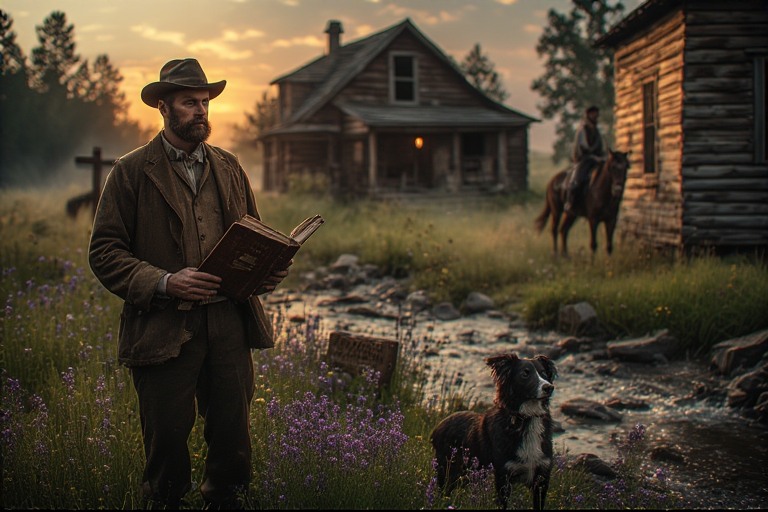
Nathaniel’s eyes narrowed. “What did you say?”
Vale’s expression closed. “Four days, Mr. Reed. Pay the account in full, or I file complaint with the county. Your debt will attach to the land. At auction, I will bid. No one will bid against me.”
Molly began to cry softly.
Saint rose and growled again, deeper this time.
Silas Vale looked down at the dog, and something like sorrow crossed his face. Then he looked once more at Anna’s grave. To Nathaniel’s surprise, Vale walked to the wooden cross, removed his hat, and bowed his head.
He stayed that way a long time.
Too long.
When he finally mounted and rode away, Nathaniel watched him go with a cold thought growing inside him.
There had been something between that man and Anna.
Whether it was love, guilt, or something darker, Nathaniel did not know.
Discover more
bed
books
Beds
But he was going to find out.
That night, the wind came down from the mountains and rattled the cabin walls.
Nathaniel fed the girls thin potato soup, tucked Molly into bed while she sobbed into Anna’s shawl, and sat beside Grace for nearly half an hour. Grace watched him in silence.
“I don’t know how to do this,” he confessed.
Grace’s face did not change.
He touched her hair. “Your mama did.”
At that, Grace closed her eyes.
Nathaniel went back to the main room and sat in Anna’s rocking chair by the stove. Across from him stood her dresser. He had not opened it since her death. Her dresses still hung on the peg behind the curtain. Her comb still lay on the washstand. Her sewing basket sat beside the bed, a needle caught in the sleeve of a little shirt she would never finish.
The locked drawer waited.
He had told himself he was respecting her privacy.
Discover more
book
water
WATER
Now he feared he had been afraid of what he might find.
He took the key from the blue teacup on the shelf, knelt before the dresser, and opened the drawer.
The smell of lavender rose up first.
Inside were handkerchiefs, folded letters from Pennsylvania, a pair of baby socks, and a wooden box holding curls from the girls’ first haircuts. Beneath those lay a leather-bound book, thick and worn soft at the edges.
Nathaniel lifted it carefully.
On the first page, in Anna’s neat hand, were the words:
Discover more
Books
Books & Literature
Beds & Headboards
THE REED FAMILY BOTANICAL BOOK
For my daughters, and their daughters, and whoever comes after. Knowledge must not be buried with the body.
Nathaniel sat back on his heels.
He turned the page.
Drawings filled the book. Not rough sketches, but careful, patient illustrations—yarrow, comfrey, chamomile, willow, mint, sage, lavender, foxglove, echinacea, blue cornflower. Beside each plant were notes in English, Latin, and another language he did not recognize. There were recipes for salves, tinctures, teas, poultices, washes, liniments, and syrups. There were warnings written in dark ink. Measurements. Harvest dates. Drying times. Soil conditions.
Then came maps.
His breath stopped.
Discover more
Patio, Lawn & Garden
family
Kitchen & Dining
Anna had drawn their land with a precision that would have shamed a surveyor. The cabin. The forge. The south pasture. The church road. The creek as it curved through the north meadow.
At the north bend was a shaded rectangle marked:
MOTHER’S GARDEN — THREE-QUARTERS ACRE PLANTED. EXPANDABLE TO FIVE ACRES IF WATER HOLDS.
Beside it were lines like veins.
Small irrigation channels.
A water gate.
Discover more
families
Bottled Water
Home Furnishings
A shallow wheel.
A note in the margin:
The men laugh at a creek this small. Let them. A spoon fills a bucket if it never stops pouring.
Nathaniel turned the pages faster.
There were designs for drying racks, a root cellar, a copper distillation still, a foot-powered grinder, and a creek-driven lift wheel that could raise water into troughs without a man carrying a single bucket.
He whispered, “Anna, what did you do?”
A folded letter slid from the back cover and landed on the floor.
Discover more
Water Supply & Treatment
FAMILY
Water & Marine Sciences
His name was written on it.
Nathaniel opened it with shaking hands.
My dearest Nate,
If you are reading this, then I am gone, and I am sorry for leaving you with a grief I cannot help you carry. Do not blame yourself. I have known since the fever last winter that my body was weaker than I wished it to be. I wanted this child. I loved him before I knew his face. If he goes with me, do not let sorrow turn him into a ghost you are afraid to name.
Nathaniel pressed the paper to his mouth.
Then he read on.
I have left you something better than money. I have left work. I have left knowledge. I have left the creek. That little creek can do more than any man in the valley if someone understands how to ask it properly. It has watered my hidden garden for three years. It has turned my small wheel. It has cooled my jars and washed my roots and carried life into soil men called useless.
Grace knows more than you think. I taught her because she listened without pride. Molly will learn when she is ready. Trust them. Trust Aunt Elspeth. Trust the book.
Discover more
Family
beds
Water
There is one more thing, and it concerns Silas Vale. Before I married you, before you ever kissed me at the winter social, Silas—
The letter ended there.
No signature.
No explanation.
Just Silas and a blank white space where the truth should have been.
Nathaniel sat on the floor until the fire burned low.
The ugly thought returned.
Before I married you.
Silas.
Had Anna loved him? Had she refused to speak of it because there was still tenderness? Had Vale’s grief at the grave been the grief of a man who had lost what was once his?
Then a floorboard creaked.
Nathaniel looked up.
Grace stood in the bedroom doorway in her white nightgown, holding a candle. Her dark hair fell down her back. For the first time in six weeks, she spoke.
“Papa,” she said, her voice rusty from disuse, “Mama told me I could talk when you opened the drawer.”
Nathaniel stared at her as though she had stepped out of a dream.
Grace walked to him, knelt, and placed her small hand over the book. “She said you would need me then.”
Something broke in Nathaniel.
He opened his arms, and Grace climbed into them. She was warm. Alive. His daughter had been carrying a secret, and grief, and obedience to a dead mother for six whole weeks because he had not been ready to hear her voice.
“I am ready now,” he whispered into her hair. “God forgive me, Gracie, I am ready now.”
Grace turned the book to the map.
“Mama said the north bend is the secret. The creek floods low in spring, then thins in summer, but it never fully dries because there is a spring under the cottonwoods. She dug little channels with a hand hoe. She did it before sunrise, while you were at the forge, and after supper, when you thought she was gathering eggs.”
Nathaniel closed his eyes.
Anna had been tired every night. He had thought it was the children, the house, the pregnancy, the endless labor of being a frontier wife. He had never once asked if she was building something.
Grace continued, “She said men see big rivers and call them power. Women see a creek and make it faithful.”
Nathaniel let out a rough sound that was almost a sob.
Grace touched the page. “She said if trouble came, we must finish the wheel.”
The next morning, Elspeth Murray came up the road with a basket of eggs, a loaf of oat bread, and the face of a woman who already knew too much.
She was seventy, Scottish-born, sharp-eyed, and had served as midwife in Mercy Creek longer than most men had owned boots. She was Anna’s great-aunt and had delivered both Reed girls. She had also been the one to close Anna’s eyes.
Nathaniel met her at the door.
Elspeth looked at him once and nodded. “You opened it.”
“I opened it.”
“And the lass spoke.”
“She spoke.”
“Then we have no more time for men being slow.” She stepped inside and set the basket on the table. “Show me the book.”
For two hours, Elspeth told him the story Anna had never finished.
Anna Murray had come west from Pennsylvania at twenty-one to teach school in Mercy Creek. Her family was Scottish by blood, and the women had carried plant knowledge across the ocean in notebooks, memory, and stubbornness. Elspeth had taken Anna in, taught her the local herbs, introduced her to mountain weather, and watched the girl’s quiet intelligence bloom like spring after a hard freeze.
Silas Vale had courted Anna first.
“He was not rich then,” Elspeth said. “Not the way he is now. He was ambitious, handsome, and hungry enough to bite the hand that fed him if he thought the bone was larger inside.”
“Did she love him?”
Elspeth looked at Nathaniel with pity. “No. But she almost felt sorry enough for him to mistake pity for love. Many a woman has done worse.”
Nathaniel absorbed that in silence.
“He proposed twice,” Elspeth continued. “Anna refused twice. She said he wanted a wife the way some men want a deed—proof that something fine belonged to them. Then she met you.”
“At the sleigh supper.”
“Aye. She came home and said, ‘Auntie, I met a man who can sit in silence without trying to own it.’ That was how I knew she would marry you.”
Nathaniel looked down at his hands.
“And Vale?”
“He never forgave her. Men like that do not forgive a woman for choosing peace over power.”
“Why buy my debt now?”
Elspeth’s mouth tightened. “Because he wants the north bend.”
“The creek?”
“The water rights. And maybe more. Anna believed his mine was poisoning the lower streams. She had been testing water with litmus and willow ash. She wrote to Helena twice. No answer.”
Nathaniel’s grief shifted, making room for anger.
“There is more,” Elspeth said quietly. “The day Anna labored, I rode to Whitcomb’s for ergot. He claimed he had none. Three days after the funeral, I saw a full bottle on his shelf dated two weeks before.”
The room went still.
Nathaniel understood at once.
“You think Vale paid him.”
“I think Amos Whitcomb sweats when Vale’s name is spoken. That is not proof. But it is smoke.”
Nathaniel stood so quickly the chair scraped the floor.
Elspeth’s voice cracked like a whip. “Do not go kill him.”
“I want to.”
“I know. But dead men do not raise daughters, and Anna did not leave you a book so you could hang from a rope.”
His fists clenched.
Grace stood in the bedroom doorway, pale but steady.
Nathaniel looked at her, and rage became duty.
He walked outside to the forge, took an iron rod from the rack, heated it white, and hammered it until sparks flew like stars. Every strike gave shape to the vow forming inside him.
He would save the land.
He would finish Anna’s work.
And if Silas Vale had helped death enter his house, Nathaniel would make him answer for it in daylight, before God and the whole valley.
The next forty days became a kind of war.
Not a war with rifles, though rifles hung above many doors in Mercy Creek. Not a war with fists, though Nathaniel’s fists wanted it. It was a war of hands, water, memory, and stubborn love.
Elspeth sent a letter to Butte, and four days later her grandson Caleb Murray arrived by stagecoach. Caleb was twenty-three, a copper apprentice with clever fingers and a grin that came and went depending on whether he understood the machinery before him. When he studied Anna’s designs for the creek wheel, he stopped grinning altogether.
“Mrs. Reed drew this?” he asked.
“She did,” Nathaniel said.
Caleb ran a finger over the measurements. “This is not woman’s dabbling. This is engineering.”
Grace lifted her chin. “Mama said engineering is only housework men decided to name after themselves.”
Elspeth barked a laugh.
Caleb looked at Grace, then back at the plans. “Your mama was right.”
They began at the north bend.
For the first time, Nathaniel saw what Anna had hidden in plain sight. Beyond the cottonwoods, where he had thought the soil too damp for hay and too tangled for grazing, lay rows and rows of herbs. Chamomile bowed in pale clusters. Yarrow stood white-headed and hardy. Comfrey spread broad leaves near the ditch. Mint crowded its bed like gossiping women. Lavender, sage, lemon balm, and purple coneflower grew in neat order. Blue cornflowers, the ones Anna had named in her final breath, marked the border.
Small channels carried creek water through the beds.
The work was plain only after one understood it. A stone placed here. A trench cut there. A board gate that could be lifted by hand. A slope so slight most men would never notice.
Nathaniel stood in the garden with shame pressing on him.
“She did all this alone?”
Grace shook her head. “Not alone. I helped.”
He knelt before his daughter. “I should have seen.”
“Mama said you saw what needed mending. She saw what needed growing.”
That did not absolve him, but it gave him somewhere to place the guilt.
They built Anna’s wheel from cottonwood planks and iron brackets Nathaniel forged himself. Caleb shaped copper tubing for the still. Elspeth supervised the drying racks. Grace measured herbs from the book with solemn precision. Molly, too small for serious work, carried clothespins, sang to Saint, and asked every morning whether Mama could see the garden from heaven.
Nathaniel always answered, “I believe she can.”
One afternoon, a wagon stopped before the cabin.
The woman who stepped down was a stranger, tall and slim, with chestnut hair pinned beneath a traveling hat and a carpetbag in one hand. She wore a dark green dress too plain to be fashionable and too well-kept to be careless. Her eyes were tired in a way Nathaniel recognized before she said a word.
“Mr. Reed?” she asked. “I am Clara Bell from Chicago. I have come to teach at the schoolhouse.”
Anna’s old post.
Nathaniel’s first instinct was resentment. The world had not waited. Already another woman had come to stand where Anna once stood.
But Clara held out three books.
“These belonged to the school library,” she said softly. “Mrs. Reed had borrowed them. I found her note inside the arithmetic primer. I thought you might want it.”
Nathaniel took the books.
A folded slip lay inside the top one.
In Anna’s hand:
Ask the new teacher to make Grace read aloud. She hides her courage in silence.
Nathaniel had to look away.
Clara saw his face and said, “I’m sorry. I did not mean to wound you.”
“No,” he said. “You didn’t.”
Elspeth invited Clara inside for coffee. In the slow manner of strangers on the frontier, Clara’s story emerged between practical questions. She was a widow. Her husband had been a Chicago attorney, dead two years from consumption. She had clerked in his office before his illness, copying briefs, indexing statutes, and learning law because paper had no opinion about whether a woman’s mind belonged near it.
“When he died,” Clara said, hands around her cup, “the house became louder than any train station. So I answered the school board’s advertisement. Montana seemed far enough to breathe.”
Nathaniel understood that sentence too well.
Molly climbed onto the bench beside Clara and touched her sleeve.
“You smell like rain,” Molly said.
Clara’s mouth trembled. “Do I?”
“And ink.”
“That is likely.”
“Can you braid hair?”
“Molly,” Nathaniel warned.
Clara smiled gently. “Yes. Not beautifully, but honestly.”
Molly considered that. “Papa’s braids look like rope after a cow chewed it.”
For the first time in six weeks, Nathaniel laughed.
It hurt.
It also helped.
Before Clara left, she paused at the door. “Mr. Reed, I know I am not Mrs. Reed. I would not insult her memory by pretending otherwise. But if the girls ever need help with lessons, or hair, or simply a woman’s presence, I am at the schoolhouse.”
Nathaniel nodded. “Thank you.”
After the wagon carried Clara away, Elspeth stood beside him on the porch.
“Do not glare at kindness because it arrives wearing an unfamiliar face,” she said.
“I am not ready for anything.”
“I did not say marry the woman, you great hammer. I said let your daughters be loved where love is offered.”
He heard her.
He was not yet able to obey.
On the twenty-second day, Silas Vale returned.
He rode into the yard while the creek wheel turned for the first time. Water lifted in small shining cups, spilled into a trough, and ran along the narrow channel Anna had marked. Caleb whooped. Molly clapped. Grace stood very still, tears on her cheeks.
Nathaniel felt something fierce and holy rise in him.
Then Saint growled.
Silas Vale sat on his mare at the edge of the yard, watching the wheel.
“So,” Vale said. “She finished it after all.”
Nathaniel stepped forward. “She drew it. We finished it.”
Vale’s eyes moved over the garden, the drying shed, the copper still cooling beneath shade. “Anna always did make small things dangerous.”
Grace stepped behind her father.
Vale looked at her. For a moment, his face softened. “You have her eyes.”
“Do not speak to my daughter,” Nathaniel said.
Vale smiled faintly. “Still angry at shadows, Reed? Or have you discovered enough to be angry at facts?”
Nathaniel went cold. “What facts?”
“That your wife had a life before you. That she was admired before you. That not every secret in a woman’s drawer belongs to her husband.”
It was a cruel shot because it struck where Nathaniel was still weak.
Then Clara, who had come to help Grace with reading, stepped out of the cabin.
She looked at Vale once and seemed to understand him.
“A man who truly loved a woman,” Clara said calmly, “would not try to poison her memory in front of her child.”
Vale turned his gaze to her. “And you are?”
“Clara Bell. Schoolteacher.”
“How very like Anna,” Vale said.
“No,” Clara replied. “I am nothing like Anna. From what I hear, Anna built a miracle with a creek and a hoe. I merely teach children to spell. But I know enough grammar to recognize possession when I hear it. You speak of Mrs. Reed as though she was stolen from you. She was not stolen. She chose.”
The yard went silent.
Vale’s jaw tightened.
Nathaniel looked at Clara with a startled respect.
Vale gathered his reins. “Eighteen days remain, Reed. Fifty-four dollars, sixteen cents. Do not let women and water wheels convince you arithmetic has changed.”
He rode away.
That night, Nathaniel could not sleep. Clara’s words stayed with him. Not because they defended Anna—though they had—but because they defended truth without asking permission.
The next test came before dawn.
Mrs. Jensen from the lower farm arrived in a wagon with her seven-year-old son burning with fever. Rain had soaked her hair flat to her head. The boy’s eyes rolled under half-closed lids, and a red rash marked his chest.
“Please,” she begged Elspeth. “Doctor Harlan cannot cross the washed bridge. He sent word he may be ten days. Please.”
Elspeth took one look at the child and said, “Bring him in.”
Nathaniel hesitated.
Anna’s book was not a doctor.
But the boy was dying in front of him, and the nearest licensed physician might as well have been in Boston.
Grace came from the bedroom carrying the leather book.
“Mama marked fever,” she said.
The cabin became an infirmary.
Elspeth led. Grace measured. Clara, caught by the storm and unable to return to town, rolled up her sleeves and did exactly as she was told. Nathaniel hauled water, split wood, kept the stove steady, and watched his daughter move through the night with Anna’s seriousness on her face.
They did not pretend herbs were magic. Elspeth cooled the boy carefully, kept him drinking, watched his breathing, and used Anna’s preparations only as Anna had written them, with warnings observed and doses cut for a child. When the fever surged, Mrs. Jensen prayed so hard her voice failed.
Near sunrise, the boy opened his eyes.
“Mama?” he whispered.
Mrs. Jensen made a sound Nathaniel would remember until he died.
By noon, three more families had come.
By the next evening, six.
A sickness had entered the valley, and soon everyone knew from where. The lower creek, the one that passed below Vale’s copper works, had gone foul after heavy rains breached a waste pond. For years, homesteaders had complained of strange tastes, dead minnows, and cattle refusing to drink. Vale’s men called them ignorant. Now children were fevered, old wounds turned bad, and coughs settled deep in chests already weakened by bad water and cold weather.
They came to the Reed cabin because there was nowhere else to go.
Nathaniel did not charge those who had nothing. Those who insisted left potatoes, oats, bacon, eggs, candles, labor promises, and sometimes coins. Women sat by bedsides. Men carried water. Clara wrote names and symptoms in a ledger. Grace kept Anna’s book open on the table. Molly handed out cups and whispered to frightened children that her mama had written the medicine down before she went to heaven.
The creek wheel turned day and night.
It watered the garden, cooled bottles in a stone trough, powered the little grinder Caleb rigged from Anna’s drawing, and washed roots clean in a slatted box. It was not grand. It was not loud. It did not look like power to men used to steam engines and mine hoists.
But it did not stop.
By the thirty-eighth day, Nathaniel had twenty-nine dollars in coins and goods he could sell quickly.
He was still short.
Then Silas Vale struck again.
Sheriff Daniel Pike arrived with a folded order in his hand and regret written plainly across his weathered face. Vale rode behind him, smiling.
“Mr. Reed,” the sheriff said, “I hate this.”
“Then don’t do it.”
“I have to. Complaint filed under the Territorial Medical Practice Act. Says you are dispensing medicine for profit without license. You are ordered to cease operations. Penalty is one hundred dollars fine or thirty days in jail.”
The yard filled with silence.
Mrs. Jensen, whose son now sat upright on the porch eating broth, stood. “Sheriff, that man saved my boy.”
“I know.”
Vale’s smile deepened. “Feeling grateful is not the same as making law, Mrs. Jensen.”
Nathaniel took the paper and read it twice.
“No more salves,” Vale said. “No more tonics. No more creek-born miracles. Sundown tomorrow, my offer expires. Thirty-five dollars and the debt forgiven. Take your girls east.”
Nathaniel folded the paper carefully.
Then he walked into the cabin and shut the door.
He did not slam it.
The quiet frightened Molly more than shouting would have.
That night, after the sick had been moved to their own homes and the still had gone cold, Nathaniel sat beside the creek wheel. It turned slowly in moonlight, lifting water with patient cups and spilling it into Anna’s channels.
Clara found him there.
She carried bread wrapped in cloth. She sat on the grass beside him and handed him half.
For a while, neither spoke.
Finally Nathaniel said, “I keep learning how much my wife knew and how little I saw.”
Clara broke a piece of bread. “Grief is cruel enough without inviting pride to sit beside it.”
“That supposed to comfort me?”
“No. It is supposed to be true.”
He almost smiled.
She took the sheriff’s order from his hand and read it by lantern light.
“I know this statute,” she said slowly.
Nathaniel looked at her.
“My husband’s firm argued a similar case in Illinois. Montana copied half its legal bones from other states and territories. These medical laws often include exemptions.”
“What kind?”
“Family practice. Folk knowledge. Midwives. Immigrant healers. Remedies passed through bloodline and household rather than sold as professional medicine.”
“Elspeth said the Murray women kept records.”
“Then we need those records.”
A small voice came from the dark porch.
Grace stood there in her nightgown, Anna’s book in her arms.
“Mama said to show you the back page on the hardest night,” she said.
She came down and opened the book.
Tucked into the back cover was a newspaper clipping from Illinois dated 1883. Beneath it, Anna had copied a legal passage in full. Clara read it once, then again, her eyes brightening.
“She knew,” Clara whispered. “Anna knew someone might come with the law.”
Under the copied statute, Anna had written:
If Silas Vale uses law as a fence, climb it. The truth is on the other side.
Nathaniel bowed his head.
The hearing took place two days later in the county courthouse, a whitewashed wooden building that served as court, meeting hall, and church overflow when funerals outgrew sorrow.
Nathaniel arrived in his best black coat. Grace walked beside him carrying Anna’s book. Molly held Saint’s rope, though Saint needed no rope and walked as solemnly as any deacon. Elspeth came with the Murray family record, a heavy book bound in cracked leather. Caleb carried diagrams of the creek wheel and still. Clara carried a folder of legal notes written in a precise hand.
Silas Vale sat at the front with a lawyer from Helena, Mr. Pritchard, who had a thin mouth and the confident boredom of a man paid to crush poorer men efficiently.
Judge Abram Whitaker presided, old and stern, with white brows that met when he read.
Pritchard argued first.
He called Nathaniel’s work dangerous. He called the still a commercial apparatus. He called Anna’s book “domestic superstition dressed in ink.” He said the law existed to protect citizens from untrained hands.
Clara stood.
“Your Honor, may I speak for Mr. Reed?”
Pritchard rose immediately. “This woman is not licensed.”
Judge Whitaker looked at Clara. “Are you claiming to be an attorney?”
“No, Your Honor. I am claiming to read.”
A murmur passed through the room.
The judge’s mouth twitched. “Proceed carefully, Mrs. Bell.”
Clara did.
She laid out the exemption. She showed the copied statute. She showed the Murray family record with entries dating back more than a century. Elspeth testified that Anna had been trained in a family tradition brought from Scotland and adapted to Montana plants over ten years. Caleb explained the creek wheel was not a factory but an irrigation and preparation aid built from Anna’s drawings.
Then Clara called witnesses.
The courthouse doors opened.
People entered until every bench filled and every wall held shoulders. Farmers, mothers, miners, widows, children, old men with canes. Mrs. Jensen came forward with her son.
“This boy would be buried,” she said, voice shaking, “if the Reed place had closed its door.”
Another woman testified that Anna’s salve had saved her husband’s leg from a wound gone foul. A miner testified that Elspeth’s steam and Anna’s syrup had eased a cough that left him unable to work. A young mother testified that Grace Reed had sat beside her baby all night counting breaths.
Pritchard objected. “Sentiment is not evidence.”
Judge Whitaker looked over his spectacles. “In a county with no hospital, Mr. Pritchard, survival carries evidentiary weight.”
Then Amos Whitcomb stood at the back.
His face was gray. His hat shook in both hands.
“I need to speak,” he said.
Vale turned sharply.
Pritchard whispered, “Sit down.”
Whitcomb did not.
He walked to the front like a man approaching his own hanging.
“Your Honor,” he said, “I lied to Mrs. Murray the day Anna Reed died.”
The room became utterly still.
Nathaniel’s heart began to hammer.
Whitcomb swallowed. “She came for ergot. I had it. I told her I did not. Silas Vale had come that morning and paid me one hundred dollars to delay any medicine requested from the Reed house.”
A sound moved through the room, low and horrified.
Vale stood. “That is a lie.”
Whitcomb pulled a folded paper from his coat. “I have the receipt. His signature. I kept it because cowardly men keep proof when they have no courage.”
He placed it before the judge.
“And after Mrs. Reed died,” Whitcomb continued, tears running now, “Mr. Vale bought the Reed account from me. Full value. He said a debt was cleaner than a gun.”
Nathaniel rose so fast his chair fell backward.
Sheriff Pike stepped near him, not touching him, but ready.
Vale did not look at Nathaniel. He looked at the judge, and for the first time, fear cracked his polished face.
Then Clara said quietly, “There is more.”
She opened Anna’s book to the water notes.
“Mrs. Reed believed waste from the Vale mine had contaminated the lower creek. She recorded dead fish, water discoloration, and illness among families downstream. She intended to petition the territorial board. The north bend on Reed land contains a clean spring. Mr. Vale did not only want the land for pride. He wanted control of the one clean water source that could prove his mine had poisoned the valley.”
That was the twist that turned the room against Vale completely.
It had never been only a dead woman’s rejected suitor.
It had never been only debt.
It had been water.
Anna’s little creek, mocked by men as useless, had become witness, weapon, and salvation.
Judge Whitaker’s voice, when he spoke, was low and hard.
“This court dismisses the complaint against Nathaniel Reed. The Reed family practice falls within the inherited household medicine exemption. The debt held by Silas Vale is voided on grounds of fraudulent and malicious acquisition. Mr. Vale, you will surrender your passport papers to Sheriff Pike and remain in the county pending inquiry into the death of Anna Reed and the contamination of Mercy Creek.”
The gavel came down.
Molly burst into tears.
Grace clutched Anna’s book to her chest.
Saint barked once, loud enough to startle the whole court.
Outside, under a hard blue sky, Nathaniel found Silas Vale standing alone by the hitching rail.
For a moment, neither man spoke.
Then Vale said, “She would have chosen you if I had owned the whole territory.”
“Yes,” Nathaniel said.
Vale flinched as though the word had struck him.
“I thought money would make me larger,” Vale said. “Every mine, every acre, every bank note. I thought if I became big enough, she would see she had chosen a small life.”
Nathaniel looked toward the mountains. “You never understood her. Anna did not think small. She simply knew the difference between size and worth.”
Vale’s mouth tightened.
Nathaniel wanted hatred to be clean. It was not. Before him stood a man who had done monstrous things, yet inside that monster was the ruin of a boy who had wanted love and chosen ownership instead.
“I cannot forgive you,” Nathaniel said. “Not today. Maybe not in this life.”
“I did not ask.”
“No. But I will tell you what Anna wrote once in the margin of her book. She wrote, ‘A bitter root can still flower if moved before frost.’ I do not know if there is any root left in you worth moving.”
Vale looked away.
Two weeks later, before the criminal inquiry concluded, Silas Vale left Montana under guard to face charges in Helena. His mine was fined, then sold. His fortune survived in pieces, but his power in Mercy Creek did not.
The story should have ended there.
It did not.
One night in November, Vale’s cousin, Rusk, rode drunk to the north bend with a kerosene can and a torch. Nathaniel was inside the cabin. Clara was reading to the girls by the stove. Elspeth was mending a sock. None of them heard the horse.
Saint did.
The collie exploded through the door with a roar.
By the time Nathaniel reached the garden with a lantern and an iron bar, Saint had Rusk pinned in the mud by his sleeve. The torch had gone out in the wet grass. The kerosene had spilled harmlessly into a ditch. Rusk had managed to cut Saint’s shoulder, but the dog had not let go.
Elspeth stitched Saint with silk thread and called him the finest Christian in Montana. Molly slept beside him on the floor three nights in a row. Grace wrote in Anna’s book:
Saint saved the garden. November 1887. Bacon prescribed twice daily.
Winter came.
Then spring.
The creek swelled with snowmelt, and the little wheel turned faster than ever. Nathaniel learned the work by doing it badly first, then better. Grace spoke every day now. Molly learned to braid. Elspeth complained that men were slow but admitted Nathaniel had become “less useless than most.”
Clara remained at the schoolhouse.
She came often. At first for the girls. Then for the garden. Then because friendship had a way of making excuses unnecessary.
One Sunday in May, she walked with Nathaniel to Anna’s grave and placed chamomile at the cross.
“I would like to think she knows me,” Clara said.
Nathaniel looked at the plain wood, the wild grass, the mountains beyond. “She does.”
“I am not here to take her place.”
“I know.”
“I am not in a hurry, Nathaniel.”
He turned to her.
Clara’s eyes were steady. “I loved a man before. I buried him. I know grief is not a room one simply leaves. I can be your friend for a year. Five years. Forever, if that is what is honest.”
Nathaniel looked back at Anna’s grave.
For months, he had believed that any warmth toward Clara would be betrayal. But standing there, with chamomile bright against the cross, he understood something Anna would have scolded him for taking so long to learn.
Love was not a lantern with oil enough for only one flame.
It was a creek.
It widened by moving.
Nathaniel and Clara married in the fall of 1890, in the same churchyard where Anna rested. Grace stood beside Clara with flowers in her hair. Molly scattered blue cornflowers down the aisle. Elspeth cried and denied it afterward. Saint, older and dignified, slept through most of the ceremony.
By then, the Reed Botanical Works had begun in earnest.
At first, it was a shed beside the creek. Then a stone building. Then a proper workshop with labeled shelves, drying rooms, a clean bottling table, and Anna’s recipes printed carefully with warnings and uses. Nathaniel refused to sell any preparation he did not understand. Clara wrote labels plain enough for farm wives and miners to read. Elspeth trained women from neighboring valleys. Caleb built better wheels, better racks, better copper fittings.
Grace, who had once stopped speaking from grief, grew into a young woman with a mind so sharp doctors twice her age learned not to patronize her. She studied medicine in Michigan and returned to Montana as Dr. Grace Reed, the first woman physician Mercy Creek had ever seen.
Molly became the gardener. She expanded Anna’s hidden three-quarter acre to five acres, then fifteen, then thirty. She never married, not from bitterness but from certainty. “Some women are called to husbands,” she told Clara once. “I was called to the creek.”
In 1896, Clara gave birth to a son. They named him Thomas, after her first husband, because Nathaniel insisted that love should make room for the dead on both sides.
Saint died that winter, old and beloved, curled beside the stove. They buried him near Anna’s grave, where Molly planted lavender.
Years passed.
The creek kept moving.
In 1909, a letter arrived from Helena. Silas Vale had died alone in a boarding hotel. His will left five thousand dollars to the Mercy Creek school fund. The note attached was brief.
In memory of Anna Reed, who once believed there might be a good man in me. I found him too late to live as him, but not too late to honor her.
Nathaniel read it twice.
He did not weep. He did not forgive. But he walked to Anna’s grave and read the note aloud because some truths, even late ones, deserved witnesses.
In 1914, researchers from an eastern university came to study Anna’s book and the Reed gardens. They wrote papers about frontier botanical knowledge, Scottish folk practice, women’s medical labor, and the unexpected sophistication of irrigation systems built without formal schooling.
Nathaniel watched them measure the creek wheel and smiled to himself.
Men with spectacles and notebooks called it ingenious.
Anna had called it common sense.
By 1923, Nathaniel was seventy-one. His beard had gone white, though his shoulders remained broad from a lifetime at the forge. Clara, sixty-four, still walked to the garden every morning with a basket on her arm. Grace visited from Bozeman twice a year with medical journals and tired eyes. Molly ran the herb fields with a crew of twelve women and three men, all of whom knew better than to argue with her about water.
One autumn afternoon, a little girl climbed the porch steps of the old Reed house. She had brown braids, solemn eyes, and a basket of apples.
“Mr. Reed?” she asked. “My grandpa says you knew the lady who saved him when he had the fever.”
Nathaniel set down his coffee.
“What is your grandpa’s name?”
“Samuel Jensen.”
Nathaniel smiled. The fever boy.
“He says I should ask about Mrs. Anna because if she had not lived, then he would not have lived, and then my mama would not have lived, and then I would not be here.”
Nathaniel looked past the child to the creek flashing silver below the hill.
“That is a very wise thing for a little girl to understand.”
“Can you tell me about her?”
He reached for the leather book on the porch table. Its cover was soft now, repaired twice with black thread. Anna’s handwriting still waited inside, clear as a voice from another room.
Clara came up the path with chamomile in her basket and stopped when she saw them. She watched her husband open the book between himself and the child.
Nathaniel began.
“Once, a long time ago, there was a woman named Anna. Men thought she was only a wife, only a mother, only a teacher, only a quiet woman with dirt on her hem. But while they were busy measuring strength by the size of their horses and mines and bank accounts, she studied a small creek. She learned its moods. She followed it through grass and stone. She asked what it could do if someone respected it instead of overlooking it.”
The child leaned closer.
“And what did it do?”
Nathaniel smiled.
“It watered a garden. It turned a wheel. It cooled medicine. It proved a crime. It saved a valley. And long after the gardener was gone, it kept growing what she planted.”
Clara sat beside him and took his hand.
The creek ran below them as it always had, small and tireless, silver in the autumn light.
And in its steady voice, Nathaniel heard Anna at last—not as a ghost, not as a wound, but as a legacy moving forward through every life she had touched.
THE END