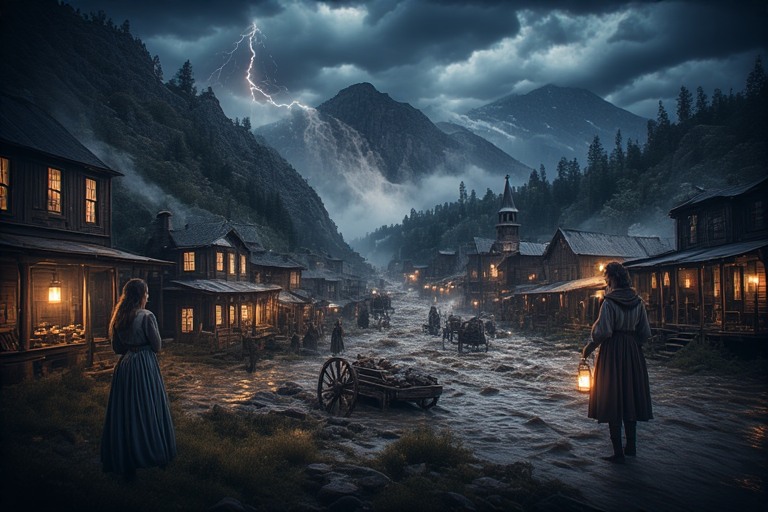
They Banished the Widow Into the Rocks…. and she Crawled Into a Crack No Wider Than Her Shoulders — 40 Feet In, She Built a Secret Shelter….. Then the Flood Came and Her Secret Shelter Exposed the Man Who Lied
At midnight, when the church bell tore loose from its steeple and vanished into a wall of brown water, Clara Mercer stood forty feet inside a crack in the mountain with a lantern in one hand and a shotgun in the other.
Outside, Redemption Gulch was screaming.
The town that had thrown her away three months earlier was being broken apart board by board. Roofs spun like driftwood. Horses cried from the livery until the sound disappeared under the roar. Barrels, wagons, fences, doors, and bodies of furniture slammed together in the flood, all of it rushing through the dry wash where the town’s main street had been built because men loved easy roads more than they respected old water.
Clara could not see all of it from the fissure, but she could hear enough.
Then a man’s voice rose through the thunder.
“Clara!”
She stiffened.
No one in Redemption Gulch said her name anymore. Not with kindness. Not without spitting after it.
The voice came again, broken by mud and terror. “Clara Mercer! For God’s sake, help us!”
She raised the lantern and stepped from the hidden chamber into the narrow passage. The crack pinched her shoulders as she moved sideways through the stone, her breath controlled, her face pale in the little flame. Beyond the mouth of the fissure, lightning lit the slope in hard white flashes.
A man crawled up the ledge on his belly.
Silas Finch.
The saloon owner.
The same man who had laughed loudest when her father-in-law called her a curse. The same man who had shouted from his porch, “How’s the hole in the rock, Clara? Found your dead husband in there yet?”
Now he dragged himself through mud with both hands, his hat gone, his face bleeding, his eyes stripped of every proud thing he had ever used to make other people feel small.
“My wife,” he choked. “My children. They’re on the saloon roof. It’s coming apart.”
Clara looked past him to the valley.
Lightning cracked again.
For one savage second, she saw Redemption Gulch laid open beneath her—the mercantile crushed sideways, the church leaning, the saloon roof trembling in the current with three small figures clinging to its chimney.
Silas grabbed at her skirt. “Please. I know what I said. I know what we did. But they’re children.”
Clara stared at him so long that he began to sob.
Then she lowered the shotgun.
“Can you climb back down?”
His mouth trembled. “I don’t know.”
“That was not my question.”
He swallowed mud and shame. “Yes.”
“Then you will listen to me exactly. You will tie this rope under your arms. You will bring your wife first, then the children one at a time. If you panic, you drown them. If you argue, you drown them. Do you understand?”
He nodded like a broken boy.
Clara tied the rope around his chest with the same steady hands Redemption Gulch had once called useless. As she worked, Silas noticed something behind her through the slit in the rock: not madness, not witchcraft, not a grave for the living, but a warm light hidden deep inside the mountain.
A shelter.
A real shelter.
Stone shelves. A fire pit. Water. Blankets. Food.
Forty feet inside a crack no wider than her shoulders, the widow they had cast out had built the only safe place left.
Silas stared, understanding coming too late.
Clara tightened the knot.
“Go,” she said. “And pray your roof holds.”
Three months earlier, Clara Mercer had stood in the center of Redemption Gulch with her husband’s blood still dried on the cuff of her black dress while her mother-in-law told the town she had killed him.
Not with a knife. Not with a gun.
With bad luck.
Martha Mercer stood on the shaded porch of Mercer Dry Goods, one hand pressed to her throat, the other pointing at Clara as if grief were a courtroom and accusation were evidence.
“My son was strong before he married her,” Martha cried. “He knew these canyons. He knew every wash and trail from here to Yuma. Then he brings this girl into our family, and within a year he is dead in floodwater.”
Clara said nothing.
She had learned during the funeral that silence could be the last wall a grieving woman had. If she spoke, they would call it hysteria. If she wept, they would call it guilt. If she defended herself, they would say she protested too much.
Beside Martha stood Jedediah Mercer, Thomas’s father, the owner of the mercantile, the man whose approval could open or close nearly every credit account in town. He did not cry. He did not tremble. His grief sat on him like a hard coat buttoned to the throat.
“You will leave before sundown,” Jedediah said.
The town fell quiet.
Clara lifted her head. “This was Thomas’s home.”
“It was Thomas’s home because he was my son.”
“I was his wife.”
Martha’s face twisted. “A wife protects a husband. You came back. He did not.”
The words struck Clara harder than she expected because they found the wound beneath the wound. She had come back from the flood with torn hands, a bruised shoulder, and Thomas’s canteen tied to her belt. Thomas had not come back at all.
She still heard him at night.
Climb, Clara. Don’t look at me. Climb.
Jedediah stepped down from the porch. His boots landed in the dust with slow authority.
“You took him into Dead Horse Canyon.”
“No,” Clara said, her voice low. “He took me there to show me where the spring trail crossed above the wash. He was worried about the town. He said—”
Jedediah’s eyes sharpened.
Clara stopped.
She remembered Thomas’s last warning the night before they rode south. He had spread a charcoal map across their kitchen table and tapped the dry channel running straight through Redemption Gulch.
“My father will not move the town,” Thomas had said. “Too much money tied up in those lots. But this wash is older than every deed in the courthouse. One big storm up in the mountains, Clara, and the whole street becomes a river.”
“He knows that?” she had asked.
—————————————————
Part 2: Thomas’s mouth tightened. “He knows enough.”
Now, in the street, Jedediah looked at her as if he could hear that memory moving behind her eyes.
“You will not speak my son’s name to excuse yourself,” he said.
Clara’s fingers curled around the strap of Thomas’s canteen. Inside the false bottom, hidden beneath a thin soldered plate Thomas had once repaired himself, lay a folded survey note she had found two days after his death. She had not understood all of it yet, but she understood enough to be afraid.
It named high ground north of town.
It named old flood scars in the canyon walls.
And in Thomas’s handwriting, it named Jedediah.
Father sold lots inside the wash after seeing the county survey. If this reaches Judge Weller, he will call it fraud.
Clara had planned to take the note to the circuit judge when he came through the following week.
Somehow Jedediah knew she had something.
Martha raised her voice so the whole town could hear. “Look at her. No tears. No repentance. She carries his canteen like a trophy.”
A woman gasped.
A child whispered, “Is she cursed?”
Then Silas Finch laughed from the saloon porch.
“She sure don’t look blessed.”
The crowd shifted. Judgment moved through them like heat through dry grass.
Only one person did not join in. Abigail Gable, the town’s widowed schoolteacher and census clerk, stood near the post office with both hands folded around her ledger. Her eyes met Clara’s, not with pity, but with recognition. She had the look of a woman who knew that public cruelty often dressed itself as common sense.
But Abigail said nothing.
No one did.
Jedediah pointed toward the road leading into the crimson foothills.
“Sundown,” he said. “After that, if you are found within town limits, I will have Sheriff Harlan remove you.”
Clara looked around at the faces of people she had mended shirts for, fed during Thomas’s wake, prayed beside in church. She wanted one of them to say this was wrong.
No one did.
So she adjusted the small cloth bundle over her shoulder, lifted her chin, and walked.
Behind her, Martha called out, “You brought death into my house!”
Clara stopped.
For the first time that day, she turned back.
“No,” she said, clear enough for every soul in Redemption Gulch to hear. “Death was already living here. Thomas was the first man honest enough to name it.”
Then she left before Jedediah could see how badly her hands were shaking.
The trail into the foothills climbed through red rock and brittle brush. Heat pressed down until the air seemed hammered flat. Clara walked because stopping felt too much like surrender. Every step carried her farther from Thomas’s grave, from the little room behind the mercantile where their bed still held the shape of their life, from the kitchen table where his warning map had disappeared the morning after his funeral.
Jedediah had searched their room.
She knew it.
He had found the map but not the note in the canteen.
That was why he had thrown her out with such speed. Grief explained cruelty, but panic explained timing.
By late afternoon, Clara’s throat burned. Her black dress clung to her back. The sun slid toward the jagged mountains, staining the stone the color of fresh blood. She was looking for shade, any shade, when she saw the crack.
It was not a cave. A cave invited notice.
This was different.
A vertical wound in the mountain face, half-hidden above a tumble of scree, no wider than a man’s shoulders at the mouth. A strip of black so complete it seemed cut from night itself. Most people would have passed it by. Clara almost did.
Then a faint breath of cool air touched her cheek.
She turned.
The crack smelled of stone, dust, and something deeper than heat. Her heart began beating harder—not with hope exactly, but with recognition. Thomas had once told her that rock spoke to people patient enough to listen. A cool draft meant space inside. Space meant shelter. Shelter meant one more day alive.
Clara climbed the loose slope, slipping twice before she reached the opening. Up close, it looked impossible. The walls were rough and close, the darkness absolute.
She thought of Redemption Gulch behind her.
The accusing faces.
Jedediah’s eyes when she nearly spoke of Thomas’s warning.
Martha calling her a curse.
Then she thought of Thomas in the flood, his hands under her boots as he shoved her onto a ledge and screamed for her to climb.
Part-3
Then she thought of Thomas in the flood, his hands under her boots as he shoved her onto a ledge and screamed for her to climb.
Clara turned sideways, pressed one shoulder into the stone, and entered the mountain.
arrow_forward_iosRead more
The first ten feet scraped her sleeves. The next ten stole her nerve. She could not turn around. She could barely lift her arms. Her breath came shallow because her chest brushed stone when she inhaled too deeply.
Twenty feet in, the sunlight disappeared completely.
Panic rose fast and animal.
She imagined the crack narrowing until she could not move. She imagined snakes. Scorpions. Falling rock. She imagined dying upright in the dark while Redemption Gulch slept comfortably in the basin below.
Then she remembered Thomas’s voice.
Climb. Don’t look at me. Climb.
So she moved.
One sideways step. Then another.
At thirty feet, the right wall vanished from under her palm.
Clara froze.
She reached outward and touched empty air.
A few more careful steps brought her through the passage into a wider chamber. She could not see it, but she could feel space around her. The air changed. The silence opened.
Her fingers shook as she knelt and untied her bundle. Thomas had insisted she carry flint and steel after the flood that took him.
“Tools are not fear,” he had said once. “Tools are respect.”
She struck the flint once. Nothing.
Twice. Sparks died.
On the third strike, dried cattail fluff caught. A small flame bloomed.
Light trembled across stone.
Clara found herself in a hidden chamber nearly twenty feet across, with a ceiling high enough for her to stand. The floor was uneven but dry. The walls curved inward like cupped hands. At the far back, darkness suggested a smaller hollow. No animal bones. No nests. No signs of recent use.
Just emptiness.
Just safety.
Clara sat down on the stone floor, held the tiny flame between her palms, and began to cry—not because she was broken, but because for the first time since Thomas died, the world had offered her a place that did not demand an explanation.
By morning, grief had become labor.
Clara could not afford to be only sad. Sadness did not fill a stomach. It did not fetch water. It did not keep snakes from bedding in corners or smoke from betraying her location.
She began with the floor. Using a flat piece of shale as a scraper, she pushed loose rock toward the entrance, carried it through the narrow passage in small loads, and scattered it among the natural scree below so no pile would give her away. The work tore her palms open. Dust filled her nose. Her shoulders bruised from squeezing through the crack again and again.
But each cleared foot of stone became proof.
She was not waiting to die.
She was making room to live.
On the fourth day, she discovered the water.
A slow drip fell from a seam in the rear wall, one bead at a time, into a shallow natural basin. Clara stared as if she had found gold. Then she laughed, a cracked, astonished sound that frightened her because she had forgotten laughter belonged to her.
The water tasted cold and mineral clean.
She scrubbed the basin with sand and cloth until her fingers cramped, then filled Thomas’s canteen and every tin she owned. That small seep changed everything. She no longer had to risk the town well every day. The mountain had not simply hidden her.
It had accepted her.
A week later, hunger drove her back to Redemption Gulch.
She went before dawn, when the street was gray and mostly empty. Mercer Dry Goods stood with its shutters closed, the painted sign above the porch still bearing her married name. She left mended grain sacks on the rear loading dock. Hours later, she returned and found a small parcel wrapped in butcher paper: flour, beans, salt, and a strip of jerky hard as saddle leather.
No note.
No apology.
Just enough food to keep her alive and indebted.
The arrangement continued because both sides needed it. Jedediah needed labor he did not have to publicly acknowledge. Clara needed supplies. She never entered the front of the store. He never spoke to her. Sometimes she saw Martha watching from the upstairs window, white-faced and rigid, as if Clara’s survival offended her.
The town saw her too.
Stone dust clung to her hems. Scratches marked her cheeks. Her eyes had changed; they no longer searched faces for mercy. That unsettled people more than begging would have.
Silas Finch made it his entertainment.
“Morning, Mrs. Mountain Mouse,” he called one day from the saloon porch. “You sleep hanging upside down in that crack?”
Men laughed.
Clara kept walking.
Another morning he shouted, “Careful, boys. She may curse the beer if we don’t bow.”
More laughter.
She did not answer.
Her silence enraged him because it denied him the scene he wanted. He wanted her to snap so he could call her unhinged. He wanted her to weep so the town could feel generous by pitying what it had destroyed. Instead, Clara walked through mockery with a sack of beans under one arm and Thomas’s canteen at her hip, her back straight as a survey stake.
Only Abigail Gable ever came close.
One morning, Clara found the widow waiting near the post office. Abigail wore a faded blue dress and carried a slate board against her chest.
“I won’t ask where you sleep,” Abigail said softly.
Clara stopped.
That was the first kindness anyone in town had given her since the funeral.
“Then why are you here?” Clara asked.
Abigail held out a paper twist of coffee grounds and a small packet of needles.
“A woman alone needs things men forget exist.”
Clara stared at the offering. “I can’t pay.”
“I didn’t ask.”
That nearly undid her.
Clara took the packet slowly. “Thank you.”
Abigail glanced toward the mercantile. Jedediah stood inside the window, watching.
“Your husband came to me before he died,” Abigail said.
Clara’s breath caught.
“He asked about county records. Land plats. Old flood reports.” Abigail lowered her voice. “He said if anything happened to him, I should remember that he had not been reckless.”
Clara’s fingers tightened around the coffee. “Do you know what he found?”
“Not all of it. But I know Jedediah bought the wash lots cheap after the railroad survey moved east. He sold them high once the freight road opened. Thomas believed there was a reason the old Spanish trail climbed the ridge instead of crossing the basin.”
Clara looked toward the dry main street, where children chased a hoop through dust.
“Because the basin floods.”
Abigail nodded. “Maybe not every year. Maybe not every ten. But the land remembers.”
Thomas’s words returned so sharply Clara almost turned to find him standing there.
The driest wash holds the memory of the greatest floods.
“Why didn’t you say this when they cast me out?” Clara asked.
Abigail’s face tightened with shame. “Because fear makes cowards of decent people. I am sorry.”
Clara wanted to reject the apology. She wanted to say it came late and cost little.
But Abigail’s hands trembled around the slate. Clara knew what it was to tremble and stand anyway.
So she said, “If you truly want to help, keep your records dry.”
Abigail frowned. “What does that mean?”
“It means Thomas was afraid the town would need proof someday.”
Clara left before Abigail could ask more.
Inside the mountain, Clara’s shelter grew from necessity into design.
She built a raised bed from flat stones against the far wall, then wove desert grass and yucca fiber into a thick mat. She carved small shelves into softer pockets of rock with a broken knife blade and stored food there in tins sealed with cloth and wax. She made a clay-lined fire pit beneath a seam in the ceiling and spent weeks widening tiny natural cracks into a hidden flue.
The smoke worried her most. Fire meant warmth, cooking, and courage, but smoke meant discovery. She studied the mountain like a puzzle, listening when she tapped, watching where cool air moved. At last she found a line of fractures leading upward to a cluster of scrub oak halfway above the ledge.
When she lit the first fire, she scrambled outside in terror and climbed until she could see the vent.
A thin gray thread rose through the scrub, so faint the morning wind tore it apart before it became a plume.
Clara laughed again, stronger this time.
That night she ate flatbread baked on hot stone and beans simmered in a tin cup. The meal was plain, but to her it tasted like victory. She sat beside the fire, Thomas’s canteen across her knees, and finally opened the hidden bottom again.
The note inside was creased and water-stained.
She had read it dozens of times, but now, with the shelter warm around her and Abigail’s words confirming her fear, she studied it differently.
Thomas had written more than an accusation.
He had written directions.
North ridge fissure above red scree. Draft at entrance. Possible chamber. High enough for emergency refuge. If town refuses relocation, mark route.
Clara looked up slowly.
The crack had not found her by accident.
Thomas had known about it.
Maybe he had not explored all the way inside. Maybe he had only marked the draft and intended to return. But he had found it. He had been planning a refuge for a town too proud to listen.
Clara pressed the note to her chest.
“Oh, Thomas,” she whispered. “You were still trying to save them.”
The discovery changed the shelter’s meaning. It was not just hers anymore. It was unfinished work.
That realization created a conflict she hated. She owed Redemption Gulch nothing. The town had watched her be humiliated. It had let Jedediah turn grief into exile. It had laughed while she starved her way into strength.
And yet, when Clara imagined floodwater roaring through the basin, she did not see Silas Finch first. She saw his children. She saw Abigail with her ledgers. She saw old Mrs. Pike, who could not climb stairs without a cane. She saw the schoolhouse full of slates and primers, the church Bible with family births written in the front, the ordinary things people loved without knowing they could be taken in a breath.
Hate could keep a woman warm for a while, but it could not build a future.
So Clara began preparing for people who might never thank her.
She widened the entrance as much as she dared without making it obvious. She stored extra dried grass, then old blankets Abigail smuggled to her under flour sacks. She marked a safer climbing route with stones turned pale side up, visible only if someone knew to look. She carried jars of water until her back ached. She dried prickly pear pads, gathered mesquite pods, and smoked strips of jackrabbit meat.
All the while, Redemption Gulch kept laughing.
By late summer, the heat changed.
It did not simply grow hotter. It grew heavy. The air stopped moving. Clouds gathered beyond the northern mountains, purple-black and swollen, though no rain fell in town. The insects went quiet. Birds vanished from the wash.
Clara noticed because solitude had taught her attention.
She climbed to a high ledge and watched the horizon boil.
Her stomach went cold.
That evening, against every instinct that told her humiliation awaited, she walked into Redemption Gulch before sundown.
The town was gathered around a traveling peddler’s wagon. Children begged for peppermint sticks. Men leaned outside the saloon. Martha Mercer stood near the mercantile steps with her arms folded. Jedediah was speaking to Sheriff Harlan, a narrow man with a silver watch chain and a talent for agreeing with whoever controlled credit.
Clara stepped into the middle of the street.
Silas saw her first. “Well, if it ain’t the fissure witch come down before dark. Sky falling, Clara?”
People chuckled.
Clara ignored him.
“There is heavy rain in the northern range,” she said. “The wash will flood tonight or tomorrow. People need to move to high ground.”
The laughter weakened, but not because they believed her. Because the warning was too specific to dismiss comfortably.
Jedediah walked down from the porch.
“Have you been frightening yourself in the dark?”
Clara faced him. “Thomas found flood scars above the canyon mouth. You saw the county survey. You knew this basin was dangerous.”
His expression did not change, but his eyes did.
Martha hissed, “Do not speak to him that way.”
Clara pulled Thomas’s note from her bodice.
Jedediah’s face hardened.
The movement was small, but Abigail saw it. So did Sheriff Harlan, though he pretended not to.
“This is Thomas’s handwriting,” Clara said. “He marked the ridge. He marked the wash. He was preparing a warning.”
Jedediah stepped closer. “Give me that.”
“No.”
The street tightened around them.
Silas leaned off the saloon rail, suddenly interested.
Clara raised her voice. “Any family with children should sleep on the north ridge tonight. Bring water. Bring blankets. Leave the basin before dark.”
Sheriff Harlan shifted. “Mrs. Mercer, you are disturbing the peace.”
“The peace is built in a flood channel.”
Jedediah smiled then, cold and public.
“Listen to her. My son died in water, and now she sees floods in dust. Grief has cracked her mind the way the mountain cracked around her.”
Martha pressed a handkerchief to her mouth. “She needs help.”
The word help landed like a trap.
Clara understood too late. If they called her mad, nothing she said would matter. If Jedediah took the note, Thomas’s last warning would vanish like the map.
She backed away.
Jedediah reached for her wrist.
Clara moved faster. Months of climbing had made her strong. She slipped his grip, turned, and ran.
“Stop her!” Jedediah shouted.
For a few breathless seconds, the town gave chase. Boys first, thinking it a game. Then Harlan, angry at being made to look slow. Silas laughed and joined for sport.
Clara cut behind the livery, scrambled through a washout, and climbed the lower rocks where skirts and town shoes could not follow easily. A bullet cracked against stone above her head.
She froze.
The laughter died below.
Sheriff Harlan lowered his pistol, suddenly pale. “Warning shot.”
Clara looked down at them, chest heaving.
Rainless thunder rolled far to the north.
Abigail Gable stepped into the street, her voice clear. “You fired at an unarmed widow for carrying her dead husband’s note.”
No one answered.
Jedediah stared up at Clara. “You come back with that paper, and I will have you confined.”
Clara folded the note and tucked it safely away.
“No,” she called down. “You will have to survive first.”
Then she climbed until the rocks hid her.
The storm broke after dark.
At first, Redemption Gulch heard only distant thunder. Men at the saloon joked that Clara had finally scared the sky into making noise. Silas bought a round and lifted his glass toward the mountains.
“To the fissure witch,” he said. “May her flood wash the dust off my boots.”
Then the floor trembled.
The sound came low at first, too deep to be rain. Cards stilled. Glasses paused halfway to mouths. Dogs began barking, then howling.
Silas stepped onto the porch.
The northern canyon was black.
Not dark.
Black.
A moving wall of water carried trees, boulders, brush, and the smashed remains of some upstream line cabin. It came through the moonlight with a voice like the end of the world.
For one stupid second, no one moved.
Then Redemption Gulch became panic.
Mothers screamed for children. Men ran toward horses that were already rearing in terror. Sheriff Harlan shouted orders no one could hear. Jedediah stood in front of his mercantile with his mouth open as if the land had betrayed him personally.
The water hit the first row of buildings and erased them.
The jail went sideways.
The livery doors burst outward.
The mercantile held for three seconds longer than anything around it, then folded with a sound like a giant snapping kindling.
Martha Mercer’s scream vanished under the roar.
Silas ran upstairs, shoved his wife and children through a dormer window, and climbed onto the saloon roof as the lower floor filled. His little daughter, Nell, clung to his neck. His son, Peter, kept asking where the street had gone.
The saloon roof lifted once, dropped, then twisted.
Silas looked toward the ridge.
Lightning showed him a small lantern high above the flood.
Clara.
Not dead. Not mad. Not cursed.
Prepared.
Hope cut through him so painfully it felt like shame.
He tied a curtain around his waist, kissed his wife hard, and lowered himself into the water on the sheltered side of the building. The current slammed him into a floating door, then spun him under. He came up choking and grabbed a roof beam. Somehow, claw by claw, he reached the slope.
He climbed toward the lantern.
Toward the woman he had mocked.
Toward the only person who had told the truth.
That was how he ended up at Clara Mercer’s feet, begging.
The rescue took nearly an hour.
Silas brought his wife first. Ellen Finch was blue-lipped and shaking, but alive. Clara pulled her onto the ledge and shoved her toward the fissure.
“In sideways,” Clara ordered. “Right shoulder first. Keep moving until you see firelight.”
Ellen stared at the crack. “I can’t.”
“You can.”
“It’s too narrow.”
“So was the roof you were dying on.”
That snapped Ellen back into herself. She turned, squeezed into the stone, and disappeared with a sob.
Next came Peter, then Nell. The children cried in the dark passage, but Clara’s voice reached them from behind.
“Follow your mother’s voice. The mountain opens. Keep going.”
Last came Silas. Twice the current nearly took him. By the time he reached the ledge again, his hands were torn and his face had the stunned emptiness of a man who had met judgment and found it wearing water.
Inside the chamber, the Finch family fell silent.
A small fire burned beneath the hidden flue. Blankets lay rolled on the raised stone platform. Food tins lined the wall. Water filled jars near the basin. The chamber was warm, dry, and orderly, so opposite the chaos outside that Ellen began to weep.
Silas stood in the center of it all, turning slowly.
“You built this,” he whispered.
Clara hung the wet rope near the fire. “Yes.”
“All this time?”
“Yes.”
“While we laughed.”
She looked at him then. Not cruelly. That would have been easier for him.
“Yes.”
Silas covered his face.
No speech could have punished him more than her calm.
Near dawn, more voices came from the ledge.
Abigail Gable arrived with two schoolchildren, old Mrs. Pike, and Sheriff Harlan, whose left arm hung useless from his shoulder. Abigail had remembered Clara’s warning. When the roar began, she had dragged whoever would follow her toward the ridge. The sheriff had refused until the jail broke apart behind him.
Clara let them in.
She did not ask who had believed her.
She did not ask who deserved shelter.
By sunrise, fourteen survivors crowded the cavern. Some were injured. Some were silent. Some shook so badly they could not hold a cup. Clara moved among them with water, blankets, and instructions. She set Silas to feeding the fire. She made Sheriff Harlan sit before shock killed him. She told Abigail to count names.
“Count the living first,” Clara said. “Then we will speak of the missing.”
Abigail nodded, tears sliding down her face as she opened her ledger.
Jedediah Mercer arrived last.
He came alone.
Mud covered him to the waist. One side of his face was bruised. In his arms he carried Martha’s shawl, soaked and empty.
The chamber quieted when he emerged from the narrow passage. For a moment he simply stood there, looking at Clara’s shelter, at the people alive inside it, at the fire his son had imagined and his daughter-in-law had built.
His eyes moved to Thomas’s canteen at Clara’s hip.
“You found his ridge,” Jedediah said.
Clara’s face tightened. “He found it. I finished it.”
Jedediah swallowed.
Martha was not with him. Neither was the mercantile. The empire of flour barrels, credit books, and quiet threats had gone downriver in a single night.
Silas stood. “You knew, Mercer.”
Jedediah looked at him.
Silas’s voice rose. “Thomas warned you. Clara warned us. You knew this could happen.”
The survivors stared.
Sheriff Harlan shifted, grimacing. “Careful, Finch.”
“No,” Abigail said. She held up her ledger. “Let him answer.”
Jedediah’s grief turned slowly into anger, because anger was the only dignity he had left.
“I built that town from nothing.”
“You built it in a wash,” Clara said.
“I built it where the freight road came through.”
“You sold lots to families without telling them what Thomas knew.”
Jedediah stepped toward her. “My son filled your head with fears.”
Clara pulled the folded note from inside her dress.
The chamber seemed to hold its breath.
“Thomas wrote this before he died,” she said. “He wrote that you had seen the county survey. He wrote that you sold the wash lots anyway.”
Jedediah’s mouth worked, but no words came.
Clara handed the note to Abigail.
“Read it,” she said.
Abigail did. Her voice trembled once, then steadied. Every line landed against the stone. The flood scars. The old survey. The high ground. The suspected fraud. The ridge fissure.
And then the final line.
If I cannot make Father listen, Clara must. She is braver than this town knows.
Clara closed her eyes.
She had read that sentence many times alone, but hearing it in front of the people who had called her cursed nearly broke something open inside her.
Abigail lowered the page.
No one spoke.
Jedediah sank onto a stone near the wall. He looked smaller than Clara had ever seen him.
“I did not kill him,” he whispered.
Clara opened her eyes. “No. The flood took him.”
His shoulders sagged with relief too soon.
Then she added, “But pride put him in its path. He went to gather proof because you would not listen. You cast me out because you wanted his warning buried with him.”
The words were not shouted. They did not need to be.
Jedediah stared into the fire.
For once, no one defended him.
Outside, the floodwater slowly fell. By afternoon, the survivors stepped from the fissure into a world remade. Redemption Gulch was gone. The main street had become a plain of mud and wreckage. The church bell lay half-buried near a cottonwood stump. The mercantile sign had lodged in a mesquite tree. Household chairs, broken dishes, and torn quilts hung from brush like sad flags.
People stood on the ledge and wept.
Clara wept too, but quietly.
She had wanted the town humbled. She had never wanted children fatherless, wives widowed, graves washed open, lives turned to splinters. Vindication was a bitter meal. It filled nothing.
Silas came to stand beside her.
“I don’t know how to apologize enough,” he said.
“You can start by stopping before cruelty becomes entertainment next time.”
He flinched. “There won’t be a next time from me.”
Clara watched the muddy valley. “Make sure there isn’t one from anyone.”
Below them, Jedediah knelt in the ruins where the mercantile had been. He found the iron strongbox from his office wedged under broken beams. For a moment, old instinct returned to his face. Money. Ledgers. Claims. Control.
Then he saw Clara watching.
Slowly, Jedediah carried the strongbox up the slope and set it at her feet.
“The land papers are inside,” he said. “The ridge parcels. The old claims. Thomas wanted them transferred for a new town site. I stopped him.”
Clara did not touch the box.
“Why?”
Jedediah looked toward the mud where Martha had vanished. “Because I thought a town on high ground would kill what I built below.”
“It might have saved it.”
“Yes.”
The admission came raw.
Then he reached into his coat and pulled out a second paper, sealed in oilskin.
“Thomas filed one transfer before I knew. The north ridge claim. He put it in your name.”
Clara stared at him.
The survivors murmured.
Jedediah held the paper out. His hand shook. “I found it after he died. I hid it.”
Clara took it slowly.
There was the twist Thomas had left behind without ever telling her. Not only a warning. Not only a shelter. A legal foothold. A future placed in her hands before the flood took him.
Silas let out a low breath. “Then the only safe ground belongs to Clara.”
Jedediah nodded once.
Old Redemption Gulch had belonged to men like him, men who mistook ownership for wisdom.
The new town, if there was to be one, would begin with the woman they had driven into stone.
Weeks passed before the mud dried enough to bury the dead properly.
They buried Martha Mercer on a slope above the flood line. Clara stood beside Jedediah during the service because Thomas would have wanted mercy, and because grief had already made enough monsters in that family. Jedediah did not ask forgiveness that day. Clara was grateful. Forgiveness spoken too soon often serves the guilty more than the wounded.
Instead, he said, “I will spend what is left making it right.”
She answered, “Then spend it well.”
They rebuilt on the ridge.
Not quickly. Not romantically. Rebuilding was blisters, arguments, missing tools, bad meals, and nights when survivors woke screaming because they heard water in their dreams. But it was also honest work. Houses rose on stone foundations above the wash. The new schoolhouse faced east to catch morning light. The church bell, dented but whole, was hung from a timber frame on high ground.
Abigail kept the records in a dry cabinet Clara designed herself.
Silas rebuilt no saloon at first. He built a cookhouse where anyone working on the ridge could eat. When someone joked that he had become too humble to pour whiskey, he said, “No. I finally learned there are thirsts a bottle can’t answer.”
Sheriff Harlan resigned before anyone asked him to. He left for Tucson with his arm in a sling and his reputation in worse condition. No one stopped him.
Jedediah worked hardest of all. He hauled lumber, dug post holes, and opened his strongbox for families who had lost everything. Some accepted his help. Some refused. He endured both without complaint. He had learned, late and painfully, that consequence was not persecution.
As for Clara, people began coming to her for decisions.
Where should the well go?
How far from the wash was far enough?
Could the fissure shelter be enlarged?
Should the old basin ever be rebuilt?
She answered carefully, never pretending to know what she did not. That, more than anything, made them trust her. She did not command like Jedediah had. She listened to the land, to records, to memory, to people who had been ignored.
One evening near winter, Clara climbed alone to the fissure. The shelter was still there, warm and clean. They had widened a second chamber for emergency stores, but the first room remained mostly as she had built it: the raised bed, the fire pit, the carved shelves, the water basin whispering one drop at a time.
She sat by the fire with Thomas’s canteen in her lap.
“I was angry,” she said into the quiet. “I still am some days.”
The mountain answered with silence.
“They call me founder now. Can you imagine that? Silas Finch nearly swallowed his tongue the first time he said Mrs. Mercer with respect.”
She smiled, then wiped at her eyes.
“I wish you had seen the ridge. I wish you had seen them listen.”
The fire shifted.
Behind her, a soft scrape sounded in the passage.
Clara turned.
Jedediah stood at the chamber entrance, thinner than he had been, older by more than months. He held his hat in both hands.
“I did not mean to intrude.”
“You already have.”
A faint, pained smile crossed his face. “Fair.”
He stepped inside only after she nodded.
For a while they sat without speaking. The old bitterness remained, but it no longer filled the whole room. Grief sat between them too, and Thomas, and the strange fact that love for the same person does not always make people kind to one another.
Jedediah looked at the walls. “He would have been proud of this.”
Clara’s throat tightened. “He started it.”
“You finished it.”
She accepted that in silence.
Jedediah drew a folded document from his coat.
“I signed the remaining ridge parcels into the town trust,” he said. “Not to me. Not to you. To the families who rebuild here, with you and Mrs. Gable as trustees.”
Clara took the document, read it, and nodded.
“That is a good beginning.”
“I know it is not enough.”
“No,” she said. “It is not.”
He closed his eyes briefly.
Then Clara added, “But enough is not where repair begins.”
He looked at her, and for the first time since Thomas died, Clara saw not the man who banished her, not the merchant who lied, but a father who had mistaken control for protection until both his wife and son were gone.
“I am sorry,” Jedediah said.
The words were plain. No defense. No bargain.
Clara let them stand.
“I believe you,” she said. “I don’t know yet what I can forgive.”
He nodded. “That is more mercy than I earned.”
“Yes,” Clara said. “It is.”
Spring came green along the ridge.
They named the new town Highwater, not because the people wanted to remember terror, but because forgetting had cost too much. At Clara’s insistence, children learned how to read clouds, washes, maps, and old survey marks along with sums and spelling. Every family kept a packed flood sack. Twice a year, the whole town practiced climbing to the fissure shelter, and no one laughed when the narrow passage frightened them.
A plaque was eventually set near the entrance, though Clara refused to let them put her name alone on it.
It read:
For Thomas Mercer, who listened to the land.
For Clara Mercer, who listened when no one else would.
For the lost of Redemption Gulch.
Build high. Remember water.
Years later, travelers would ask why Highwater sat so stubbornly on the ridge when the valley below looked flat and convenient. Old residents would point to the red scar of the wash and tell them convenience was sometimes just danger waiting for weather.
And if the traveler stayed long enough, he might see Clara Mercer walking the ridge at sunset, no longer the cursed widow, no longer the fissure witch, but a woman shaped by grief and stone into something steadier than either.
She never remarried. Not because her life had ended with Thomas, but because she had learned that love could become many things after loss: a shelter, a warning, a town, a law, a lantern held high in a storm.
On quiet evenings, when the wind moved through the scrub oak above the hidden flue, Clara sometimes heard the old flood in memory. But she also heard children laughing from the schoolyard on high ground, hammers striking new beams, Abigail calling roll, Silas serving supper, Jedediah teaching boys how to set stone foundations properly.
Life, stubborn and imperfect, had climbed.
And deep inside the mountain, where a widow had once crawled into darkness with nothing but a tin cup, a canteen, and the refusal to die by other people’s judgment, the water still dripped steadily into the basin.
One bead at a time.
One mercy at a time.
One future at a time.
THE END