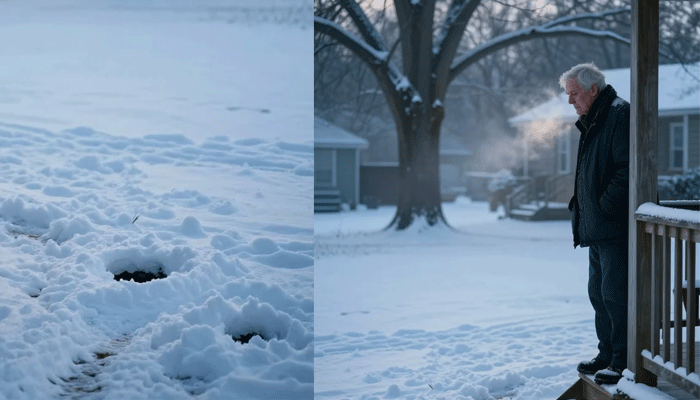
My name is Michael Reyes, and I found out my only son was trying to steal my life because of a dent in the snow.
I was fifty-six, widowed, and still living in the old house my wife, Caroline, and I had spent thirty years fixing with our own hands. She died of cancer four years earlier, and after that, the house became more than walls and wood. It was the last place where I could still hear her laugh in the kitchen, still see her sitting under the oak tree in the backyard, still feel like I had not lost everything.
Eight months before it happened, my son Connor moved back home.
He was thirty-two, handsome in the careless way Caroline used to say would get him in trouble someday, with his mother’s eyes and my stubborn jaw. He showed up one rainy April evening with two suitcases, a cracked phone screen, and a story about losing his apartment after a business deal went bad.
“I just need a month or two, Dad,” he said, standing on the porch with rain dripping from his hair. “Just until I get back on my feet.”
Of course I let him in.
What kind of father closes the door on his only child?
At first, having him there helped. The house had been too quiet. Connor fixed the loose railing on the back porch, shoveled mulch around Caroline’s roses, and sat with me in the evenings while baseball played low on the television. Sometimes I’d look across the room and remember him at eight years old, running through the same living room with a plastic sword, Caroline yelling at him not to knock over the lamp.
But then things changed.
Small things at first.
My checkbook disappeared, then turned up in the laundry room. My reading glasses were found in the freezer. A burner on the stove was left on low, and Connor looked at me with patient concern when I insisted I hadn’t touched it.
“Dad,” he said softly, “you’ve been under stress for years. Maybe you should talk to somebody.”
I laughed it off. I was grieving, not losing my mind.
Then my neighbors started asking if I was all right.
Mrs. Delaney from across the street said Connor had mentioned I was “getting forgetful.” My old friend Ray, who owned the hardware store, called me after Connor stopped by to ask about installing extra locks “in case Dad wandered at night.”
That one made me angry.
“I don’t wander,” I told Connor.
He put both hands up like I was a skittish horse. “I never said you did. I’m just trying to protect you.”
“You told Ray I wandered.”
“I said you got confused once.”
“I did not.”
He stared at me with a sadness that felt practiced. “Dad, you left your truck running in the driveway for almost an hour.”
I had not. At least, I didn’t think I had.
That was the first time fear slipped under my anger.
Because when someone keeps telling the world you’re slipping, and the world starts believing them, you begin checking yourself. You begin wondering whether maybe you did leave the truck running. Maybe you did put your glasses in the freezer. Maybe grief and age had hollowed out parts of you without your permission.
By November, Connor had taken over the grocery shopping, the bills, and most phone calls.
“It’s easier,” he said. “You relax.”
I told myself he was being helpful.
I told myself a lot of things.
The first heavy snow came two weeks before Christmas. It blanketed our little Michigan town in silence, thick enough to swallow the curbs and bury the garden beds. Caroline had loved the first snow. She used to drag me outside before coffee just to stand under the porch light and watch it fall.
That December, the snow only made the house feel lonelier.
On a Thursday afternoon, I drove to Harlow’s Market because Connor had taken my truck to “run errands,” and I needed coffee. Real coffee, not the decaf he kept buying me by mistake.
The store was crowded with people stocking up before another storm. I was waiting behind an elderly woman in a blue wool coat when her card was declined.
She was tiny, maybe eighty, with silver hair pinned under a knitted hat. The cashier lowered her voice, but everyone nearby could still hear.
“I’m sorry, ma’am. It says insufficient funds.”
The woman looked at the groceries on the belt: bread, eggs, soup cans, a small bag of oranges, and cat food.
“Try it again, please,” she whispered.
The cashier did.
Same result.
People behind me shifted impatiently. Someone sighed.
I stepped forward and handed the cashier my debit card.
“I’ve got it.”
The woman turned to me, startled. “No, sir. I couldn’t possibly.”
“You can,” I said. “And you will. My wife used to say groceries are no place for pride.”
Her eyes softened at that. “Your wife sounds like she was a good woman.”
“The best.”
I paid for both our orders, and the cashier bagged everything. Outside, the wind slapped cold against my face. I was loading my coffee into my old sedan when the woman appeared beside me.
“You have a son,” she said.
I looked at her. “Excuse me?”
“Tall. Dark hair. Drives a black pickup with a dented tailgate.”
My hands tightened around the grocery bag. “Connor?”
She glanced toward the parking lot like she expected someone to be watching. “I’ve seen him.”
“Where?”
“Not here.” Her voice dropped. “At the county records office. At the pharmacy. With a man in a gray coat.”
I stared at her, confused and uneasy.
“Ma’am, who are you?”
“My name is Evelyn Moore. I used to work nights at Mercy Hospital before they shut the old wing down. I know what people look like when they’re preparing for a death that hasn’t happened yet.”
A coldness moved through me that had nothing to do with the weather.
Before I could speak, she leaned close. Her breath smelled faintly of peppermint.
“When your son goes out,” she whispered, “don’t touch the snow in the yard.”
I blinked. “What?”
“Don’t shovel it. Don’t walk through it. Don’t let him smooth it over.” Her eyes were sharp now, almost frightened. “Just look first.”
Then she pressed a folded receipt into my hand and hurried away, her blue coat disappearing between parked cars.
I stood there for a long moment, feeling foolish.
An old woman says something strange in a parking lot, and suddenly you think your own son is dangerous?
I almost threw the receipt away.
But when I unfolded it, I saw a phone number written on the back.
Under it were four words.
Snow remembers the truth.
I drove home with those words stuck in my head.
Connor was already there when I arrived, his black pickup parked crooked near the garage. He came out before I reached the porch.
“Where were you?”
The question was too sharp.
“At the store.”
“You should’ve told me. Roads are bad.”
“I’ve driven in worse.”
He looked at the grocery bag in my hand. “Coffee?”
“Regular coffee.”
His face changed for half a second. Just half a second, but I saw it.
I saw annoyance.
Then he smiled. “You know the doctor said caffeine isn’t great for your blood pressure.”
“What doctor?”
“The one you saw last month.”
“I didn’t see a doctor last month.”
His smile stayed, but his eyes went flat. “Dad, yes, you did.”
I walked past him into the house.
That night, Connor made chili. He was cheerful at dinner, too cheerful, talking about a new job possibility in Grand Rapids and how he might be able to help me “downsize” in the spring.
“Downsize?” I said.
He stirred his bowl. “This place is too much for you.”
“This place is my home.”
“I know. But Mom’s gone. You don’t need four bedrooms.”
I set down my spoon. “Your mother is gone. That does not mean this house is empty.”
He looked hurt. Again, practiced.
“I’m just thinking about your future.”
“No,” I said quietly. “You’re thinking about yours.”
The room went still.
Connor pushed back from the table. “You’ve been impossible lately.”
“And you’ve been very interested in my money.”
His chair scraped the floor.
For a second, I thought he might hit me.
Instead, he laughed. Not loudly. Worse than that. Softly, like I was embarrassing myself.
“Dad, you paid a stranger’s grocery bill today and forgot you had an appointment with a doctor last month. Maybe don’t lecture me about judgment.”
I stood up.
“I’m going to bed.”
He didn’t stop me.
At 2:17 in the morning, I woke to the sound of the back door opening.
I lay still in the dark.
The hallway outside my room was black, but pale snowlight leaked through the curtains. I heard Connor’s boots on the kitchen tile. Then the soft thud of the back door closing.
My first instinct was to get up and ask where he was going.
Then I remembered Evelyn Moore’s voice.
When your son goes out, don’t touch the snow in the yard.
I sat on the edge of my bed, heart thumping.
Through my window, I could see part of the backyard. The oak tree stood bare and black against the snow. Connor moved beneath it in a dark coat, carrying something long over one shoulder.
A shovel.
I stopped breathing.
He crossed the yard toward the garden shed, but he didn’t use the stone path. He walked wide, around the porch, through fresh untouched snow.
Then he disappeared behind the shed.
I waited.
Five minutes.
Ten.
The cold from the floor climbed into my feet.
When he returned, he wasn’t carrying the shovel anymore. He paused near the oak tree and looked back at the house. I stepped away from the window before he could see me.
A few minutes later, the back door opened and closed again. Water dripped from his boots in the kitchen. Then the house went silent.
I did not sleep.
At dawn, I put on my robe and walked to the front door instead of the back. I stepped onto the porch, careful to stay on the wooden boards.
The backyard lay untouched except for Connor’s tracks.
They were clear as writing.
Boot prints curved from the back door to the shed, then to the oak tree, then to the far side of the yard where Caroline’s old flower bed slept beneath the snow. Near the flower bed was a dent.
Not a footprint.
Not an animal track.
A long, shallow depression in the snow, roughly the size of a body.
My knees weakened.
I grabbed the porch railing.
The dent lay beside a disturbed patch where the snow was slightly smoother than the rest, as if someone had shoveled and then brushed powder back over it. Connor’s boot prints circled it. There were knee marks too, and one deep hole where the shovel had bitten through.
I did not touch it.
I did not step off the porch.
I went back inside, locked my bedroom door, and called the number on Evelyn Moore’s receipt.
She answered on the second ring.
“You saw it,” she said.
“How did you know?”
“Because men like your son get impatient before storms.”
“What is out there?”
“I don’t know. But don’t call him. Don’t confront him. Call Sheriff Pike. Tell her Evelyn Moore said to bring a camera and a warrant if she can get one.”
“You know the sheriff?”
“I know everybody worth knowing.”
Then she hung up.
I called Sheriff Janet Pike with shaking hands. I had known Janet since she was a teenager bagging groceries at Harlow’s. Her father had played poker with me and Ray every other Friday until his stroke.
She answered in a voice thick with sleep.
“Michael? Everything all right?”
“No,” I said. “I need you to come to my house.”
“What happened?”
I looked out the window at the dent in the snow.
“I think my son buried something in my yard.”
There was a pause.
“Is Connor there now?”
“Yes.”
“Don’t wake him. Don’t go outside. I’m on my way.”
Connor came downstairs twenty minutes later, yawning and scratching his chest through his T-shirt.
“You’re up early,” he said.
I was sitting at the kitchen table with my coat on.
“So are you,” I said.
His eyes moved to the back door.
The snow on his boots had melted into a puddle on the mat. He saw me looking.
“I went out for firewood last night.”
“We don’t have a fireplace.”
He froze.
It was the first real mistake I’d seen him make.
Then he smiled. “I mean the space heater from the shed. I was checking it.”
“At two in the morning?”
“You were awake?”
Before I could answer, red and blue light flashed across the kitchen window.
Connor turned toward it.
“What the hell is that?”
Sheriff Pike knocked on the front door hard enough to rattle the glass.
I stood up. Connor stepped in front of me.
“Dad,” he said softly, “what did you do?”
That was exactly what Evelyn Moore’s eyes had warned me about.
Not what happened.
Not are you okay.
What did you do?
I walked around him and opened the door.
Sheriff Pike stood on the porch with Deputy Aaron Bell and a camera hanging from his neck.
“Morning, Michael,” she said. Then she looked past me at Connor. “We need everyone to stay inside for a minute.”
Connor laughed. “Is this a joke?”
“No.”
“Because my father has been confused lately.”
Sheriff Pike’s face didn’t change. “Then I’m sure you won’t mind us documenting the yard.”
“You can’t just search our property.”
“Our?” I said.
Connor looked at me.
For the first time, I saw hatred in his face without the mask over it.
Janet noticed too.
“Michael,” she said, “step outside with me. Stay on the porch.”
Connor moved toward the back door.
Deputy Bell put a hand near his belt. “Sir, stay where you are.”
“I’m getting coffee.”
“You can get it after we’re done.”
Connor’s jaw flexed.
For the next hour, my backyard became a crime scene.
Janet photographed everything before anyone disturbed it: the boot prints, the knee marks, the shovel line, the long dent in the snow. Deputy Bell followed the tracks to the shed and found a shovel hidden under a tarp, still wet with soil.
Then they cleared the snow near Caroline’s flower bed.
Under it was not a body.
It was a black plastic contractor bag.
Inside the bag were my winter coat, my old work gloves, one of my pill bottles, three empty whiskey minis, a roll of duct tape, a flashlight, and a copy of my driver’s license.
There was also a handwritten note.
Janet unfolded it with gloved hands.
I watched her expression harden.
“What does it say?” I asked.
She hesitated.
“Michael…”
“Read it.”
She looked at Connor, then back at me.
“It says: ‘I’m sorry. I can’t do this anymore. Connor, forgive me. The house is yours. Tell your mother I’m coming.’”
The yard tilted under me.
“That’s not my handwriting.”
“I know,” Janet said.
Connor exploded.
“This is insane. He planted that.”
Deputy Bell stared at him. “Your father planted a fake suicide note in his own yard and called us before sunrise?”
“He’s not well!”
Janet turned to Connor. “Where were you last night between two and three a.m.?”
“Asleep.”
“You told your father you went outside.”
“I didn’t say that.”
“Yes,” I said. “You did.”
Connor pointed at me. “Listen to him. He’s making things up.”
Janet’s voice sharpened. “Connor Reyes, stop talking.”
That shut him up.
But only for a moment.
“You don’t understand,” he said. “He’s deteriorating. I have paperwork from his doctor. He needs supervision.”
“What doctor?” Janet asked.
Connor looked at me and smiled.
That smile made me colder than the snow.
“Dr. Alan Pierce,” he said. “Neurology.”
I had never heard the name.
By noon, Connor was in the back of a sheriff’s cruiser, not under arrest yet, but “being interviewed.” Janet told me to pack a bag and stay somewhere else until they figured out what was happening. I refused to leave.
“This is my house,” I said.
“Michael, I understand.”
“No, Janet. You don’t. My wife died in that bedroom. My son tried to bury a lie in her garden. I am not leaving.”
So Deputy Bell stayed in his cruiser outside, and Janet promised to check in by evening.
Before she left, she touched my arm.
“There’s more here,” she said quietly. “That bag wasn’t the whole plan.”
I already knew.
After they drove Connor away, the house felt different. Not empty anymore. Watched.
I searched Connor’s room.
I know that sounds like a violation. Maybe it was. But once your son hides a fake suicide kit in your yard, privacy stops being sacred.
His room was neat. Too neat. Clothes folded, laptop gone, drawers mostly empty. But Caroline had built the closet shelves herself, and one board in the back never sat flush. Connor wouldn’t have known that.
I pulled it loose.
Behind it was a folder wrapped in a plastic grocery bag.
Inside were copies of documents with my name on them.
A power of attorney.
A deed transfer.
A medical evaluation.
A life insurance policy.
All unsigned by me, but several had signatures that looked close enough to make my stomach twist.
On the medical evaluation, Dr. Alan Pierce claimed I suffered from “progressive cognitive decline,” “paranoid delusions,” and “suicidal ideation linked to unresolved grief.”
The address for Dr. Pierce’s clinic was in Lansing.
The letterhead looked real.
The signature looked real.
But the date was wrong.
It said I had been evaluated on November 14.
On November 14, I had been at St. Matthew’s Church helping Ray fix a burst pipe in the basement. Twenty people had seen me there.
I took pictures with my phone and called Janet.
Then I called Evelyn Moore.
She arrived an hour later in a dented Buick driven by a middle-aged woman she introduced as her niece, Beth. Evelyn stepped into my kitchen like she’d been there before, removed her blue coat, and looked around with sorrowful eyes.
“She loved yellow,” Evelyn said.
“My wife?”
“She planted those daffodils by the front walk. I remember.”
I frowned. “You knew Caroline?”
“Everybody knew Caroline. She brought casseroles to strangers and remembered birthdays nobody else did.” Evelyn sat at the table. “She once drove my sister to chemotherapy in a blizzard because the ambulance was delayed.”
I swallowed hard.
That sounded exactly like Caroline.
“Why didn’t you tell me this yesterday?”
“Because grief makes men suspicious when strangers know too much.”
Fair enough.
I showed her the documents.
Evelyn put on reading glasses and studied them one at a time.
“This doctor is real,” she said.
“You know him?”
“I know of him. He was pushed out of Mercy years ago. Too many private evaluations for families trying to take control of elderly relatives’ assets.”
“I’m not elderly.”
“No,” she said. “But you are alone. Sometimes that’s enough.”
Beth, her niece, looked at the power of attorney. “This says Connor can manage your finances if two physicians declare you incapacitated.”
“I never signed it.”
Evelyn tapped the paper. “He didn’t need you to sign perfectly. Not if he planned to say your signature changed because of cognitive decline.”
I felt sick.
“What was the snow for?”
Evelyn looked toward the backyard.
“To tell a story.”
I sat down across from her.
She continued, “A grieving widower, supposedly declining, supposedly suicidal, walks into the snow at night after drinking. Leaves a note. Maybe he falls. Maybe he disappears. Maybe he’s found later.”
“Found where?”
She didn’t answer.
She didn’t have to.
There was an old drainage ravine beyond the far edge of my property, hidden by brush and snow. In summer, kids used to dare each other to climb down there. In winter, it was a white ditch deep enough to swallow a man.
I closed my eyes.
Connor had not been trying to steal my house someday.
He had been preparing to erase me.
That evening, Sheriff Pike returned with news.
Connor had lawyered up and claimed I was unstable. He told them I had written the note myself and buried the bag during a “confused episode.” He said he had gone outside at night because he heard me moving around and wanted to check the yard.
“Then why were his boot prints the only ones out there?” I asked.
Janet nodded. “Exactly.”
She also told me Connor had been meeting with a man named Grant Voss, a real estate developer from Grand Rapids who had recently bought three properties near mine.
That name meant nothing to me until she spread a county map on my table.
Grant Voss owned the parcels north, east, and south of my land.
My house sat in the middle like the last tooth in an old mouth.
“He wants your property,” Janet said. “A private lakeside access road would run right through your backyard.”
I laughed once, without humor. “The lake is barely a lake.”
“Enough for luxury cabins, apparently.”
Caroline and I had bought the land cheap in 1989 because nobody wanted a drafty farmhouse near marshland. But over the years, the county improved the road, the state stocked the lake, and city people started buying “rustic weekend retreats.”
I had received letters offering to buy. I threw them away.
Connor must have seen them.
“How much?” I asked.
Janet’s face answered before her mouth did.
“Voss offered Connor two million dollars, contingent on clear title.”
The room went silent.
Two million dollars.
Caroline and I had once spent three months saving for a new water heater.
I looked toward the hallway where Connor’s childhood photos still hung: first day of kindergarten, Little League, high school graduation, him dancing with Caroline at his cousin’s wedding.
“What happened to him?” I whispered.
Nobody answered.
Three days later, they found the second part of the plan.
The old freezer in my garage had stopped working years earlier, but I kept it because Caroline had taped Connor’s childhood drawings to the lid. Deputy Bell searched it after getting a warrant and found a backpack hidden beneath folded tarps.
Inside were zip ties, a prepaid phone, a bottle of sedatives prescribed to someone named Daniel Cross, and a printed email chain between Connor and Grant Voss.
The emails were not poetic. Evil rarely is.
It talks in schedules, payments, contingencies, and clean wording.
Voss wrote: The old man needs to be legally out of the way before January 1. Investor group won’t wait.
Connor replied: He’s getting worse on paper. Doctor is handled. If snow hits like forecast says, it gives us the scenario.
Voss: No violence. I’m not paying for violence.
Connor: You’re paying for the property. Let me handle my father.
My father.
Not Dad.
Not him.
My father.
Like I was an obstacle in a contract.
After that, things moved quickly. Connor was arrested for fraud, forgery, conspiracy, and attempted kidnapping after investigators decided the sedatives and zip ties made his intent impossible to explain away. Grant Voss was arrested two days later at a hotel bar in Traverse City, where he was apparently meeting another landowner’s son.
Dr. Alan Pierce disappeared for six days, then was caught trying to cross into Canada with forty thousand dollars in cash.
The story hit local news by Christmas Eve.
Reporters called. Strangers drove slowly past my house. People at church hugged me too tightly and said things like, “At least you found out in time,” as if that made it easier to breathe.
Connor called me from jail on Christmas morning.
I almost didn’t accept the call.
But I did.
His voice came through thin and small.
“Dad.”
I said nothing.
“I know you hate me.”
Still nothing.
“I wasn’t going to kill you.”
My eyes moved to the window. Snow shone bright under the morning sun.
“What were you going to do, Connor?”
He breathed shakily.
“I was just going to scare you. Make you sign things. Maybe take you somewhere for a few days until the paperwork cleared.”
“With zip ties?”
“You don’t understand what kind of pressure I was under.”
There it was.
The great anthem of cowards.
You don’t understand.
“I owed money,” he said. “A lot. Voss said he could fix it. He said the land was wasted on you.”
I closed my eyes.
“And you agreed?”
“I was desperate.”
“No,” I said. “Desperate is stealing cash from my wallet. Desperate is pawning my tools. Desperate is asking your father for help and hating yourself for it. What you did was something else.”
He began to cry then.
When he was little, Connor cried like Caroline, quietly, like he was ashamed of needing comfort. I remembered holding him after nightmares. I remembered promising him monsters weren’t real.
Now the monster on the line had his voice.
“I’m your son,” he whispered.
That broke something in me.
“No,” I said. “You were my son when you came home in the rain. You were my son when I made up the guest room and pretended not to see you were broke. You were my son every time I asked what was wrong and you lied to my face. But the man who buried my coat and a fake suicide note beside his mother’s flowers? I don’t know who that is.”
“Dad, please.”
I hung up.
Then I sat at the kitchen table and cried until the coffee went cold.
The trial took eleven months.
By then, the snow had melted, the daffodils had come up, and Caroline’s oak tree had filled with leaves again. But the yard never looked the same to me. For months, I couldn’t step near the flower bed without seeing the dent.
The prosecution built its case piece by piece.
The grocery store cameras showed Connor meeting Grant Voss in the parking lot twice. Pharmacy records showed Connor picked up sedatives using a fake ID connected to Daniel Cross, one of his former roommates. County records showed repeated attempts to access my deed. Dr. Pierce admitted he wrote the false evaluation without ever meeting me.
And then there was Evelyn Moore.
She walked into court in her blue wool coat, placed one hand on the Bible, and told the truth in a voice that did not shake.
She had seen Connor and Voss outside the county records office. She had overheard enough to know they were discussing my property and my “decline.” She had followed them, suspicious because she had once seen families manufacture incompetence cases at the hospital. Then, two nights before I met her, she had been at the pharmacy when Connor picked up medication under another name.
“Why warn Mr. Reyes in such an unusual way?” the prosecutor asked.
Evelyn looked at the jury.
“Because if I told him his son might be planning something, he might confront him. If he confronted him, the son would destroy evidence. Snow is fragile. Men who lie hate anything fragile that records the truth.”
Connor stared at the table.
He never looked at me.
Not once during the trial.
His lawyer tried to paint me as confused, grieving, unstable. He asked about my wife. He asked if I sometimes talked to her photograph. He asked if I forgot appointments. He asked if I drank.
I answered every question.
“Yes, I talk to my wife’s photograph sometimes. No, that does not make me incompetent.”
“Yes, I forgot our anniversary dinner reservation once in 1998. Caroline reminded me for twenty years.”
“Yes, I drink one beer during baseball games. Sometimes two if the Tigers are losing badly enough.”
A few jurors smiled at that.
Then the lawyer asked, “Mr. Reyes, isn’t it true you resented your son moving back home?”
I looked at Connor.
His head remained down.
“No,” I said. “I was grateful. I thought God had given me back a piece of my family.” Family
The courtroom went quiet.
“And when did that change?” the lawyer asked.
“When I saw what he had done to the snow.”
The jury found Connor guilty on all major counts.
Grant Voss was convicted too. Dr. Pierce took a plea deal and lost his license.
Connor received sixteen years.
When the judge read the sentence, my son finally turned around.
His face was pale. He looked younger than thirty-three. For one terrible second, I saw the boy who used to fall asleep on Caroline’s lap during Sunday movies.
His mouth moved.
I think he said, “I’m sorry.”
Maybe he did.
Maybe I needed him to.
After court, reporters waited outside, but Sheriff Pike led me through a side hallway. Evelyn was there, sitting on a bench with her hands folded over her purse.
“You did well,” she said.
“I don’t feel like it.”
“You survived.”
“That’s not the same thing.”
“No,” she agreed. “But sometimes it’s the first thing.”
I drove home alone.
For a while, I considered selling the house. Too many people knew the story. Too many strangers slowed down outside. Too many rooms had Connor’s ghost in them now, not Caroline’s.
Then spring came.
The snow vanished from the yard, and under the place where Connor had buried the bag, Caroline’s daffodils bloomed brighter than they had in years.
I stood there one morning with a cup of coffee in my hand and laughed.
Not because it was funny.
Because Caroline would have.
She would have said, “Well, Mike, even betrayal makes good compost if you bury it shallow enough.”
So I stayed.
I changed the locks. I updated my will. I gave Ray power of attorney, with Sheriff Pike as backup, because friendship built over decades is safer than blood corrupted by greed.
I also put up a small wooden sign near the oak tree.
It read:
Snow remembers. So do I.
People asked about it. I told some of them the truth. Others, I let wonder.
Evelyn Moore became a regular visitor. Every Thursday, I drove her to Harlow’s Market, and every Thursday she pretended to complain about needing help while secretly enjoying the company. She had no cats, by the way. The cat food she’d tried to buy that day was for strays living behind the abandoned laundromat.
Of course it was.
The following Christmas, the first snow came late.
I woke before dawn and made coffee. Real coffee. Strong enough to make Connor complain, if Connor had been there.
Then I opened the back door and stepped onto the porch.
The yard was clean and white beneath the morning sky.
No tracks.
No lies.
No dent.
For the first time in years, the silence did not feel empty. It felt peaceful.
I stood there until the cold bit through my slippers, watching snow settle on Caroline’s oak tree. I thought about my wife, my son, the woman in the blue coat, and the strange mercy of a warning I had almost ignored.
I had paid for groceries.
She had saved my life.
And the snow, untouched and honest, had given me the truth when my own blood would not.
THE END