The night Ethan Harper was kicked out, the rain came down like the sky had finally decided to empty every sorrow it had ever held.
It was late October in northern Georgia, the kind of cold, wet night that slipped through jackets, shoes, and skin until it seemed to settle directly in a man’s bones. The trees along the county road bent and groaned under the wind, their black branches scraping the gray sky like fingers begging to be let inside somewhere warm.
Ethan had nowhere warm to go.
He stood at the end of a gravel driveway with a torn duffel bag hanging from one shoulder, his clothes soaked, his left cheek still burning from the slap his stepfather had given him before shoving him out the front door.
“You’re twenty-four years old,” Ray Caldwell had shouted, his beer-heavy breath filling the small kitchen. “You ain’t my responsibility. You never were.”
Ethan’s mother, Linda, had stood behind Ray with her arms crossed over her chest. She had not looked at her son. Not once.
That was what hurt the most.
Not the slap. Not the shove. Not the way Ray had thrown Ethan’s duffel bag down the porch steps so hard that the zipper split open and half his clothes spilled into the mud.
It was the way his mother had stared at the floor and let it happen.
Ethan had only moved back home three months earlier after losing his job at a small auto shop in Athens. The owner had retired, the building had been sold, and everyone had been let go with nothing but a handshake and two weeks of pay. Ethan had tried to find work. He had applied everywhere—garages, warehouses, grocery stores, even a gas station off Route 441. But the town was small, jobs were scarce, and Ray had never liked having him around.
Ray had married Linda when Ethan was fifteen. From the beginning, the man treated Ethan like an unpaid burden who had somehow wandered into his house and refused to leave. For years, Ethan had learned to stay quiet, work odd jobs, and keep out of Ray’s way.
But that night, after Ray accused him of stealing forty dollars from a coffee can in the laundry room, something inside Ethan snapped.
“I didn’t take your money,” Ethan had said.
Ray had laughed. “Then who did? The ghost of your dead daddy?”
Ethan’s father, Thomas Harper, had died when Ethan was seven. A logging accident, his mother had always said. A chain snapped. A tree fell wrong. One moment Thomas was alive, the next he was gone.
Ethan barely remembered him. Just flashes: a deep laugh, rough hands, the smell of sawdust, the way his father used to whistle old country songs while fixing things in the garage.
“Don’t talk about him,” Ethan had warned.
Ray had stepped closer. “Or what?”
The fight had not lasted long. Ray was bigger, drunker, meaner. Ethan had refused to swing back because his mother was screaming by then, and because some part of him still believed that if he acted calm enough, reasonable enough, somebody might realize the truth.
Nobody did.
Ten minutes later, he was outside in the rain with no money, no car, no job, and no idea where he was supposed to sleep.
The porch light switched off behind him.
That was how Ethan Harper became homeless.
For nearly an hour, he walked along the county road with water filling his boots and the wind pushing against his chest. Every passing car threw spray across his jeans. None slowed down. He didn’t blame them. He probably looked half crazy, walking in the storm with a broken duffel bag and blood at the corner of his mouth.
His phone had died before sunset. He had three dollars and eighteen cents in his pocket, a pocketknife his father had once owned, two pairs of socks, and a faded photograph of himself at age six sitting on Thomas Harper’s shoulders at Lake Burton.
That was everything.
By midnight, the houses had thinned out. The road narrowed and twisted into wooded hills where old properties sat abandoned behind rusted gates and sagging fences. Ethan knew the area from childhood. His father used to drive these back roads before dawn, heading toward logging sites. Ethan remembered sleeping in the passenger seat, waking only when the truck bounced over potholes.
Lightning flashed, revealing an old dirt lane nearly hidden between two walls of pine trees.
Ethan stopped.
A wooden sign leaned crooked at the entrance, so faded that the words were almost gone. He wiped rain from his eyes and squinted.
HOLLOW CREEK ROAD
PRIVATE PROPERTY
He knew the name.
Hollow Creek had once been a small settlement years ago, before floods ruined the lower fields and most families moved closer to town. Now it was nothing but forest, broken fences, and hunting cabins nobody used much anymore.
A cabin meant a roof.
That was enough.
Ethan turned down the lane.
The dirt road had washed out in places, turning to slick red mud beneath his boots. Briars scratched his arms. Twice he nearly fell. The trees closed in so tightly that the rain softened, caught in the branches overhead before dripping down in cold, heavy drops.
After half a mile, he saw it.
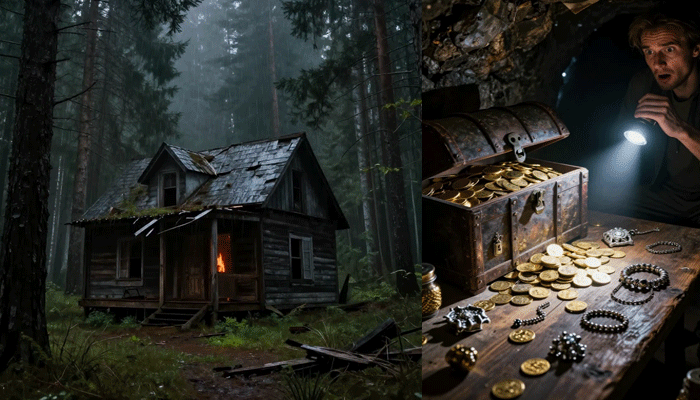
An old cabin stood in a clearing beside a creek swollen with rainwater. It was small, one story, built of dark logs and weather-stained boards. Part of the front porch had collapsed. The windows were dusty but unbroken. The chimney leaned slightly to one side, like an old man with a bad hip.
No lights. No car. No sign of life.
Ethan approached carefully.
“Hello?” he called.
Only the rain answered.
He climbed onto the porch, avoiding the broken boards, and tried the door. Locked.
For a moment, he almost laughed. Of course it was locked. Even abandoned cabins had better boundaries than his own family. Family
He walked around the side, searching for a loose window. The second one he tried lifted with a swollen groan. Ethan shoved his duffel bag through first, then climbed after it, landing hard on a dusty wooden floor.
The air inside smelled of mildew, old smoke, and mice. He stood still, listening.
Nothing.
Lightning flashed through the window, revealing a simple room: stone fireplace, iron bedframe, rough table, two chairs, shelves lined with old jars, and a small kitchen area with a hand pump over a sink. A narrow doorway led to what looked like a bedroom.
It was cold, but it was dry.
That made it beautiful.
Ethan found a stack of old newspapers near the fireplace, along with a few pieces of split wood that had somehow stayed dry in a corner box. He checked the chimney as best he could with his phone’s dead flashlight useless in his hand, then used one of his three damp matches from his duffel bag.
The first match died instantly.
The second burned low and weak.
The third caught a twist of newspaper.
Ethan crouched in front of the fireplace, shielding the tiny flame with both hands, whispering, “Come on. Come on.”
The paper blackened. The kindling smoked. Then, finally, a small orange flame rose and grabbed the wood.
Heat filled the room slowly, like mercy arriving late.
Ethan peeled off his soaked jacket and hung it over a chair. His hands shook as he sat near the fire. Exhaustion hit him all at once. He had spent the past three months pretending everything would work out. Pretending his mother still wanted him around. Pretending Ray’s cruelty was something he could endure until he got another job.
Now there was nothing left to pretend.
He pulled the old photograph from his pocket. The edges were damp, but the image remained. His father smiled in the picture, young and sunburned, with Ethan perched on his shoulders wearing a bright red cap.
Ethan stared at it until his vision blurred.
“I don’t know what I’m doing, Dad,” he whispered.
Outside, thunder rolled over the mountains.
Inside, the fire cracked softly.
Ethan lay down on the hard floor beside the hearth, using his duffel bag as a pillow. He told himself he would leave at sunrise. He would find a church, maybe a shelter, maybe walk into town and ask around for work again.
But deep down, he knew the truth.
He had no plan.
He slept.
When Ethan woke, the rain had stopped.
Gray morning light filled the cabin. For a few peaceful seconds, he forgot where he was. Then his back ached, his stomach growled, and the memory of the night before returned like a door slamming.
He sat up.
The cabin looked less frightening in daylight, though no less abandoned. Dust coated the floorboards. Spiderwebs hung from the rafters. A raccoon had left muddy paw prints near the kitchen shelves. The bed in the corner room held no mattress, only a rusted frame and a folded quilt too eaten by moths to use.
Ethan searched the shelves and found nothing edible except a sealed jar of peach preserves so old that the contents had turned nearly black. He left it alone.
In a cabinet beneath the sink, he found a dented tin cup. The hand pump groaned but worked after several tries, coughing up brown water before running clear and cold. Ethan drank greedily.
Then he explored.
The cabin had only two rooms and a tiny back pantry. No bathroom. No electricity. No personal belongings except a broken lantern, a few tools, a Bible with water-warped pages, and a wooden chest at the foot of the bed.
The chest was locked.
Ethan knelt before it. The lock was small and rusted. He knew he had no right to open it. He also knew whoever had owned this cabin had been gone a very long time.
Still, he left it alone.
He stepped outside.
The clearing was surrounded by dense woods. The creek ran fast over stones at the edge of the property. Behind the cabin, half hidden under vines, stood a small shed with a missing door. Inside were a rusted shovel, a broken axe handle, and several empty feed sacks. No food, no gas, no help.
Ethan walked back to the front porch and sat on the least broken step.
Morning mist rose from the ground. Somewhere far away, a dog barked. The world carried on as if Ethan had not been thrown out of his home.
His stomach twisted with hunger.
He had three dollars. The nearest store was probably six miles away.
He thought about going back.
Not to beg Ray. Never that. But to speak to his mother. To make her look him in the eye. To ask if she truly believed he had stolen money from the man who had spent years stealing peace from both of them.
But he knew what would happen. Ray would answer the door. Linda would stay behind him. Ethan would leave feeling smaller than before.
So he stayed.
For two days, Ethan survived at the cabin.
He walked to a gas station the first afternoon and spent his three dollars on a pack of crackers and a banana. The cashier eyed him suspiciously, probably because of his muddy clothes and bruised face, but said nothing. Ethan ate half the crackers walking back and saved the rest for dinner.
On the second day, he searched the woods and found wild muscadines, bitter but edible, clinging to vines near the creek. He drank from the pump and kept a small fire going. At night, he lay awake listening to the cabin settle, the wind move through the trees, and the creek rushing in the dark.
He told himself this was temporary.
Everything had to be temporary.
On the third morning, he found the first clue.
It happened while he was trying to fix the broken porch step. Ethan had always been good with his hands. His father had taught him before dying, and later Ethan had sharpened those skills in repair shops and garages. Sitting still made him feel useless, so he took the rusted shovel from the shed, used it as a lever, and pried loose a rotten board.
Under the board was a metal tobacco tin.
Ethan frowned.
The tin was old, green with corrosion, and wrapped in oilcloth. Someone had hidden it deliberately beneath the porch.
His heart began to beat faster.
He carried it inside and set it on the table. For a full minute, he only stared.
Then he opened it.
Inside was a folded piece of paper, yellow and brittle with age.
Ethan unfolded it carefully.
The writing was faded but readable.
“If you found this, then maybe you need shelter worse than you need permission. I know that feeling. There is food money under the hearthstone. Take only what you need. Leave the cabin better than you found it.”
It was signed:
M. Whitaker
1978
Ethan read it three times.
Then he turned toward the fireplace.
The hearth was made of flat stones set into the floor. Most were fixed in place with old mortar, but one near the left corner looked slightly raised. Ethan took out his father’s pocketknife and worked the blade carefully along the edge. The stone shifted.
Beneath it was a hollow space.
Inside lay a small glass jar.
Ethan pulled it out. His hands trembled as he unscrewed the lid.
There was money inside.
Not a fortune. Not stacks of cash. Just folded bills, mostly ones and fives, with a few tens. Ethan counted it twice.
One hundred and eighty-seven dollars.
To a rich man, it would have been nothing.
To Ethan, it felt like oxygen.
He sat back on his heels, stunned.
Someone had left money in this cabin nearly fifty years ago for strangers who had nowhere else to go.
His throat tightened.
“Thank you,” he said quietly, though he had no idea who M. Whitaker was.
He took twenty dollars, then hesitated. The note said food money. Take only what you need. He almost laughed at himself. Who was going to know if he took it all?
But something about the cabin had changed.
It no longer felt abandoned. It felt entrusted.
Ethan put the remaining money back in the jar and returned it beneath the hearthstone.
That afternoon, he walked to town and bought bread, peanut butter, apples, a small bag of rice, matches, and a cheap flashlight. The woman at the Dollar General register barely glanced at him. He carried the bags back to the cabin under a pale afternoon sun, feeling richer than he had in months.
When he returned, he cleaned.
He swept the floor with a bundle of branches tied together. He wiped dust from the table. He cleared broken glass and dead leaves from the pantry. He patched the window with cardboard from behind the store. He scrubbed the tin cup and found two more usable jars.
Every repair made the cabin feel less like a hiding place and more like a promise.
On the fourth night, while eating rice and peanut butter by the fire, Ethan looked again at the locked wooden chest.
It sat at the foot of the rusted bed, dark and silent.
M. Whitaker had hidden money for strangers. Maybe the chest held more notes, more history. Maybe it held nothing. Maybe opening it was wrong.
But the lock was badly rusted, and curiosity pressed at him harder than hunger had.
Ethan carried the chest into the main room. “I’m not stealing,” he said aloud, as if the cabin itself were judging him. “I just want to know who you were.”
He used the pocketknife and the rusted shovel edge. After ten minutes, the lock snapped.
The chest creaked open.
Inside were old clothes wrapped in paper, a wool coat, a pair of leather gloves, a cracked shaving mirror, and a stack of letters tied with blue ribbon. At the bottom was a black-and-white photograph.
Ethan picked it up.
It showed a man standing in front of the cabin, probably in his thirties, wearing work pants and suspenders. Beside him stood a woman with dark hair and a serious face. Between them were two children, a boy and a girl, both smiling.
On the back someone had written:
Matthew and Clara Whitaker
Hollow Creek Cabin
Summer 1952
M. Whitaker.
Matthew.
Ethan untied the letters and began to read.
Most were ordinary family letters. Clara writing to Matthew while visiting her sister in Tennessee. Matthew writing back about the creek flooding, about fixing the roof, about missing her biscuits. There were letters from their daughter, Ruth, after she moved to Atlanta. A few from their son, Samuel, who joined the Army. Family
The deeper Ethan went, the sadder the story became.
Clara died in 1969.
Samuel never came home from Vietnam.
Ruth married and stopped writing after 1975.
By 1978, Matthew Whitaker was alone in the cabin.
The final letter was not in an envelope. It was folded separately.
Ethan opened it carefully.
“To whoever finds this cabin after I’m gone,
I was not always kind when I should have been. I worked hard, but work is not love. I held grudges too long. I let pride cost me my daughter. I let grief turn my heart into a locked room.
If you are here because the world has pushed you out, know this: a man is not finished because he has no money, no home, or no family standing beside him. Sometimes the life you are meant to live begins after the life you begged to keep falls apart.
There are things buried here that I could never bring myself to use. Some are worth money. Some are worth memory. If you find them, use them better than I did.
M.W.”
Ethan stared at the final line.
Things buried here.
His pulse quickened.
He read the letter again, looking for clues, but there were none. He searched the chest and found only clothes and papers. He checked beneath the bedframe, behind shelves, under loose floorboards. Nothing.
Buried here.
Outside? Under the cabin? Near the creek?
The thought of hidden valuables should have filled him with excitement. Instead, Ethan felt wary. He had known enough disappointment to distrust sudden hope.
Still, the next morning, he searched.
He began around the porch, then the shed, then the base of the chimney. The ground was soft from rain, thick with roots and rocks. He used the rusted shovel until his palms blistered. He found nails, broken pottery, a horseshoe, and one empty mason jar.
No fortune.
By afternoon, he was sweating despite the cold. He sat beside the creek, frustrated, and threw a pebble into the water.
“Things buried here,” he muttered. “That’s real specific, Matthew.”
Across the creek, partly hidden by brush, something caught his eye.
A stone marker.
Ethan stood.
He crossed carefully over slick rocks and pushed through the brush. The marker was not a grave, as he first feared. It was a boundary stone, old and moss-covered. Three letters were carved into it.
M.W.C.
Beneath the letters was an arrow.
Ethan followed its direction with his eyes.
It pointed uphill, toward a slope thick with mountain laurel.
He climbed.
The hill rose behind the cabin, steeper than it looked from below. After twenty minutes of fighting through brush, Ethan found another marker. Same letters. Another arrow.
The second arrow pointed toward a massive oak tree at the top of the ridge.
The oak was ancient, its trunk wide enough that three men could not have reached around it. One heavy branch stretched eastward over a patch of ground where almost nothing grew.
At the base of the tree sat a flat stone.
Ethan dropped to his knees.
The stone was too heavy to lift by hand. He wedged the shovel under it and pushed. It shifted, then settled. He pushed again, using every bit of strength he had.
The stone tipped over.
Underneath was a rusted iron ring set into a square wooden hatch.
Ethan froze.
For a moment, the woods went silent.
Then a crow called from somewhere overhead, harsh and sudden, making him flinch.
He grabbed the ring and pulled. The hatch resisted, sealed by dirt and time. He dug around the edges, cleared roots, and pulled again.
This time, it opened.
A dark hole waited beneath.
Stone steps led down into the earth.
Ethan’s mouth went dry.
He turned on the flashlight he had bought with Matthew Whitaker’s money. The beam shook in his hand. It revealed a narrow root cellar built into the hillside, lined with stone and timber.
The air coming from below was cold and stale.
Ethan almost closed the hatch.
Every sensible part of him said not to climb into a hidden underground room alone, with no one knowing where he was.
But he had no one to tell.
So he descended.
The steps were slick. He moved slowly, one hand on the wall. At the bottom, the space opened into a small chamber about twelve feet wide. Shelves lined one wall, holding dusty jars and rotten wooden crates. Most had collapsed. A barrel sat in the corner. There was an old workbench, a lantern, and a metal trunk.
A large metal trunk.
Unlike the chest in the cabin, this one looked strong and heavy, with iron bands and a brass lock.
Ethan stepped closer.
On top of the trunk lay an envelope sealed inside a waxed cloth pouch.
His name was not on it, of course. No one could have known he would come.
But written across the front were three words:
FOR THE FINDER
Ethan opened it.
The letter inside was shorter than the others.
“If you have come this far, you are either desperate, curious, or both. I was both most of my life.
The contents of this trunk belonged to men who trusted me during the hardest years this county ever saw. Some lost farms. Some lost families. Some never returned to claim what they left. I kept records because honesty is all a poor man can afford to keep.
If any rightful family can be found, do right by them. If none can be found, then let what remains serve the living. Family
Do not let greedy men take it.
M.W.”
Ethan lowered the letter.
His breath sounded loud in the underground room.
The lock on the trunk was old but solid. He searched the workbench and found a coffee can filled with rusted keys. One by one, he tried them.
The seventh key turned.
The trunk opened with a deep metallic groan.
Inside were smaller boxes, cloth bundles, and ledgers wrapped in oilskin.
Ethan opened the first bundle.
Gold coins spilled into his palm.
He stopped breathing.
They were old American coins, heavy and bright even beneath decades of dust. Some were twenty-dollar gold pieces. Others were smaller. Ethan knew almost nothing about coins, but he knew enough to understand that what he held was worth far more than twenty dollars now.
He opened another box.
Inside were silver dollars stacked in paper rolls.
Another held jewelry: wedding rings, brooches, a pocket watch, a string of pearls yellowed with age.
At the bottom of the trunk were bank envelopes, old stock certificates, and three leather-bound ledgers filled with names, dates, amounts, and descriptions.
Ethan sat down hard on the dirt floor.
The hidden fortune was real.
For several minutes, he did nothing. He simply stared at the trunk, waiting for the world to correct itself. Waiting for a voice to shout that he had no right. Waiting for Ray to appear and snatch it away. Waiting to wake up back on the cabin floor with an empty stomach.
But the trunk remained.
Gold. Silver. Jewelry. Records.
A fortune.
Ethan’s first thought was not noble.
It was simple and human.
I could leave.
He could take the coins, sell them somewhere far away, buy a truck, rent an apartment, start over in another state where nobody knew Ray Caldwell or Linda Harper or the shame of being thrown out like trash.
He could disappear.
The thought was so beautiful it hurt.
Then he looked at Matthew Whitaker’s letter.
“If any rightful family can be found, do right by them.” Family
Ethan closed his eyes. Family
Doing right had never gotten him much.
Still, it was the only thing he owned that no one had taken from him.
He put everything back exactly as he had found it, locked the trunk, took the envelope and one ledger, and climbed out of the cellar. He covered the hatch with the flat stone again, then sat under the oak tree until sunset, thinking.
The next morning, Ethan walked eleven miles to the county library.
By the time he arrived, his legs ached and his shirt clung to his back. The library stood beside the courthouse, a brick building with white columns and a flag snapping in the wind. Inside, warm air and the smell of paper greeted him.
The librarian at the front desk looked up. She was a Black woman in her sixties with silver hair pinned neatly at the back of her head and reading glasses hanging from a chain.
“Can I help you?” she asked.
Ethan suddenly became aware of how he looked: unshaven, muddy boots, worn jacket, duffel bag over one shoulder.
“I need to look up some county records,” he said. “Old property records. Family names too, maybe.”
She studied him for a moment. Not unkindly.
“Local history room is in the back,” she said. “No food or drinks. Ask if you need help.”
“Thank you.”
The local history room was small but well kept. It held shelves of old newspapers, census books, maps, and binders of cemetery records. Ethan sat at a table and opened the ledger he had taken from the trunk.
The first page read:
Hollow Creek Trust Holdings
Maintained by Matthew Whitaker
1931–1958
Below were names.
Caleb Norris
Helen and George Avery
Samuel Pike
Elias Boone
Margaret Delaney
Joseph Reed
Thomas Harper
Ethan froze.
Thomas Harper.
His father’s name.
He leaned closer, heart pounding.
The ledger entry was dated 1957, decades before his father was born. So it could not be his father. Maybe a grandfather. A great-uncle. Ethan knew almost nothing about the Harper side of his family. After Thomas died, Linda rarely spoke of them. She said they were poor mountain people with too many secrets and not enough sense. Family
Ethan read the entry.
Thomas Harper deposited:
1 gold pocket watch, engraved “E.H. to T.H.”
6 Liberty Head gold coins
1 deed packet, sealed
Purpose: safekeeping during bank seizure and land dispute
Claimant/heir instructions: Harper bloodline, documented by family Bible or county birth record.
Ethan’s fingers went numb.
Harper bloodline.
He spent the next four hours searching records.
He found a Thomas Harper born in 1908, married to Eleanor Hayes in 1930. They had a son, Daniel Harper. Daniel had a son named Thomas Lee Harper in 1968.
Ethan’s father.
That meant the Thomas Harper in the ledger was Ethan’s great-grandfather.
The hidden trunk did not merely contain strangers’ valuables.
Part of it belonged to him.
He sat back, overwhelmed.
“Find something?” the librarian asked from the doorway.
Ethan looked up. Her name tag read: Mrs. Coleman.
“I think so,” he said carefully. “Can I ask you something strange?”
Mrs. Coleman smiled faintly. “Strange keeps this place interesting.”
He hesitated. “Do you know anything about Matthew Whitaker? Lived out near Hollow Creek.”
The smile faded into recognition.
“Old Matt Whitaker,” she said. “That is a name I haven’t heard in years.”
“You knew him?”
“My father did. Said Matt was stubborn as a mule, but honest. During the Depression, folks around Hollow Creek didn’t trust banks. Some of them left valuables with people they trusted. Matt was one of those people.”
Ethan tried to keep his face still.
“What happened to him?”
“Died alone, far as I know. Early eighties maybe. His daughter never came back for the property. County forgot about it.” Mrs. Coleman stepped farther into the room. “Why are you asking?”
Ethan swallowed.
Because I found enough buried treasure to change my life.
Because I’m sleeping in his cabin.
Because my great-grandfather’s name is in his ledger.
He said only, “I found some old papers.”
Mrs. Coleman looked at the ledger, then at him.
“Old papers can be powerful,” she said. “They can also bring out ugly things in people.”
“I’m starting to understand that.”
She pulled out a chair and sat across from him. “If those papers involve property, money, or family claims, don’t go waving them around town. Half the county is kin to the other half, and the other half thinks they should’ve inherited something.” Family
Ethan gave a tired laugh. “I don’t even have a place to sleep.”
Mrs. Coleman’s expression softened, but she did not pity him. He appreciated that.
“What’s your name?” she asked.
“Ethan Harper.”
At the word Harper, her eyes sharpened.
“Thomas Harper’s boy?”
Ethan stared. “You knew my dad?”
“I knew of him. He used to fix engines for folks. Quiet man. Kind eyes.”
Ethan looked down at the table.
Mrs. Coleman’s voice gentled. “I was sorry when he passed.”
“Thank you.”
She tapped the ledger lightly. “Be careful, Ethan Harper.”
“I will.”
But he was not careful enough.
When Ethan left the library, he did not notice the man watching from a pickup truck across the street.
Ray Caldwell had come into town to buy beer and cigarettes. He saw Ethan walking out of the library with a ledger under his arm and mud on his boots. At first Ray only sneered. The boy looked like a stray dog.
Then he saw Ethan cross toward the courthouse records office.
Ray’s eyes narrowed.
There was something different in Ethan’s posture. Something secretive. Something that looked almost like purpose.
Ray did not like it.
He waited until Ethan disappeared inside, then pulled out his phone and called Linda.
“Your boy’s up to something,” he said.
Linda sounded tired. “Leave him alone, Ray.”
“Funny how you say that now.”
“I mean it.”
Ray took a drag from his cigarette. “He came out of the library carrying some old book. Now he’s going into records. You know anything about that?”
There was a pause.
“No,” Linda said.
But her voice had changed.
Ray heard it.
“What ain’t you telling me?”
“Nothing.”
“Linda.”
Another pause.
“Thomas’s family used to have land out near Hollow Creek,” she said quietly. “That’s all.” Family
Ray sat up straighter.
“Land?”
“It was gone long before I met Thomas. Some dispute. I don’t know.”
“How much land?”
“I said I don’t know.”
Ray ended the call without saying goodbye.
Across the street, the courthouse doors opened. Ethan came out holding photocopies and a folded map.
Ray smiled.
The next week changed everything.
Ethan began spending his days between the cabin, the library, and the courthouse. He learned that the Hollow Creek cabin property still technically belonged to the Whitaker estate, but unpaid taxes had accumulated for years. Because the property was remote and considered nearly worthless, the county had never pushed hard to seize it.
He learned that Matthew Whitaker’s daughter, Ruth Whitaker Bell, had died in 1999 in Florida, apparently with no children.
He learned that several families listed in the ledger still had descendants in the county.
He learned that the Harper deposit was real, and that the sealed deed packet in the trunk might connect to twenty acres of ridge land once taken during a questionable foreclosure in the 1950s.
Most importantly, he learned that the fortune was not something he could simply cash in without consequences.
The coins and jewelry might be valuable, but the ledgers made them complicated. They represented trust. Promises. Old losses.
Ethan could not afford a lawyer, so he kept reading. Every night, he returned to the cabin and took notes by firelight. He ate cheap food, repaired what he could, and slept on a mattress made from pine boughs and old clothes.
He also began to feel watched.
At first it was only a feeling on the back of his neck as he walked the dirt road. Then he noticed tire tracks near the entrance to Hollow Creek Road. Fresh ones. Wide truck tires.
One afternoon, he returned from town and found the cabin door open.
Ethan stopped at the tree line.
The porch creaked.
Someone was inside.
His first thought was Ray.
His second thought was the trunk.
Ethan set down his grocery bag quietly and picked up a fallen branch. He moved toward the cabin, heart hammering.
Inside, drawers had been opened. The bed chest had been overturned. Letters lay scattered across the floor.
A man stepped out of the bedroom.
It was not Ray.
He was older, maybe late fifties, with a narrow face, expensive boots, and a tan jacket too clean for the woods. His gray hair was combed back neatly. He looked more like a lawyer than a burglar.
He froze when he saw Ethan.
“Who are you?” Ethan demanded.
The man recovered quickly. “I could ask you the same thing.”
“You’re in my shelter.”
“Your shelter?” The man smiled. “Interesting choice of words.”
Ethan tightened his grip on the branch. “Get out.”
The man looked around the cabin. “You broke in here, didn’t you?”
“So did you.”
“I came to inspect property.”
“Whose property?”
The man took a card from his jacket pocket and held it out. “Grant Bell. Real estate acquisitions.”
Ethan did not take the card.
Bell.
Ruth Whitaker Bell.
“Are you related to Ruth Bell?” Ethan asked.
Grant’s eyes flickered. “She was my aunt.”
Ethan’s stomach sank.
So there was an heir.
Maybe.
Grant smiled again, but this time it did not reach his eyes. “Sounds like you’ve been doing research.”
“I asked a question.”
“And I answered it. Now you answer mine. What are you doing here?”
“Staying dry.”
Grant glanced at the scattered letters on the floor. “And reading private family documents?” Family
Ethan said nothing.
Grant stepped closer. “Listen to me, son. This property is going to be sold. Whatever romantic little squatter story you’ve got going on ends now.”
“Sold to who?”
“To people with money.”
“For what?”
Grant’s smile thinned. “That’s not your concern.”
But Ethan knew enough about the county to guess. Developers had been buying rural land for cabin rentals and luxury retreats. Hollow Creek was isolated, wooded, and beautiful. Worthless on paper did not mean worthless forever.
Grant moved toward the door. As he passed Ethan, he lowered his voice.
“Whatever you think you found here, it belongs to the Whitaker family.”
Ethan stared at him.
Grant leaned closer. “And I am the Whitaker family.”
Then he walked out.
Ethan watched him climb into a black SUV parked behind the trees and drive away.
Only after the engine faded did Ethan run up the ridge to the oak tree.
The flat stone was still in place.
The hatch was untouched.
He sank to the ground, breathing hard.
Grant Bell did not know where the trunk was.
Not yet.
That night, Ethan made the hardest decision of his life.
He could not protect the fortune alone. He could not sleep beside it, could not carry it, could not legally claim it without help. And if Grant Bell had already found the cabin, others might follow.
So the next morning, Ethan went back to the library and told Mrs. Coleman everything.
Not every detail at first. But enough.
He showed her Matthew’s letters. He showed her photographs of the trunk and ledger entries, taken with his phone after charging it at the library. He showed her the Harper name.
Mrs. Coleman listened without interrupting.
When he finished, she sat very still.
“Ethan,” she said, “you need an attorney.”
“I can’t pay one.”
“You need one anyway.”
“With what money?”
She folded her hands. “There’s a legal aid office in Gainesville. And I know a retired probate judge who still takes calls from me because I once caught his grandson tearing pages out of a history book.”
Despite everything, Ethan laughed.
Mrs. Coleman did not.
“You also need to move those items somewhere safe,” she continued. “Not sell them. Not hide them under your coat. Secure them. Document everything.”
“What if Grant Bell really is the heir?”
“Then he has rights. But not the right to destroy records or steal property that may belong to other families.” Her gaze sharpened. “And not the right to threaten you.”
“He didn’t exactly threaten me.”
“Men like that rarely do exactly anything.”
By sunset, Mrs. Coleman had arranged a meeting with a retired judge named Arthur Pennington and a young legal aid attorney named Naomi Brooks.
Naomi was thirty-two, sharp-eyed, and direct. She wore a navy blazer, scuffed boots, and no patience for nonsense. When Ethan explained where he had been sleeping, she looked angry on his behalf but did not make him feel ashamed.
Judge Pennington, white-haired and slow-moving, examined the ledger pages with a magnifying glass.
“Well,” he said finally, “this is either the most elaborate forgery I’ve seen in forty years, or you stumbled into a mess that will keep lawyers fed for a decade.”
“I was hoping for better news,” Ethan said.
Naomi leaned over the table. “The good news is that you reported it before someone else took it. The bad news is that everyone with a possible claim may come running once word gets out.”
“I don’t want to steal anything,” Ethan said. “I just don’t want Grant Bell to take it all.”
Judge Pennington looked at him over his glasses. “Why not? If he’s the heir, some might say it’s his.”
“Because Matthew Whitaker kept records for a reason. He wanted things returned if families could be found.”
The old judge studied him for a long moment.
“That answer may save you,” he said.
Two days later, under Naomi’s guidance, Ethan led Judge Pennington, Mrs. Coleman, and a sheriff’s deputy named Carla Ruiz to the hidden cellar. Everything was photographed, cataloged, and removed under official supervision.
The trunk contained far more than Ethan had realized.
There were 143 gold coins, many rare. Over 600 silver dollars. Jewelry from at least nine families. Old bonds. Deeds. A pocket watch engraved E.H. to T.H. A packet connected to the Harper land dispute. And ledgers detailed enough to make even Judge Pennington whistle softly.
“This man documented everything,” Naomi said.
“Matthew was honest,” Mrs. Coleman replied.
The items were placed in secure storage while legal notices were prepared for possible heirs.
Ethan watched the trunk carried away and felt both relief and grief. The fortune had been found, but it was no longer his secret. Maybe it never had been.
That evening, he returned to the cabin alone.
For the first time since arriving, it felt empty.
Three days later, Ray showed up.
Ethan was repairing the shed door when he heard the truck. He turned and saw Ray’s rusted Ford bouncing into the clearing. Linda sat in the passenger seat, pale and tense.
Ray climbed out with a grin that made Ethan’s stomach harden.
“Well, look at this,” Ray said. “Mountain man Ethan.”
Ethan set down the hammer. “Leave.”
Ray laughed. “That any way to talk to family?” Family
“You made it clear we’re not family.”
Linda stepped out slowly. “Ethan.”
He looked at her, and all the anger he had tried to bury rose in him.
“Why are you here?” he asked.
She flinched.
Ray answered for her. “Heard you found something interesting.”
Ethan’s eyes went cold. “From who?”
“Small town.”
“There’s nothing here for you.”
Ray walked toward the cabin. “I’ll decide that.”
Ethan stepped in front of him.
Ray stopped, surprised. Ethan had never blocked him before.
“Move,” Ray said.
“No.”
Ray’s jaw tightened. “Boy, don’t make me teach you another lesson.”
But Ethan was not in Ray’s kitchen anymore. He was not standing under that yellow light with his mother looking away. He was outside, on ground he had survived by himself, beside a cabin that had given him shelter when his own family would not.
“I said no,” Ethan repeated.
Ray shoved him.
Ethan stumbled but did not fall.
Linda cried, “Ray, stop.”
Ray ignored her and swung.
This time, Ethan ducked.
Ray’s fist hit the porch post with a crack. He cursed and lunged again, but Ethan stepped aside and shoved him hard. Ray slipped in the mud and went down on one knee.
For a moment, nobody moved.
Ray looked up, stunned with humiliation.
Ethan’s voice was quiet. “Get off this property.”
Ray stood slowly. “You think some old coins make you better than me?”
“No,” Ethan said. “I think walking away from you does.”
Ray’s face twisted. He turned toward Linda. “You gonna let him talk to me like that?”
Linda stared at Ethan. Tears stood in her eyes.
For the first time in years, she did not look away.
“Yes,” she said.
Ray blinked. “What?”
Linda’s voice trembled, but she kept going. “I said yes.”
Ray stepped toward her. “Get in the truck.”
“No.”
The word was small, but it changed the air.
Ray’s expression darkened. “Linda.”
She backed away. “I should’ve said it years ago.”
Ethan felt something break open in his chest.
Ray looked between them, realizing he had lost control of the moment. He pointed at Ethan. “This ain’t over.”
“Yes,” Ethan said. “It is.”
Ray spat into the mud, climbed into his truck, and slammed the door. For one second, Ethan thought Linda might follow.
She did not.
Ray drove away alone.
The sound of his engine faded down Hollow Creek Road.
Linda stood in the clearing, shaking.
Ethan did not go to her immediately. Some wounds were too deep for quick embraces.
Finally, she whispered, “I’m sorry.”
Ethan looked at the woman who had raised him, failed him, loved him badly, and let fear make too many choices.
“Why didn’t you defend me?” he asked.
She covered her mouth.
“I was scared,” she said. “And tired. And ashamed. But that’s not an excuse.”
“No,” Ethan said. “It’s not.”
She nodded through tears.
“I didn’t steal his money,” Ethan said.
“I know.”
The answer hurt more than he expected.
“You knew?”
Linda closed her eyes. “Ray found it later. In his jacket. He’d been drunk. He didn’t remember putting it there.”
Ethan turned away.
“I wanted to call you,” she said. “I wanted to tell you to come home.”
“But you didn’t.”
“No.”
The creek rushed behind them.
Ethan looked at the cabin, at the repaired porch, at the smoke rising from the chimney.
“I don’t have a home to come back to,” he said. “Not there.”
Linda wiped her face. “I know.”
She left that evening on foot with Ethan walking beside her as far as the main road. Mrs. Coleman helped her find a women’s shelter in town, and within a week Linda filed for separation from Ray. It did not fix what she had done. It did not erase Ethan’s hurt. But it was a beginning.
The legal battle over the Hollow Creek fortune lasted months.
As Judge Pennington predicted, news spread quickly. Grant Bell filed a claim to the entire Whitaker estate, insisting that as Ruth Bell’s nephew, he had sole inheritance rights. But Naomi challenged him immediately. She discovered that Grant was not Ruth’s nephew by blood or adoption. He was the grandson of Ruth’s second husband from a prior marriage, legally unrelated to the Whitaker line.
Grant’s claim weakened.
Then Naomi found evidence that Grant had known about possible valuables on the property from an old family rumor and had tried to quietly purchase the tax lien before anyone else investigated. His visit to the cabin made him look less like an heir and more like an opportunist. Family
Meanwhile, descendants of several families named in the ledgers came forward. Some wept when shown wedding rings or pocket watches. Others had no interest in old claims and signed releases. A few disputes got messy, but the ledgers were clear enough to settle most of them.
The Harper packet changed Ethan’s life.
Inside was the engraved pocket watch, the six gold coins, and a deed showing that Ethan’s great-grandfather had owned twenty acres along the ridge above Hollow Creek. The land had been taken in a foreclosure connected to a bank that failed soon after. The legal path to reclaiming it was complicated, but the county eventually acknowledged flaws in the old transfer.
Naomi negotiated a settlement.
Ethan received clear title to eight acres surrounding the cabin and ridge, including the old oak and the hidden cellar. The remaining disputed land became part of a conservation easement. The Harper gold coins and pocket watch were returned to him as family property. And because Ruth Whitaker had no direct heirs, Matthew’s unclaimed personal share of the trunk—after verified family items were returned—was placed into a trust.
At Ethan’s request, the trust had a purpose.
Restoring the Hollow Creek cabin.
Not as a luxury rental. Not as a private getaway for rich weekenders.
As temporary shelter for people who had nowhere else to go.
The county resisted at first. There were zoning issues, liability concerns, insurance questions, and plenty of officials who disliked anything that sounded like compassion without profit. But Mrs. Coleman rallied church groups, Naomi handled paperwork, Judge Pennington made calls, and families who had recovered heirlooms from the trunk donated money.
Even Linda helped. She painted walls, cooked for volunteers, and never asked Ethan for forgiveness again after the first time. Instead, she worked quietly and let her actions speak.
By the next autumn, Hollow Creek Rest Cabin opened.
It had electricity now, though Ethan insisted on keeping the old fireplace. The roof was repaired. The porch was rebuilt. The hand pump remained beside a modern sink as a reminder. The hidden cellar was reinforced and turned into a small museum room displaying photographs, copies of Matthew’s letters, and the story of the Hollow Creek Trust.
Above the fireplace, framed in simple wood, hung Matthew Whitaker’s words:
“A man is not finished because he has no money, no home, or no family standing beside him.” Family
Ethan read that line often.
He had sold only one of the six Harper gold coins, enough to buy a used truck, pay bills, and start a small repair business in town. He kept the pocket watch in a drawer by his bed. Sometimes, when life felt too strange to believe, he held it in his palm and imagined his great-grandfather handing it to Matthew Whitaker for safekeeping, never knowing that one day his desperate descendant would find it beneath the same mountain.
Ray Caldwell disappeared from town after a drunk driving arrest and a failed attempt to claim that Ethan had stolen “family assets.” No one missed him much.
Linda rented a small apartment above a bakery and got a job at the library helping Mrs. Coleman organize archives. She and Ethan had dinner every Sunday. Some Sundays were easy. Others were quiet and painful. But they kept showing up.
That, Ethan learned, was sometimes what healing looked like.
One cold November evening, almost exactly a year after he had first climbed through the cabin window, Ethan stood on the new porch watching rain fall over Hollow Creek.
Inside, a young man named Cody slept on the couch near the fire. He had arrived that afternoon with a backpack, a bruised eye, and the hollow stare of someone who had run out of doors to knock on. Ethan had given him soup, dry socks, and a blanket.
He had not asked for the whole story.
Not yet.
People told their stories when warmth convinced them they might survive.
Mrs. Coleman came out onto the porch carrying two mugs of coffee.
“You look thoughtful,” she said.
Ethan accepted a mug. “Just remembering.”
“The night you found this place?”
“Yeah.”
She smiled. “You broke into a historic property, you know.”
“Best crime I ever committed.”
Mrs. Coleman laughed softly.
Rain tapped on the porch roof. The creek moved through the dark trees, steady and alive.
After a while, she said, “Do you ever wonder what would’ve happened if you’d taken the trunk and run?”
Ethan looked toward the ridge where the old oak stood.
“Sometimes.”
“And?”
He thought about gold coins in his shaking hand. About hunger. About Ray. About his mother’s silence. About Matthew Whitaker dying alone with secrets buried in the hill. About all the families who had gotten back pieces of their past. About Cody asleep inside with a full stomach.
“I think I would’ve had money,” Ethan said. “But I wouldn’t have had this.”
Mrs. Coleman nodded.
From inside the cabin, the fire popped. Cody stirred but did not wake.
Ethan looked through the window at the room that had once saved him. It was brighter now, stronger, filled with clean blankets, canned food, books, tools, and emergency numbers pinned near the door. But in one corner, beneath a loose hearthstone that only Ethan knew how to lift, there was still a glass jar.
Inside were folded bills.
Food money.
A note rested beside it, written in Ethan’s own hand.
“If you found this, maybe you need shelter worse than you need permission. I know that feeling. Take only what you need. Leave the cabin better than you found it.”
He had signed it:
E. Harper
The fortune had changed his life, but not because it made him rich.
It changed his life because it showed him that a man with nothing could still choose what kind of person he wanted to become.
And on that cold rainy night, standing on the porch of the old cabin that had once been his last refuge, Ethan Harper understood something clearly.
He had not been kicked out of his life.
He had been pushed toward the beginning of it.
THE END