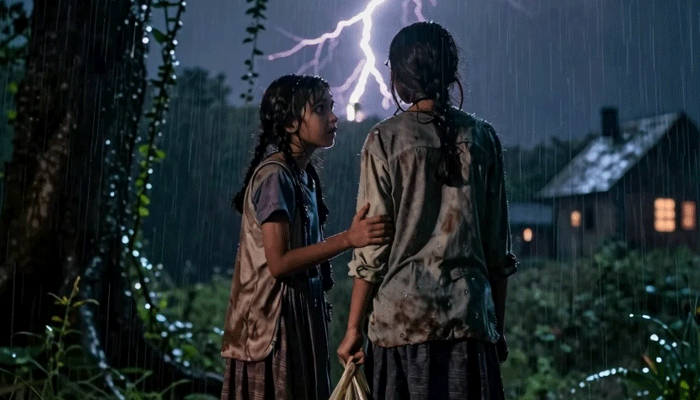
I was seventeen years old the night my father pointed at the front door and told me I was no longer his daughter.
The rain had not started yet, but the sky over Pine County, Missouri, had turned the color of wet ashes. Heat lightning flickered beyond the black line of oak trees, and every window in our old farmhouse reflected the same ugly scene: my father in his work boots, my stepmother Denise with her arms crossed, my little sister Lily standing barefoot on the kitchen linoleum, and me holding a trash bag full of clothes like a criminal caught stealing silver.
Except I had not stolen anything.
Denise said I had.
She claimed the envelope of cash she kept in the cookie tin had gone missing. Three hundred and eighty dollars. Grocery money, she called it, though I had seen her spend twice that much on hair appointments in Conway. She found the empty tin at six o’clock, waited until my father came home from the sawmill, and then performed her hurt little speech while he sat at the kitchen table rubbing sawdust from his beard.
“Emma’s been talking about leaving,” she said, her voice soft and poisonous. “She’s always hated me. Always thought she was too good for this house.”
“I didn’t take it,” I said.
My father would not look at me.
That hurt more than the accusation.
Wade Carter had once been the kind of father who carried Lily on his shoulders through the county fair and let me steer the truck down the gravel lane before I could reach the pedals. After my mother died, grief turned him into somebody hollow. Denise filled that hollow place with her own voice. By the time I was sixteen, he believed whatever she said because believing her was easier than waking up.
“Empty your pockets,” Denise said.
I did.
A library card. Two dollars and thirteen cents. A receipt from Hank’s Feed & Hardware, where I worked weekends sweeping aisles and restocking nails. A folded photograph of my mother standing beside a creek with her jeans rolled to her knees.
Denise picked up the photograph and looked at it like it smelled bad.
“Still carrying this around?” she said.
“Give it back.”
She smiled and dropped it on the table.
My father finally spoke. “Pack a bag.”
The room went so quiet I heard the refrigerator click off.
“What?” I asked.
“You heard me.”
“Dad, I didn’t take anything.”
“I said pack a bag.”
Lily started crying then. Not loud. Just a small, broken sound that made my stomach twist. She was thirteen, thin as a fence rail, with my mother’s brown eyes and my father’s stubborn chin. She had learned to be quiet around Denise, but that night her fear slipped out.
“Don’t make Emma leave,” she whispered.
Denise turned on her. “You can stop the dramatics.”
My father stood. “Both of you.”
I stared at him. “Both of us?”
“You girls need to learn consequences.”
Lily grabbed my arm. “Daddy, please.”
He flinched at that word, but not enough.
Denise’s mouth curved. “Maybe a night away will teach them respect.”
A night away.
That was how she dressed it up. Like we were being sent to summer camp instead of thrown into the dark with a thunderstorm rolling in.
I shoved clothes into a trash bag because Denise would not let me take a suitcase. Lily tried to pack her school backpack, but Denise dumped half of it out, saying we did not need books where we were going. I took my mother’s old denim jacket from the closet and wrapped it around Lily’s shoulders. I took the photograph from the table. I took my work shoes. I took the twenty-eight dollars I had hidden inside a sock because a girl learns to hide money when home stops being home.
At the door, my father stood with one hand on the frame.
He smelled like pine sap, sweat, and beer.
“Come back tomorrow,” he muttered, so low Denise could not hear.
Something in me snapped.
“No,” I said. “When we walk out, we don’t come back because she lets us. We come back when you remember we’re yours.”
His jaw tightened.
Denise laughed. “Always so dramatic.”
I looked at her. “You should check the pocket of your blue coat.”
Her smile faded for half a second.
That was enough. I knew then. The money had never been missing. Or if it had, Denise knew exactly where it went.
But my father opened the door anyway.
The first raindrop struck the porch rail as Lily and I stepped outside.
Behind us, the door closed.
Not slammed. Closed.
Somehow that was worse.
We walked down the gravel driveway under a sky full of thunder, two girls with one trash bag, one backpack, and nowhere legal to sleep. The farmhouse lights glowed behind us until the road curved and swallowed them.
Lily cried for the first mile.
I did not.
I was too angry to cry.
The road into town was four miles, and I knew we could not go there. Denise had friends at the sheriff’s office. My father’s cousin worked dispatch. If they picked us up, we would be taken back before sunrise, and Denise would call it proof that we could not survive without her.
So I turned left at Miller Creek Road instead.
“Where are we going?” Lily asked.
Her voice shook under the denim jacket.
“To the woods.”
“That’s not a place.”
“It is tonight.”
The woods beyond Miller Creek had belonged to families like ours before banks, taxes, bad luck, and worse men carved the land apart. My mother used to take us there when we were little. She knew where the wild blackberries grew and where spring water bubbled clear through limestone. She said her grandfather had trapped rabbits in those hollows during the Depression and hid from debt collectors in places the map forgot.
She had also told me never to go past the split sycamore.
“There are old sinkholes back there,” she said once, tying Lily’s shoe on a flat rock. “A person could disappear if they weren’t careful.”
I thought about that as lightning flashed over the ridge.
Maybe disappearing did not sound so terrible.
By the time we reached the tree line, the rain had become heavy and cold. It ran down my neck and soaked through my shirt. Lily’s shoes slipped in the mud. She was trying not to complain, which made me feel worse than if she had screamed at me.
We pushed through cedar and scrub oak, using flashes of lightning to see the narrow deer trail. Branches scratched my arms. The trash bag tore on a thorn bush, and I had to gather our clothes against my chest.
“We should go back,” Lily said after she stumbled for the third time.
“We can’t.”
“What if Dad comes looking?”
I stopped.
Rain dripped from my hair into my eyes.
“Then he can look,” I said. “But he doesn’t get to find us easy.”
She stared at me, frightened and trusting, and I hated my father for making me the grown-up before I even graduated high school.
We kept walking.
The storm grew meaner. Wind shoved through the trees, turning leaves silver. Somewhere nearby, a branch cracked like a gunshot. Lily screamed, and I pulled her against me until the sound rolled away.
That was when I saw the split sycamore.
It stood at the edge of a shallow ravine, pale trunk divided into two arms, exactly as I remembered. Beyond it, the land dropped steeply into a tangle of mossy rocks and ferns. Water ran down the slope in muddy ribbons.
“We stop here,” I said.
But Lily was looking past me.
“What’s that?”
At first I saw only darkness. Then lightning flashed again, and for one second the hillside opened its mouth.
Behind a curtain of hanging vines and wild grape, there was a black gap in the limestone.
Not big. Not obvious. A person walking by in daylight might miss it.
But rainwater flowed away from it, not into it, and the ground before it was strangely flat, as if something heavy had once blocked the entrance.
I remembered my mother’s voice.
A person could disappear if they weren’t careful.
“Emma,” Lily whispered. “Is that a cave?”
I should have said no. I should have dragged her back to the sycamore and waited under the trees until daylight.
Instead, another burst of thunder shook the ground, and hail began tapping through the leaves.
“Yes,” I said. “And it’s dry.”
The entrance was lower than it looked. I had to crouch and push aside wet vines. The air coming out of the cave was cool and smelled like stone, dirt, and something old but not rotten. I went first, feeling ahead with one hand, my shoes scraping rock.
“Stay close,” I told Lily.
“I’m scared.”
“Me too.”
That was the first honest thing I had said all night.
Five feet in, the passage widened. Ten feet in, we could stand. The storm noise softened behind us until it sounded like the world was underwater. I pulled out my cheap gas-station flashlight, the one I used walking home from work, and clicked it on.
The beam shook in my hand.
The cave was not a deep, endless tunnel like in adventure movies. It was a limestone chamber about the size of our kitchen, with a ceiling low enough in places that my hair brushed it. The floor was mostly dry sand and flat rock. Tree roots hung through cracks overhead like black thread. Along the back wall, water trickled into a shallow stone basin and disappeared through a slit.
But what made Lily grab my wrist was not the water.
It was the crates.
Three wooden crates sat against the left wall, gray with age but stacked neatly. Beside them was a rusted metal lantern, a broken shovel, and an old army-green trunk with leather straps.
“Someone lives here,” Lily whispered.
“No,” I said, though my heart was beating hard. “Not anymore.”
The place had the stillness of something forgotten.
We listened.
Nothing moved except the water.
I set the trash bag down. Lily sank beside it, shaking from cold and fear. I took off my mother’s denim jacket, wrung rain from the sleeves, and put it back around her.
“We’ll stay until morning,” I said. “Then I’ll figure something out.”
“What?”
I had no idea.
But big sisters are supposed to have answers, so I said, “A bus. Work. Maybe Aunt Rachel in Springfield.”
“Aunt Rachel doesn’t answer Mom’s Christmas cards.”
“I know.”
“Then why would she answer us?”
I sat beside her on the stone floor and pulled her close.
“Because we’ll make her.”
Lily leaned against my shoulder. For a while we just listened to the storm beat the woods.
Then her stomach growled.
I dug through the backpack. We had two granola bars, a bruised apple, and half a pack of gum. I gave Lily the apple and one granola bar. She tried to split the apple with me, but I shook my head.
“Eat.”
“You too.”
“I had food at work.”
It was a lie. She knew it was a lie. She ate anyway because hunger is stronger than pride.
The flashlight beam faded yellow, so I turned it off to save battery. Darkness pressed in, thick and complete. Lily’s breathing slowed after a while. She fell asleep with her head in my lap.
I stayed awake.
I thought about my father at the kitchen table.
I thought about Denise’s blue coat.
I thought about school on Monday, my locker, my English essay unfinished, the guidance counselor who always asked if everything was okay at home in a voice that meant she already knew the answer.
Mostly I thought about my mother.
Her name was Sarah Carter, and when she laughed, people turned toward it like flowers toward sun. She died three years earlier driving home from the hospital after a double shift. A deer jumped the road, the truck rolled twice, and by dawn everyone in Pine County had brought casseroles to our porch.
After the funeral, my father stopped singing in the barn. He stopped fixing things. He stopped looking at me because I had my mother’s face and he could not forgive either of us for it.
Denise appeared six months later with lemon bars, red nails, and a talent for finding weak places.
By midnight, the storm moved east.
By two in the morning, Lily woke with a gasp.
“What?” I whispered.
“I heard something.”
We held still.
At first I heard only water. Then came a faint scraping from outside the cave.
Not animal.
Slow. Heavy. Deliberate.
Someone was moving through the brush.
My blood turned cold.
A light swept across the vines.
Lily clamped both hands over her mouth.
A man’s voice cursed softly outside.
Then my father called, “Emma?”
I closed my eyes.
Lily’s whole body strained toward the entrance, but I gripped her arm.
“Emma, Lily,” he called again. “You girls out here?”
Another voice answered. Denise.
“Wade, they’re not in these woods. They went to town. I told you.”
“They used to come here with Sarah.”
“That was years ago.”
The light moved closer.
I could see the pale beam through the vines now.
Lily trembled so hard her teeth clicked.
I wanted to run to him. I wanted to crawl out and make him see us soaked and freezing and ask if this was enough punishment for money we had not taken.
But then Denise said, “If you find them now, they’ll think they can manipulate you forever.”
My father said nothing.
Denise continued, sharper now. “You want those girls ending up like their mother? Always wandering, always dreaming, always making you feel small?”
There was a silence.
Then my father said, “Don’t talk about Sarah.”
For one breath, hope lit inside me.
Denise lowered her voice. “Then stop chasing ghosts and come home.”
The flashlight beam moved away.
I waited for my father to call again.
He did not.
Their footsteps faded.
The woods went quiet.
Lily turned her face into my shirt and cried without making sound.
That was the moment I decided I would never beg him again.
Morning came gray and cold. The cave entrance glowed faintly behind the vines. Birds called from wet branches. My back hurt from sitting upright all night, and Lily’s hair had dried in tangled waves around her face.
“We need water,” I said.
The stone basin at the back of the cave held water clear enough to reflect the flashlight beam. I tasted it first. Cold, clean, sweet with minerals. Lily drank from cupped hands and sighed like she had been rescued already.
Then curiosity, that dangerous little spark, pulled us toward the trunk.
It was locked, but the latch had rusted through. I found the broken shovel, wedged its edge under the lid, and pushed. The metal groaned. Dust rose. Lily sneezed.
Inside were oilcloth bundles, two glass jars, a stack of yellowed newspapers, and a small wooden box wrapped in a flour sack.
“No gold?” Lily asked weakly.
“Sorry.”
But my hands were shaking as I unwrapped the wooden box.
Inside lay a bundle of letters tied with blue ribbon, a black-and-white photograph, and a leather notebook.
The photograph showed a young woman standing at the mouth of the cave beside a man in overalls. The woman had dark hair, serious eyes, and Lily’s chin.
On the back, written in faded ink, were three words:
Maggie Bell, 1934.
“My middle name,” Lily said.
It was true. Lily’s full name was Lily Margaret Carter. My mother had named her after someone but never explained who.
I opened the notebook.
The first page read:
Mercy Hollow Root Cellar and Spring Cave
Built by Thomas Bell, 1932
For family, neighbors, and any hungry soul who needs shelter
Under that, in smaller handwriting:
If the world gets cruel, remember there are still places made for saving.
I read the line three times.
Lily touched the page. “Who was Thomas Bell?”
“Mom’s side,” I said. “Her grandmother was a Bell.”
The notebook was part diary, part ledger. During the Depression, Thomas Bell and his wife Maggie had used the cave to store canned vegetables, smoked meat, medicine, blankets, tools, and jars of coins. Neighbors who lost farms came there. Children slept there during floods. A midwife delivered babies in the dry chamber. Men hid from violent creditors. Women hid from violent husbands.
Mercy Hollow, they called it.
Not because it was beautiful.
Because people survived there.
Lily leaned closer as I turned pages carefully.
There were names, dates, debts forgiven, warnings about unstable passages, notes about planting beans in poor soil, instructions for purifying water. Near the back, several pages had been folded together.
I opened them.
A hand-drawn map showed the cave entrance, the split sycamore, Miller Creek, and an old property line marked in red pencil. Beside it was a note:
Never let Wade Hardin’s people claim the hollow. They tried once. Papers copied and sealed in jar behind north wall.
I frowned.
“Wade Hardin?” Lily said.
“Our dad’s name is Wade.”
“Maybe family?”
I searched the trunk and found the glass jars. One held buttons, old coins, and a silver thimble. The other was sealed with wax. Inside, rolled tight, were papers.
The first was a deed.
I knew almost nothing about legal documents, but I understood names. Thomas Bell. Maggie Bell. Sarah Bell Carter.
My mother.
The deed described forty-two acres of woodland around Miller Creek, including what it called “the limestone spring hollow.”
At the bottom, in a lawyer’s stamp dated fifteen years earlier, was a transfer-on-death clause naming Sarah Bell Carter as heir.
Behind it was another document.
This one named Emma Grace Carter and Lily Margaret Carter as successor beneficiaries if Sarah died.
My mouth went dry.
“What does that mean?” Lily asked.
“I think…” I swallowed. “I think Mom owned this land.”
Lily stared. “Then Dad owns it now?”
“I don’t know.”
There were more papers. Tax receipts. A letter from my mother to someone named Mr. Callahan, attorney at law. A handwritten note in her familiar loops:
If anything happens to me, Wade is not to sell Mercy Hollow. It belongs to the girls. They’ll need one place no one can take from them.
I pressed the paper to my chest.
For three years, I had thought my mother left us nothing but photographs and recipes tucked in cookbooks.
But she had left us land.
She had left us water.
She had left us a cave built for saving people.
And somehow my father had never told us.
By noon, the rain stopped. Sunlight came through the wet vines in green strips. I knew we could not stay hidden forever. We needed food, a phone, and someone who understood deeds better than a seventeen-year-old girl with muddy shoes.
There was one person in Pine County I trusted almost enough.
Mrs. Ada Brooks lived two miles from Miller Creek Road in a white house with blue shutters and a porch full of ferns. She had been my mother’s high school English teacher and later mine. She was seventy-one, sharp as a sewing needle, and known for correcting grammar on church signs with a red marker.
When I knocked on her back door that afternoon, holding Lily’s hand and the oilcloth bundle under my arm, she opened it with a flyswatter raised like a weapon.
Then she saw our faces.
“Oh, sweet Lord,” she said. “Get in this house.”
She did not ask questions until we had showered, eaten scrambled eggs, and wrapped ourselves in towels warm from the dryer. Then she sat across from us at her kitchen table, listened to everything, and grew quieter with every word.
When I showed her my mother’s note, she took off her glasses.
“I knew Sarah had kept something back,” she said.
“You knew?”
“I knew she was afraid Wade would lose the farm after she died. Not because he was cruel then, Emma. Because he was weak. There’s a difference, but sometimes the damage looks the same.”
“Can Denise take the land?”
Mrs. Brooks looked at the deed. “Not if this says what I think it says.”
Lily sat straighter. “So we have a cave?”
“You may have forty-two acres and a cave,” Mrs. Brooks said. “Which is more than most people have after being thrown out in a thunderstorm.”
I almost laughed. Instead, I cried.
Not loud. Not pretty. I just folded over the kitchen table and sobbed until Mrs. Brooks came around and held me the way my mother used to, one hand firm on the back of my head.
That evening, she called a lawyer in Branson named Daniel Price, who owed her a favor from 1989 involving a failed marriage, a fishing boat, and, as she put it, “a spectacular lack of common sense.” Mr. Price agreed to meet us the next morning before his regular office hours.
We slept in Mrs. Brooks’s guest room that night.
I dreamed of the cave.
Not dark and cold, but lit with lanterns. Shelves along the walls. Blankets folded. Jars of peaches. People coming in from storms.
At breakfast, Mrs. Brooks set bacon, biscuits, and a warning on the table.
“Your father called me last night.”
My fork froze.
“What did you say?”
“That I had not seen you.”
“Was that a lie?”
“It was strategy.”
Lily smiled for the first time in twenty-four hours.
Mrs. Brooks poured coffee. “He sounded worried.”
“He should be.”
“He also sounded sober.”
That landed harder than I wanted it to.
“Denise?”
“In the background, telling him what to say.”
“Of course.”
Mrs. Brooks studied me. “Anger can keep you standing, Emma. But don’t let it drive the car.”
“I don’t have a car.”
“You know what I mean.”
I did.
But I was not ready to be fair.
Mr. Price’s office smelled like paper, coffee, and lemon polish. He was a thin man with silver hair and suspenders, and he read every page twice before speaking.
“This is legitimate,” he said.
My hands tightened around Lily’s.
“The land passed to your mother when your great-grandmother died,” he continued. “Your mother recorded a beneficiary deed before her accident. Upon her death, the property should have transferred to you girls, with a custodial arrangement because you were minors.”
“Should have?” I asked.
He grimaced. “The transfer was never completed.”
“Why not?”
“Because someone would have needed to file the death certificate and claim documents with the county recorder.”
“My father?”
“Likely.”
Lily whispered, “He knew?”
Mr. Price did not answer quickly enough.
“There is evidence he knew there was land,” he said. “Whether he knew the exact terms, I can’t say yet.”
“What happens now?”
“We file immediately. Because you are seventeen, the court can appoint a guardian for property matters until you turn eighteen. For Lily, longer. If Mrs. Brooks is willing—”
“I am,” Mrs. Brooks said.
He looked at Lily. “We also need to address the fact that you were forced out of your home.”
Lily looked down.
I said, “I don’t want to go back.”
“No one is making that decision today,” Mr. Price said. “But the law takes a dim view of parents throwing minors out in storms.”
The law, I soon learned, took a dim view slowly.
Paperwork moved like a tired mule. Calls were made. A social worker visited Mrs. Brooks’s house. My father denied kicking us out, then said we had “run off after an argument.” Denise cried in front of the deputy and said she had been worried sick.
But the cave changed everything.
Not because it was magic.
Because it was proof.
Proof that my mother had planned for us. Proof that Denise had lied when she said we had no place. Proof that the woods my father called worthless had value he had hidden or ignored.
Three days after we left, Mr. Price took us to the county recorder’s office. I wore Mrs. Brooks’s borrowed blouse. Lily wore a yellow dress that made her look younger than thirteen. My father was there with Denise.
He looked older than he had on the porch.
Denise looked furious beneath her church makeup.
When my father saw us, he took one step forward.
“Girls.”
Lily moved behind me.
I hated him for noticing.
Mr. Price placed a hand on my shoulder. “Not here, Wade.”
Denise’s eyes narrowed. “You got yourself a lawyer?”
I looked at her. “You got yourself caught.”
Her face hardened. “You little—”
“Denise,” my father said.
She turned on him. “Don’t start.”
That was the first time I heard fear in her voice.
Inside the recorder’s office, Mr. Price filed the documents. It was almost disappointing how ordinary it looked. A clerk stamped papers. A printer hummed. No thunder. No music. No judge banging a gavel.
But when it was done, Mr. Price handed me a copy.
“Emma,” he said, “pending final court approval, Mercy Hollow belongs to you and Lily.”
Lily squeezed my hand so hard it hurt.
My father sat down like his knees had failed.
Denise stood stiff beside him.
“You knew,” I said to him.
His eyes filled, but tears no longer moved me the way they used to.
“I knew Sarah had land,” he said. “I didn’t know she’d filed that.”
“Why didn’t you tell us?”
Denise snapped, “Because it was none of your business.”
The room went still.
My father looked up at her then.
Really looked.
Like a man waking in a room he did not remember entering.
“She was seventeen,” he said quietly. “It was her business.”
Denise rolled her eyes. “Oh, now you’re going to act noble?”
He stood. “Where’s the money from the cookie tin?”
Her mouth opened.
Nothing came out.
I thought of the blue coat.
My father did too.
He left the recorder’s office without another word. Denise followed, hissing at him in the hallway.
I expected satisfaction.
Instead, I felt tired.
Winning, I learned, does not erase the night you lost.
Over the next month, Mercy Hollow became the center of our lives.
Mrs. Brooks drove us there on weekends with gloves, flashlights, buckets, and strict rules about not entering narrow passages. Mr. Price introduced us to a county inspector named Marlon Reeves, who had a gray mustache and a habit of saying “Well, now” before delivering bad news.
“Well, now,” he said, standing at the cave entrance. “This is either a hazard, a historical site, or the start of a fine lawsuit.”
“Can it be fixed?” I asked.
He pushed his hard hat back. “Most things can, if folks respect rock and gravity.”
We hired no one at first because we had no money. Mrs. Brooks organized volunteers under the harmless name of “historical cleanup.” Church ladies came with sandwiches. Mr. Hank from the hardware store donated lumber and told me my job would be waiting when I was ready. My English teacher brought battery lanterns. Two boys from my senior class hauled rotten crates out of the chamber and pretended not to stare at me like I had become town gossip in human form.
Lily found it easier than I did.
She loved the cave in daylight. She sketched the stone basin, the roots, the old trunk. She read Maggie Bell’s diary out loud, giving different voices to different neighbors.
“Listen to this,” she said one Saturday, sitting cross-legged on a tarp. “‘Mrs. Hollis came with three children and a split lip. Thomas put them near the spring. No questions asked. Mercy first, questions after.’”
Mrs. Brooks stopped sweeping.
“Read that again.”
Lily did.
Mercy first, questions after.
That became our rule.
At first, I thought we were cleaning the cave so we could sell the land. Forty-two acres sounded like freedom if it turned into money. We could rent an apartment in Springfield. I could finish school online. Lily could start over somewhere nobody knew Denise.
But every time I pictured selling Mercy Hollow, my mother’s note rose in my mind.
They’ll need one place no one can take from them.
So we kept it.
Mr. Price found a small emergency fund attached to my mother’s estate, less than four thousand dollars, overlooked because nobody had asked the right questions. It was enough to pay taxes and buy materials. Mrs. Brooks became our temporary guardian by court order. Lily enrolled back in school using Mrs. Brooks’s address. I returned to classes two weeks late, walking through hallways full of whispers with my head high and my stomach in knots.
Some people thought we were brave.
Some thought we were trash.
Some thought both.
At lunch, my friend Kayla slid into the seat across from me and said, “So is it true you live in a cave now?”
I stared at her.
Then she grinned. “Because that is the most metal thing anyone at this school has ever done.”
I laughed so hard chocolate milk came out of my nose.
That was the first time I laughed without feeling guilty.
My father tried to see us.
The first time, I refused.
The second time, Lily refused before I could.
The third time, he came to Mercy Hollow while we were clearing brush near the entrance. He parked his truck at the old logging road and walked down carrying two paper bags of groceries.
I saw him before Lily did.
My body went tight.
Mrs. Brooks noticed. “Do you want me to send him away?”
I almost said yes.
Then I saw how he looked at the cave.
Not greedy. Not angry. Ashamed.
“No,” I said. “But stay close.”
He stopped ten feet away.
“Girls.”
Lily kept pulling vines from the fence line like she had not heard.
I crossed my arms. “Denise with you?”
“No.”
“Good.”
He swallowed. “She’s gone.”
That surprised me.
“Gone where?”
“Her sister’s in Tulsa. I told her not to come back.”
Lily turned then.
My father’s eyes went to her, and his face folded.
“Lily,” he whispered.
She stepped behind me again, but this time I felt her watching him.
He set the grocery bags on the ground. “I brought food. Canned stuff. Peanut butter. Those crackers you like.”
“We’re not starving,” I said.
“I know.”
“Then why bring it?”
“Because I don’t know what else to do.”
The honesty of that made me angrier than a lie.
“You could have opened the door,” I said. “You could have believed me. You could have checked her blue coat before you threw us out.”
He nodded.
No defense. No excuse.
“I found the money,” he said.
Lily’s breath caught.
“In the coat?” I asked.
He nodded again. “Inside pocket. Along with receipts from the casino over in West Plains.”
The woods seemed to lean in.
“Did she admit it?”
“She said she was testing you.”
I laughed once. “And you believed that too?”
“No.”
“Finally.”
He flinched.
Good, I thought. Then hated myself for thinking it.
He looked at the cave entrance. “Your mother loved this place.”
“You knew?”
“She brought me here once before you were born. Said her family used it when times got hard.” His voice broke. “I forgot. Or I made myself forget. After she died, everything that reminded me of her felt like standing too close to fire.”
“So you let us burn instead.”
He covered his mouth with one hand.
Lily made a small sound beside me.
My father looked at her. “I’m sorry.”
She stared at the ground.
“Sorry doesn’t put us back inside,” she said.
“No,” he said. “It doesn’t.”
He left the groceries and walked away.
I watched until the trees hid him.
Mrs. Brooks came up beside me. “That was something.”
“It wasn’t enough.”
“No,” she said. “But sometimes enough comes in pieces.”
I did not want pieces.
I wanted the father from before. The one who danced with Mom in the kitchen to old country songs. The one who taught me to bait a hook. The one who would have torn the world apart before letting us sleep in the rain.
But that father was gone, or maybe buried.
Mercy Hollow taught me that buried things can still be found, but not always in the shape you remembered.
By late summer, the cave had changed.
The entrance was cleared and reinforced with a timber frame approved by Mr. Reeves. Solar lanterns hung from hooks along the main chamber. We built shelves where the old crates had been and filled them with blankets, canned food, first-aid supplies, bottled water, socks, notebooks, and flashlights.
Mrs. Brooks called it “reckless charity.”
Then she donated three boxes of books.
Mr. Hank built a wooden sign but left it blank.
“What do you want to call it?” he asked.
I looked at Lily.
She did not hesitate. “Mercy Hollow.”
So that was what he painted.
MERCY HOLLOW
Mercy First. Questions After.
At first, it was not official. It was just a place people knew about quietly. A woman from church whose husband drank too much came one evening with a suitcase and two boys. Mrs. Brooks let them sleep in her house, but the boys spent the afternoon in the cave reading comic books beside the spring.
A trucker stranded after a wreck on Route 9 came down for water while waiting for a tow.
A family whose trailer flooded stored their belongings on our shelves for a week.
Nobody stayed long. That was one of Mr. Reeves’s rules. The cave was safe as a shelter during storms, not a permanent home. But it became something between a pantry, a refuge, and a promise.
Then came the October flood.
Rain fell for three days over Pine County. Miller Creek rose brown and violent, dragging branches, fence posts, and one unlucky chicken coop past the bridge. Roads washed out. Power failed. The low trailer park near Route 9 took water waist-high before dawn.
Mrs. Brooks woke me at 4:12 in the morning.
“Get dressed,” she said. “People are trapped.”
The next hours blurred into headlights, rain, shouts, and mud. Volunteers brought families up the logging road because the church basement had flooded and the school gym was blocked by a downed power line. Mercy Hollow sat above the creek, dry and cold and waiting.
By sunrise, twenty-three people were inside or under tarps near the entrance.
Lily handed out blankets with a seriousness that made adults obey her. Mrs. Brooks organized names. Mr. Hank set up a camp stove outside once the rain eased. I carried water from the spring until my arms shook.
A little girl named Ava clung to my hand and asked if the cave had monsters.
“No,” I said. “Only stubborn women.”
She considered that. “Are they nice?”
“Depends.”
She smiled.
Near noon, a county emergency truck made it through. Sheriff Nolan climbed out, rain dripping from his hat, and stared at the people gathered around our cave.
“Well,” he said. “I guess the old Bell place still knows what it’s doing.”
The story hit the local paper two days later.
HIDDEN CAVE SHELTERS FLOOD VICTIMS
They printed a picture of Lily standing beside the Mercy Hollow sign, hair frizzy from rain, chin raised like a general. They called us “the Carter sisters,” which made me proud and uncomfortable. They mentioned our mother, Sarah Bell Carter. They mentioned Thomas and Maggie Bell. They did not mention Denise, which annoyed me at first, then relieved me.
People started showing up.
Some brought donations. Some wanted tours. Some wanted to see the “miracle cave,” which made Mrs. Brooks snort so hard she scared a reporter.
“It is not a miracle,” she said. “It is maintenance. More people should try it.”
Mr. Price helped us form a nonprofit trust so Mercy Hollow could accept donations legally. A history professor from the community college confirmed the cave had been used during the Depression and found references to it in old county records. The state historical society sent a woman with careful hands who cried when Lily showed her Maggie Bell’s diary.
“This is extraordinary,” she said.
Lily beamed.
I felt something unfamiliar then.
Not fear. Not anger.
Possibility.
By winter, Mercy Hollow had become more than a cave.
It became a weekend volunteer site, a county emergency shelter, and a small historical stop for school groups. We did not let people wander deep. The main chamber was enough. Lily painted a mural on a plywood panel showing Maggie Bell, my mother Sarah, and two girls walking out of rain toward lantern light.
I pretended not to cry when I saw it.
The first paid tour happened in March, though we called it a “suggested donation.” I stood at the entrance in jeans and a Mercy Hollow sweatshirt, facing twelve tourists from Arkansas, two local teachers, and one boy who asked if outlaws had hidden treasure there.
“No gold,” I said. “Just food, water, records, and people who refused to give up.”
The boy looked disappointed.
His grandmother elbowed him.
I told them about Thomas Bell building shelves into the limestone. About Maggie keeping names in her diary so nobody would disappear without being remembered. About the spring that never ran dry, even in drought. About my mother preserving the deed because she believed her daughters might one day need shelter.
I did not tell them everything.
Some parts of a story are not for tourists.
But when I finished, people put cash in the donation box. More than I expected. Enough to buy new emergency radios and pay the electric bill at Mrs. Brooks’s house.
On my eighteenth birthday, Mr. Price met us at Mercy Hollow with final court papers.
The land was legally ours.
Mine and Lily’s, protected in trust until she turned eighteen, with Mrs. Brooks as guardian advisor and me as managing trustee.
It sounded too official for a girl who still got nervous ordering at restaurants.
Mr. Price handed me a pen. “Sign here.”
My father stood at the edge of the group.
I had invited him.
Lily said she did not care if he came, which meant she cared but did not want to give him the satisfaction.
He had been sober for five months by then. He went to meetings in Conway twice a week. He fixed Mrs. Brooks’s porch steps without being asked. He left groceries sometimes but no longer tried to force conversation. He wrote letters to us because Lily said she liked being able to decide whether to read him.
I signed the papers.
Lily signed where Mr. Price pointed.
Everyone clapped. Mrs. Brooks wiped her eyes and denied it.
My father approached after the others moved away.
“I brought something,” he said.
He held out a small wooden box.
I knew it immediately.
My mother’s recipe box.
Denise had kept it in the kitchen after Mom died, saying recipes belonged to the woman of the house. I had hated her for that almost as much as anything.
My father’s hands trembled. “I should’ve given it to you years ago.”
I took it carefully.
Inside were index cards in my mother’s handwriting. Chicken and dumplings. Blackberry cobbler. Cornbread. Apple butter. Between two cards was a folded note with my name on it.
Emma, my steady girl,
If you are reading this, I hope it is because I handed it to you myself and we are laughing about how dramatic I can be. But if I am gone, remember this: you are allowed to build a life out of what hurt you. Not because pain is good. It is not. But because you are good, and anything held in your hands has a chance to become useful.
Take care of Lily. Let Lily take care of you.
Mercy Hollow is yours.
Make it kind.
Love, Mom
The words blurred.
Lily read over my shoulder and began crying openly.
My father turned away, but I saw his shoulders shake.
For a long time, none of us spoke.
Then Lily stepped forward and hugged him.
Not the way she used to, throwing herself into his arms. This was cautious. A small bridge, not a full road.
But he held her like she was made of glass and mercy.
I did not hug him that day.
I would, later.
Not because everything was forgiven. Forgiveness, I learned, is not a door you walk through once. It is a field you cross slowly, sometimes turning back, sometimes sitting down because you are too tired to move.
But that day, I let him stand with us outside Mercy Hollow while Mrs. Brooks took a picture.
In it, Lily is smiling through tears. My father looks broken and grateful. Mrs. Brooks looks like she is commanding a small army. I am holding my mother’s recipe box in one hand and the deed in the other.
Behind us, the cave entrance is dark.
But inside, lanterns are burning.
Two years later, Mercy Hollow saved us in a way I never expected.
Not from rain.
Not from hunger.
From leaving.
I had planned to move to Springfield for community college. I wanted nursing, maybe emergency medicine. I wanted a clean apartment, a used car, and a life where nobody knew the shape of my childhood.
Lily, sixteen then, acted excited for me.
Too excited.
The night before I was supposed to leave, I found her in the cave, sitting by the spring with Maggie Bell’s diary open on her lap.
“You’re hiding,” I said.
“You taught me.”
I sat beside her.
The cave was cool, steady, familiar. Our shelves were full. The donation box near the entrance had been replaced with a locked metal one. The historical society had given us proper display cases. A local Eagle Scout troop had built steps down the steepest part of the trail.
Mercy Hollow looked almost professional.
Lily did not.
She looked thirteen again.
“What’s wrong?” I asked.
She traced the diary’s edge. “If you leave, it’s just me.”
“You have Mrs. Brooks.”
“She’s old.”
“Never say that where she can hear you.”
Lily smiled a little, then lost it. “Dad tries. I know he does. But when you’re gone, I feel like the last person who remembers that night right.”
I understood.
Trauma is strange that way. You can want to escape a memory and still be terrified of being the only one left holding it.
“I’m not disappearing,” I said.
“Mom disappeared.”
“That was different.”
“You don’t know that.”
I wanted to argue, but the cave had taught me to respect echoes.
So I listened.
Lily closed the diary. “Mercy Hollow saved us because we stayed. What if you leave and it stops being ours?”
I looked around at the shelves, the spring, the carved initials left by people long dead, the lantern light on limestone.
Then I realized the truth.
Mercy Hollow had never asked us to stay trapped.
It had only given us a place strong enough to leave from.
“We can make a schedule,” I said. “I come home weekends. You run Saturday tours. Mrs. Brooks handles donations. Dad repairs whatever breaks. Kayla does social media because she loves bossing strangers online.”
Lily wiped her face. “You’d still come back?”
“Every week.”
“What if college changes you?”
“I hope it does.”
She looked hurt.
I nudged her shoulder. “And I hope it changes me into somebody who can help people better.”
She thought about that.
“Emergency nurse?”
“Maybe.”
“For Mercy Hollow?”
“For places like it.”
Lily leaned against me. “Mom would like that.”
“Yes,” I said. “She would.”
I did leave the next morning.
I cried halfway to Springfield.
Then I turned up the radio and kept driving.
College was hard. Work was harder. I cleaned motel rooms before morning classes and worked evening shifts at a diner where men called me sweetheart until I learned to stare them silent. Some nights I slept four hours. Some weeks I lived on peanut butter toast.
But every Friday, I drove back to Pine County.
Mercy Hollow grew.
Lily became its best storyteller. She could make a group of restless fifth graders stand silent while she read Maggie Bell’s words. She painted new signs, organized supply drives, and once physically blocked a city councilman from entering an unsafe side passage by spreading both arms and saying, “Sir, the cave does not care about your title.”
Mrs. Brooks said she had never been prouder.
My father became the maintenance man, though nobody officially gave him that title. He repaired railings, cleared storm debris, built benches, and never touched the donation money. He and Lily slowly built a new language out of practical things.
“Need more nails.”
“Bought them.”
“Step’s loose.”
“Fixed it.”
“Tour at three.”
“I’ll sweep.”
Love can sound like that when it is learning to speak again.
As for Denise, she tried once to come back.
It was a hot July afternoon, three years after the storm. I was home for summer, working at the county clinic and helping Lily prepare for a regional history fair. A white sedan rolled down the logging road, and Denise stepped out wearing sunglasses too large for her face.
She looked thinner. Harder.
Trouble in heels.
My father was tightening bolts on the entrance rail. He saw her and went still.
I walked up from the trail before she reached him.
“Emma,” she said, smiling like we were old friends. “Look at you. All grown.”
“No.”
Her smile flickered. “Excuse me?”
“No to whatever you came for.”
She laughed. “Still dramatic.”
Lily emerged from the cave behind me, carrying a clipboard. “Still stealing?”
Denise’s face hardened.
My father set down his wrench. “You need to leave.”
She took off her sunglasses. “Wade, don’t be ridiculous. I heard this place is making money.”
“There it is,” I said.
“It was my home too,” she snapped. “I put years into that family.”
“You put us out of it,” Lily said.
Denise looked at my father. “Are you going to let them talk to me like that?”
My father’s answer was quiet.
“Yes.”
For once, he did not look away.
Denise tried lawyers after that. Mr. Price handled it in one letter. She had no claim, no standing, and no welcome. We never saw her again.
That night, my father apologized again.
Not the old apology full of shame and hope for quick forgiveness. A different one.
“I should have protected you from her,” he said. “But the worse truth is, I should have protected you from me.”
We were sitting outside Mercy Hollow after a volunteer dinner. Fireflies blinked over the creek bottom. Lily was laughing with Kayla near the donation table. Mrs. Brooks was telling Sheriff Nolan he stacked chairs inefficiently.
I looked at my father.
His beard had gone mostly gray. His hands were scarred from work. His eyes were clear.
“Yes,” I said. “You should have.”
He nodded.
“But you’re here now,” I added.
He looked at me, hope and pain crossing his face.
“That matters?” he asked.
“It doesn’t erase anything.”
“I know.”
“But yes,” I said. “It matters.”
He cried then.
Quietly.
I let him.
Years passed the way creek water passes over stone: constant, shaping everything.
I finished nursing school. Lily won a scholarship for art and historic preservation. Mrs. Brooks finally admitted she was aging, then appointed herself “executive elder” of Mercy Hollow and refused to retire. Mr. Price put our paperwork into what he called “bulletproof order.” Sheriff Nolan arranged for Mercy Hollow to be included in the county emergency plan.
And the cave kept becoming.
It became a shelter during tornado warnings.
It became a pantry when the paper mill closed and families needed groceries.
It became a field-trip destination, a volunteer hub, a place where teenagers painted murals instead of getting lost in parking lots.
It became the subject of Lily’s college application essay.
It became the reason I returned to Pine County after three years working in Springfield’s emergency department. I came back with medical training, a tired heart, and a plan for a rural outreach clinic that everyone said was too ambitious until Mrs. Brooks banged her cane on the floor at a town meeting and declared, “Ambition built this country, and stubborn women kept it alive.”
The clinic opened in a renovated ranger station near the Mercy Hollow trailhead.
We named it Sarah House.
On opening day, Lily painted the sign. My father built the ramp. Mrs. Brooks cut the ribbon with sewing scissors because she said ceremonial scissors were for people with no imagination.
I stood at the door in blue scrubs, watching neighbors walk in for blood pressure checks, flu shots, wound care, and help filling prescriptions they could not afford.
A little girl tugged her mother’s sleeve and pointed toward the woods.
“Is that where the cave is?”
Her mother nodded. “That’s where people go when they need help.”
The girl thought about it. “Like superheroes?”
Mrs. Brooks, passing by with a clipboard, said, “Better. Like neighbors.”
That evening, after everyone left, I walked alone to Mercy Hollow.
The path was smooth now, edged with stones and solar lights. The split sycamore still stood, older and more hollow than before, but alive. The cave entrance waited beyond it, framed in timber, the sign freshly painted.
MERCY HOLLOW
Mercy First. Questions After.
Inside, lanterns glowed against limestone. The spring whispered into its basin. Display cases held Maggie Bell’s diary, copies of the deed, my mother’s note, and photographs from the flood. Shelves along the back wall held emergency supplies, each labeled in Lily’s careful handwriting.
I sat where Lily had slept that first night and closed my eyes.
I could still feel the cold. The fear. Her wet hair against my arm. My anger burning so hot I thought it would eat me alive.
Then I opened my eyes and saw what the cave had become.
Not because someone rescued us.
Because someone long before us had prepared a place.
Because my mother had protected it.
Because Mrs. Brooks believed us.
Because Lily and I refused to let the worst night of our lives be the end of the story.
Footsteps sounded at the entrance.
I turned.
Lily stood there, older now, paint on her jeans, hair pinned messily on top of her head. Behind her came my father, carrying a toolbox. Mrs. Brooks followed with a thermos and the expression of a woman who had never once arrived anywhere by accident.
“What are you doing sitting in the dark?” Lily asked.
“It’s not dark.”
She looked around at the lanterns and smiled. “No. I guess it isn’t.”
My father set down the toolbox. “Loose hinge on the supply cabinet.”
“Of course there is,” I said.
Mrs. Brooks handed me the thermos. “Coffee. Bad, but hot.”
I took it. “That should be your family motto.”
She sat beside me with a satisfied groan. “Don’t tempt me.”
For a while, we sat together without speaking.
The cave held us the way it always had.
Finally Lily said, “Do you ever think about what would’ve happened if we hadn’t found it?”
I looked toward the entrance, where evening light softened the vines.
“Yes,” I said.
“What do you think?”
I thought of roads, shelters, locked doors, my father’s silence, Denise’s smile. I thought of how close a life can come to breaking without making any sound.
Then I thought of Maggie Bell writing names by lantern light. My mother folding the deed into a jar. Lily handing blankets to flood victims. Mrs. Brooks lying with perfect grammar. My father learning to repair what he could not undo.
“I think we did find it,” I said. “That’s the part that matters.”
Lily leaned her head on my shoulder, just like she had that first night.
Only now she was not shaking.
Outside, the woods darkened. Inside, the lanterns burned steady. The spring kept running, clear and cold, from somewhere deep in the earth.
I had been kicked out at seventeen with nothing but a trash bag, a frightened sister, and a photograph of my mother.
I thought I had lost my home.
But hidden in the woods, behind vines and rain and a warning about disappearing, we found the place our family had built for people who had nowhere else to go.
And what it turned into did more than save Lily and me.
It saved the best parts of everyone who came through its mouth broken, ashamed, hungry, or afraid.
It saved my father from the man he had become.
It saved my sister from believing survival was all she deserved.
It saved me from thinking anger was the only inheritance my mother left behind.
Mercy Hollow was never just a cave.
It was proof that even when a door closes behind you, even when the people who should love you fail, even when the night is cold and the road is washed out, there may still be a hidden place waiting in the dark.
A place built by hands you never knew.
A place kept safe by love you thought was gone.
A place where the first rule is mercy.
And the second is to keep the lanterns burning for whoever comes next.
THE END