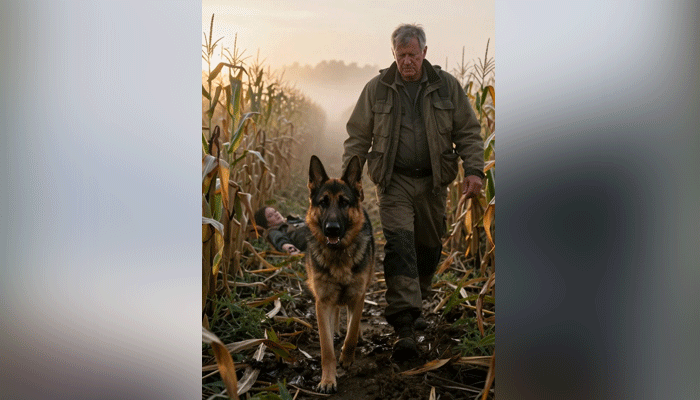
I moved to that farm because silence was easier than people.
After sixteen years in the Navy, most of them spent in places I still do not name out loud, I bought forty acres outside Millbrook, Kansas, and told everyone I wanted peace. That was partly true. The other part was simpler. I was tired of waking up with my hands clenched, tired of scanning rooftops in grocery store parking lots, tired of hearing helicopters in dreams that had no sky.
My name is Jack Callahan. My only steady company was Knox, a ninety-pound German Shepherd with one torn ear, a bad habit of judging strangers, and better instincts than any man I ever served with.
Every morning before sunrise, Knox and I ran the dirt road along the cornfields. Same pace. Same route. Same empty horizon. It was the closest thing I had to prayer.
Then one September morning, Knox stopped.
Not slowed.
Stopped.
His body went rigid beside a break in the corn. His nose lifted. A low sound came from his chest, not a bark, not a warning exactly, but the kind of sound that makes a man listen before he thinks.
I stepped off the road.
Twenty yards into the rows, I saw blood on a corn leaf.
Thirty yards in, I found her.
She was lying on her side in the mud, barefoot, bruised, and barely breathing. Her blouse was torn. One wrist was zip-tied. Her face was swollen so badly I could not guess her age at first. But her eyes opened when Knox pressed his nose near her hand.
She whispered two words.
“Don’t trust…”
Then she passed out.
I called 911, kept pressure on the wound above her ribs, and watched the road like the people who left her there might come back to finish the job. At the hospital, a nurse asked if I knew her. I said no.
An hour later, two men in suits arrived before her name had even appeared in the system.
That was my first problem.
The second was the police officer standing outside her room. He kept asking how much she had said, whether she had named anyone, whether she had anything on her when I found her.
He was not worried about a victim.
He was worried about evidence.
By noon, her identity came back.
Claire Whitmore. Thirty-eight. Majority shareholder of Whitmore BioSystems, one of the largest private medical technology companies in the country. The kind of woman who usually appeared on magazine covers, not half-dead in a cornfield.
When I stepped into her room, she grabbed my wrist with what little strength she had left.
“My sister,” she whispered. “My CFO. They know I’m alive.”
Then the officer outside her door answered a phone, looked through the glass at us, and quietly reached for his sidearm.
That was when I realized the hospital was not protecting Claire Whitmore.
It was holding her in place.
I did something that would have gotten me court-martialed in another life.
I took the patient.
Not because I wanted to play hero. Not because I trusted myself more than the police. I did it because Claire was shaking in that hospital bed, terrified of people who already knew where she was, and the officer outside her door had the face of a man waiting for permission.
I pulled the fire alarm near the service hallway.
Chaos does not create safety, but it creates seconds. Seconds were enough.
A nurse named Maria, who had seen the officer’s behavior too, helped me get Claire into a wheelchair and out through the delivery entrance. Knox waited in the truck bed, ears high, watching every moving shadow like it owed him money.
I drove back roads to my farm.
Claire drifted in and out beside me. Once, she opened her eyes and said, “You shouldn’t have done this.”
I kept both hands on the wheel. “I’ve heard that before.”
At the farm, I cleaned her cuts, changed the hospital bandages, and locked down the house the way I had locked down safe rooms overseas. Curtains closed. Lights off. Shotgun by the pantry door. Knox at the front window.
By evening, Claire could sit up.
Whitmore BioSystems had developed a portable blood filtration device that could keep trauma patients alive long enough to reach surgery. Battlefield medics wanted it. Rural hospitals wanted it. Disaster teams wanted it. But Claire had discovered the company’s chief financial officer, Martin Sloane, had been hiding fatal prototype failures from federal reviewers.
When she tried to delay the launch, her younger sister, Audrey, sided with Sloane.
“She said I was destroying our father’s legacy,” Claire said. “But it was never about legacy. It was stock value. Licensing. Control.”
The night before I found her, Claire had gone to meet a board member who claimed he would help expose the fraud. Instead, she was forced into a vehicle, beaten, and dumped in the field when they believed she was dead.
I called the only federal agent I still trusted.
His name was Ben Harrow, FBI, former Navy intelligence liaison, and one of the few men alive who knew when I said “problem,” I did not mean paperwork.
He arrived after midnight in an unmarked SUV.
Claire handed him the password to a secure account containing copied internal reports, altered safety data, and a recorded call between Audrey and Sloane.
Ben listened to three minutes of audio and looked at me.
“This is bigger than attempted murder.”
I glanced toward the dark windows.
Outside, Knox stood up.
A second later, headlights cut across my barn.
Claire whispered, “They found me.”
I checked the magazine in my pistol and felt the old war crawl back into my hands.
This time, it had come to my front porch.
There were three vehicles.
That told me everything I needed to know. One car might have been a warning. Two could have been intimidation. Three meant they expected resistance and had planned for it.
Ben killed the lights inside the house. Claire stayed low behind the kitchen island, wrapped in one of my old field jackets, her face pale but steady. She had been beaten, betrayed, and hunted, but she was not broken. I had seen that look before in wounded people who had made a private decision not to die.
Knox moved beside the front door without a sound.
Men spread across the yard.
Not professionals. Hired muscle. Confident enough to be dangerous, careless enough to make mistakes.
One shouted my name like we were neighbors settling a fence dispute.
“Callahan, send her out. This doesn’t involve you.”
I almost laughed.
Men like that always believe decency is a temporary inconvenience. They think everyone has a price because they do.
Ben whispered, “Federal backup is twelve minutes out.”
The first man tried the porch.
Knox hit the door before I opened it.
He launched into the dark with a sound that froze the entire yard. The man went down screaming, not dead, not even badly injured, but suddenly educated. I moved next, using the porch rail for cover, dropping the second man’s weapon hand with one shot into the dirt beside him and enough authority in my voice to make him rethink his career.
Ben took the rear angle.
The third man ran toward the barn, probably looking for a way around us. He did not know the land. I did. I cut him off near the equipment shed and put him face-first into gravel before he got both hands out of his jacket.
Then a fourth figure stepped from the passenger side of the last vehicle.
Audrey Whitmore.
Claire’s sister looked nothing like a woman ordering murder. That was the frightening part. She wore a tailored coat, expensive shoes, and the calm expression of someone who had spent years signing papers that hurt people she never had to meet.
Claire stepped onto the porch before I could stop her.
Audrey stared at her like she was seeing a ghost.
“You were supposed to let it go,” Audrey said.
Claire gripped the porch post. “You left me in a field.”
“You were going to destroy everything.”
“No,” Claire said. “I was trying to stop us from selling broken hope to dying people.”
Audrey’s face cracked then. Not with guilt. With rage.
She reached into her coat.
Ben drew first.
“Don’t.”
For once, Audrey listened.
The FBI arrived minutes later. Martin Sloane was arrested at a private airfield before dawn with two passports, cash, and a laptop full of deleted files that were not nearly as deleted as he believed. The police officer from the hospital was taken into custody that afternoon. Audrey was charged with conspiracy, attempted murder, evidence tampering, and enough financial crimes to keep lawyers busy for years.
Claire spent six weeks recovering at my farm.
At first, she stayed because it was safe. Then she stayed because the quiet helped. We walked the fence line when she was strong enough. Knox never left her side. He slept outside her door, followed her to the porch, and growled at every delivery truck like corporate assassins often used UPS.
Somewhere in those weeks, the farm changed.
Or maybe I did.
Claire talked about betrayal like a woman trying to understand how blood could turn into business. I talked about war in pieces, never all at once, but more than I had told anyone in years. She did not try to fix me. I did not try to fix her. We just kept showing up in the same room until silence stopped feeling like hiding.
When the case finally became public, Whitmore BioSystems lost half its board, gained federal oversight, and delayed the device until independent testing could prove it safe. Claire returned as interim chair, not to save the company’s image, but to save whatever was still worth saving inside it.
The morning she left, Knox refused to get out of her SUV.
She looked at me from behind the wheel. “Is he always this loyal?”
I leaned against the gate. “Only when he’s right.”
She smiled for the first time without pain in it.
Months later, Claire came back to the farm for good on weekends, then longer, then without pretending it was temporary. The newspapers called her survival a corporate scandal, a family betrayal, a federal case. They never understood the real story.
The real story was a dog stopping in a cornfield.
A woman refusing to die.
A tired man remembering that peace does not mean avoiding every fight.
Sometimes peace is knowing exactly which fight is still worth standing for.
I used to think I had left the battlefield behind. But that morning taught me something I should have known all along: darkness does not only live overseas. It can wear a suit, sit in a boardroom, smile across a hospital bed, and call murder a business decision.
But light can be ordinary too.
It can be muddy boots, a barking dog, an unlocked truck, a stranger who refuses to look away, and one wounded person brave enough to tell the truth.
Knox still runs with me at sunrise.
Every time we pass that cornfield, he slows down.
Not because he smells danger.
Because he remembers where we found a life that was not supposed to survive.
And I remember that the smallest act of attention can become the line between a grave and a second chance.
If this story stayed with you, comment “Knox,” share it, and follow for more emotional American rescue stories.