My name is Caleb Monroe, and I thought I had already seen every kind of heartbreak the world could put in front of a veteran. I was wrong.
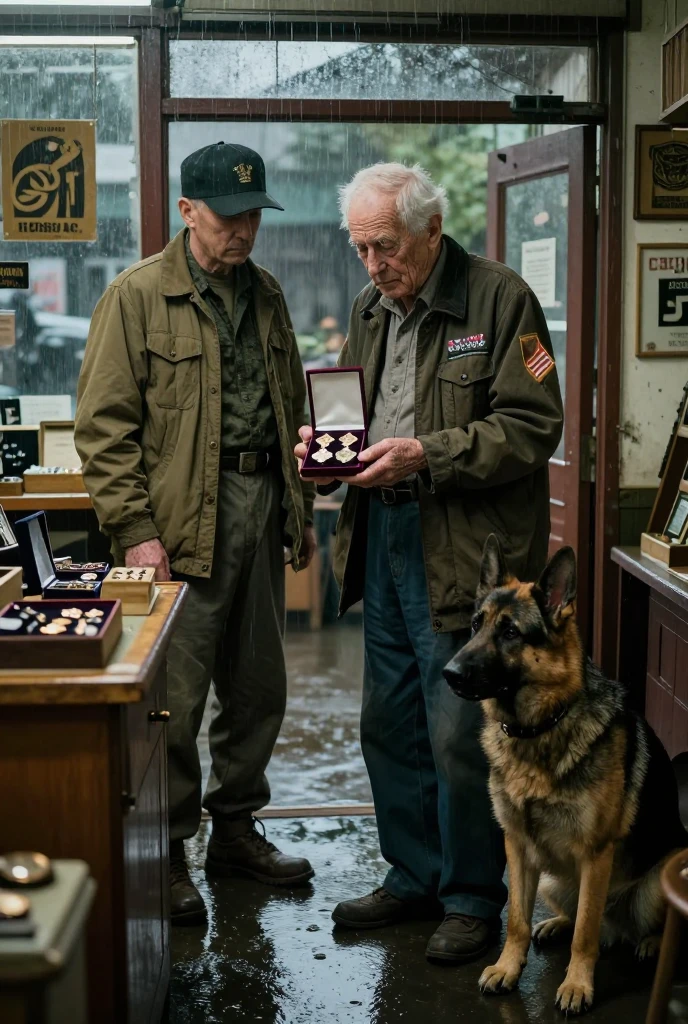
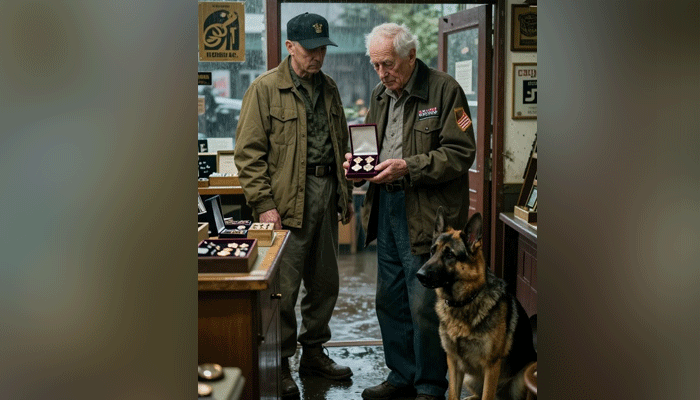
It happened on a rainy Thursday afternoon inside a small pawn shop outside Dayton, Ohio. I had stopped there with my German shepherd, Duke, to pick up an old field watch I had left for repair. I was a former Marine, thirty-six years old, working security jobs and trying to rebuild a life that still felt louder at night than during the day.
Then the bell over the pawn shop door rang.
An old man walked in slowly, one hand gripping a cane, the other holding a small velvet box against his chest. He wore a faded brown coat, polished shoes, and the kind of posture that told me he had once stood inspection, even if age had bent him down.
Duke lifted his head immediately.
The old man’s hands were shaking. Not just from age. From hunger. From fear.
The clerk asked what he wanted to sell.
The old man opened the box.
Inside were military medals, ribbons, unit pins, and a folded photo of a young soldier standing beside a tank decades earlier. The clerk leaned forward, but I stepped closer before he could name a price.
“Sir,” I said gently, “those look important.”
The old man looked embarrassed. “They were. But I can’t eat memories.”
His name was Walter Hayes. He was ninety years old, a Korean War veteran, and he said he needed money for bread, soup, and heart medication. He insisted he had no family nearby, but when he reached for the box, his sleeve pulled back.
I saw bruises around his wrist.
Finger marks.
Duke saw something too. He moved closer to Walter, not aggressive, but protective. The old man’s eyes filled with tears when Duke rested his head against his knee.
I bought the medals from the clerk before the clerk could buy them from Walter. Then I handed the box back.
Walter shook his head. “I can’t take charity.”
“It’s not charity,” I said. “It’s a loan between veterans.”
I drove him home with groceries. That was when the story changed.
His refrigerator was empty. His bills were stacked unopened. His heat was barely working. And on the kitchen table sat legal papers giving control of his house and bank account to a nephew named Eric Hayes.
Walter whispered, “He says I’m too old to know what’s best.”
Then headlights swept across the window.
A truck pulled into the driveway.
Duke stood in front of him and growled.
The man coming up the steps was not here to check on Walter.
He was here to finish taking everything.
Part 2
Eric Hayes opened the front door without knocking.
He was in his forties, well dressed, angry before he even saw me. The kind of man who walked into another person’s home like he owned the air inside it.
“What is this?” Eric snapped. “Who are you?”
Walter lowered his eyes. That told me more than any explanation could.
I stood between them. Duke stayed beside Walter’s chair, watching Eric’s hands.
“My name is Caleb,” I said. “Walter needed groceries.”
Eric laughed. “He needs supervision. He gets confused.”
Walter whispered, “I’m not confused.”
Eric ignored him. He grabbed the legal papers from the table and shoved them into a folder. “You don’t get to bring strangers here, Uncle Walt. We talked about this.”
Duke growled.
Eric froze.
That was when I noticed more details. Walter’s phone had no service. His medication bottles were empty. His checkbook was missing. A retirement award plaque on the wall had been removed, leaving a clean square in the dust.
Eric had not just taken money.
He had taken control.
I asked Walter if he had signed the papers willingly. He looked at Eric, then at me.
“No,” he said. “He told me if I didn’t sign, he’d put me somewhere and sell the house anyway.”
Eric’s face hardened. “You have no idea what you’re interfering with.”
“I know exactly what I’m interfering with,” I said.
I called the police, then Adult Protective Services. Eric tried to leave with the folder, but the clerk from the pawn shop had already posted a photo online of Walter’s medal box, saying an old veteran had nearly sold his honors just to buy food. The post was spreading fast. People were calling the shop, asking his name, asking how to help.
By the time officers arrived, neighbors were standing outside in the rain.
Walter finally spoke clearly.
He told them Eric had taken his bank card, controlled his mail, yelled at him, withheld food, and pushed him when he refused to sign more documents.
Eric denied everything.
Then Duke walked to the hallway closet and barked.
Inside a gym bag, officers found Walter’s missing checkbook, unopened benefit letters, prescription notices, and several of his military keepsakes wrapped for resale.
Eric stopped talking.
Walter sat at the kitchen table with both hands around a cup of soup, staring at the medals I had placed beside him.
“I fought overseas,” he said quietly, “and came home to be afraid in my own kitchen.”
No one knew what to say.
But everyone in that room knew one thing.
Walter Hayes was not going to be alone anymore.
Part 3
The next morning, Walter’s house looked different before anything inside had changed.
There were cars along the curb. Neighbors brought food, blankets, batteries, and tools. A local electrician fixed the heating unit without sending a bill. A nurse from the veterans clinic checked Walter’s medication schedule. The pawn shop clerk came by with tears in her eyes and a handwritten apology for almost buying the medals.
Walter did not know what to do with kindness at first.
He kept saying, “I don’t want to be trouble.”
I told him the truth.
“Sir, trouble already found you. We’re just helping it leave.”
Adult Protective Services opened a case immediately. The bank froze suspicious transfers. A veterans legal group stepped in to challenge the papers Eric had pressured him to sign. Within a week, the court suspended Eric’s access to Walter’s accounts and property. Within a month, investigators found he had drained thousands from Walter’s savings while telling him his benefits had been delayed.
Eric had used shame as a weapon.
He convinced Walter that needing help made him weak. He told him no one would believe him. He made him choose between silence and being locked away. That was the cruelest part. Not the stolen money. Not even the empty refrigerator.
It was the way he made a man who had survived war feel like a burden.
But Walter began to come back.
Slowly.
First, he let volunteers repair the porch steps. Then he agreed to regular grocery deliveries. Then he allowed a neighbor named Mrs. Landry to stop by every morning at nine with coffee and the local paper. Duke and I visited twice a week, sometimes more.
One afternoon, Walter asked me to help him clean the medal box.
We sat at his kitchen table with a soft cloth between us. He told me the story behind each ribbon. Not loudly. Not like a man bragging. Like a man returning names to rooms where silence had taken over.
“This one was for my friend Joseph,” he said, touching a small ribbon. “He didn’t come home.”
Another medal had belonged to a day he refused to describe. He simply held it for a long time, then placed it back with care.
The community raised money, but Walter refused anything beyond what he needed. Food. Medicine. Repairs. A working phone. A safe bank arrangement. He wanted dignity, not pity.
The judge eventually voided the documents Eric had forced him to sign. Eric was charged with elder financial abuse, coercion, and theft. When he appeared in court, he tried to say he had only been “managing things.”
Walter stood with a cane in one hand and my arm under the other.
“No,” he said to the judge. “He was managing my fear.”
That sentence ended the room.
Eric took a plea deal. He was ordered to repay what he stole, barred from contacting Walter, and sentenced to jail time plus probation. It was not perfect justice, but it was enough to let Walter sleep without listening for a truck in the driveway.
Two years passed.
Walter spent his final years in his own home, surrounded by groceries in the pantry, warm light in the windows, and people who knocked before entering. He never sold his medals. On holidays, he wore one small pin on his jacket and told children that courage was not about never needing help.
It was about accepting help before evil convinced you that you did not deserve it.
When Walter passed away at ninety-two, he was in his bedroom, under the quilt Mrs. Landry made for him, with Duke sleeping on the rug nearby. His medals were placed beside him at the funeral, polished and bright.
The church was full.
Veterans came. Neighbors came. The pawn shop clerk came. Even people who only knew him from that first online post came to stand in silence for a man who almost traded his life’s honor for a few cans of soup.
I kept one thing from Walter’s house.
Not a medal.
A note he had written and taped inside the velvet box.
It said: “If you are reading this, remember that old soldiers still feel hunger, fear, pride, and loneliness. Please look closer.”
I still do.
Every time I see an elderly person counting coins at a register, every time I hear someone dismiss an old veteran as confused, every time Duke stops and watches someone too carefully, I remember Walter Hayes.
And I remember that sometimes saving a life does not begin with a siren, a badge, or a rescue team.
Sometimes it begins when one stranger refuses to let another man sell his honor just to survive dinner.
If this story touched you, check on an elderly neighbor today and comment “Respect” for every forgotten veteran.