Part 1: The Silence of the Snow
Silence is a funny thing. Most people think it’s just the absence of noise. But when you’ve spent enough time in places where every single sound can mean the difference between drawing another breath and bleeding out in the dirt, you learn that silence has a weight to it. It has a texture.
I had learned how to move through silence a long time ago.
My name is Mason Cole. I’m thirty-five years old, and until a week ago, I was operating deep inside Iraq and Syria as a US Navy SEAL.
Operation Silent Lantern. That’s what they called it on the official briefings. For a full year, it was my entire world. It was night extractions in the pitch black. It was lying completely still on a rooftop for forty-eight hours, feeling the desert sun bake the moisture out of my bones while I watched a target through a scope. It was pulling terrified civilians out of crumbling concrete buildings that smelled of cordite and copper, operations that would never make the evening news, losses that would never be etched into public memorials.
I did my job. I did it with the kind of ruthless, mechanical precision they train into you at Coronado. But precision has a price tag. And eventually, the bill comes due.
When I finally rotated back to the States, my commander didn’t throw a parade. He didn’t shake my hand and offer me a medal. He called me into his sparse, fluorescent-lit office, sat back in his chair, and just looked at me for a long, quiet minute.
He saw right through the uniform. He saw through the posture.
“You’re holding it together on discipline alone, Cole,” he said, his voice flat, stripped of any military formality. “That works in a firefight. But if you keep doing it here, it’s going to hollow you out completely.”
I didn’t say a word. I just stared at the wall behind his head.
“Six months of leave,” he continued, signing a piece of paper and sliding it across the desk. “I approved it personally. You’re not going to travel. You’re not going to go drink yourself blind in a bar. You’re going to go somewhere quiet, and you’re going to learn how to breathe like an ordinary man again before I send you back out. I don’t need an operator who can perform flawlessly while his soul is bleeding out inside his chest.”
I accepted the orders without argument. I always did.
Now, a week later, I was sitting behind the wheel of my heavy-duty pickup truck, driving north through the Okanogan-Wenatchee forest in Washington state. The heater was blasting, but I still felt the chill in my bones.
I was heading to a small, isolated cabin and a patch of overgrown farmland I owned. I hadn’t truly lived there in years. It was just a place on a map, a piece of land that waited patiently, indifferent to the wars I fought and the life I had lost.
Because I had lost my life. Not overseas. Here. At home.
Six years ago, I married Belle Hart. She was my high school sweetheart. Back then, she was everything bright and warm in the world. She had this honey-blonde hair and a smile that just naturally drew people in. She worked in interior design; she made things beautiful. She loved gathering people together, hosting dinners, building a life that you could look at and say, Yes, this is stable. This is good.
Before I deployed the first time, she held my hands in our kitchen and told me she understood my career. She told me love would be enough to bridge the gap.
It wasn’t.
It never is.
On our first anniversary, I was completely off the grid, buried deep in a classified op in the Middle East. I couldn’t send a flower. I couldn’t send a text. When I finally got access to a sat-phone weeks later, I called her.
Her voice wasn’t warm anymore. It was practiced. It was cold.
She told me she was tired of being alone. She was tired of spending holidays fixing broken screen doors by herself, tired of sleeping on a mattress beside a terrifying absence.
Then she dropped the hammer. She told me she had met someone else. Trent Caldwell. A wealthy construction contractor. A guy who was always in town, always at the dinner parties, always safe.
I stood there in the desert dirt, thousands of miles away, gripping the plastic phone, and I listened in total silence. I didn’t beg her to reconsider. I didn’t scream. The mission came first. It always had to. Even as my marriage shattered through the static of that long-distance connection, I was actively protecting families I would never meet.
I just couldn’t save my own.
I tightened my grip on the steering wheel, forcing the memory away.
Outside the windshield, the world was turning violently white. The storm had come out of nowhere, a massive blizzard sweeping down from the mountains. The road narrowed as the snow thickened, blowing sideways in sharp, aggressive gusts of wind that rocked my heavy truck.
I eased my speed down to a crawl. My senses, permanently wired for threat detection, were suddenly on high alert. The visibility was dropping to zero.
That was when I saw it.
Through the churning whiteout, a figure emerged. Barely a shadow at first, moving agonizingly slowly along the shoulder of the freezing road.
I squinted, leaning forward. My heart gave a heavy, uncomfortable thump in my chest.
It was a young woman.
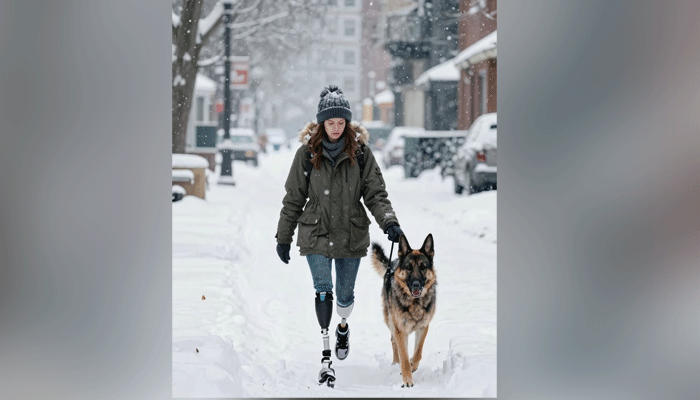
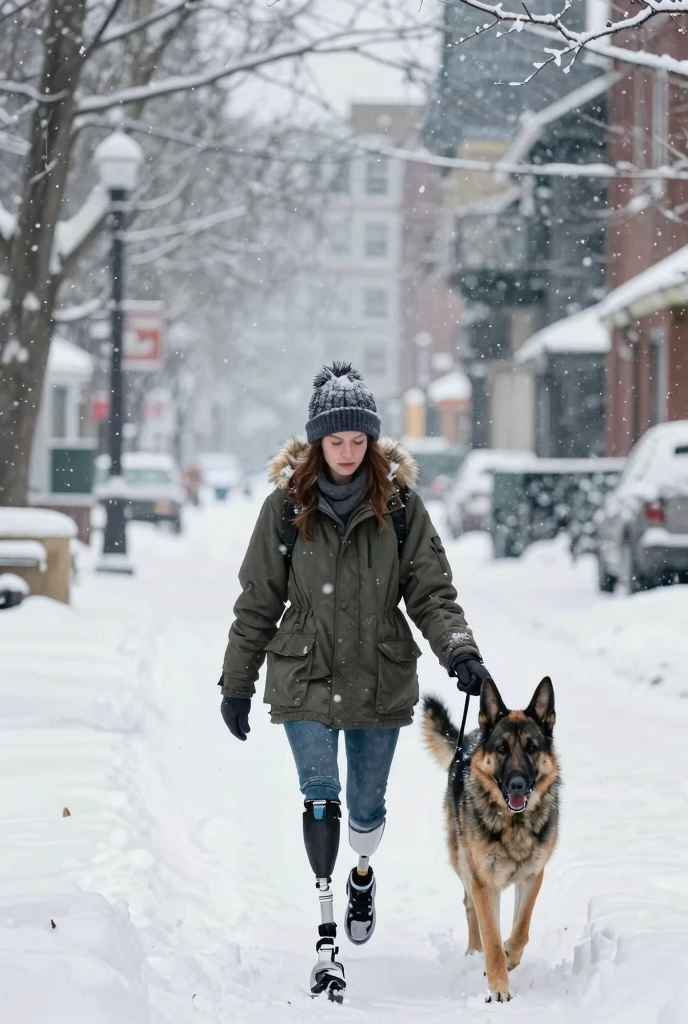
She was leaning heavily on a pair of metal crutches. With every step, I could see the intense, deliberate effort it took her to keep her balance. As I got closer, the headlights washed over her, and my stomach tightened. One of her legs was gone. Beneath her soaked winter coat, the metallic glint of a prosthetic caught the light, completely packed with ice and snow.
And she wasn’t alone.
Walking tight against her side, practically acting as a living shield against the wind, was a massive German Shepherd. Its thick black-and-tan coat was heavily dusted with snow, but its head was up, eyes scanning the terrifying environment.
I brought the truck to a controlled stop, the tires crushing the fresh powder.
I threw the truck into park and rolled the passenger window down just a fraction. The wind screamed into the cab, biting my face with ice crystals.
She was maybe in her late twenties. She was slim, almost fragile, but her entire body was locked in tense exhaustion. Dark auburn hair clung wetly to her pale cheeks beneath a soaked knit cap. Her lips were legitimately tinged blue. Hypothermia wasn’t far away.
But it was her eyes that struck me. They weren’t the eyes of a victim. They were sharp, wary, highly intelligent, and filled with a profound, aggressive distrust. She gripped the dog’s leash with a white-knuckled fist, as if it were the only thing keeping her tethered to the earth.
The German Shepherd—a powerful, broad-chested animal of about four years—immediately shifted. He placed himself subtly between my truck and the woman. His muscles coiled, but he didn’t bark. He was calm. This wasn’t a stray. This was a highly trained guardian.
I pushed the door open and stepped out into the storm. The wind howled, trying to push me back.
I didn’t rush her. I kept my hands visible. I didn’t put on a fake, overly friendly smile. People in pain can smell a lie from a mile away.
“I’m not stopping traffic,” I said. I kept my voice deep, even, and steady. It was the voice I used in war zones when the panic started to set in. “There’s no town for miles in that direction.”
She stopped. She leaned hard on her crutches, her chest heaving. She glanced at my dark winter jacket, her sharp eyes taking in my posture, the military bearing I couldn’t hide if I tried. Experience had clearly taught her to be terrified of strangers.
The wind shrieked between us. The dog watched my hands.
I met her gaze, holding it firmly.
“Ride with me,” I said quietly. Not a request, but a lifeline. “No one should face a night like this alone.”
She hesitated. I could see her breath coming in short, shallow bursts, visible in the freezing air. I saw the internal war flashing across her face. Pride versus survival. She had learned the hard way not to trust, not to rely on anyone.
But the blizzard didn’t care about her pride. And out here, on one leg, endurance was a losing battle. She was going to die on this road.
Slowly, painfully, she gave a single nod.
The moment she did, the massive dog relaxed his posture just a fraction. He sensed her acceptance.
I walked over to her. I didn’t grab her or treat her like she was broken. I opened the passenger door and offered my arm. She took it, her grip surprisingly strong despite the violent shivering, and hoisted herself into the heated cab.
I opened the rear door for the Shepherd. He didn’t hesitate. He hopped up into the backseat and immediately positioned himself right behind her headrest, his amber eyes locked on me.
I shut the doors, walked around the front of the truck, and climbed behind the wheel.
The heater hummed, blasting warm air across the dashboard.
I put the truck in drive and pulled slowly back onto the treacherous road. I didn’t ask her name. I didn’t ask what the hell she was doing out here. I just drove.
Behind us, the heavy snowfall immediately swallowed our tire tracks, erasing the path she had walked.
For the first time all night, neither of us was moving forward alone.
Part 2: The Fire and the Frozen
The heater in my heavy-duty Ford hummed with a coarse, mechanical rattle. Usually, it was just background noise, a minor annoyance I tuned out on long drives. But right now, with the absolute, suffocating silence inside the cab, that rattling fan sounded like a jet turbine.
Outside the windshield, the Okanogan-Wenatchee forest was being swallowed alive.
The blizzard was intensifying, turning the world into a violent, swirling tunnel of white. The snow piled up against my wipers faster than the heavy rubber blades could push it away. I kept my speed locked at a agonizingly slow fifteen miles per hour, my hands gripped loosely at the ten-and-two positions on the leather steering wheel.
I was trained for high-stress environments. I could navigate a Black Hawk through a sandstorm by instruments alone. But right now, the tension inside my truck was thicker than any combat zone I had ever operated in.
I glanced out of the corner of my eye.
She sat completely rigid in the passenger seat. Her hands were folded in her lap, fingers locked together so tightly that her knuckles were entirely white. The cold had seeped deep into her bones, and her entire body vibrated with a microscopic, uncontrollable tremor.
Up close, bathed in the faint green glow of the dashboard lights, she looked even younger. Twenty-seven, maybe twenty-eight at most.
But her face carried a specific kind of exhaustion that had absolutely nothing to do with age. It was the deep, hollowed-out fatigue of someone who had been fighting a losing battle for a very long time.
Water dripped from her soaked auburn hair, pooling darkly on the heavy canvas shoulders of her winter coat. Beneath the hem of the coat, the metallic struts of her prosthetic leg caught the faint light. It was packed with crushed ice and road salt.
She didn’t look at me. She just stared straight ahead into the blinding snow, her jaw locked.
Behind her, taking up the entire backseat, the German Shepherd lay across the leather. He was a massive animal, easily ninety pounds of pure muscle and instinct.
I glanced at him in the rearview mirror. His thick coat was steaming slightly as the ice melted off his fur, filling the cab with the heavy, unmistakable scent of wet dog and cold pine.
He wasn’t sleeping. His amber eyes were wide open, locked entirely on the back of my head. He wasn’t growling, but he was actively assessing me.
He was a guardian. And until I proved otherwise, I was still a potential threat.
“Smart dog,” I said. My voice sounded unnaturally loud in the confined space.
She flinched slightly at the sudden sound, pulling her shoulders up toward her ears. She swallowed hard, her throat visibly working.
“His name is Atlas,” she whispered. Her voice was brittle, cracking at the edges like thin ice.
“Atlas,” I repeated quietly, nodding my head toward the mirror. “Fits him. He looks like he carries the world for you.”
She didn’t respond. The silence rushed back in, heavy and defensive.
We drove for another solid mile. The tires crunched rhythmically over the packed snow. Every time the truck slipped slightly on the ice, I felt her tense up, her hand flying instinctively to the grab handle above the door.
I eased off the accelerator, letting the heavy engine do the braking. I needed to calm her down. A panicked passenger is a dangerous variable.
“I’m Mason,” I offered, keeping my eyes fixed on the treacherous road. “Mason Cole.”
She took a slow, rattling breath. “Ellie. Ellie Renn.”
“Well, Ellie Renn. You picked one hell of a night to go for a hike.”
I didn’t say it with a smile. I said it completely deadpan. It wasn’t a joke; it was an invitation to explain, an opening if she wanted to take it.
She let out a short, humorless exhale that might have been a laugh under different circumstances. She leaned her head back against the frosted glass of the passenger window, the cold condensation clinging to her pale cheek.
“It’s my birthday,” she said.
The words just hung there in the freezing air, utterly devoid of any joy or celebration. She said it the way someone might announce a medical diagnosis. Flat. Final.
I shot a quick glance at her profile. I didn’t say, I’m sorry. I didn’t offer a hollow, Happy birthday. When you’re broken, platitudes feel like insults. I knew that better than anyone.
I simply nodded, acknowledging the heavy, suffocating weight of her statement.
“I didn’t plan to be out there,” Ellie continued, her voice dropping lower, almost as if she were talking to herself. She traced a slow, meaningless pattern on her frost-covered knee. “I wasn’t just wandering. I’m not crazy.”
“Never thought you were,” I said evenly. “Takes a specific kind of survival instinct to keep walking in this. Most people would have curled up in the ditch and waited for the end.”
She turned her head slightly, her gray-green eyes studying my face for the first time. She was looking for pity. She wouldn’t find any. Pity is useless.
“I was staying with my aunt,” she said, her voice tightening. “Ruth. Ruth Renn.”
When she spoke the name, the temperature in the truck seemed to drop another ten degrees. There was a profound, deeply rooted bitterness there.
“Ruth belongs to this… community,” Ellie explained, choosing her words with extreme caution. “A church on the edge of town. But not the kind of church that brings you casseroles when you’re sick. The kind that believes suffering is a direct transaction. A test.”
I tightened my grip on the leather steering wheel. I had seen religious zealotry in the Middle East. I had seen the horrific things people justified in the name of divine righteousness. It disgusted me then, and it disgusted me now.
“They don’t say it outright,” Ellie continued, her eyes fixed blindly on the hypnotic swirl of the snow in the headlights. “They smile and they nod. But everyone in that house knows exactly what they think. They look at me, they look at this…”
She gestured sharply down toward the prosthetic leg strapped to her thigh.
“…and they see an unfinished person. They see someone being punished. They think that being physically broken means your soul is fractured, too. That you remind them of things they absolutely refuse to face.”
She shifted in the seat, wincing slightly as the rigid plastic socket of her prosthetic dug into her residual limb. I could tell she was in immense physical pain, but she was forcing it down, compartmentalizing it.
In the backseat, Atlas whined low in his chest. He sensed the shift in her breathing. He pushed his massive black nose past the center console, pressing it firmly against Ellie’s trembling shoulder.
She reached back without looking, her freezing fingers tangling into his thick, warm fur. It grounded her. I could visibly see her heart rate begin to slow down just from the contact.
“So what happened tonight?” I asked, my voice barely above a whisper, keeping the space safe for her to speak.
“An argument,” she said bitterly. “It always starts over something incredibly small. I told her I was applying for some remote design work. Freelance illustration. Logo layouts. Work I could do sitting at a desk. Work I could do quietly, without having to ask her or anyone else for a single dime.”
“Sounds like a solid plan,” I noted.
“Not to Ruth,” Ellie snapped, a flash of pure anger finally breaking through her exhaustion. “Ruth sat there in her perfect kitchen, drinking her perfect tea, and told me that my ambition was a sin of pride. She told me that accepting my ‘condition’ with humility meant knowing my place in the world. She told me I was refusing God’s lesson by trying to pretend I wasn’t… damaged.”
My jaw locked. The muscles in my neck tightened like coiled steel cables. I felt a familiar, icy rage blooming in my chest.
It was the same protective rage I felt when I saw warlords starving their own people. The abuse of power. The weaponization of vulnerability.
“I told her I didn’t need to be punished to be faithful,” Ellie whispered, the fight suddenly draining out of her, leaving her hollow again. “I told her I just wanted to work. To live.”
“And?”
“And she walked to the front door, opened it into the blizzard, and told me to leave.” Ellie’s voice finally cracked, a single tear escaping her eye and freezing almost instantly on her cheek. “She said I could come back when I understood gratitude.”
The sheer cruelty of it hung in the air, heavy and toxic.
“I didn’t have anywhere else to go,” she admitted, her voice entirely broken now. “My plan was desperate. It was stupid. There’s an old, abandoned stone church about three miles down the road. I thought… I thought if I could just make it to the stone walls, maybe Atlas and I could huddle in the corner and wait out the storm. Maybe call a shelter tomorrow.”
She let out a ragged sob, immediately choking it back down.
“But the storm came down so fast. I have no money. No car. My phone died an hour before you drove past. I was just… I was just going to keep walking until I couldn’t.”
I stared through the windshield. The snow was a blinding, impenetrable wall.
“It sounds worse when I say it out loud,” she added softly, a deep shame creeping into her tone.
“It sounds exactly like what it is,” I said, my voice hard and uncompromising. “It sounds like a coward pushing their own cruelty onto faith to avoid taking responsibility for being a terrible human being.”
Ellie turned her head, staring at me in absolute shock. “Really?”
I kept my eyes on the road. “I’ve spent a lot of time around monsters, Ellie. I’ve fought them in deserts and I’ve fought them in cities. Sometimes they wear tactical gear, and sometimes they wear conservative dresses and quote scripture. Cruelty is cruelty. Don’t you ever absorb her shame. It belongs to her, not you.”
Atlas shifted in the back, letting out a long, heavy sigh, resting his chin on the center console near my elbow.
Trust, earned by degrees.
“I didn’t want help out there,” Ellie confessed after a long, stretching silence. “I didn’t want to need anyone.”
“Needing help doesn’t make you weak,” I replied automatically. It was a truth I knew objectively, even if I was failing terribly at applying it to my own shattered life.
She gave a short, cynical laugh. “That highly depends on who you ask.”
“Well,” I said, hitting the turn signal as my private dirt road finally appeared through the whiteout. “You’re asking me.”
The truck lurched as we turned off the paved highway and onto the deeply rutted, unplowed dirt road that led to my property. The heavy tires dug deep into the powder, the four-wheel-drive system grinding in protest.
The pine trees closed in tight around us, heavy branches sagging under the weight of the snow, creating a dark, claustrophobic tunnel.
In the distance, about a quarter-mile through the dense timber, a faint, solitary yellow light flickered. The porch light of my cabin.
The storm was still raging above the tree line, but down here in the thick woods, the wind had finally softened, its violent shrieks muffled by the ancient timber.
I saw Ellie’s shoulders slump slightly as the cabin light came into view. A massive, undeniable wave of relief washed over her face before she quickly tried to hide it behind her mask of stoicism.
“I won’t stay long,” she said rapidly, almost defensively, the panic returning to her voice. “Just until the storm breaks and the plows come through. I swear I won’t be a burden.”
I didn’t answer right away. I eased the truck up the long drive, navigating the hidden dips and curves from pure memory.
I brought the Ford to a halt just inches from the snow-covered wooden porch. I put the truck in park, killed the engine, and pulled the keys from the ignition.
The sudden silence was deafening. The heater died, leaving only the soft, muffled ticking of the cooling engine block and the whisper of snow against the glass.
I turned my head and looked at her. Really looked at her.
“We’ll get you warm first,” I said quietly, leaving absolutely no room for argument. “Then we’ll talk about tomorrow. Right now, your only job is to survive the night.”
I pushed my door open and stepped out into the knee-deep snow.
The cold was vicious, an immediate physical assault that bit through my thick denim jeans and military-issue boots. I slammed my door and waded around the front grille of the truck.
I opened the passenger door. Ellie was struggling. Her freezing hands fumbled clumsily with the metal crutches, trying to wedge them out the door before she moved her body. Her prosthetic leg was stiff, the joints locked up from the extreme temperature.
“Let me,” I said, stepping directly into her personal space.
She flinched, her eyes wide, but she didn’t push me away.
I took the freezing metal crutches from her shaking hands and leaned them carefully against the truck. Then, without asking for permission, I reached in, gripped her firmly by the waist, and lifted her down.
She gasped at the sudden movement, her hands flying to my shoulders to steady herself. For a split second, I felt how alarmingly light she was. She was wasting away, burning calories just trying to stay warm.
I set her down gently on her one good leg, keeping my hands on her hips until I was absolutely sure she had her balance.
“I’ve got you,” I murmured.
I handed her the crutches. She situated them under her arms, her breath coming in ragged, painful gasps.
I opened the rear door. Atlas bounded out, his massive paws hitting the deep snow with a soft thump. He didn’t run off to explore. He instantly circled Ellie, pressing his heavy, warm flank tightly against her good leg, acting as a living, breathing brace.
“Go to the door,” I commanded gently.
She dragged herself up the three wooden steps of the porch. It was an agonizing process to watch. Every movement required immense, calculated effort.
I grabbed her soaked canvas duffel bag from the floorboard of the truck—it was shockingly light, holding almost nothing—and followed her up the steps.
I unlocked the heavy oak door and pushed it open.
The cabin was freezing. It was the kind of deep, hollow cold that settles into the very marrow of a house when it’s been left empty for too long.
I flipped the switch by the door. A single, tired amber lamp flickered to life in the corner, casting long, stretching shadows across the room.
The space was aggressively functional. I hadn’t decorated. I hadn’t made it a home. There was a scarred wooden dining table in the center, a worn leather couch pushed flush against the far wall, and a massive river-stone fireplace that looked like a black, empty cavern.
Ellie hesitated in the doorway, the snow blowing in past her.
Up close, in the dim light, the cabin felt painfully intimate. I could see the severe discomfort rolling off of her. She was used to hiding in the corners of borrowed rooms, making herself as small and invisible as possible to avoid angering her hosts.
Standing in the center of my stark, empty living room, balancing precariously on one leg and two metal poles, she looked completely exposed.
I didn’t try to make small talk. Words were useless right now. Action was required.
I moved past her, taking her heavy, dripping coat off her shoulders. I hung it on a wooden peg near the fireplace.
“Sit on the couch,” I said. It wasn’t an order, but it held the authority of one.
She hobbled over to the worn leather and collapsed into it, her crutches clattering loudly against the hardwood floor. Atlas immediately jumped up beside her, curling his massive body into a tight ball against her hip.
I knelt on the hearth. I grabbed several pieces of dry kindling and arranged them with practiced efficiency. I struck a long match against the stone and touched the flame to the dry paper underneath.
The fire caught immediately. It snapped and cracked, the sharp sound echoing off the timber walls.
I fed larger split logs into the flames, building a pyramid of heat. Within minutes, the fire was roaring, casting a brilliant, dancing orange glow across the room. The smell of burning pine sap filled the stale air, pushing back the scent of damp dust and isolation.
I stood up and walked to the small kitchenette. I filled an old tin kettle with water and set it on the gas stove, twisting the knob until the blue ring of fire flared to life.
I opened a cedar chest near the wall and pulled out a thick, heavy wool blanket—military surplus, scratchy but incredibly warm.
I walked over to the couch and draped the heavy wool carefully over Ellie’s violently shivering shoulders. I handed her a clean towel to dry her dripping hair.
She pulled the blanket tight around her neck, burying her pale face in the dark wool.
“Thank you,” she whispered, her teeth still chattering uncontrollably.
I didn’t reply. I went back to the stove, poured the boiling water into a thick ceramic mug, dropped in a cheap teabag, and brought it over to her.
She wrapped both of her frozen hands around the hot ceramic, letting the heat seep into her pale, bloodless fingers. The violent shaking in her chest began to slow, turning into a subtle, rhythmic tremble.
I pulled a wooden chair from the dining table and sat backward on it, crossing my arms over the backrest. I was close enough to share the radiating heat of the fireplace, but far enough away that I wasn’t crowding her space.
I just watched the flames. I let the silence stretch out, giving her time to thaw.
Twenty minutes passed. The ice on the windows began to melt. Atlas fell into a deep, snoring sleep, completely exhausted from his guard duties.
Finally, Ellie lowered the mug from her face. Some color had returned to her cheeks.
“I haven’t told many people about this,” she said quietly. She wasn’t looking at me. She was staring deep into the heart of the roaring fire, mesmerized by the glowing embers. “Not because it’s a profound secret. Just because… it feels too heavy to hand to someone. Most people don’t know how to hold it.”
I leaned my chin on my crossed arms. “I’m used to heavy things, Ellie. Go ahead.”
She took a long, shuddering breath, fortifying herself against the memories.
“It was a gas explosion,” she said, her voice dropping to a hypnotic, detached murmur. “In the apartment building where we lived in Seattle. Five years ago.”
I closed my eyes briefly. Jesus.
“My parents were just… ordinary,” she continued, a sad, distant smile touching the corners of her mouth. “My dad worked maintenance for the city parks department. My mom was a night nurse at a children’s clinic. They worked so hard. And my little sister, Lily… she was fourteen. She was the loudest, kindest kid you’ve ever met. The kind of girl who brought home injured birds in shoeboxes and cried over roadkill on the highway.”
The smile faded, replaced by a devastating, hollow emptiness.
“It was three in the morning,” Ellie whispered. “We were all asleep. The main gas line in the basement ruptured. The spark came from a faulty boiler.”
She stopped speaking. Her knuckles turned white around the ceramic mug.
I didn’t push her. I just let the crackle of the fire fill the void.
“I just remember waking up under a mountain of concrete and drywall,” she said, her voice devoid of emotion, totally flat. “The air was completely thick with dust and gray smoke. I couldn’t breathe. I couldn’t move. A massive structural beam had come down across my lower body.”
She looked down at her prosthetic leg, her eyes dead and vacant.
“I remember screaming for my dad,” she choked out. “I screamed until my vocal cords physically tore. I screamed until I was choking on my own blood. Rescue teams didn’t dig me out for nine hours.”
A single tear cut a clean line down her dirty cheek.
“The doctors were incredibly kind,” she said bitterly. “But they were honest. The crush syndrome was too severe. My left leg was dead tissue. They had to amputate above the knee to save my life.”
She lifted her head, turning her tortured gaze directly onto me.
“My family didn’t make it out,” she said softly, the absolute finality of the words hanging in the air like an executioner’s axe. “None of them. Just me.”
I stared back at her. The silence in the cabin was suddenly suffocating.
Survivor’s guilt isn’t a loud, dramatic thing. It doesn’t scream. It’s a quiet, cancerous rot. It shows up in the middle of the night when you’re staring at the ceiling. It shows up on holidays. It shows up when you look in the mirror and ask the universe, Why me? Why did I get to walk out of the rubble when better people died?
I knew that guilt intimately. I had carried it in a rucksack across three continents.
I didn’t offer her a platitude. I didn’t tell her it was part of God’s plan. If I had, I think she would have walked right back out into the blizzard.
“I’m sorry you had to carry that rubble by yourself,” I said quietly.
Her breath hitched. She pressed a hand hard against her mouth, trying to stifle the sob that ripped through her chest.
I looked away, giving her the dignity of her grief. I stared into the fire, watching the flames consume the wood, turning something solid into ash.
“I was married once,” I said suddenly.
The words bypassed my brain entirely. I hadn’t spoken about Belle out loud in over a year. But the truth demanded a trade. She had bled her soul on my floor; I owed her a piece of mine.
Ellie wiped her eyes, sniffing quietly, and looked up at me.
“High school sweetheart,” I continued, my voice rough, like rusted metal grinding together. “Belle. We were young. We thought that just loving each other hard enough would magically solve all the logistics of life.”
I didn’t soften the reality. I didn’t paint myself as the flawless victim.
“I became a SEAL,” I explained. “I was gone more than I was home. I missed anniversaries. I missed birthdays. I missed Tuesday nights on the couch. I was constantly calling her through satellite static from across oceans, telling her I’d be home soon, knowing it was a lie.”
I rubbed a hand aggressively over my short-cropped beard.
“I was out there, pulling terrified strangers out of war zones,” I said, the bitter irony choking me. “I was a highly trained protector. But protecting strangers meant I was neglecting the one person who was supposed to be my home. I kept thinking I could fix it later. I treated our marriage like a paused video game. Turns out, some people don’t want to live their lives on pause.”
“She left?” Ellie asked softly.
“She found someone who was present,” I answered flatly. “Someone safe. Someone who didn’t come home smelling like gunpowder and carrying nightmares.”
We just sat there. Two fundamentally broken strangers, stripped completely raw, staring at each other across the flickering firelight.
The wind howled outside, battering the thick log walls, but inside, the air was warm. The space between us, which had been thick with tension and fear an hour ago, was suddenly completely devoid of walls.
I looked up at the old analog clock ticking above the mantle. It was almost midnight.
I stood up abruptly, the wooden legs of my chair scraping loudly against the floor.
“Wait here,” I commanded.
I walked past her into the small, cramped pantry off the kitchen. I flipped on the bare bulb. The shelves were practically empty. I had only bought the barest of essentials when I arrived two days ago.
A box of instant pancake mix. A small paper bag of white sugar. A jar of instant coffee. A stick of butter wrapped in wax paper.
It was pathetic.
I grabbed a metal mixing bowl, dumped a massive amount of pancake mix into it, added water and sugar, and whisked it violently with a fork until it turned into a thick, gloopy paste. I greased a cast-iron skillet with the butter, dumped the batter in, and shoved it into the gas oven.
While it baked, I rummaged desperately through the disorganized junk drawer near the sink. Batteries, zip-ties, a broken flashlight.
At the very back, buried under a pile of rusted keys, I found it. A single, cheap birthday candle. It was crushed in the middle, bent at an awkward forty-five-degree angle, the wick slightly frayed.
Twenty minutes later, I pulled the skillet out. The “cake” was an absolute disaster. It was burnt completely black around the edges, sunken violently in the middle, and smelled faintly of scorched iron.
I didn’t care.
I slid the ruined pancake onto a ceramic plate. I jammed the bent, broken candle directly into the sunken center. I grabbed a match, struck it on my boot, and lit the tiny wick.
The small flame flickered, struggling to stay alive in the drafty kitchen.
I walked slowly out of the kitchen, carrying the plate in both hands like it was a live explosive.
Ellie turned her head. Her gray-green eyes widened in absolute shock as she saw the plate, the flickering light reflecting off the tears still wet on her cheeks.
I walked over and set the plate down gently on the coffee table right in front of her.
I stood there, suddenly feeling incredibly awkward. I was a 220-pound tier-one operator. I had kicked down doors in Fallujah. I had fast-roped out of helicopters into active firefights.
I was terrified of singing.
I cleared my throat, shifting my weight from foot to foot. I stared at the ceiling.
“Happy birthday to you,” I mumbled, my voice rough, off-key, and horribly gravelly.
Ellie gasped, her hands flying up to cover her mouth.
I forced myself to look down at her, locking eyes with her.
“Happy birthday to you,” I continued, pushing past the brutal awkwardness, singing a little louder. “Happy birthday, dear Ellie…”
My voice cracked right down the middle on her name.
“Happy birthday to you.”
The cabin fell completely silent. The only sound was the popping of the fire and the ragged, sharp intakes of her breath.
Ellie stared at the hideous, burnt pancake. She stared at the pathetic, bent candle. And then, she broke.
She didn’t cry silently this time. She leaned forward, buried her face in her hands, and wept with the absolute, agonizing relief of a prisoner who had just been handed a key. It was a dam breaking. Years of held breath, years of stoic survival, years of being told she was a burden, all of it violently washing away.
Atlas jolted awake. He let out a low whine, his tail thumping once heavily against the leather couch. He stood up, stepped carefully over her legs, and pressed his massive forehead directly against her chest, whining softly, offering his own silent comfort.
I knelt down on the rug opposite her. I didn’t touch her. I just stayed close.
“Make a wish, Ellie,” I said gently, my voice thick. “Close your eyes.”
She lowered her hands. Her face was red, her eyes swollen, but for the first time since I pulled her out of that freezing storm, the crushing tension was gone from her shoulders.
She looked at the candle. She closed her eyes.
I didn’t know what she wished for. I doubt she wished for her leg back, or for miracles. People like us don’t believe in magic. We just wish for an end to the cold. We wish for a night where we don’t have to fight to exist.
She leaned forward and blew out the candle.
A tiny wisp of gray smoke curled upward toward the timber ceiling, thin and fragile, before disappearing completely into the warm air.
I reached forward and pulled the candle out of the ruined cake. I snapped off a piece of the burnt edge and tossed it to Atlas, who caught it in mid-air and swallowed it whole, unbothered by the taste.
We didn’t speak again for a long time.
I sat on the floor with my back against the couch. Ellie leaned against the cushions above me. Atlas draped himself across both of us, a heavy, warm bridge between two isolated islands.
Outside, the Washington blizzard screamed, throwing its fury against the solid oak and stone. It buried the roads, it buried the world, locking us entirely inside this tiny glowing box in the forest.
But inside, the fire held. The cold had been pushed back into the dark.
For the first time in years, the silence didn’t feel like an enemy. It felt like a surrender. It felt like peace.
Part 3: The Ghost in the Wood
The morning arrived with a silence so absolute it felt heavy.
When I opened my eyes, the cabin was bathed in a pale, ethereal light. The frost had etched intricate, fern-like patterns across the windowpanes, turning the glass into a gallery of frozen art.
The blizzard had finally exhausted itself, leaving behind a world that looked rinsed clean, as if the white fury of the night had carried away everything that was old and tattered.
I stayed still for a moment, my body instinctively running through a status check. Muscles tight? Yes. Mind alert? Always. Perimeter secure? I listened to the house.
I heard the rhythmic, heavy thud of Atlas’s tail against the floorboards in the living room. Then, I heard the soft, unmistakable metallic clink of a prosthetic limb being locked into place.
I sat up, the cold air hitting my bare chest. I had slept on a small cot in the back room, giving Ellie the bedroom. It was the first time I had slept more than four hours straight since I touched down in the States.
I pulled on a thermal shirt and my worn work pants, stepping out into the main room.
Ellie was sitting at the wooden dining table. She had already dressed in her damp clothes from the night before, though they looked like they had been hung near the dying embers of the fire to dry.
Atlas was sitting at her feet, his head resting on her knee. He looked up at me as I entered, his ears perking up in a silent greeting.
“You’re up early,” I said, my voice sounding like gravel being ground together.
Ellie looked up. She looked better. The blue tint was gone from her lips, replaced by a faint, natural pink. Her hair was dry now, falling in loose auburn waves over her shoulders.
“I didn’t want to overstay my welcome,” she said quietly. “I thought if I was ready to go when the plows came…”
I walked to the stove and started a fresh pot of coffee. The smell of the roasting beans began to cut through the scent of woodsmoke.
“Plows won’t be up this far for at least twenty-four hours,” I said, not looking back at her. “The county focuses on the main arteries first. We’re at the end of a dead-end logging road. We’re officially on an island, Ellie.”
She slumped slightly in her chair, a mixture of frustration and relief crossing her face.
“Then I’ll stay out of your way,” she promised.
“You aren’t in the way,” I replied, finally turning around. “I have work to do. Wood needs splitting. The generator needs a check-up. You stay here, keep the fire going, and let that leg rest. That’s the deal.”
She opened her mouth to argue, her chin lifting in that defiant way I was starting to recognize, but then she looked at Atlas, who was staring at her with soulful, pleading eyes.
“Fine,” she whispered. “But I’m not a guest. I’ll clean. I’ll cook. I don’t do charity, Mason.”
“Neither do I,” I said. “I do teamwork. There’s a difference.”
I spent the next four hours outside.
The snow was nearly waist-deep in some drifts. I waded through it, my lungs burning with the crisp, oxygen-rich air. I found the woodpile and began to work.
There is a specific kind of therapy in manual labor for a man like me. In the Teams, everything is complex. Tactics, electronics, geopolitics, life-and-death decisions made in milliseconds.
But splitting wood? That’s simple.
You find the grain. You set your feet. You swing the six-pound maul with a clean, fluid arc. Crack. The wood yields. It splits into two clean pieces, exposing the raw, fragrant heart of the cedar.
I worked until my thermal shirt was soaked with sweat despite the sub-zero temperatures. I worked until my shoulders ached and my mind finally went quiet.
Every time I looked toward the cabin, I saw a thin curl of gray smoke rising from the chimney. It felt… strange. For years, I had returned to empty apartments or barracks rooms.
The idea that someone was inside—that the house was alive—tugged at a part of me I thought had died in a desert somewhere between Baghdad and Damascus.
When the sun began to dip behind the jagged peaks of the mountains, I hauled a final load of split logs onto the porch and kicked the snow off my boots.
I walked inside, and the change was immediate.
The cabin didn’t just smell like smoke anymore. It smelled like toasted bread and savory herbs.
Ellie had found the few cans of soup I had in the pantry and had somehow transformed them. She had cleaned the windows, wiped down the scarred wooden table, and organized the messy stack of topographical maps I had left on the counter.
“I found some dried thyme in the back of the cabinet,” she said, stirring a pot on the stove. She didn’t look back, but her voice was steadier than it had been that morning. “I hope you don’t mind. It was a little bland.”
“I don’t mind,” I said, leaning my axe against the doorframe.
I watched her move. She was getting better at navigating the cramped space of the kitchen on her crutches. She had developed a rhythmic, swinging gait, using her good leg as a pivot point.
She was graceful, in a way that was painful to watch. She was a woman who had been forced to reinvent the way she interacted with the physical world, and she had done it with a grit that most able-bodied men I knew didn’t possess.
We ate in a comfortable silence. The soup was the best thing I had tasted in years.
“Where did you learn to cook?” I asked, breaking the quiet.
“My mom,” she said, her eyes softening at the memory. “She used to say that if you could make a good soup, you could survive anything. She called it ‘healing water.’ When I was in the hospital after the… after the accident… I used to close my eyes and try to remember the exact smell of her kitchen. It was the only thing that kept me from giving up.”
I nodded. “Sensory anchors. We use them in survival training. A smell, a song, a specific memory. It keeps your brain from spiraling into the dark.”
She looked at me, her gray-green eyes searching mine. “Is that what you do, Mason? You seem like a man who spends a lot of time making sure he doesn’t spiral.”
I set my spoon down. “I’m an operator, Ellie. My job is to control variables. My environment, my body, my emotions. If you lose control, people die.”
“But you’re not on a mission now,” she pointed out gently.
“I’m always on a mission,” I countered. “The target just keeps changing.”
After dinner, Ellie went into the small storage room at the back of the cabin. She had asked if she could look for a broom to finish the floors. I told her to knock herself out.
I sat by the fire, cleaning my sidearm by habit, the rhythmic click-slide of the metal parts a soothing cadence.
Suddenly, the house went completely silent. The sound of Ellie moving around in the back stopped.
I waited. One minute. Two.
My internal alarm went off. I stood up, my hand instinctively dropping to the knife on my belt.
“Ellie?” I called out.
No answer.
I moved toward the back of the house, my footsteps silent on the rug. I reached the storage room door and pushed it open.
Ellie was sitting on an overturned crate. The room was dim, lit only by a shaft of moonlight cutting through a high, dusty window.
In her lap was a small, unmarked wooden box.
I froze. I knew that box.
It was the box I had tucked behind a stack of old tarps three years ago, promising myself I would burn it. But I never did. I was a SEAL; I was supposed to be able to destroy anything. But I couldn’t destroy that.
Ellie looked up at me, her face pale. In her hand, she held a single, yellowed piece of paper.
“I… I wasn’t prying,” she whispered, her voice trembling. “I was looking for the broom, and it fell. The lid came off. I tried to put them back, but I saw the handwriting…”
I stepped into the room, the scent of dust and old paper filling my lungs. I should have been angry. I should have snatched the box away and told her to get out.
But I wasn’t. I just felt a profound, hollow exhaustion.
“It’s okay,” I said, my voice barely a breath.
“Mason,” she said, looking down at the letter. “This… this is beautiful. ‘To the girl I love.’ You wrote this before your prom?”
I leaned against the doorframe, closing my eyes. I could see it. I could see myself at seventeen, sitting at my mother’s kitchen table, sweating through my shirt as I tried to put into words what Belle meant to me.
“I was a kid,” I said. “I didn’t know anything about the world. I thought life was like a movie. You work hard, you stay loyal, and you get the girl. The end.”
Ellie looked back at the letter, her thumb tracing the faded ink. “You wrote about how the noise of the school hallway went quiet when she walked past. You wrote that if the world ever felt too heavy, you wanted to be the person who showed up. Even if you didn’t have the words.”
She looked up at me, her eyes shimmering with a sudden, deep empathy.
“You did that, Mason,” she said. “You’re still that boy. You showed up for me on that road. You didn’t have the perfect words, but you showed up.”
“And look what happened,” I said, the bitterness finally leaking out. “I showed up for the whole world, and I lost the only thing that mattered. Those letters… they’re just evidence of a failure.”
“No,” Ellie said firmly, standing up with the help of the crate. “They’re evidence of a capacity. You have this massive capacity to love and protect, Mason. Just because one person didn’t know how to hold it doesn’t mean the capacity is gone. It just means it’s looking for a place to land.”
I didn’t know what to say to that. I reached out and took the box from her. My fingers brushed hers, and for a second, a spark of pure, human electricity shot up my arm.
She didn’t pull away.
We stood there in the dusty moonlight, the past and the present colliding in the small, cramped room.
“You should get some sleep,” I said, my voice thick with things I couldn’t name.
“Mason?”
“Yeah?”
“Thank you for not being angry.”
I watched her walk back to the bedroom. I stayed in the storage room for a long time, holding the box.
The next few days were a blur of quiet domesticity.
The roads remained blocked, but we didn’t seem to mind. We fell into a rhythm that felt centuries old.
I taught Ellie how to maintain the woodstove. She taught me how to sketch.
One afternoon, she sat me down and told me to stay still. I hated it. Staying still felt like being a target. But she insisted.
I watched her as she worked. Her face was a mask of absolute concentration. She would look at me, her eyes darting across the lines of my face, and then her hand would move with a fluid, confident grace across the charcoal paper.
“You have a lot of lines around your eyes,” she murmured, her pencil scratching softly. “Not from age. From squinting. You’re always looking for something on the horizon.”
“It’s a hard habit to break,” I admitted.
“Don’t break it,” she said. “Just… maybe look at what’s right in front of you for a change.”
When she finished, she turned the pad around.
It wasn’t just a drawing of a man. It was a drawing of a soul. She had captured the hardness of my jaw, the scars on my neck, but she had also captured the quiet, hidden sadness in my eyes—the part of me that was still that seventeen-year-old boy waiting for someone to stay.
“It’s too much,” I whispered, looking at the image.
“It’s just the truth,” she replied.
On the fourth day, the mail truck finally made it up the drive.
Tom Avery was an old-timer, a man who had seen forty winters in these mountains. He crunched up the drive in his chain-wrapped Jeep, the engine groaning.
I met him at the porch.
“Heard you had company, Mason,” Tom said, his eyes twinkling behind his wire-rimmed glasses. He handed me a small stack of bills and a catalog.
“News travels fast,” I said.
“In these woods, news is the only thing that travels faster than a blizzard,” Tom laughed. He looked past me at Ellie, who was standing in the doorway with Atlas.
He didn’t pry. He didn’t ask who she was or why she was there. He just tipped his cap.
“Glad to see you’re not rattling around this big house all by yourself, son. A man wasn’t meant to be an island. Even a man like you.”
He drove away, leaving us in the silence again.
But the silence was different now. It wasn’t the silence of isolation. It was the silence of a beginning.
That evening, I decided to help Ellie with her physical therapy. She had been complaining about the phantom pains in her missing limb—a common and agonizing side effect of amputation.
“In the Teams, we used a lot of sports medicine and neurological rehab,” I told her.
I cleared the living room floor. I had her sit on the rug, and I showed her how to use a mirror to trick her brain into thinking the missing leg was still there, a technique developed to soothe the firing nerves.
“Close your eyes,” I said, my voice low and steady.
I sat behind her, supporting her back with my chest. I placed my hands on her shoulders.
“Imagine your breath is a white light. It starts at the top of your head and moves down. Through your heart. Through your hips. Down to where the pain is.”
She leaned back against me. I felt the warmth of her body, the softness of her hair against my neck.
“It’s working,” she whispered. “The burning… it’s fading.”
We stayed like that for a long time. The fire burned low, the shadows stretching long across the hardwood.
I felt her relax completely into me. It was a level of trust I hadn’t earned from anyone in a decade.
“Mason?”
“Yeah?”
“Why did you really stop for me? That night? You could have just called the sheriff. You could have kept driving.”
I looked at the back of her head, at the way the firelight caught the red highlights in her hair.
“I saw the dog,” I said.
She laughed softly. “The dog?”
“Yeah. I saw him pressing against you. I saw how he was trying to be your strength when yours was running out. And I realized that if a dog wasn’t willing to give up on you, then the world shouldn’t either.”
I paused, my heart hammering against my ribs.
“And then I saw your eyes. You looked like you were ready to fight the storm itself. I liked that. I’ve spent my whole life around people who fight. I didn’t want to see a fighter lose to something as mindless as a blizzard.”
She turned around in my arms, her face just inches from mine.
“I’m glad you stopped,” she said.
She reached up, her fingers grazing the scar on my cheek.
The air between us suddenly felt charged, like the atmosphere right before a lightning strike. The world outside—the war, the divorce, the aunt, the accident—all of it seemed to vanish.
There was only this room. This fire. This woman.
I leaned in, my heart in my throat.
But just as my lips were about to touch hers, Atlas stood up and let out a sharp, piercing bark.
He wasn’t barking at us.
He was staring at the front door.
His hackles were raised, a low, menacing growl vibrating through his chest.
I was on my feet in a heartbeat, my SEAL training overriding everything else. I grabbed my sidearm from the table, my thumb flicking the safety off in one fluid motion.
“Stay behind me,” I hissed at Ellie.
I moved to the window, peering through a small gap in the frost.
A pair of headlights were cutting through the dark, bouncing up the drive. It wasn’t the mail truck. It wasn’t the sheriff.
It was a sleek, silver Mercedes SUV. A car that had no business being in the Okanogan forest.
The car came to a stop. The door opened.
A woman stepped out. Even through the snow and the dark, I recognized the way she moved. I recognized the honey-blonde hair, now windswept and messy.
It was Belle.
My heart turned into a block of ice.
“Mason!” she screamed, her voice echoing off the trees, sounding thin and desperate. “Mason, please! I know you’re in there!”
I felt Ellie’s hand on my arm. She was looking at the woman outside, and then she looked at me.
The peace we had built over the last four days shattered into a thousand jagged pieces.
The past hadn’t just arrived at my door. It had come to claim the space I was trying to fill.
“Who is she?” Ellie whispered, though I think she already knew.
“The ghost I forgot to burn,” I said.
I lowered my weapon, but I didn’t feel safe.
I looked at Ellie, at the drawings on the wall, at the warmth we had shared. And then I looked at the door.
The storm wasn’t over. The second wave had just hit.
I walked toward the door, my hand on the latch. I didn’t know what was about to happen, but I knew one thing for certain.
The silence was gone. And it wasn’t coming back anytime soon.
I opened the door, and the cold air rushed in, smelling of expensive perfume and old regrets.
“Mason,” Belle sobbed, falling toward me.
I caught her, but I didn’t hold her. I looked over her shoulder, back into the cabin, where Ellie was standing in the shadows, her crutches held like weapons, her eyes filled with a sudden, devastating clarity.
The war had followed me home.
And this time, I didn’t have a mission plan.
Part 4: The Choice in the Whiteout
The freezing air that rushed into the cabin when I opened the door didn’t just carry snow; it carried the scent of a life I had spent years trying to forget.
Belle stood there, shivering in her expensive wool coat, her honey-blonde hair plastered to her cheeks by the melting sleet. She looked smaller than I remembered. Brittle. Like a piece of fine porcelain that had been dropped one too many times and glued back together by someone with shaky hands.
“Mason,” she sobbed again. She didn’t wait for an invitation. She practically fell into the entryway, her boots tracking slush across the hardwood floor I had just watched Ellie clean.
I didn’t move. I didn’t reach out to hold her. My body was a pillar of salt, frozen in a doorway between a past that haunted me and a present that had finally started to feel like home.
“Belle,” I said, my voice as cold as the wind outside. “What are you doing here?”
She looked up at me, her mascara running in dark streaks down her face. “I had to see you. I heard you were home. I went to the base… someone from Team 5 told me you were at the cabin. I’ve been driving for six hours, Mason. The roads… I almost went off the mountain twice.”
Behind me, I felt the heavy presence of Atlas. The German Shepherd hadn’t stopped growling. It was a low, vibrating warning that hummed through the floorboards. He knew. Dogs always know when the energy in a room turns toxic.
And then there was Ellie.
I didn’t have to turn around to know she was standing in the shadows of the kitchenette. I could feel her gaze—sharp, grey-green, and filled with a sudden, devastating understanding. She was looking at Belle, the woman from the letters. The “girl I love.” The woman who was whole, beautiful, and possessed a history with me that Ellie couldn’t touch.
“Who is this?” Belle asked, her voice sharpening as she finally noticed the figure in the shadows. She wiped her eyes with the back of her hand, her gaze landing on Ellie’s crutches.
I saw the flicker of something in Belle’s eyes. It wasn’t pity. It was a strange, twisted kind of relief—as if seeing a woman who was “damaged” made her feel more secure in her own standing.
“This is Ellie,” I said firmly, stepping back so I was positioned between the two of them. “She’s staying here. The storm caught her on the road.”
“Staying here?” Belle repeated, a hysterical edge creeping into her voice. “Mason, we need to talk. Privately. Please.”
“There is no ‘we’, Belle,” I said.
“Don’t say that!” she cried, reaching out and grabbing my forearm. Her fingers were ice-cold. “I was wrong. Trent… he wasn’t what I thought he was. I thought I wanted safe. I thought I wanted someone who was always there, someone who didn’t come home with blood on his boots. But he was a monster, Mason. The control, the drinking… the way he looked at me like I was just another piece of property he’d acquired.”
She pulled back her sleeve, revealing a fading yellow-and-purple bruise on her wrist.
“I left him,” she whispered. “I have nowhere else to go. You were always my rock. You were the only person who ever truly protected me.”
I looked at the bruise, and for a second, the old Mason—the protector, the SEAL, the boy who wrote those letters—wanted to roar. I wanted to find Trent Caldwell and show him exactly what a real monster looked like. But then I looked past Belle.
I looked at Ellie.
She was ashen. She was holding her crutches so tightly her knuckles were translucent. She looked like she was witnessing the resurrection of a ghost, and she didn’t think there was room for three people in this cabin.
“Ellie, wait,” I started to say.
But Ellie didn’t wait. She didn’t say a word. She turned with a practiced, rhythmic swing and disappeared into the back bedroom, the door clicking shut with a finality that echoed louder than Belle’s sobbing.
The next hour was a slow-motion car crash.
I made Belle sit by the fire. I gave her tea, but I didn’t give her my heart. I sat across from her and listened to the wreckage of her life. She talked about the parties that ended in screaming matches. She talked about the isolation of being married to a man who used his wealth like a cage.
“I kept thinking about the cabin,” Belle said, staring into the flames. “I kept thinking about the way you used to look at me before the deployments changed you. I thought if I could just get back here… back to us… everything would be okay again.”
“Belle,” I said, leaning forward. “The man you’re looking for doesn’t exist anymore. You didn’t just leave a husband; you left a version of me that died when you walked away. I’m not your rock. I’m just a man trying to figure out how to breathe again.”
“But that girl…” Belle gestured toward the back of the house. “She’s just someone you found. You’re a SEAL, Mason. You’re a hero. You have a ‘savior complex.’ You’re just taking care of her because she’s broken. But we have history. We have a life.”
“She isn’t broken,” I snapped, the anger finally boiling over. “She’s the strongest person I’ve ever met. She walked through a blizzard on one leg while you were driving a Mercedes and crying about your mistakes. And she didn’t ask for a damn thing.”
Belle flinched as if I’d slapped her.
“I’m going to go check on her,” I said, standing up.
I walked to the back bedroom and knocked softly. “Ellie? Can we talk?”
Silence.
I pushed the door open. The room was empty.
The window was cracked open, the sheer curtains fluttering in the freezing draft. My heart plummeted into my stomach. I looked at the bed—her small duffel bag was gone.
I ran to the front door, ignoring Belle’s confused questions.
There, on the scarred wooden table, was a small scrap of paper. I picked it up, my hands shaking.
Mason,
Thank you for the warmth. Thank you for the cake. But she’s your wife, and I’m just a stranger from the road. I can’t be the reason you don’t find your way back to what you lost. You deserve someone who is whole. You deserve your history. Atlas and I will be okay. We’ve practiced this.
— Ellie
I crushed the paper in my fist. “Dammit, Ellie!”
I grabbed my heavy coat and my boots.
“Where are you going?” Belle asked, standing up, her face pale.
“She went back out into the storm,” I yelled, shoving my feet into my boots. “She’s on crutches, Belle! In two feet of fresh snow! She won’t last an hour!”
“Let her go, Mason!” Belle screamed, her voice cracking. “If she wanted to leave, let her leave! We can fix this! Just stay here with me!”
I stopped at the door. I looked at Belle—really looked at her. I saw the woman I had loved since I was seventeen. I saw the girl from the prom. I saw the honey-blonde hair and the beautiful face.
And I felt absolutely nothing.
The love wasn’t gone because she had cheated. It wasn’t gone because she had left. It was gone because she didn’t see me. She saw a “rock.” She saw a “hero.” She saw a “protector.”
Ellie saw Mason.
“The letters are in the storage room, Belle,” I said, my voice eerily calm. “In a wooden box behind the tarps. Take them. Read them. Remember that boy, because he’s the only one who can help you. But the man standing here? He’s going to find the woman he loves.”
I didn’t wait for her response. I slammed the door and stepped out into the night.
The world was a nightmare of white and black.
The storm had picked up again, the wind whipping the fresh powder into blinding spirals. I couldn’t see my own hand in front of my face.
“Ellie!” I roared.
The wind swallowed my voice.
I didn’t use a flashlight. The beam would just reflect off the falling snow and blind me. I moved by instinct. I knew her. She wouldn’t go toward the road; the wind was coming from the north. She would try to follow the treeline toward the abandoned church. It was the only landmark she knew.
I waded through the drifts, my thighs burning, my lungs screaming as the freezing air scorched my throat.
“Ellie! Atlas!”
I moved like a predator, my SEAL training taking over. I looked for the subtle disturbances in the snow. There—a divot where a crutch had sunk too deep. There—a scuff mark from a prosthetic foot.
I ran. I didn’t care about the branches slapping my face or the ice forming in my beard.
I found them a half-mile from the cabin.
Ellie was collapsed against the trunk of an ancient hemlock tree. She was sitting in the snow, her breath coming in short, agonizing gasps. Atlas was standing over her, his body hunched, trying to shield her from the wind, his fur matted with ice.
He growled as I approached, his eyes wild with protective instinct, but as soon as he recognized my scent, he let out a broken, high-pitched whimper.
“Ellie!” I fell to my knees beside her, grabbing her shoulders.
She was freezing. Her skin was the color of marble. She looked up at me, her eyes unfocused.
“Go… away…” she whispered, her teeth chattering so hard I thought they might break. “Go back… to her.”
“Shut up, Ellie,” I growled, pulling her into my lap and wrapping my heavy coat around both of us. “Just shut up and listen to me.”
“I’m… damage…” she choked out, a single frozen tear clinging to her eyelash. “I’m not… whole. She’s… she’s the girl… in the box.”
I gripped her face in both of my hands, forcing her to look at me.
“The girl in the box is a memory, Ellie! She’s a ghost! She’s a version of a life that doesn’t exist anymore! Do you hear me?”
The wind shrieked around us, trying to tear us apart.
“I didn’t start breathing again because of my past,” I yelled over the storm. “I started breathing because you sat at my table! I started breathing because you looked at my soul and didn’t flinch! I’m not choosing her, Ellie. I’m choosing you. I’m choosing every jagged, broken, beautiful inch of you! Every single day!”
Ellie’s eyes cleared for a second. She reached out, her frozen fingers brushing the stubble on my chin.
“You’re… sure?”
“I’ve never been more sure of anything in my life,” I said, my voice breaking. “I’m not a hero, Ellie. I’m just a man who found his home in the middle of a blizzard. And I’m not letting it go.”
I stood up, lifting her into my arms. I didn’t need the crutches. I had her.
“Come on, Atlas,” I commanded.
The dog let out a joyful bark and began to leap through the snow, leading the way back toward the yellow glow of the cabin light.
When we got back, the silver Mercedes was gone.
The cabin was quiet. The front door was closed, but the box of letters was sitting on the dining table.
It was open.
A single note was left on top, in Belle’s elegant, flowing script:
You were right. I was looking for a ghost. I hope she’s the one who finally teaches you how to stay. Goodbye, Mason.
I didn’t feel a sting. I didn’t feel a loss. I felt a weight lift off my chest that had been there for six long years.
I carried Ellie to the fire. I stripped off her wet clothes and wrapped her in every blanket we owned. I heated water. I fed the fire until the stones were radiating heat like a furnace.
We didn’t talk about Belle again. Not that night. Not ever.
An hour later, as the warmth finally returned to Ellie’s limbs, I took the wooden box to the fire pit behind the cabin.
Ellie watched from the porch, wrapped in a quilt, Atlas sitting like a statue at her side.
I opened the box. I looked at the letters. I looked at the seventeen-year-old boy’s handwriting.
“Thank you,” I whispered to the boy. “You did your best.”
I fed the letters into the flames.
One by one.
I watched the words love and forever and always curl into black ash. I watched the ink vanish into the smoke. I watched the past turn into heat.
When the last ember died out, I stood up and walked back to the porch.
I sat down next to Ellie. She leaned her head on my shoulder.
“What now?” she asked softly.
“Now,” I said, taking her hand. “We wait for spring.”
Five Months Later
The Okanogan valley was a different world in the spring.
The oppressive white had been replaced by an explosion of green so vibrant it hurt your eyes. The creek behind the cabin was roaring with snowmelt, the sound of rushing water a constant, rhythmic heartbeat for the land.
Wildflowers—purple lupine and yellow glacier lilies—were pushing through the dark earth, reclaiming the ground where the blizzard had once ruled.
I was out in the field, clearing the last of the winter debris from the garden patch. I had spent the last two months repairing the old barn and fixing the fences. My hands were calloused, my skin was tanned, and for the first time in my adult life, my mind was quiet.
I didn’t think about Syria. I didn’t think about the desert.
I thought about seeds. I thought about timber. I thought about the woman in the cabin.
I heard the sound of the porch door creaking open.
I looked up. Ellie was walking toward me.
She wasn’t using the crutches anymore.
She was wearing a new, high-tech prosthetic—one we had spent three months researching and fitting. She moved with a slight, graceful hitch in her gait, but she was steady. She was strong. She was wearing a simple sundress that caught the breeze, her auburn hair tied back with a piece of twine.
Atlas was trotting beside her, his coat glossy and black in the afternoon sun. He carried a tennis ball in his mouth, the very picture of a dog who had forgotten what it felt like to be on guard.
“Lunch is ready,” Ellie called out, her voice clear and bright, carries across the meadow.
I stuck my shovel into the dirt and wiped the sweat from my brow.
“Be right there!”
I watched her for a moment. She stopped by a patch of lilies, kneeling down to touch the petals. She looked so rooted, so permanent. Like she had grown right out of the Washington soil.
I reached into my pocket and felt the small, velvet box.
I had been carrying it for three weeks. I was waiting for the right moment. I was waiting for the “perfect” sign.
But as I watched her stand up, brushing the dirt from her dress and laughing at something Atlas did, I realized that I was still thinking like a SEAL. I was waiting for the “optimal conditions.”
Life doesn’t have optimal conditions. Life is a blizzard. Life is a gas explosion. Life is a broken promise.
The miracle isn’t in the perfect conditions; the miracle is in the person who stays when the conditions are at their worst.
I started walking toward her.
“Ellie, wait!” I called out.
She stopped, turning to look at me, her brow furrowed in confusion. “Everything okay, Mason?”
I reached her in the middle of the meadow, the smell of damp earth and blooming flowers thick in the air.
I didn’t say anything at first. I just took her hands.
“Mason?” her voice was a whisper now, her eyes wide.
I dropped to one knee in the tall grass.
Atlas dropped the ball and sat down, his head cocking to the side, his amber eyes watching us with a strange, solemn intensity.
“Mason Cole, what are you doing?” Ellie laughed, her breath catching in her throat.
“I’m breaking a promise,” I said, looking up at her.
“What promise?”
“I promised myself I wouldn’t try to fix anything anymore. I promised I wouldn’t try to be a ‘hero’. But I realized I was wrong. I don’t want to fix you, Ellie. And I don’t want to save you. I just want to be the man who walks beside you.”
I pulled out the box and flipped it open.
The ring was simple. A band of hammered white gold with a small, raw diamond in the center. It wasn’t perfect. It had edges. It had character.
“I won’t promise you an easy life,” I said, my voice thick with emotion. “I won’t promise that the storms won’t come back. But I promise that every time they do, I will be the one holding the door open. I promise I will choose you every single day I am allowed to draw breath on this earth.”
Ellie was crying now. Soft, silent tears that tracked through the faint freckles on her cheeks.
“Would you really choose a wife with only one leg?” she asked, her voice shaking with that old, lingering doubt.
I stood up, cupping her face in both of my hands. I kissed her forehead, her eyelids, and finally, her lips.
“I’m not choosing a wife with one leg, Ellie,” I said against her skin. “I’m choosing the woman who kept walking when everything else collapsed. I’m choosing the fighter. I’m choosing the soup-maker. I’m choosing the girl who showed me how to breathe again.”
“Yes,” she sobbed, throwing her arms around my neck, burying her face in the crook of my shoulder. “Yes, Mason. A thousand times, yes.”
Atlas let out a joyous, thunderous bark, jumping up and spinning in circles around us, his tail wagging so hard his entire back half was wiggling.
We stood there for a long time, held together in the middle of a Washington meadow, under a sky so blue it looked like a dream.
The wedding was small.
We held it right there on the porch of the cabin, under the shadow of the mountains that had nearly claimed us both.
Tom Avery, the mailman, acted as the officiant. He wore his best Sunday suit and read the vows with a voice that sounded like wind through the pines.
A few guys from the Team showed up. They stood in the back, silent and broad-shouldered, their eyes hidden behind sunglasses, but I saw them wipe their eyes when Ellie walked down the “aisle”—the gravel path—on her own two feet, her hand resting lightly on the harness of a very proud-looking German Shepherd.
Atlas wore a bowtie. He carried the rings in a small silk pouch attached to his collar, and he delivered them to me with a level of dignity that made the whole crowd laugh.
There was no grand reception. No expensive catering. We had a potluck dinner on the lawn. We had soup. We had a cake that wasn’t burnt.
As the sun began to set, casting a golden glow over the forest, I stood on the porch and looked out at the life we were building.
Sometimes, I still wake up in the middle of the night. I still hear the echoes of the desert. I still feel the weight of the silence.
But then I feel the warmth of the woman beside me. I hear the steady, rhythmic breathing of the dog at the foot of the bed.
And I remember.
Miracles don’t always arrive with the sound of trumpets or a flash of light from the heavens.
Most of the time, they arrive quietly.
They arrive as a stranger who decides to hit the brakes on a frozen road.
They arrive as a door that opens when you have nowhere else to go.
They arrive as a hand that reaches out when the night feels endless and the cold has started to win.
Maybe that was the plan all along. Not for God to stop the blizzard, but for Him to place the right soul on the road at the exact second someone could no longer walk alone.
Life is going to throw more storms at us. I know that. I’ve seen enough of the world to know that the sun doesn’t stay out forever.
But let the snow fall. Let the wind howl. Let the world turn white.
I’m not afraid of the silence anymore.
Because as long as she’s beside me, and as long as we keep walking, I know we’ll always find our way back to the fire.
And for a man like me, that’s all the miracle I’ll ever need.
The End.