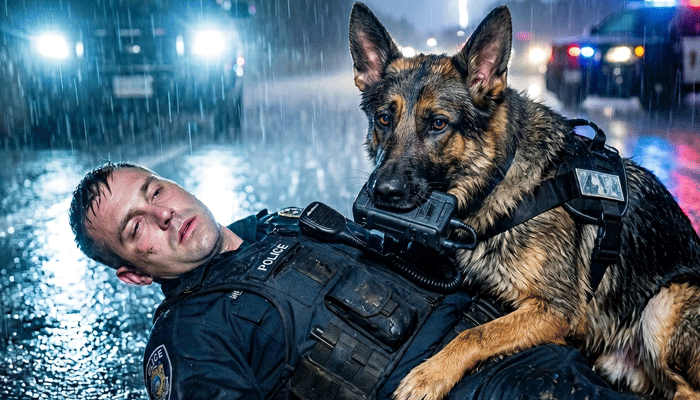
My name is Officer Aaron Cole, and if you ask the department what happened that night on Highway 16, they’ll tell you I was the one who answered the call.
That is technically true.
It is also one of the least important truths in the story.
The night started as routine, which is how bad nights prefer to dress before they show their real face. Rain was coming down hard enough to turn the windshield into a moving sheet of silver, and the dispatch note read like the kind of disturbance we’d both handled dozens of times before—possible stranded vehicle, possible trespass complaint near the rural shoulder, uncertain caller, line disconnected. The kind of nothing call that still gets a unit sent because sometimes nothing is where trouble hides best.
Koda was in the passenger seat, alert in the way good police dogs are even when their body looks calm. His ears twitched at every engine echo and thunder roll. Six years working together had taught me that silence from him wasn’t emptiness. It was sorting. Watching. Measuring.
We never saw the ambush coming.
The first shot hit metal before my brain fully recognized it as gunfire. Then glass went. Then heat tore across my torso with the kind of force that doesn’t feel like pain at first—just impact, shock, interruption. I remember the steering wheel slipping under my hands, the door opening badly, the wet asphalt rushing up too fast, and Koda barking somewhere close with a sound I had never heard from him before. Not command. Not pursuit. Panic held under discipline.
I hit the road hard.
Warmth spread under me immediately, mixing with rainwater and running toward the gutter in thin red lines. I reached for the radio by reflex, because training survives even when the body starts failing. My fingers touched nothing. I turned my head enough to see it lying just out of reach on the slick blacktop, close enough to mock me.
“Aaron Cole, officer down…” I tried to say.
What came out wasn’t language. Just a torn rasp swallowed whole by weather.
Koda had been hit too. Later they told me the bullet only grazed his hind leg. At the time it looked like enough. He limped but stayed planted beside me, body angled toward the dark shoulder where the shots had come from, teeth bared, fur slicked down by rain and blood. He nudged my hand once, then twice, like he was trying to restart me.
Headlights passed in the distance.
None stopped.
That’s something people don’t understand about dying on a road. The world does not pause around you. It continues in beams, tires, and strangers hoping the trouble belongs to someone else.
My vision narrowed. The rain got louder. Koda looked at the radio, then at me, then back at the radio again in a way that made something inside me try to rise even while the rest of me was shutting down.
Then he moved.
Limping. Careful. Deliberate.
He crossed the wet pavement, lowered his head, and took the radio gently in his mouth.
At first I thought I was hallucinating from blood loss. Dispatch radios are not part of canine training protocol. We teach search, hold, track, defend, bark on command. Not this. Not improvisation under gunfire. Not the kind of decision that belongs more to partnership than program.
But Koda dragged the radio back to my side anyway.
Static cracked to life.
Far away, in a room full of consoles and voices, somebody heard the channel open.
And before I lost consciousness again, the last clear thing I registered was this:
my life was no longer resting on procedure, backup time, or even my own training.
It was resting on whether one wounded German Shepherd could make the right people understand what he was trying to say through rain.
When I woke the first time in the hospital, I thought the hardest part of the story was already over.
I was wrong.
The bullet had gone through soft tissue, missed the artery by a margin nobody in the trauma bay described as luck out loud because people in medicine know better than to insult survival by oversimplifying it. I had tubes in my arms, pain stitched through my torso, and the strange half-floating clarity that comes after blood loss when memory returns in shards instead of sequence.
Koda was alive too.
That was the first question I asked, and Sergeant Elaine Porter answered it before the doctor even got a word in. “He’s at the veterinary unit. Leg wound. Stubborn as hell. Mad at everyone.”
Good.
That sounded like him.
Then Elaine said, “You need to hear the recording.”
She didn’t say it dramatically. She said it like a dispatcher who had spent too many years around bad nights to waste theater on one more. But even then, I could tell something in her had shifted. Dispatchers know voices. Breathing patterns. Panic textures. The sounds around emergencies are their version of the street. If Elaine wanted me to hear the tape before Internal Affairs or command briefing summaries, that meant the audio carried something official language might try to flatten.
They played it on a tablet at my bedside.
First came static.
Then rain—loud, constant, merciless on pavement and metal.
Then one bark.
Koda’s.
Not random. Not repeated wildly. Distinct. Forced into the open channel by a dog who had no reason to understand the system and every reason to understand me. Elaine told me the room froze when she heard it. Everyone on that shift knew Koda’s bark because he’d come through dispatch enough times after training days and court security details. Not many dogs have a voice people remember. He did.
Then the tape got stranger.
You could hear my breathing. Wet, shallow, wrong. You could hear Koda scratching the radio closer. You could hear him pressing up against me every few seconds, the mic rubbing fabric and fur. But behind all that—buried under rain and distance—was another sound.
A vehicle door closing.
Then footsteps in water.
Then a voice.
Male. Calm. Too calm.
“Should’ve finished the dog too.”
The room in my hospital bed seemed to drop away when I heard it.
Because that meant someone had come back.
Not to help. Not even to confirm from a distance. Close enough to the open radio to speak over my bleeding body and my wounded dog. Close enough to assume the storm was still stronger than evidence.
Elaine paused the recording there and said, “We enhanced what we could.”
There was more.
A second voice, farther off, answering: “Leave it. Treadwell said move.”
Treadwell.
Sheriff Colin Treadwell of Mason County. That name landed like bad medicine because it gave the ambush shape. Not random highway violence. Not drifting rural criminals. The local sheriff’s name in the background of an officer-down scene before backup arrived.
I told Elaine to play it again.
The first voice had no panic in it. No urgency. Just irritation, like my survival was a scheduling problem. The second voice used Treadwell’s name not with fear, but with familiarity. And once you hear that, routine dies completely.
The official explanation started forming by noon anyway.
Possible radio contamination. Misheard audio artifacts. Storm distortion. Those phrases moved fast because systems protecting themselves always move fastest around language. But Koda had done too much by then for the tape to disappear quietly. Every dispatcher on shift had heard the open channel live. Every one of them heard the bark, the dragging, the footsteps, the voice. Too many people now owned some piece of the truth.
What no one outside a tight circle knew yet was what Koda had done after the radio opened.
He had not left me.
That part came from a passing trucker’s dash camera and from rain-smeared scene photos. Koda stayed pressed against my side for twenty-three minutes after the transmission, wounded leg under him, body temperature shielding mine from shock and cold, growling whenever headlights slowed and moved on. By the time first responders arrived, he was nearly hypothermic and still refusing to back off the lane where the shooters had disappeared.
A dog did what no policy manual had prepared for.
He made the call.
Then he held the line.
But the more I listened to that recording, the less the miracle of Koda’s choice felt like the whole story.
Because men don’t come back to a wounded officer lying in the road unless they think they have time.
And men only think they have that kind of time when they believe the county around them is already helping.
Sheriff Colin Treadwell held a press conference the next afternoon.
That was the moment I knew he was afraid.
Bad sheriffs hide when chaos hits unless they need to get in front of a narrative before evidence starts choosing its own route. From my hospital bed, I watched him stand behind a county seal and describe the ambush as “an isolated criminal attack on law enforcement,” his face set in exactly the expression men use when they hope grief will keep questions polite for at least forty-eight hours.
He praised my service.
Praised Koda’s “extraordinary instinct.”
Promised full cooperation.
Never mentioned the recording.
Never mentioned the voice.
Never mentioned why his own name had shown up in the rain over my blood.
That omission did not survive long.
Sergeant Elaine Porter took the risk that changed the case. She sent a preserved copy of the live dispatch capture—not the post-processed one, the raw one—to the state bureau liaison before local command could lock dissemination under the excuse of evidentiary control. That mattered because once outside ears heard the audio without county filtering, Mason County stopped owning the first interpretation.
State investigators heard the same thing we had.
A voice at the scene.
A second voice using Treadwell’s name.
No sign of first-response confusion.
No indication anyone was trying to save the officer.
By the time Internal Affairs tried to caution the department against “premature conclusions,” the conclusion was already running ahead of them.
Then Koda gave them more.
Three days after surgery, leg stitched and wrapped, he was brought under controlled condition to the secured patrol yard where the involved vehicles had been impounded. He ignored my cruiser first. Ignored the backup unit. Ignored the tow truck. Then he went rigid in front of one county sheriff SUV parked off to the side under “storm contamination hold.”
He alerted at the driver-side floorboard.
Hard.
Inside investigators found trace blood transfer not matching any deputy officially assigned to the scene, plus rain-soaked gravel consistent with the shoulder where I went down, and one missing dash-camera segment logged as a “weather malfunction.”
Weather malfunction.
That phrase nearly made me laugh through the pain.
Koda had already exposed one lie. Now he was exposing the transport that connected it.
The state bureau took over from there, and once they stopped trusting Mason County’s own channels, the rest unraveled faster than anyone in local uniform wanted. Sheriff Treadwell hadn’t organized the ambush himself—not directly. Men like him don’t often do the shooting. They do the enabling. Road unit placements. Dead radio pockets. Delayed routing. Calling off one patrol while another “handles it.” The gunmen turned out to be private security subcontractors working off-book for a quarry company facing federal waste-dumping charges I had helped reopen six weeks earlier. The company’s lawyer had political ties. The sheriff had money ties. The highway stop that night had not been random. It had been a corridor selected because help would arrive late enough for weather to finish the report.
Except Koda ruined the timing.
That is the part I still struggle to explain without sounding like I’m making my partner into something mythical. He wasn’t mythical. He was hurt, wet, scared, and acting beyond any command structure we had ever drilled. But because he dragged that radio back, because he barked into an open channel dispatch recognized, because he stayed on me long enough for responders to find the exact lane instead of a broad storm grid, the people who planned the road to become my grave lost the one thing they needed most:
silence.
Treadwell resigned before indictment.
That is the polite version.
The impolite version is that once the state matched the sheriff SUV, the missing dash segment, the dispatch anomalies, and the recording using his name, his allies realized he had become too expensive to keep standing. The quarry executives went next. Then the security contractor. Then a county commissioner who had been smoothing permit problems in exchange for “campaign support.” The ambush did not expose one rotten deputy or one dirty sheriff alone. It exposed a local protection system that had grown so confident it believed a storm and one bleeding officer would be enough to close the file.
As for Koda, he came back to work because of course he did.
Not immediately. Not dramatically. Recovery first. Rehab. Vet clearance. A limp in cold weather that never fully left. But he came back, and when the department tried to write the commendation in the usual human-centered language, half the dispatch floor nearly mutinied until the citation said what everyone knew was true:
The dog made the call.
People still ask me how he knew what to do.
I don’t think that’s the right question.
The right question is why we’re so uncomfortable admitting that partnership can become something deeper than training under enough pressure. Koda didn’t operate a radio because someone programmed him like a machine. He understood a pattern: I needed the thing, the thing was out of reach, getting it back mattered. Then he refused to quit after that. Not protocol. Not miracle either. Something harder and simpler.
Commitment.
There is one piece of the recording they never released publicly.
After the footsteps. After the voice saying they should have finished the dog. Just before the second speaker says Treadwell’s name, there’s a small sound buried under rain.
A growl.
Low. Steady. Close to the microphone.
Koda, wounded and freezing, warning armed men over my body.
That sound is the reason I know the story doesn’t end with survival.
It ends with defiance.
And that leaves one question I still carry even after the indictments and resignations:
if the ambush was built around timing, dead radio space, and delayed response, then how many other “routine” incidents in Mason County only looked random because no dog had ever dragged a radio far enough for the truth to get out?
Do you think Treadwell was the mastermind—or just the local gatekeeper for people who had already used that road before? Tell me below.