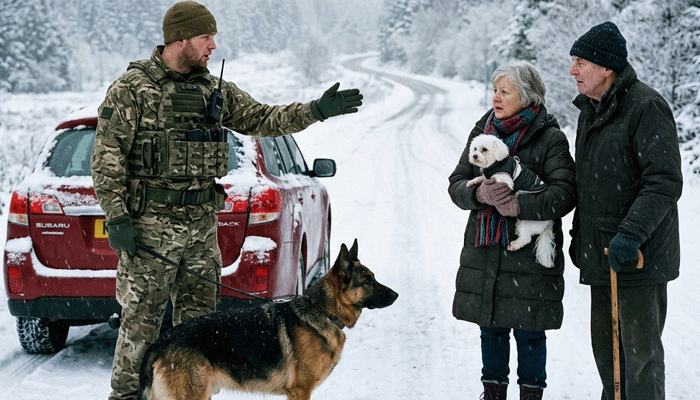
My name is Caleb Mercer, and the night the blizzard hit northern Minnesota hard enough to erase the road, I was planning to see no one but my dog.
That was how I liked it.
I had spent years in the Navy SEALs, then more years trying to learn how to live without the noise, the missions, and the constant need to stay ready for violence. My cabin sat outside a small town where winters were merciless and silence could feel almost honest. That night, the wind was throwing snow across the highway so fast it looked like the world was being sanded down to white. My German shepherd, Ranger, sat rigid in the passenger seat of my truck, staring into the storm like he had seen something I had not.
Then he barked.
At first I thought it was a deer or a branch moving wrong in the headlights, but when I slowed down, I saw two figures stumbling near the ditch. An elderly man and woman, barely able to stand, wrapped in layers too thin for that kind of cold. In the woman’s arms was a tiny white puppy trembling so badly I thought it might not make it another mile. I got them into the truck fast. The man’s name was Walter Bennett. The woman was June. The puppy was Daisy.
By the time we reached my cabin, June’s hands were blue with cold, Walter could barely speak, and Ranger was pacing like he understood we were racing something invisible. I got the fire going, wrapped them in blankets, and made coffee strong enough to raise the dead. That was when I learned they had not just gotten lost in the storm. They had been trying to return to the old farmhouse they once owned after being pushed out of their son’s place.
June told me the story in pieces. Their son, Trevor Bennett, had grown impatient with age, medical bills, and anything that did not fit into his plans. He wanted them in assisted living, wanted the house sold, wanted the land converted into money before sentiment got in the way. According to June, the pressure had gotten worse for months. The heat had been cut off at the farmhouse. The repairs were ignored. The message was clear: sign the papers or become a problem.
Then Walter clutched his chest.
Everything changed in one second. The color drained from his face, his breathing shortened, and June froze in the kind of fear that tells you this is not the first time. She said his heart medication had been left behind. I tore through every drawer in the cabin looking for my old emergency kit, but the storm had me rattled and memory is a bad map under pressure. Ranger solved it before I did. He scratched at a loose floorboard near the mudroom where an old steel medical box had been shoved years ago and forgotten. Inside was aspirin, emergency cardiac medication, and enough hope to buy Walter time.
He survived the night.
I thought the storm was the worst thing waiting for them. I was wrong.
The next morning, when the snow finally eased and I drove them back toward their farmhouse, I found sagging walls, chewed wiring, and a place one spark away from burning down. And standing in the yard with legal papers in his hand was Trevor Bennett, smiling like the storm had done him a favor. What kind of son shows up at his parents’ ruined home ready to take what little they have left?
Trevor Bennett did not look like a monster.
That was the first thing that bothered me.
He looked like a regular middle-aged man in an expensive winter coat, standing beside a clean pickup with polished boots and the expression of someone who had already decided how the conversation would end. Men like that are often more dangerous than the openly cruel ones. Cruelty is easy to confront. Polished selfishness hides behind procedure.
June stepped out of my truck slowly, one hand on Walter’s arm, Daisy tucked inside her coat. Trevor saw them and immediately started talking, not asking if they were safe, not asking where they had spent the night, not asking whether Walter had survived the storm. He held up a folder and said the county notices were final. Property taxes, penalties, compliance issues. If they signed now, he could “take care of everything” before the house became a total loss.
Walter looked at the farmhouse like it still held fifty years of memory, even in that condition. Trevor looked at it like it was already lumber and leverage.
I walked a little closer and told him they were not signing anything that morning.
He gave me the kind of smile men use when they think they can dismiss another man by reducing him to a category. Outsider. Drifter. Meddler. He asked who I was supposed to be. I told him I was the one standing there while he tried to force his parents out in the cold.
The look in June’s eyes changed then. Not relief exactly. More like the fragile recognition that someone had finally said aloud what she had been living with in silence.
Once Trevor realized intimidation would not work, he shifted tactics. He talked about debt, code violations, unpaid taxes, and how nobody in town would help now because everything had gone too far. That line stuck with me. People who want control often claim the world is already settled. They want you to feel late.
So I drove Walter and June into town.
The clerk at the municipal office was a woman named Hannah Doyle, sharp-eyed and patient, the kind of person who had seen too many families come apart over paperwork and pride. She started checking the records. At first the numbers looked bad. Then they started looking strange. Duplicate penalties. A missed exemption. A filing error attached to a storm damage assessment that had never been properly updated. Hannah kept digging.
That was when the town began to remember who Walter Bennett actually was.
An old mechanic came by and said Walter once fixed his furnace for free during a brutal winter. A retired teacher said June used to bring food to her porch when her husband was dying. A hardware store owner remembered Walter helping rebuild half the town after a spring flood twenty years earlier. One by one, people stopped seeing the Bennetts as two elderly strangers with a failing house and started seeing them as part of the foundation under everyone’s lives.
Hannah finally looked up from the files and said the truth Trevor had been hiding in plain sight: the tax burden was real, but it had been made worse by errors and aggressive notices that never should have gone out the way they did. With correction and appeal, the Bennetts could get time.
Trevor arrived just as she said it.
He looked less certain now, but not ashamed yet. Men do not become honest the moment they are cornered. First they become angry. Then defensive. Then, if there is still any conscience left, they finally become quiet.
Trevor accused the town of turning against him. Accused his parents of making him look heartless. Accused me of poisoning the situation. But when Hannah calmly laid out the corrected records and the extension terms, the legal pressure he had been using started to collapse.
That should have solved the property fight.
But it did not solve the family.
Because on the drive back, Walter told me something that made everything sadder than simple greed. Trevor had not always been like this. Somewhere between financial trouble, resentment, and the belief that weakness was contagious, he had stopped seeing his parents as people and started seeing them as obstacles.
And I knew paper alone would never fix that.
I have seen men break in combat for many reasons.
Fear. Exhaustion. Shame. Loss. The slow rot that comes from carrying too much anger for too long. What I had not expected was to see that same kind of breaking in a small Minnesota town over an old farmhouse, unpaid taxes, and a son who had convinced himself that efficiency was more important than love.
After Hannah Doyle corrected the tax records and secured an extension, the practical crisis eased. The house was no longer going to disappear overnight. Trevor no longer had legal momentum on his side. But when we returned to the farmhouse, the deeper truth was still waiting in the yard with us. Walter and June might have won time, but they were still standing in front of a house with failing wires, damaged walls, broken heat, and years of neglect. Paper could stop the seizure. It could not make the place livable.
The first person to step forward was the hardware store owner, Ben Carrow. He showed up with spools of wire, two toolboxes, and the blunt certainty of a man who had already made up his mind. Then came a roofer. Then a retired electrician. Then a pair of high school kids with shovels and more energy than sense. By noon, the Bennetts’ front yard looked like the start of a barn raising from another century. No speeches, no heroics, just people working because once the truth was visible, doing nothing would have made them smaller.
I stayed on the ladder most of the day, clearing damaged siding and checking the lines in the attic. Ranger patrolled the yard like a foreman with fur. Daisy, the tiny white puppy June had carried through the storm, had recovered enough to follow him in clumsy circles. That image stayed with me longer than I expected—old dog, young dog, snow melting off the porch, and a house getting another chance.
Trevor came late.
He did not arrive with paperwork this time. He arrived alone, without his usual confidence, and stood at the edge of the yard while people who knew exactly what he had done kept working around him. Shame is a strange thing. Public humiliation can harden some people forever. But sometimes quiet decency all around them works like a mirror they cannot avoid.
Walter saw him first and straightened slowly.
June stopped hammering nails into salvaged trim and just watched her son the way mothers do when love and disappointment are fighting to stay in the same body. Trevor opened his mouth once, closed it, then finally walked toward them without looking at anyone else.
He said he had been wrong.
Not “things got complicated.” Not “everyone made mistakes.” Just wrong.
He admitted he had been drowning in debt, angry at his own failures, and resentful that his parents’ house felt like one more burden he could not control. He told the truth that selfish people hate most: once he began justifying small cruelties, larger ones came easier. Cutting the heat. Pressuring them. Treating their home like a transaction. He had spent months calling it practical when really it was cowardice dressed up as management.
Walter listened without interrupting. That took more strength than most people realize.
Then he said something I have not forgotten. He told Trevor that forgiveness was not the same as pretending nothing happened. If he wanted to be their son again, he would have to become one in action, not in language.
Trevor nodded like the words hurt, which meant they might actually matter.
And to his credit, he stayed.
He hauled rotten boards to the burn pile. He carried insulation. He spent an hour on his knees under the sink with a wrench and a flashlight while Ben Carrow barked instructions at him from the kitchen doorway. No one applauded. No one rushed to absolve him. Redemption that comes too quickly is usually theater. This was better—uncomfortable, practical, earned inch by inch.
The work took days.
By the end of the week, the wiring was safe, the furnace was running, the roof no longer leaked, and the front porch light came on at dusk for the first time in months. When that bulb glowed against the snow, June started crying softly into Walter’s shoulder. He held her hand with both of his, and in that moment the house stopped looking like a collapsing asset and started looking like what it had always been: proof that a life shared long enough can survive even ugly seasons.
As for me, I had not planned on becoming part of any of it.
I was the man in the truck with the dog, the one passing through his own quiet life. But that is the thing about storms. Sometimes they do not just reveal who needs saving. They reveal who you still are when you no longer have a uniform, a mission order, or a team behind you. I had spent years believing solitude was peace. Maybe sometimes it is. But that week reminded me that peace can also look like staying long enough to help rebuild what somebody else nearly lost.
Before I left, Walter handed me an old photograph of the farmhouse in summer, taken decades earlier. The paint was fresh, the garden was full, and a much younger June stood on the porch laughing at something outside the frame. On the back, Walter had written one line in shaky pen: A home survives when people do.
I keep it in my cabin now.
The last time I drove past the Bennetts’ place, the snow had begun to melt, the porch light was on, and Trevor was repairing a fence post while June watched from the doorway with Daisy in her arms. Walter stood nearby, pretending to supervise while doing almost nothing. Ranger pressed his nose against my truck window, then settled back into the seat as if he already knew the story had ended the way it was supposed to.
Maybe not perfectly.
But honestly.
And in the real world, that is often the better miracle.
If this story touched you, share it, comment below, and remember this: sometimes saving a life begins with refusing to pass by.