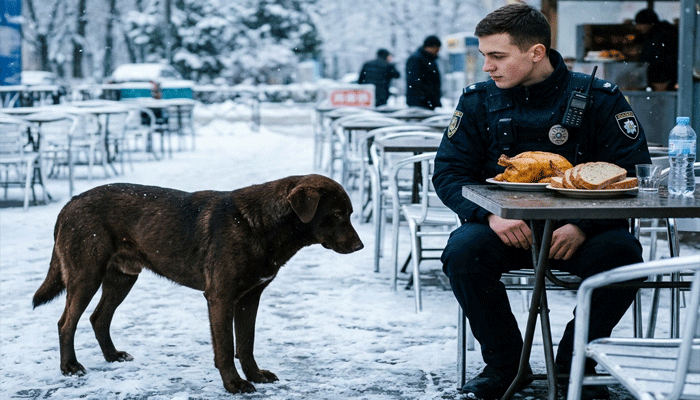
My name is Owen Parker, and the night I met that old German Shepherd, the entire town of Silver Hollow was trying not to notice him.
Snow was blowing sideways across Main Street, the kind of hard winter wind that makes people walk faster, speak less, and pretend anything outside their own warmth does not exist. I had stopped at the Pine Lake Diner near the edge of town after a long patrol shift, mostly because I did not feel like going home to an empty apartment and reheated leftovers. I was halfway through bad coffee when I heard a faint tapping against the front window.
At first, no one looked up.
Then I saw him.
An aging German Shepherd stood just outside the glass, ribs visible beneath dirty matted fur, his paws cracked from cold, his body trembling from exhaustion. But it was not just the condition he was in that caught me. It was the way he was standing there—calm, focused, tapping once, then waiting, like he was not begging so much as asking one last time whether anyone inside still had a conscience.
A waitress walked over and banged on the glass to scare him off. The manager muttered something about strays and health codes. A couple near the counter complained that the dog was ruining their meal. The shepherd did not growl, bark, or run. He just looked through that window with tired eyes that had seen too much and expected very little.
I got up and went outside.
The cold hit like a fist. The dog flinched when I approached, but he did not back away. Up close, he looked worse. Old scars. Torn ear. Thin frame. A collar so worn it looked like it had survived years of weather and neglect. I crouched down slowly and held out my hand. He sniffed it once, then leaned the side of his head against my wrist like he had already made his choice about me.
I called him Ghost before I knew his real name.
Against the manager’s protests, I brought him inside and sat with him near the far booth. Someone found scraps of grilled chicken. Someone else brought a towel. The mood in the diner changed one person at a time. That happens sometimes. Kindness spreads slower than cruelty, but it spreads.
Then I checked his collar.
There was a damaged tag and, underneath it, a microchip number. I took him straight to the all-night veterinary clinic, where the scanner pulled up a record none of us expected. Ghost was not a stray. His real name was Titan, a retired Colorado State Police K9 officially presumed dead two years earlier in a drug lab explosion that also killed his handler, Sergeant Luke Merritt.
But Titan had not died.
He had survived.
And when I brought him home that night, I had no idea that the old dog sleeping beside my heater was carrying the first clue that would reopen the case, expose the man responsible for Luke Merritt’s death, and turn one freezing act of mercy into the biggest investigation of my career. Why had Titan come back now—and what was he trying so hard to lead me toward?
I did not sleep much that night.
Titan curled up on the rug near my radiator like he had not been warm in a very long time. Every so often he twitched in his sleep, paws moving slightly, breath catching as if some part of him was still working through commands, chaos, and memory. I sat on the couch and kept looking over at him, trying to understand how a police dog declared dead could appear half-frozen outside a diner in a town three states away.
By morning, the story had already started moving.
The vet had made a few calls after scanning the chip, and one of them reached Captain Elena Morse from Colorado State Police. She confirmed Titan had been partnered with Sergeant Luke Merritt, a respected K9 handler killed in the lab explosion during a narcotics raid two years earlier. The scene had been so destructive that investigators concluded Titan had died in the blast and his remains were never recovered. The case closed around that assumption. Everyone grieved and moved on.
Except Titan had not moved on.
When Captain Morse arrived the next afternoon, she looked at Titan for less than two seconds before her whole face changed. Titan recognized her too. He stood up slowly, tail low, then pressed into her legs with a sound I had never heard from him before—something between a whine and a memory breaking open. Even the toughest people become fragile around loyalty like that.
She told me Luke Merritt had been one of the best handlers in the state. Patient, disciplined, the kind of man who treated his dog like a partner rather than equipment. After his death, the department honored him, closed the file, and accepted the official conclusion that the blast had wiped out everything else.
But Titan did something strange while she was talking.
He went to my front door and started scratching at it.
I thought he needed to go outside. Instead, the second I opened it, he headed straight to my cruiser and stopped at the rear passenger door. He looked back at me once, then barked.
Captain Morse saw it too. “He wants to work,” she said quietly.
So we let him.
We drove to the abandoned storage property on the edge of town where local deputies had recently found signs of transient activity and possible narcotics movement. Titan had never been there before, at least not as far as any record showed. But the moment he hit the ground, he changed. His age was still there in his body, but training snapped into place like muscle memory had been waiting for permission. He tracked across the frozen lot, ignored distraction scents, and led us to a collapsed shed behind the property line.
Under loose boards and an old tarp, we found a rusted metal case.
Inside were sealed bundles of paperwork, cash records, burner phones, and a partial ledger tied to chemical shipments matching the same supplier network from the lab explosion two years earlier. More important, one phone still contained recoverable data linking the operation to a man long suspected but never charged: Wade Kessler, a former logistics contractor who vanished after Luke Merritt’s death.
Titan had not just survived.
Somehow, somewhere in the chaos after the explosion, he had remained tied to the case in a way no human investigator had realized.
That should have been enough to make him a hero again.
But what happened next made the entire town understand that this old dog was not done serving yet.
Because when a missing officer case suddenly intersected with Kessler’s name, Titan caught the scent trail before any of us did.
The strange thing about second chances is that they rarely arrive looking noble.
Most of the time, they show up tired, dirty, limping, and inconvenient. They ask something from you before they offer anything back. That was Titan. By the time the story spread through Silver Hollow, people were calling him a miracle dog, a hero returned from the dead, a legend. But when I first saw him, he was just an old animal outside a restaurant window in a snowstorm, asking not to be ignored.
That mattered to me.
Because it meant everything that followed began with a choice no bigger than opening a door.
After we recovered the case materials from the shed, Colorado State Police reopened the lab explosion file formally. The burner phones and shipping logs linked Wade Kessler to a network moving chemicals through several rural properties, and one of those properties overlapped with the last known area of a missing local deputy named Aaron Velez. His cruiser had been found three days earlier near an access road outside town, but no one had located him. Weather had ruined part of the trail. Search teams were stretched thin. Time was becoming the enemy.
Titan changed that.
He worked off one of Aaron’s gloves taken from the deputy’s locker, and the transformation in him was something I will never forget. He was old, yes. Scarred. Slower than he once had been. But purpose seemed to straighten his spine. He moved through the snow with that deep, disciplined focus dogs like him never truly lose. We followed him across a tree line, over a drainage ditch, and into an abandoned service corridor behind an old pumping station.
That was where we found Aaron Velez.
Alive.
Cold, injured, barely conscious, but alive.
He had been held there after stumbling onto a transfer site connected to Kessler’s network. When the suspects fled because of increased patrol pressure, they left him restrained in a side chamber, assuming the weather would finish the job quietly. Titan found him before that could happen. I still remember kneeling beside Aaron while paramedics worked, hearing Captain Morse whisper, almost to herself, “Luke would’ve known he’d do this.”
That rescue broke the case open completely.
Aaron was able to identify one of the men guarding him. The data from the recovered phones connected that man directly to Wade Kessler. Within forty-eight hours, warrants went out across two states. Kessler was arrested at a roadside motel trying to travel under a false identity, and the evidence trail tied him back not only to the current narcotics operation but also to the lab explosion that killed Luke Merritt. It turned out the blast had not been an accident of volatile materials the way the original report suggested. It had been triggered during a rushed cover-up when Kessler realized Luke was closer than expected to exposing the shipment chain.
In other words, Titan had carried the last living truth out of that fire, and nobody knew.
When the arrest became public, the diner where I first found him filled with flowers, handwritten notes, dog treats, and more opinions than the town had shown him on the night he stood freezing outside its window. People wanted to help. They wanted to donate. They wanted to apologize in the indirect way communities often do—through generosity after they realize they were late to compassion.
I did not judge them too harshly for that. Being late is better than never arriving at all.
One moment from that week stayed with me almost as strongly as the arrest. A little boy named Mason, who had not spoken in nearly a year after a traumatic loss, came into the diner with his mother while Titan was lying under my booth. The boy sat on the floor near him and just watched. Titan lifted his head, moved closer, and rested his chin on the child’s sneaker. A full minute passed. Then the boy smiled and whispered one word.
“Good.”
His mother burst into tears.
That was the thing Titan did to people. He made them softer without making them weaker. He reminded them that loyalty can survive fire, abandonment, age, and indifference. He reminded me of that too.
I signed the adoption papers the next week.
Some people said I rescued him. That was only half true. Titan rescued parts of me I had let go numb. Police work can do that if you let it. You start seeing reports instead of people, patterns instead of pain, and procedure instead of mercy. Titan cut through that the same way he cut through snow on a track—quietly, completely, without asking permission.
A month later, the department held a ceremony in the town square. It was small by state standards, huge by local ones. Captain Morse stood beside me in dress uniform. Aaron Velez, still healing, came with a cane. Mason and his mother stood near the front. The mayor read a proclamation recognizing Titan as an Honorary K9 Deputy for extraordinary service, past and present. Someone placed a new badge-shaped tag on his collar. Titan tolerated the attention with the weary dignity of someone who had long ago learned applause is less important than the work.
I looked down at him during the ceremony and thought about Luke Merritt, a man I never met but somehow came to know through the dog who never stopped carrying him. Real loyalty does that. It becomes a bridge between the dead, the living, and the people who still need saving.
Titan is asleep near my desk as I tell this story now. His muzzle is whiter, his steps are slower, and sometimes he dreams hard enough to whine softly into the dark. But he is home. Fed. Safe. Remembered properly. That matters.
Every town says it values kindness until kindness becomes inconvenient. Every person says loyalty matters until loyalty requires patience, cost, or care. Titan taught all of us in Silver Hollow that love is not proven when something is easy to cherish. It is proven when something arrives worn down, overlooked, and asking for one last chance—and you say yes anyway.
If this story touched you, share it, comment below, and remember: sometimes the soul you save is waiting outside your door.