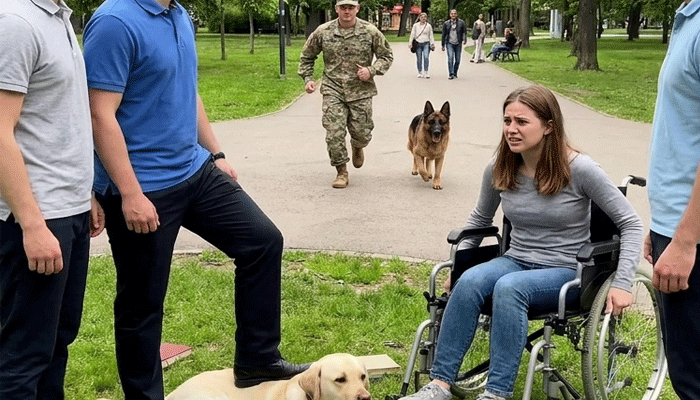
My name is Nora Bennett, and the day everything changed started like any other quiet afternoon in Zilker Park. I had my sketchbook balanced on my lap, my wheelchair locked in place under the shade of a live oak, and my yellow Labrador, Scout, stretched beside me with his chin on my shoe. Since the crash that damaged my spine two years ago, drawing outside had become the one thing that still made me feel like myself. It gave structure to days that might otherwise have blurred into frustration, pity, and silence.
That afternoon, I was sketching the tree line near the river when I heard laughing behind me. The kind of loud, careless laughter that makes people look away instead of confront it. Three young men in expensive athletic clothes came strutting across the grass as if the whole park belonged to them. The one in front—Tyler Ashford—wore mirrored sunglasses and the expression of someone who had never once been told no and believed that made him untouchable.
He stopped directly in front of me and looked down at my drawing like he was examining something beneath him. “You sell these?” he asked. Before I could answer, one of his friends snickered and said, “Maybe it’s charity art.”
I tried to ignore them. I had plenty of practice ignoring people who mistook disability for weakness. But Tyler moved closer. He nudged Scout with the side of his shoe. Scout stood up instantly, not aggressive, just alert. Protective. Loyal. That should have been the end of it. Any decent person would have backed off.
Tyler wasn’t decent.
He kicked Scout once, hard enough to make him yelp. I shouted at him to stop, and Scout stepped between us, trembling but refusing to retreat. Tyler kicked him again. Then a third time. I leaned forward and tried to grab Tyler’s arm, but he slapped me across the face so hard my head snapped sideways. One of his friends laughed while the other reached behind my chair and locked the wheel brakes tighter, pinning me in place.
“Sit there and watch,” Tyler said.
I screamed for help. People turned. Some stared. Nobody moved fast enough.
Scout tried to lunge back to me, and Tyler raised his foot again—but before it came down, a voice cut across the park like a command. “Step away from the dog.”
A tall man in running gear was already closing the distance, a black-and-tan working dog at his side, both moving with terrifying control. The stranger didn’t shout again. He didn’t have to. Something in his posture made Tyler’s friends step back immediately. But Tyler swung first, and in less than ten seconds all three of them were on the ground, gasping, stunned, and suddenly very aware that they had picked the wrong victim.
The man knelt beside Scout, checked him with calm, practiced hands, then looked up at me and said, “I’m Marcus Reed. Former Marine. You’re safe now.”
I wanted to believe him. I really did.
But that night, after Scout was treated at the emergency clinic and I thought the worst was behind us, I returned to my studio and found the door cracked open, my paintings slashed to ribbons, and a message spray-painted across the wall in dripping black letters:
NEXT TIME, THE DOG DIES.
And tucked beneath the broken frame of my favorite canvas was something even worse—proof that Tyler’s family knew exactly where I lived.
I barely remember calling Marcus. My hands were shaking so badly I hit the wrong contact twice before I got it right. He answered on the second ring, and the moment he heard my voice, his tone changed. He didn’t ask useless questions. He didn’t tell me to calm down. He just said, “Are you inside?” and when I whispered yes, he told me to lock the door to the bathroom and wait until he got there.
He arrived in under fifteen minutes with his retired K9, Titan, and a police officer he knew from his years working security consulting after leaving the service. By then, I had replayed the scene in my studio a hundred times. The smashed easels. The shredded canvases. The paw print of muddy boots across one unfinished portrait. The message on the wall. It wasn’t random vandalism. It was a performance. A warning designed to say they could reach into the only place left in my life that still felt mine.
The responding officers took photos and filed a report, but even standing there, I could feel the limits of what paperwork could do against money. Tyler’s father, Grant Ashford, owned half the commercial real estate downtown and sat on more charity boards than I could count. By morning, his attorney had already contacted me.
She arrived at my apartment with a smile so polished it felt rehearsed. She told me Mr. Ashford was “deeply concerned” and wanted to “resolve this unfortunate misunderstanding privately.” She offered to pay Scout’s veterinary bills, replace my damaged artwork, and even “assist” with accessible housing costs if I signed a confidentiality agreement and publicly stated the altercation in the park had been exaggerated.
When I refused, the smile vanished.
She warned that if I chose to “pursue false claims,” there would be consequences. A countersuit. Questions about whether Scout had provoked the incident. Pressure on my landlord. Scrutiny of my finances. She spoke in that smooth professional voice people use when they want cruelty to sound reasonable.
Marcus sat beside me for the entire meeting and never interrupted until the very end.
Then he leaned forward and said, “Tell your client this is over when she says it is—not when his money says it is.”
The attorney left, but the threat stayed in the room after the door closed.
That evening Marcus told me something that changed the way I saw everything. Tyler and his friends hadn’t panicked in the park because they were guilty. They’d panicked because they were used to being protected. Men like that only get bolder when they’ve been rescued before. Marcus believed they would come back—not just to intimidate me, but to destroy whatever evidence or testimony could still hurt them.
He wanted to move me and Scout somewhere safe for a few days. I hated the idea. It felt like surrender. But when I looked at Scout sleeping restlessly with his bandaged side rising and falling, I knew pride wasn’t worth his life.
So I went.
Marcus took us to his sister’s guesthouse outside the city, quiet and private, with enough land that Titan and Scout could both breathe. I thought distance might buy us time.
Instead, on the second night, Marcus got a call from a neighbor near my studio.
There were lights on inside.
And someone had gone back in.
PART 3
Marcus didn’t tell me to stay put. He knew me better than that by then. He just looked at me across the small kitchen table and said, “If you come, you follow my lead exactly.” I agreed before he finished the sentence.
We drove back toward the city in silence, Titan in the rear cargo space and Scout curled against my leg, still sore but alert. The studio sat above a narrow storefront in an older warehouse strip on the east side, the kind of place developers kept circling but hadn’t fully swallowed yet. When we turned the corner, the street looked empty. Too empty. One security light near the back alley flickered against the brick wall, and through the second-floor studio window I saw movement behind the blinds.
Marcus parked half a block away. He called the police first, not after. That mattered. He wanted the record straight before anyone tried rewriting it. Then he positioned me in the neighboring shop’s recessed doorway where I could see the stairwell landing without being exposed. He moved like a man who had done hard things in worse places, controlled and patient, never theatrical. Titan stayed at heel, ears forward, body tense but disciplined.
A minute later the side door opened.
Tyler stepped out first, looking over his shoulder with the easy arrogance of someone sure no one would challenge him. Two friends followed carrying my portfolio cases and a plastic bin filled with paint tubes, hard drives, and invoices from recent commissions. They weren’t just vandalizing property anymore. They were stealing records. Erasing proof. Killing my income while they were at it.
Marcus let them get halfway down the stairs.
Then he said, “Drop it.”
The sound of his voice froze all three of them. Tyler recovered first, of course. Men like him always think confidence can substitute for innocence.
“You stalking me now?” he snapped, tossing my portfolio onto the landing. “This place is a mess anyway.”
Marcus didn’t move. “Police are already coming.”
For the first time, I saw real fear crack through Tyler’s posture. Not because he was ashamed. Because he was cornered. He lunged for Marcus, maybe thinking one fast attack could scatter the moment long enough to escape. It didn’t work. Marcus sidestepped him, redirected the charge, and Tyler slammed shoulder-first into the rail. One of the others bolted for the alley, but Titan surged forward on command and cut him off without making contact, all muscle, discipline, and certainty. The third kid dropped the bin and put both hands in the air.
Then Tyler did the one thing that finished him.
He reached into his pocket and pulled out his phone, shouting that his father would “own this whole block by morning” and that everybody there would regret embarrassing him. Marcus told him to put the phone down. Tyler kept yelling. And because panic makes stupid men sloppy, he never noticed his camera was still recording live.
By the time officers arrived, Tyler had given them everything: threats, trespassing, attempted destruction of evidence, even a rant about how the first incident in the park “wasn’t a big deal because it was only a dog.” The responding officers recovered my property, documented the break-in, and seized the spray paint cans and tools still inside the studio. One officer, after hearing Tyler’s live-stream tirade replayed on the phone, looked at him like he’d just gift-wrapped the prosecution.
Grant Ashford tried anyway.
He hired a crisis firm. He pushed stories through friendly contacts. He suggested I was exploiting sympathy for money. But the facts were no longer fragile. There was veterinary documentation for Scout’s injuries. Witness statements from the park. Surveillance from nearby shops catching Tyler’s group near my studio the first night. Body-cam footage from the second break-in. And the video Tyler accidentally recorded himself.
Once the district attorney’s office moved, the whole structure protecting him started to crack. One friend took a plea and cooperated. Another’s parents stopped paying for silence the moment felony charges entered the conversation. Grant Ashford resigned from two boards within a month, not out of conscience, but because headlines finally did what decency never had.
The civil case took longer. Real life usually does. Justice isn’t cinematic when you’re living inside it. It’s depositions, paperwork, therapy appointments, bad nights, and learning how not to jump when a door closes too hard. I testified. I told the truth plainly. No dramatic flourishes. No revenge speech. Just the truth.
And it was enough.
Scout healed before I did. Dogs are merciful that way. He went from wincing in his sleep to chasing tennis balls again, then back to resting beside my chair while I painted. I moved into a new accessible apartment with better security, helped partly by a victims’ fund and partly by the sale of a painting I almost never finished—one of the few canvases they hadn’t destroyed. I called it Witness. It was of a battered yellow dog standing between shadow and light, body shaking, eyes steady.
It sold in three days.
Marcus never tried to become the hero of my story, which may be why he mattered so much in it. He checked in, fixed what he could, and gave me room to reclaim the rest myself. Over time, friendship with him became the kind built on ordinary things—coffee, bad jokes, long walks where Scout and Titan trotted ahead like they had known each other forever. Safety didn’t return to me all at once. It came back in pieces. In locks that held. In mornings without dread. In paint on my hands. In the moment I rolled into a public art fair months later and didn’t scan every crowd for Tyler Ashford’s face.
People like Tyler count on two things: your fear and everyone else’s silence. What they never expect is what happens when both run out at the same time. I lost paintings, sleep, innocence, and the illusion that power protects the right people. But I didn’t lose Scout. I didn’t lose my voice. And in the end, neither money nor influence could save the men who thought cruelty was entertainment.
That is how my life split into a before and an after.
And if you’ve ever seen someone being cornered in public and wondered whether stepping in matters, believe me—it does. One person’s courage can interrupt a tragedy before it becomes a funeral. Marcus did that for me. Later, when I finally told my story myself, I realized something else: surviving is one kind of victory, but speaking is another.
I did both. And this time, they heard me. If this story moved you, share it, leave your thoughts, and remind someone today that courage counts when silence feels easier.