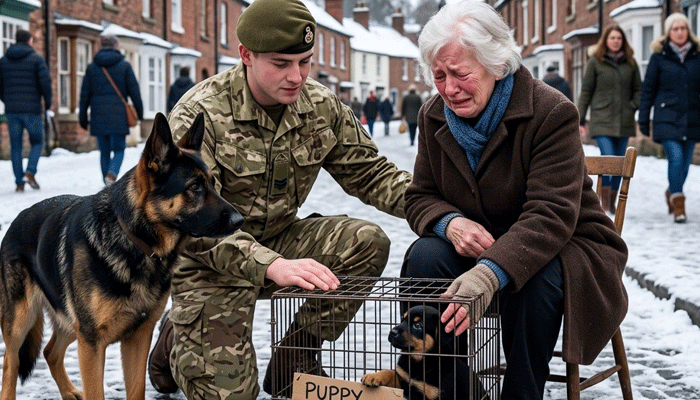
My name is Caleb Mercer, and the day I met that old woman on a frozen sidewalk in Colorado, I thought I was making a simple stop.
Buy the puppy. Help a stranger. Move on.
That was the plan when I first saw her.
It was late afternoon, the kind of mountain cold that cuts through gloves and makes every breath feel thinner than it should. I had just come out of a hardware store with a bag of dog food in one hand and my retired K9, Duke, walking close at my side. Duke was a German Shepherd I had served with overseas. He was older now, calmer, but still sharp enough to read danger and pain faster than most people read street signs.
That was why he stopped before I did.
On the corner near the bus stop sat a woman in a heavy gray coat that looked too worn for weather like that. She had to be in her seventies. Beside her was a cardboard sign with two words written in shaky black marker: Puppy for Sale. At her feet sat a small golden-brown puppy with oversized paws and sad, watchful eyes. He was clean, well cared for, and pressed so tightly against her boot that it looked less like sitting and more like holding on.
Duke refused to move.
He stood still, ears forward, staring at the woman with the same focus he used to have when something was wrong but not yet visible. I walked closer and asked the question anybody would ask.
“How much for the puppy?”
The woman looked up, and I saw the kind of embarrassment that hurts more than pride. Her name was Helen Whitaker. She told me the puppy’s name was Benny. He was the last of a litter. Her husband had bred dogs years earlier, before he passed. Benny was the last one she had left, and she said the money would help with rent, heat, and medicine. Her voice stayed steady while she said it, but her hands did not.
Then Benny climbed into her lap.
That changed everything.
Dogs do not fake attachment, and neither do lonely people when they think no one is going to save them. The puppy licked her wrist. She kissed the top of his head without even realizing she had done it. Duke sat down beside her as if he had already made his judgment about the situation. That was when I stopped seeing a transaction and started seeing what it really was.
She was not selling a dog because she wanted money.
She was surrendering the last living piece of her husband because winter had cornered her.
I asked a few more questions, gently this time. The rent was overdue. The heat bill had stacked on top of it. Her medication costs were rising. She had skipped meals. Selling Benny was the last idea she had left.
So I reached for my wallet.
But not to buy the puppy.
Because once I understood what was really happening on that sidewalk, I knew taking that dog would be one more cruelty disguised as help. And when I told Helen I was going to pay her rent instead, she looked at me like I had just said something impossible.
What I did not know yet was that helping her once would lead me into a much bigger promise—one that would pull me back into the world I had spent years avoiding after war.
Helen did not believe me at first.
That was the hardest part to watch.
When I told her I was not taking Benny, that I wanted to help her keep him, she just stared at me through the cold as if kindness had become too expensive to trust. People talk a lot about pride, but what they miss is how poverty slowly trains people not to hope out loud. Helen kept saying, “You don’t have to do that,” in the same quiet tone people use when they are already preparing for disappointment.
But I did have to.
Maybe not by law. Maybe not by obligation. But there are moments in life when you meet suffering so honest that walking away becomes its own kind of damage. I had seen enough damage already.
I brought Helen and Benny to a diner two blocks away, mostly to get them warm. Duke stayed pressed against her chair the whole time, calm and watchful, like he understood his role had changed from companion to witness. Over coffee and soup, Helen told me about her husband, Walter. He had raised dogs for years, not as some big business, but because he loved the work. After he died, the apartment got quieter, the bills got louder, and the world started shrinking around her. She sold most of the litter to survive. Benny was the last one because she kept delaying the inevitable.
“He sleeps by my bed,” she said, then looked down into her coffee. “I think he still thinks Walter’s coming back.”
That line stayed with me.
From the diner, I drove her to her apartment building. The place was older than it should have been, drafty, with paint peeling around the entrance and the kind of hallway smell that tells you management fixes only what absolutely cannot be ignored. I met the landlord that same evening, confirmed the amount owed, and paid the overdue rent plus enough to cover the next month. Then I called the utility company and cleared the heating balance. After that, I went with Helen to the pharmacy and covered her medications.
By the time I got back to my truck, it was dark.
Duke jumped in first, then turned back to look at Helen standing under the apartment light with Benny in her arms. She was crying quietly, not dramatically, just the way exhausted people cry when they finally stop bracing for the worst.
I thought that would be the end of it.
It was not.
Because once you enter someone’s life at the point where everything is about to collapse, you start seeing how many other things are also close to breaking. The apartment needed repairs. Helen had no family nearby. Her fridge was almost empty. Her arthritis made basic errands difficult. And something in me—something I had spent years numbing after leaving the Marines—started waking up every time I thought about that cold sidewalk and the sign.
So I came back the next day.
Then the next week.
Then again after that.
What began as one act of help slowly became a relationship neither of us had planned. And somewhere in those visits, over groceries, check-ins, and Benny learning to play with Duke, I realized the puppy had not just kept Helen alive.
He had led me straight toward a purpose I thought I had lost for good.
Before I met Helen Whitaker, most of my life was built around controlled distance.
That is one of the quieter things military life can leave behind when it ends badly or ends too fast. You learn how to function, how to complete tasks, how to stay dependable, even kind, without actually letting yourself become woven into other people’s daily struggles. It looks healthy from the outside. Structured. Disciplined. Independent. But sometimes it is just loneliness with better posture.
Helping Helen cracked that open.
At first, I told myself it was temporary. A rent payment. A few groceries. Medicine. Maybe a ride now and then. But small acts have a way of exposing bigger needs. I started checking on her every few days, then every week without fail. Duke came with me every time, and Benny quickly made it clear that he considered Duke both mentor and giant fuzzy bodyguard. Watching those two dogs together became one of the easiest joys I had felt in years. Duke, who had seen enough of human violence to become cautious around most noise, softened around that puppy in a way I had not seen since deployment ended. Helen softened too.
She began opening the door before I knocked.
She started setting out coffee for me before I arrived.
Sometimes she would save half a pie from the church pantry just because she knew I liked apple more than cherry. Sometimes I would bring her groceries and find she had already knitted something ridiculous for Duke, who tolerated sweaters with the grave dignity of a soldier following orders he did not respect.
It would be easy to make the story sentimental there and leave it that way. But real life is never held together by emotion alone. What helped Helen most was not one dramatic rescue. It was consistency. I helped her apply for a senior assistance energy program. A friend of mine from the VFW connected her with a community legal advocate who pushed the landlord to make overdue repairs. I arranged automatic delivery for some of her prescriptions. A woman from a local church began visiting twice a week. A teenager in the building started carrying her laundry downstairs after I paid him once and Helen embarrassed him into doing it free the next time.
That is how kindness actually works when it lasts. It spreads by becoming practical.
And Helen changed me right back.
She never treated me like a hero. I think that saved the whole thing from turning into something false. She treated me like a man who had shown up when it mattered and now had no excuse for disappearing. She asked about my service without prying. Asked about Duke like he was family. Asked the kinds of questions lonely older people ask when they have learned to listen closely: whether I was sleeping enough, whether I still talked to anyone from my old unit, whether I had a reason to come home to besides a dog and a locked apartment.
She saw too much.
One evening, a few months after we met, I found myself telling her things I had not said plainly in years. About the Marines. About coming home with more silence than answers. About how easy it had become to move through life helping everybody in small ways but never belonging anywhere long enough for help to come back to me if I needed it.
Helen listened, nodded once, then said, “Sometimes God sends people a puppy when what they really need is a reason not to stay alone.”
That sounds like something written for a movie, but Helen said it while folding dish towels in a kitchen with a flickering overhead light and a half-broken drawer. That is why it mattered. Truth usually arrives in ordinary rooms.
Over time, the visits became part of my life, not an interruption to it. I helped her move into a warmer senior apartment the following spring, one on the ground floor with better light and safer stairs. Benny came, of course. Duke inspected every room like he was clearing a building. Helen laughed more there. Ate better. Slept better. She even started baking again once the new oven stopped smoking every time it was turned on.
By summer, Benny had grown into a long-legged young dog with too much energy and no respect for flowerpots. Duke remained patient, if slightly offended by youth in general. Watching them together on the grass outside Helen’s new place, I sometimes thought about how close that entire life had come to ending on a sidewalk with a cardboard sign.
That is what stays with me most.
Not my decision. Not the money. Not even the gratitude.
The closeness of the loss.
One bad winter, one overdue bill, one more day without help, and Helen might have let go of the last creature tying her to love. I might have driven past. Duke might not have stopped. Benny might have gone to someone who never understood what he meant. People call moments like that chance. Maybe they are. But I have lived long enough to think responsibility begins the second chance places itself directly in front of you.
Helen lived three more good years after that winter.
They were not perfect years. Age still makes its claims. Health still rises and falls. But they were warm years. Connected years. Dignified years. She stayed in her home. Kept Benny. Made friends in her building. Told the story of that cold day so many times she started improving my part in it beyond recognition. I let her.
When she passed, it was quiet and not alone.
I was there. So was Benny. Duke had gone the year before, and I still like to imagine Helen greeting him first somewhere beyond language, telling him he did good, like we used to.
Benny came home with me after the funeral.
There was never any doubt about that.
Now he sleeps in the same room Duke once did, older and calmer than the puppy I first saw trembling against Helen’s boot. Sometimes he sits by the window in the late afternoon light, and I think about Walter, and Helen, and all the ways love survives by changing hands without losing itself.
That is what this story really gave me.
Not proof that I did something generous.
Proof that ordinary people can interrupt despair before it becomes permanent.
If this story stays with you, let it stay for the right reason: not because it is dramatic, but because it is repeatable. Most people will never be asked to do something grand. But nearly everyone will one day meet a moment where they can either protect someone’s last thread of hope or walk past it because it looks inconvenient. In the end, character lives there.
That winter corner in Colorado changed Helen’s life.
It changed mine too.
If this touched you, share it and check on someone struggling today—small kindness in hard seasons can save whole lives.