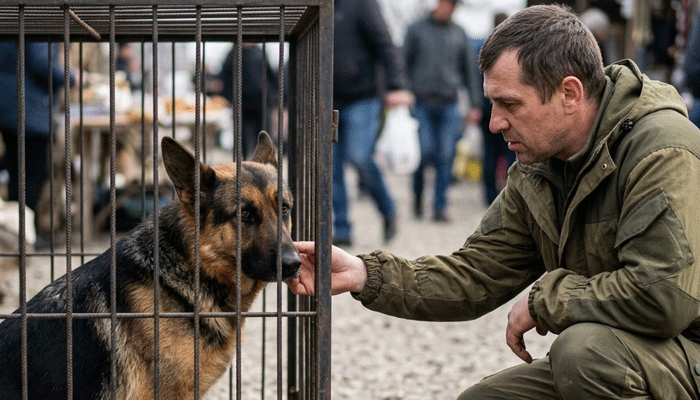
My name is Garrett Boone, and I did not go to the roadside market looking for a dog.
I went for feed, coffee, and the kind of ordinary Saturday errand that helps a man pretend his life is stable. I had been out of the Navy for a few years by then, living quietly in a small northern town where people mostly respected distance. I kept routines. Fixed what was broken. Worked with my hands. Slept badly. Said little. It was a manageable life, which is not the same thing as a good one.
Then I saw the sign.
It was handwritten in black marker on a warped piece of cardboard: MOTHER DOG + PUPPIES CLEARANCE.
That word stopped me. Clearance. Like they were old tools. Bad inventory. Something taking up space.
The pen behind the livestock tents smelled like dirt, wet straw, and neglect. Inside a rusted wire enclosure was a thin German Shepherd with three small puppies pressed against her body. She was exhausted, ribs visible, coat dull, eyes sunken from too many litters and too little care. But when I stepped closer, she did not snarl. She did not beg. She just looked at me with a kind of tired endurance I recognized immediately.
I had seen that look in men too.
One of the puppies stumbled toward the front of the pen. The smallest one was weak enough that it looked like a hard wind could push him over. When I reached down to lift him, the mother moved in front of me—not attacking, just blocking. Protective. Testing me.
So I said the only honest thing that came to mind.
“I’m taking all of you.”
The seller, a cold man named Mason Varr, gave me a price so low it felt like an insult. Not just to the animals, but to the fact that they were alive. I paid it anyway, because arguing morals with men like that only wastes time. I loaded the mother and all three puppies into my truck and drove them home.
I named the mother Hazel after the color in her eyes. The smallest pup became Finn. The other two started recovering fast once they had food, warmth, and quiet. Hazel stayed cautious, but she watched everything. Every movement. Every doorway. Every sound outside.
A kind older neighbor, Marlene Pike, began bringing over knitted blankets and homemade broth, pretending she was “just checking on the dogs” when really she was checking on me too. Little by little, the house changed. It got warmer. Less empty. Less like a place someone was hiding in.
But the past those dogs came from was not finished with them.
A few weeks later, Finn vanished.
No broken fence. No open gate. No accident.
He was taken.
And before the sun went down, I got the message I had been dreading: if I wanted the puppy back alive, I was supposed to return Hazel.
That was when I understood this had never been a simple rescue.
It was an extraction from a brutal breeding operation—and now the men behind it wanted their most “valuable” dog back.
So how far would I go to save one stolen puppy, and what would Hazel do when the people who treated her like property forced us both back into the dark?
I read the note three times before I folded it and slipped it into my jacket pocket.
No signature. No wasted words. Just a location, a threat, and one line written like a business instruction: Bring the mother if you want the small one returned alive.
Marlene stood in my kitchen, one hand pressed to her chest. Hazel was pacing near the back door, already sensing that something was wrong. The other two puppies were whining in their box, confused by the sudden tension in the room.
“I’m calling the sheriff,” Marlene said.
“You should,” I told her. “But I’m not waiting.”
That was the truth. Men like the one who sold me those dogs depended on delay. Fear. Confusion. The hope that decent people would stay inside process while they moved suffering around like cargo. I knew better.
Mason Varr had not just sold off animals. He had run part of a hidden breeding chain in the woods, the kind of place that stays invisible because enough people profit from not looking too closely. Hazel had not been worthless to them. She had been productive. That made the whole thing uglier.
I checked the property first. Tire impressions near the side access road. A boot print by the fence line. One broken strip of cloth caught on a nail. Clean job, but not clean enough.
Then Hazel did something I will never forget.
She picked up Finn’s old blanket in her mouth, carried it to the truck, and stood there waiting.
She knew.
I brought her with me.
The sheriff’s office said deputies were moving, but rural response takes time, and time was the one thing Finn might not have. Hazel rode in silence except for one low sound in her throat every few minutes, like she was holding panic in place through force alone.
The trail led toward a logging corridor west of town, then deeper into a stretch of forest broken by service roads and old trailers. I found fresh tracks near a pull-off half hidden by brush. That was where I saw the transport van.
White. Mud-splashed. Rear doors chained.
I cut the engine, checked the tree line, and moved on foot.
Finn was inside. I did not know that from sight. I knew it from Hazel. The second she caught the scent, every muscle in her body locked with purpose. She did not bark. She tracked.
And when voices rose near the van and one of them said Hazel was worth more than the pups anyway, the last piece clicked into place.
They never wanted a trade.
They wanted breeding stock returned.
Which meant if I made one wrong move in those woods, Finn would not be the only one I could lose.
There is a moment before action when the body goes still.
Not calm. Not relaxed. Still.
That is where training lives after the uniform is gone. In the breathing. In the scan. In the fast separation between emotion and sequence. I loved Finn already, and that was dangerous if I let panic lead. So I made myself slow down and read the ground, the van, the voices, the angles, the light breaking through the trees.
Two men near the rear doors. One smoking. One restless, checking the road every few seconds. A third farther back by a small generator trailer, talking on a phone. No sign of Mason yet, but this smelled like his work. Sloppy cruelty wrapped in false confidence.
Hazel stayed beside me in the brush, trembling but silent.
I put one hand lightly on her shoulder. “I’m bringing him back,” I whispered.
She looked toward the van so hard it felt like she was pulling the whole forest in that direction.
I circled left first, using the tree cover and the engine noise from the generator to mask movement. The smoker drifted away from the van to flick ash into the dirt. The restless one bent to check the chain on the rear doors. That gave me the opening. I closed distance fast, drove the first man down before he could shout, then hit the second in the ribs and throat hard enough to fold him over the bumper. He grabbed for me, missed, and slammed into the door. I took the keys, stripped the knife from his belt, and opened the back.
Finn was inside in a plastic crate, terrified but alive.
That should have been the end of it.
Then Mason stepped out from behind the trailer with a pistol in his hand.
“Leave the pup,” he said, voice flat. “The female stays with us.”
Hazel heard him.
The change in her was instant. Not wild. Not reckless. Focused. She burst from the brush and ran straight for the van, not at Mason, but toward Finn. A mother moving for her baby. Mason pivoted toward her, and that half-second was all I needed. I hit his gun arm, the shot went wide into the trees, and we went down together in the mud.
He fought dirty and desperate. Men like him always do when money is involved. He elbowed my face, tried to roll for the gun, clawed for leverage. But he was not fighting someone surprised by violence. He was fighting someone who had spent years surviving worse men in worse places. I pinned his wrist, drove his shoulder into the ground until he lost grip of the weapon, then put him face-first in the dirt and kept him there.
By then Hazel had reached the open van.
I will remember that sound for the rest of my life.
Finn gave one broken little cry from inside the crate, and Hazel answered with a low, shaking whine I had never heard from her before. Not fear. Recognition. Relief. She licked his face through the bars until I got the crate open, and the second he was free, he crawled against her chest like he had been holding himself together by memory alone.
Sirens came minutes later.
The sheriff’s deputies secured the scene, and once one trailer led to another, the whole thing started unraveling fast. Records. Hidden cages. Veterinary supply orders. Transport logs. More dogs than anyone should ever have found in conditions like that. A local reporter named Jenna Cross got the story once the raid widened, and for the first time, the people running that system could not hide behind rural distance and silence.
Mason was charged. Others followed.
Hazel never fully became an easy dog after that. She startled at sudden metal noises. Hated enclosed pens. Slept closest to the door for months, like she still believed she might need to stand between danger and her puppies at any hour. But she softened in ways that mattered. She learned the rhythm of the house. She accepted Marlene’s blankets. She let Finn climb all over her without flinching. Eventually, she even rested with her head on my boot while I sat on the porch in the evening.
The puppies grew stronger. Finn, especially, turned out to have more grit than his size ever suggested. The two larger pups were later adopted by good families I knew and trusted. Finn stayed. Hazel too. There had never really been another option.
A few months after the case broke wide open, I built a wooden sign and fixed it by the front gate.
I carved the words by hand because some messages should cost effort.
No soul is worthless just because someone else priced it wrong.
People slowed their trucks to read it.
Some nodded and drove on. Some came up the walk and asked about the dogs. Some brought donations to the shelter network that formed after the raid. Marlene cried when she saw the sign, then blamed the wind.
As for me, I understood something I had missed for too long. Service does not always look like uniforms, missions, or grand public acts. Sometimes it looks like noticing suffering where everyone else has learned to call it normal. Sometimes it looks like taking the inconvenient life, the damaged life, the one others already reduced to numbers, and saying no—this one matters too.
Hazel taught me that with one look through rusted wire.
Finn taught me that survival can fit inside the smallest body in the room.
And the whole town, in its own uneven way, learned that cruelty survives best when decent people treat it like background noise.
So I stopped treating it that way.
The house is louder now. Messier too. There are chew marks on one table leg, dog hair on everything I own, and muddy prints on the porch more mornings than not. It is the best kind of disorder. The kind built by life returning. Sometimes I sit outside at dusk and watch Hazel stretched in the yard while Finn barrels through the grass like joy is a skill he practices daily, and I think about how close they came to disappearing into a system that only measured what could be extracted from them.
They were never worthless.
Just trapped.
And maybe that is true for more of us than we like to admit.
If this story carries anything worth keeping, let it be that. Look closer. Stop when something feels wrong. Trust the eyes that tell you the truth before words do. The lives people dismiss fastest are often the ones that reveal the most about who we are when nobody is forcing us to care.
I did not go to that market looking for a fight.
I went for coffee and feed.
I came home with a mother dog, three puppies, and a reason to believe that rescuing something broken does not just change them.
Sometimes it brings you back too.
If this story touched you, share it, comment below, and follow for more powerful American stories about rescue, healing, and hope.