In a city where people pass each other by with the practiced speed of survival, one of the most moving acts of compassion imaginable appears in the least glamorous place possible: a narrow strip of sidewalk beside an old wall, exposed to dust, traffic, and the indifference of ordinary life.
There is no shelter here in the traditional sense. No roof. No front door. No warm lamp glowing in a window. There is only a thin mat spread over the concrete, two floral pillows placed with care, and a man sitting close by as if he understands that safety is sometimes not a structure, but a presence.
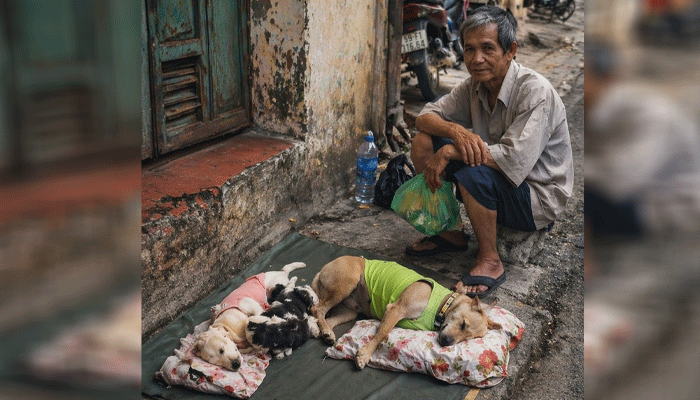
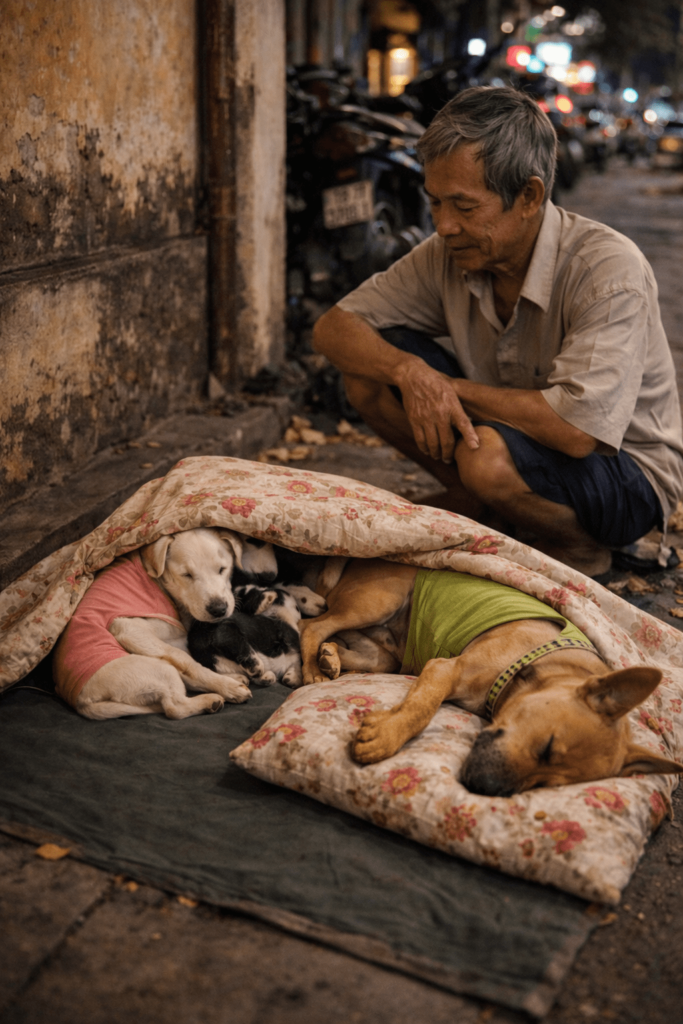
At first glance, the image seems simple. An elderly man crouches near two sleeping dogs and several puppies nestled between them. One adult dog wears a faded green shirt. The other, smaller and light-colored, is dressed in pink. Their bodies are curled into the awkward yet complete surrender of deep sleep—the kind of sleep that only comes when fear has loosened its grip. Around them, the street tells another story: a weathered wall stained by years of rain and heat, motorbikes parked behind them, shop lights stretching into the distance, the hard edge of city life never far away.
But the longer one looks, the more extraordinary the scene becomes.
Nothing about it suggests abundance. The man’s clothes are modest. Beside him sits a simple plastic bag and a bottle of water. There are no signs of comfort for himself, no visible proof that he has more to give than the little already laid out on the pavement. And yet the arrangement at his feet reveals a kind of richness many people never manage to possess. The dogs are not lying on bare ground. They have pillows. They have clothing. They have been tucked in as carefully as children. The puppies, black and white and impossibly small, are sleeping in the warm hollow formed by adult bodies that have, for one quiet moment, stopped bracing against the world.Apparel
If the accompanying account is true—and nothing in the image contradicts it—this scene is not accidental. Every night, the man reportedly creates a sleeping place for stray dogs on the sidewalk, choosing their comfort over his own convenience. He dresses them, arranges their bedding, and stays nearby like a night watchman with no salary and no shift change. He asks for nothing in return. He does not pose for applause. He does not appear to be performing kindness for an audience. Instead, he seems to be doing something rarer and far more difficult: practicing tenderness when no reward is guaranteed.
That is what makes the image so disarming. It overturns several assumptions at once.
We are used to thinking of help as something delivered by institutions, by people with resources, by those who can afford generosity. We are trained, often unconsciously, to associate compassion with comfort and goodness with stability. But this man, seated on a rough curb with little visible wealth, disrupts that story entirely. He suggests that the instinct to protect does not belong exclusively to the privileged. Sometimes, the people who understand suffering most intimately are the very ones who refuse to let others endure it alone.Apparel
There is another detail that quietly deepens the power of the moment: the dogs are fully asleep.
Animals living on the street rarely surrender to rest without caution. Their sleep is usually light, interrupted, strategic. Survival teaches them to remain ready. Hunger sharpens them. Noise startles them. The threat of being chased away, hurt, or left exposed never fully disappears. Yet here, their bodies tell a different truth. The larger dog’s head rests heavily on a pillow, eyes closed, limbs loose. The smaller dog lies on its side with the unmistakable stillness of genuine peace. The puppies, pressed close, are not alert but safe.
That may be the most shocking part of all—not that a man without much is caring for animals, but that he has managed to create the one thing street life almost never offers: enough trust for sleep.
It is easy to underestimate what that means. Food is vital, of course. Water is vital. Clothing, medicine, shelter—all of it matters. But safety is a deeper form of nourishment. To rest without fear is to be reminded that the world is not entirely hostile. To close one’s eyes in confidence is to experience mercy in its purest form. These dogs may not understand the language humans use to describe love, but their sleeping bodies appear to recognize it perfectly.Apparel
The image also reveals something else, something many modern lives are structured to hide: care is made up of small, repetitive acts that few people notice. A shirt pulled gently over a fragile body. A pillow offered to a tired head. A mat spread over cold concrete. A human staying close enough that danger might think twice before approaching.
There is no spectacle in any of it. No grand rescue vehicle. No dramatic before-and-after transformation. No polished campaign language. Just the slow, humble labor of making the world less harsh for someone more vulnerable than yourself.
That may be why the scene lingers. It is not inspiring in the shallow sense of the word. It is unsettling first, because it forces a comparison. How many people, with homes, beds, locked doors, and warm meals, would extend this kind of care consistently? How many would notice the suffering of animals outside their own walls and respond not with pity, but with responsibility? The man in the photograph does not appear to have solved poverty, homelessness, or animal abandonment. He has done something both smaller and, in a moral sense, larger: he has refused to let hardship strip him of his ability to protect.
There is a quiet irony here that cuts straight to the heart. Society often describes people like him as having nothing. Yet the picture argues the opposite. He may lack property, comfort, and security as the world measures them, but he possesses patience, empathy, and a willingness to share what little he has. Those are not decorative virtues. They are the foundation of community. In a harsher accounting, he may be poor. In a more honest one, he is practicing a wealth of spirit that many affluent lives never reach.
Even the setting amplifies the message. The old wall, cracked and faded, stands like a witness to time. The motorbikes and storefronts in the background suggest a city still moving, still bargaining, still hurrying toward tomorrow. And right there, on the edge of that movement, a man has created a pause. A pocket of gentleness in a landscape built for endurance. He has made room for rest where there should have been only exhaustion.
And perhaps that is the deepest surprise of all: he is not simply caring for stray dogs. He is restoring a piece of the moral world.
Every society reveals itself through whom it protects and whom it ignores. Street animals often fall into the second category, treated as background scenery to urban life—visible, suffering, but easy to overlook. Yet in this single act of care, the man rejects the logic of neglect. He sees individuals where others might see inconvenience. He sees need where others see nuisance. He sees lives worth cushioning, warming, and guarding through the night.
For readers encountering this story, the temptation may be to call him extraordinary. In one sense, he is. But perhaps the harder truth is that his actions look extraordinary only because ordinary compassion has become so scarce in public life. He is doing what the world should make more common: protecting the vulnerable, quietly and without calculation.
By morning, the mat may be folded away. The pillows may be carried off. The traffic will swell, the city will resume its relentless tempo, and most people who pass that stretch of sidewalk may never know what happened there during the night. They will not know that, in the darkness, a man with very little built a sanctuary out of cloth, patience, and love. They will not know that two dogs and their puppies slept not as strays, but as creatures briefly claimed by tenderness.
But the evidence remains in the image, impossible to dismiss once truly seen.
On that bare patch of pavement, there is no luxury. No comfort by conventional standards. No guarantee of tomorrow.
And yet there is a home.
Not because walls were built. Not because money was spent. But because one man chose, night after night, to make another life feel protected.
In an age obsessed with ownership, status, and display, that may be the most radical kind of wealth there is.