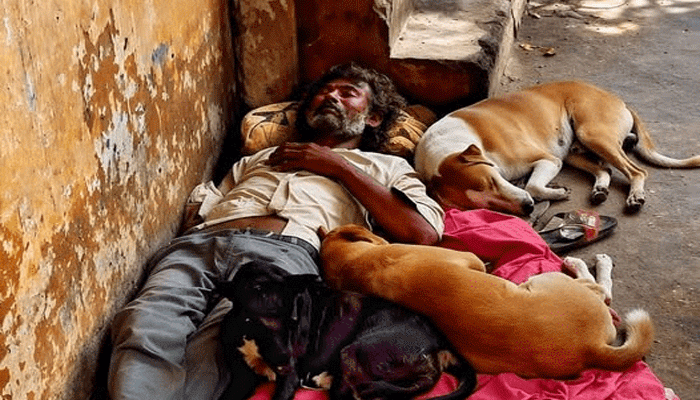
On a narrow stretch of pavement beside a weathered wall, a man lies asleep beneath the open sky. There is no roof over his head, no locked door nearby, no stack of belongings tucked safely out of sight. A thin cloth and a small pillow seem to be all that separate his body from the concrete. Around him, however, is something extraordinary: a circle of sleeping dogs, pressed close in complete trust.
Some curl against his legs. One rests near his chest. Another lies stretched out at his side, calm and still, as if it has spent countless nights there. Together, they form an image so striking that it stops people in their tracks. At first glance, the scene looks almost unbelievable—a homeless man asleep outdoors, surrounded not by fear or chaos, but by the quiet loyalty of stray animals who seem to have chosen him as their own.
That image alone is enough to stir emotion. But the story behind it is what truly lingers.
People in the area say the man has no permanent home and very little to call his own. He survives day to day, receiving whatever help or food comes his way. Yet those who have watched him over time say there is one thing he does with remarkable consistency: he shares. Whatever little food he gets, locals say, he offers to the dogs first.Dogs
That detail transforms the photograph from a touching moment into something much deeper. It explains why so many stray dogs, animals shaped by hunger, danger, and rejection, would gather around one man and settle beside him as though he were the safest place in the world.
For anyone who has spent time around street dogs, their behavior says more than words ever could. Stray animals do not hand out trust easily. They know how to read threats. They know which footsteps to avoid, which hands are dangerous, which voices carry cruelty. They do not gather around a human being by accident. Certainly not this many of them. Certainly not in such a relaxed, defenseless way.
And that may be the first surprising truth hidden inside this scene: the dogs are not simply following him because he feeds them. They are with him because they know him. They have learned his rhythms, his scent, his silence, and the intentions behind his hands. They do not just expect food from him. They feel safe with him.
s
Safety is easy to overlook when we talk about animal welfare, but for a dog living on the street, it may be the rarest gift of all.
The image captures that gift in its purest form. None of the dogs appear tense or ready to flee. Their bodies are loose. Their eyes are closed. Their paws are stretched in the careless way animals rest only when they believe, at least for the moment, that no harm is coming. One dog lies partly draped across the blanket. Another has chosen the vulnerable spot near the man’s torso. These are not random positions. They suggest familiarity, routine, and a bond that has been built day after day in small, unrecorded acts of kindness.
In many cities, homeless people and stray animals exist on the same invisible edge of society. Both are seen and not seen. Both move through public spaces without truly belonging to them. Both learn how quickly the world can look away. It is perhaps no coincidence that these lives so often intersect. A person who knows abandonment may recognize it instantly in an animal. A creature used to being chased away may understand gentleness faster than we expect.
What makes this story especially powerful is the reversal at its center. When people first look at the man, they may assume he is the one with the least to give. He appears to have no wealth, no shelter, and no physical comfort. He seems to be the one most in need of rescue. But according to those nearby, he is also the one offering what he can to others every single day.
That contradiction is what makes the scene unforgettable.
There is a tendency in modern life to measure generosity by surplus. People give, we assume, when they have enough money, enough time, enough stability, enough space. Kindness is often imagined as something that flows outward from security. Yet stories like this challenge that assumption. Here is a man with empty pockets who still chooses to divide what little he receives. Here is someone whose own life is precarious, yet who makes room in it for creatures even more vulnerable than himself.
The second surprise is that the dogs seem to return the favor in a way no one could have scripted.Dogs
Look carefully at the scene and it no longer feels like a man caring for animals from a position of strength. It feels more like a family formed in hardship. The dogs keep close to him not only because he gives them food, but because they give something back: company, warmth, protection, and perhaps most importantly, presence. In a life defined by instability, their loyalty may be one of the few constants he can count on.
That is what gives the photograph its emotional force. It is not just about pity. It is about mutual devotion.
In many places, stray dogs live harsh lives. They dodge traffic, search through trash, endure heat and rain, and often suffer untreated wounds or illness. The man in this story appears to understand their suffering not as an outsider, but as someone who shares a version of it. He knows what it means to go without. He knows the uncertainty of the next meal. He knows what it means to rest in a place that is not truly safe and still try to sleep anyway. Perhaps this is why his compassion feels so instinctive. He is not helping from a distance. He is helping from within the same storm.Dogs
And perhaps that is why the dogs trust him so completely.
There is another layer to this story that many readers may find hard to shake: in a world crowded with resources, institutions, and systems, it is often the poorest people who become the last refuge for abandoned animals. While others pass by, busy or indifferent, someone with almost nothing still stops to notice a hungry dog. Someone with no front door still creates a sense of home. Someone society may dismiss as powerless becomes, to a cluster of strays, the center of safety and belonging.
That uncomfortable truth says as much about us as it does about him.
The wall beside which they sleep is cracked and peeling. The bedding is improvised. The setting is rough, exposed, and fragile. Nothing about the environment suggests ease. And yet the emotional atmosphere of the image is strangely tender. The dogs are not scattered. They are gathered. The man is not isolated. He is surrounded. In the middle of visible hardship, there is unmistakable evidence of attachment.Dogs
That is the third surprise: this photograph, though born from poverty, is not empty of abundance. It is full of it—just not the kind most people are trained to recognize.
There is abundance in trust.
Abundance in routine.
Abundance in being awaited, followed, and loved.
To the outside world, he may appear to have nothing. But to the dogs sleeping beside him, he is not a man with nothing. He is a provider. A protector. A familiar heartbeat at the end of a hard day. And in return, they offer him something that money cannot secure: unquestioning companionship.
Stories like this resonate because they restore something many people fear has been lost. They remind us that compassion does not belong only to the comfortable. It survives in the margins. It survives in people who know suffering personally. It survives in gestures so small they rarely make headlines: a piece of bread broken in two, a hand reaching down to feed another mouth before feeding one’s own, a body making space for another body on a blanket spread over concrete.
No one can say exactly when the first dog began following him. No one knows how many meals he has given away, or how many nights he has fallen asleep like this, watched over by the very animals he once helped. But the image suggests something profound: kindness, when repeated often enough, becomes visible. It changes the behavior of the world around it. It creates its own quiet gravity.
That may be the most unexpected detail of all. This man, who owns no land, no house, and no possessions of value, has managed to build something many people spend their entire lives searching for.
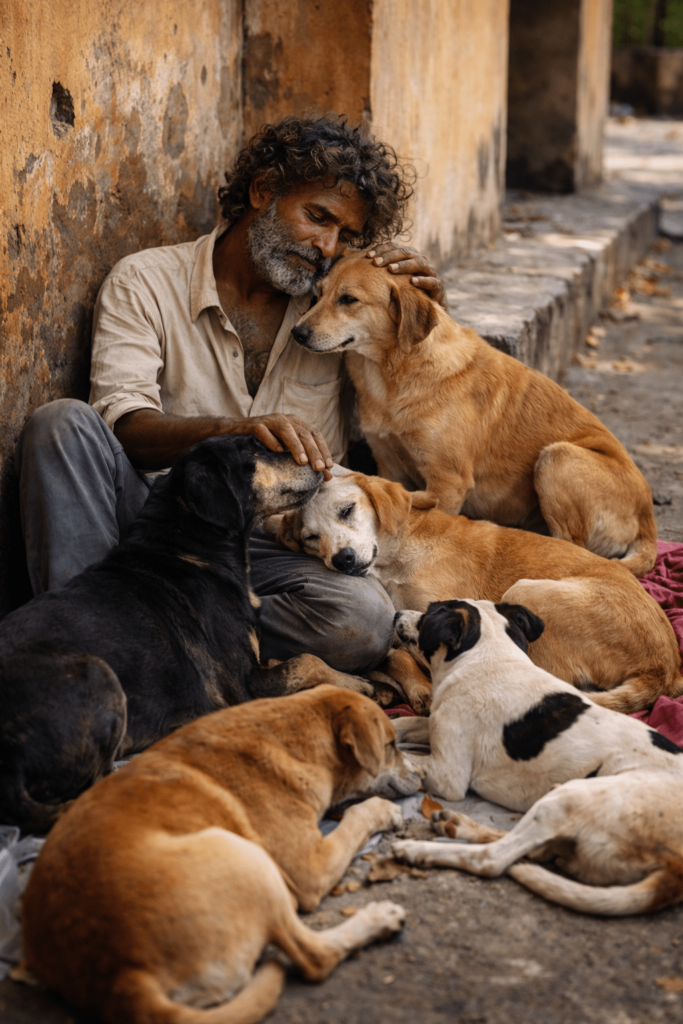
And he built it with almost nothing except love.
In the end, that is why the dogs do not leave him.
They are not simply following the hand that feeds them.
They are staying with the man who, despite having so little, never treated them like they were unwanted.
On a hard sidewalk under an open sky, among cracked walls and passing strangers, that choice has created a small circle of belonging powerful enough to stop the world and make it look again.