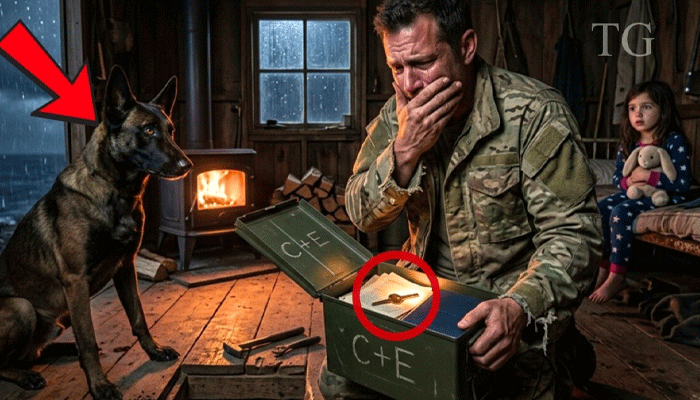
The storm hit Port Callahan, the way bad news always does. Without warning. All at once.
It came off the Pacific just before 11:00 at night, a wall of black water and 50 knot wind that bent the harbor pines sideways and sent the buoy markers swinging wild in the dark.
The old cannery sign on Tide Street flickered twice and went out. Down at the marina, the crab boats groaned against their moorings like they were trying to pull free and run south before whatever was coming got any worse.
Gareth Lund sat in the leather chair by the front window and watched the rain come down in sheets across the yard.
He had been sitting there since 8:00. He did this most nights now. Not because he could not sleep.
Because sleeping meant going upstairs. And going upstairs meant the bedroom. And the bedroom still smelled like Nora’s hand cream, that faint lavender scent she had used every night for 30 years before she turned the light off.
And some nights that smell was the only thing in the world that felt real.
And other nights, it was the thing he could not bear. Nine months. Nine months since he had stood at the graveside in the November cold and listened to Pastor Elliman read the 23rd Psalm while the wind came off Hadley Bay and cut right through his good wool coat.
Nine months since he had driven home alone and sat in the same chair and understood for the first time in his 64 years what the word empty actually meant.
Not as a description of a room or a glass or an afternoon. But as a description of a cheSt. A set of hands.
A house that used to have a particular sound to it, the sound of another person moving through it, making coffee, closing a drawer, calling his name from the kitchen for no reason except that she wanted to know where he was.
The chair faced the window. He had moved it there after she died. He told himself it was because he liked watching the weather come in off the water.
That was partly true. The other part, the part he did not say out loud to anyone, was that facing the window meant his back was to the room.
And the room without Nora in it was harder to look at than the storm.
Birch was on the floor to his left. The dog was not asleep. He was doing what Belgian Malinois do when they are not working, which is rest their body while keeping their mind fully online, ears rotating in small precise adjustments, cataloging the sounds of the storm, separating the ordinary from the notable.
Gareth had worked with K9 units for 11 of his 26 years at Portland PD.
He knew what a resting Malinois looked like. And he knew what a watchful one looked like.
And Birch right now was both at once, the way the best ones always were.
On the sofa, Wren slept with one arm hanging off the cushion and her mouth slightly open.
Seven years old, dark-haired, her grandfather’s jaw and her grandmother’s eyes. She had fallen asleep during the movie they had been watching, some animated thing about a bear and a lighthouse that Gareth had not really followed because he kept looking at the window.
She still had one sock on. The other one had disappeared somewhere between the kitchen and the sofa, and Gareth had not investigated because some things you learn to let go of when you were raising a 7-year-old by yourself.
He had been raising Wren for 2 years. Her father, his son Daniel, had died in a climbing accident in the Cascades when Wren was 5.
Her mother had been out of the picture long before that, gone back to her family in Vermont when the marriage fell apart in the second year.
After Daniel, there was no one else. So, Gareth had driven to the hospital in Bend where they were keeping Wren overnight for observation after the rescue team brought her down from the camp, and he had sat beside her small bed in the pediatric ward and held her hand.
And when she woke up and looked at him with those eyes that were entirely Nora’s eyes, he had said, “You are coming home with me.”
And she had nodded like she already knew. That was how he had become, at 62 years old, the primary caregiver of a kindergartner.
His colleagues at Portland PD, the ones he still talked to, thought this was either the most remarkable thing they had ever heard or the most exhausting, depending on who you asked.
Gareth thought it was both. He also thought it was the thing that had kept him functional after Nora died because Wren needed feeding and bathing and driving to school, and helping with her reading, and all of that needed doing whether or not the man doing it had any interest in getting out of the chair.
The storm doubled in intensity around 10:30. The rain on the roof went from a steady percussion to something that sounded like a different category of weather entirely, something that had decided to make a point.
Birch lifted his head. Not at the rain, at something else. Something below the frequency of the storm.
A vehicle on the gravel drive. Gareth heard it a second later. Headlights swept across the ceiling through the front window, briefly illuminating the room in a cold white arc.
He checked his watch, 10:47. He was not expecting anyone. He did not move quickly.
26 years of detective work had burned the instinct for dramatic response out of him a long time ago.
Dramatic response was what civilians did when they were startled. Professionals observe firSt. He sat still and watched the headlights die, listened to the car doors, counted the footsteps on the porch.
More than one set. Two, possibly three, with a fourth hanging back. He noted the weight distribution of each step.
Not nervous footsteps. Deliberate ones. The knock was formal. Not aggressive, not tentative. The knock of someone who had decided exactly what they were going to say before they raised their hand.
Gareth stood. He was 6 feet tall, still carrying most of the build he had maintained throughout his police career.
Though the years since retirement had softened the edges slightly. His hair had gone fully white in his late 50s, which had bothered him for about a week and then stopped bothering him when Nora told him it made him look distinguished rather than old.
He was wearing the blue flannel shirt she had given him two Christmases ago. He wore it often.
He opened the door. Douglas Fenn stood on the porch with two men behind him and a lawyer to his left.
Fenn was 56 years old, silver-haired with a particular brand of tan that comes from a boat rather than a beach.
The kind of man who had never done an honest day’s outdoor labor but had spent enough time on the water to develop the weathered look he believed gave him credibility.
He wore a charcoal overcoat that cost more than Gareth’s truck. In his right hand, he held a Manila folder, which he tapped against his palm with a measured rhythm that was clearly practiced.
The two men behind him were not introduced and did not need to be. Gareth clocked them the moment the porch light reached their faces.
Private security, ex-military by their posture, both carrying under the left shoulder. The lawyer was younger, mid-30s, holding a briefcase and looking at a point slightly above Gareth’s head in the way that lawyers look at things when they are trying to appear neutral.
“The paperwork is straightforward,” Fenn said. His voice had the smooth, pre-laundered quality of a man who had spent decades in boardrooms where the language of power was disguised as the language of reason.
“The property was held under a trust instrument that Nora established 2 years ago. With Nora gone, the trust reverts.
You have no legal claim.” He set the folder on the side table just inside the door and spread the documents open like a man presenting a business proposal he expected to be accepted.
Gareth did not look at Fenn. He looked at the documents. He had spent 26 years reading paperwork, police reports, court filings, warrants, witness statements, financial disclosures, autopsy reports.
He had developed a kind of relationship with written documents that some people develop with faces, the ability to read them quickly, deeply, and with particular attention to what was wrong rather than what was present.
A good document flows. A forged one has friction in its small places where the logic stutters, where the dates do not quite align with the language, where a provision references something that does not exist in the statute it claims to cite.
He read for 90 seconds. The filing date on the trust transfer was offset by 13 days from the probate court stamp.
The provision on page three cited an Oregon statute number that did not correspond to any section of the probate code.
The notary seal was legitimate, but the commission number was from a notary whose license had lapsed in 2021.
Three separate friction points in 90 seconds. He had built felony cases on less. He looked up at Fenn.
He did not say what he had found. This was something he had learned early in his career and never forgotten.
When you know something the other person does not know, you know you do not announce it.
You file it. You use it later when and where it does the most damage.
He said nothing at all. Fenn filled the silence the way men like Fenn always fill silence with more words, more certainty, more repetition of the conclusion.
As though repetition could substitute for evidence. He said something about cooperation and about the county sheriff and about how much easier this would be for everyone if Gareth simply signed the transfer forms tonight.
Gareth walked to the sofa. He lifted Wren gently the way he had learned to lift sleeping children with one arm under the knees and one behind the back, distributing the weight so nothing would wake her.
She stirred slightly, made a sound, pressed her face into his shoulder. He carried her to the hall closet.
He retrieved her yellow rain slicker and his own field jacket, the old canvas one he had worn on surveillance operations in the early years.
It’s left pocket still carrying the ghost of the pen he had kept there for two decades.
He found Wren’s boots by the door. He put them on her feet without waking her.
She accepted this with the unconscious trust of a child who has learned that the person holding her will handle the situation.
He clipped Birch’s lead. He picked up the go bag from the closet shelf, a habit from 26 years of being the kind of man who kept a bag ready because the day you stopped being ready for the worst was statistically the day the worst arrived.
He had repacked it 6 months ago with Wren in mind. Extra socks, her inhaler, or small stuffed rabbit she called Pip that she claimed she did not need anymore, but which appeared in her arms every morning without fail.
He walked to the front door. He stepped off the porch into the full force of the storm.
Finn said something behind him. Gareth did not turn around. The rain hit him across the face and the wind pushed at his back and he walked to the truck with Wren against his chest and Birch at his left heel and none of it felt as cold as standing in that living room had felt.
He got Wren buckled into the back seat. She was half awake now, looking at him with the patient serious expression she used when she was deciding whether a situation required her to be worried.
He said, “Close your eyes, bug.” She closed them. Within a minute her breathing had evened out again.
Birch settled beside her, his flank against her legs. Gareth sat behind the wheel and did not start the engine.
He sat for 30 seconds and watched the light in the living room window. Finn’s silhouette moving through it.
Already measuring the space. He started the truck. He pulled out onto Cliffside Road and drove south toward the harbor, away from the direction of Finn’s convoy.
Away from the direction of anything that could be called a plan, because he did not have a plan.
Yet, he had a direction. He had the knowledge of what the documents were not.
And he had the habit built over a quarter century of thinking before acting, even when every instinct said to move.
He drove for 4 minutes, then he stopped in the parking area above the harbor, where the view on a clear night would have shown him the whole spread of Hadley Bay and the lights of the crab fleet at anchor.
Tonight there was only rain and dark and the sound of water against the breakwater below.
He opened the glove compartment. He opened it not because he was looking for anything specific, but because it was the kind of reflexive movement a man makes when he needs something to do with his hands while he thinks.
His fingers found the registration, the insurance card, the flashlight he kept wrapped in a cloth band so it would not rattle.
And then they found something that should not have been there. An envelope. Plain white sealed approximately 4 in by 6.
His name written on the front in handwriting he would have recognized in a pitch dark room on the back of a moving vehicle, through the window of a burning building.
Nora’s handwriting. He held it for a moment without moving. The rain hammered the roof of the truck.
In the back seat Wren slept. Birch watched him steadily from beside her unhurried waiting.
He turned the envelope over in his hands. On the back below the seal, two lines in the same handwriting.
Only open when you really need to. And below that, smaller, I love you. He set it on the passenger seat.
He looked at it for 10 seconds. Then he picked it up and opened it.
Inside a single sheet of paper folded in thirds. He unfolded it under the dome light.
Storage unit, Hadley Self Storage Route 9 North. Bay 22C. Combination 71491. Everything you need is there.
I am sorry I did not find a way to tell you while I still could.
He turned the paper over. Read it again. Then it landed on him slowly, the way cold water lands when you lower yourself into it a degree at a time.
He had rented unit 22C 8 months ago. He had chosen it because the number meant nothing to him and he had wanted nothing that meant anything at the time.
But he had not chosen Hadley Self Storage on any deliberate basis. He had driven there in the first weeks after the funeral, on what he had taken to be instinct.
The way grief drives you to gas stations and parking lots and other places with no associations.
And he had picked the facility because it was on the north road and he had needed to keep driving.
Except that Nora had taken him to that facility 2 years earlier. He had not remembered it until this moment.
A Saturday errand she had described as routine returning something for a neighbor. She had pointed to the second row of units as they passed and said [clears throat] that one is good, the number is easy to remember.
He had registered it as nothing. Small talk on a Saturday. She had registered it as something else entirely.
He folded the paper. Put it in his shirt pocket. Started the truck. Hadley Self Storage was 3 miles north of the harbor on Route 9, a single story concrete block facility with an automated gate and two rows of orange roll up doors running perpendicular to the road.
He tried the combination she had written at the keypad. 7 14 91. The date on the back porch.
The evening they had sat there for the first time after buying the Port Callahan house and watched the sun go down over Hadley Bay together.
The gate opened. He drove through slowly. Bay 22C was in the second row middle of the run.
He parked in front of it, left the engine running with the heat on for Wren.
Birch looked at him. Gareth said, “Stay.” The dog settled. He walked to the unit and dialed the combination on the padlock.
The same numbers. It opened on the first try. He raised the door. He had expected his own boxes, the ones he had loaded here in January.
When he could not bear to donate Nora’s things, but also could not bear to keep looking at them.
What he found instead was entirely different. Four cardboard banker’s boxes numbered one through four in black marker, stacked in two pairs.
A laptop computer plugged into the single outlet on the side wall and fully charged.
A small digital voice recorder on top of box number one with a strip of masking tape across it and two words written in Nora’s hand.
Listen firSt. He stood in the entrance of the storage unit with the rain driving sideways at his back and looked at what his wife had built in here without telling him and he understood with the clarity that comes to men who spent decades reading crime scenes, that this was not a storage unit.
This was a case file. He picked up the recorder. Pressed play. Nora’s voice came through the small speaker, unhurried and clear.
The voice of a woman who had thought carefully about every word she was about to say and then said them anyway, because there was no time left for hesitation.
Gareth, if you are listening to this, Douglas Finn has made his move. I want you to know that I tried to find a way to tell you all of this in person and I could not find the way, because every time I tried to figure out how to start the conversation, I kept thinking about what you would do when I told you and I was afraid of what you would do.
I know you. I know how you handle things and I needed you to still be there for Wren.
So I am telling you this way instead. 16 months ago I was hired to audit the financial records for a company called Tidewater Coastal Ventures.
That company is a shell. It exists to move money from one set of accounts to another while disguising the origin.
The man behind it is Douglas Finn. I know this because I followed the numbers, which is what I do and the numbers do not lie the way people do.
What I found is not small. Finn has been running money through a network of real estate acquisition companies along the northern Oregon coast for at least 5 years.
The amounts are large enough to constitute federal wire fraud, possibly money laundering. I have documented everything.
It is in the boxes. Box one is the financial structure. Box two is the property acquisition chain.
Box three is the medical records. Do not skip box three. The reason Finn wants our property is because of the dockside development project.
The federal approval came through 6 months ago. The northern coastal quarter, our 12 acres included, is worth $220 to the development consortium once the project is certified.
Finn owns 70% of that quarter through his shell companies. He needs our land to complete the chain.
He will come for it. I always knew he would come for it. That is why I prepared this.
There was a brief pause on the recording. The sound of a breath being taken and held and slowly released.
And Gareth, box three, please read it carefully. I need you to read it the way you used to read evidence.
The recording ended. He stood in the storage unit for a long moment after the voice stopped.
He had spent 26 being the person who called people with bad news. The one who sat across the table and delivered facts that rearranged lives.
He had done it professionally with the measured compassion that the work required and he had been good at it.
He had never been the one receiving the call. He pulled box three off the stack.
Inside two folders. The first was labeled OHSU with Nora’s name and her patient number.
He opened it. Her oncology records, the real ones, the ones from Oregon Health and Science University where she had been treated.
He read the dates, the treatment notes, the physician assessments. The final entry from her primary oncologist was dated the 11 months ago, 2 months before she died.
Patient remains cognitively intact, the note read. Treatment response guarded, but not terminal at current projection.
Continue monitoring protocol. He set that folder down. He picked up the second one. This one was labeled Grants Pass.
The letterhead was from something called Pacific Crest Medical Consultants. The physician’s name was Philip Oaks.
Gareth did not recognize it. The dates in this file were different from the OHSU records clustered in the last 2 months of Nora’s life.
The language was clinical and precise and entirely wrong. Patient demonstrates significant cognitive deterioration inconsistent with underlying oncological condition.
Patient has expressed desire to reorganize financial holdings in anticipation of incapacity. Patient was advised of available options and elected to execute a voluntary property transfer agreement designating Douglas Finn, identified as family representative, as authorized agent for all real estate assets.
He closed the folder. He set it on top of the box. He walked to the entrance of the storage unit and stood in the opening with the rain in his face and looked at the dark row of storage doors across the lane and breathed in through the nose, out through the mouth, the way the department psychologist had taught him in 1998 after a particularly bad homicide case in which he had practiced ever since.
Philip Oaks. He did not know that name. But he would. He looked back at the laptop on the shelf.
He looked at the four numbered boxes. He thought about Nora in the last 2 months of her life, the period he had spent at her bedside reading to her, watching movies on the small tablet propped against the hospital tray, holding her hand through the nights when the pain made sleep impossible.
He remembered those nights with a fidelity that nothing had managed to blur. He remembered the crossword puzzles she had worked in pen, the arguments she had won about the plots of books they had both read, the letter she had written for Wren, one sealed envelope for each of Wren’s birthdays until the child turned 18, labeled in order, stacked in the safe deposit box at First National.
That was not a woman whose cognition had deteriorated. That was not a woman who had needed a family representative to organize her affairs.
He went back inside. He opened box one. The financial structure Nora had documented was meticulous.
She had been a forensic accountant for 30 years and the work in this box showed every hour of that training.
Shell company registration filings, bank transfer records obtained through sources she did not explain, but which he could guess from the notation style, property acquisition chains mapped in colored ink on sheets of graph paper.
The network was large and carefully designed and had clearly [clears throat] been built over years by someone who understood how to make money disappear and reappear wearing a different name.
He worked through this first box for 20 minutes. Then he opened the laptop. The laptop was organized the way Nora organized everything, which was to say, it was organized in a way that a person who was not Nora could figure out without a manual.
Folders labeled by date and category, a master index file on the desktop called read me first that linked to every document in the system and explained in plain language what each one showed and why it mattered.
He opened the master index. He read it once through for content and once through for what it did not say, the way he had always read intelligence documents in his career.
The picture that emerged was complete. Fenn had been building this structure for 5 years.
He had needed the northern coastal corridor to complete the development deal. He had identified Nora’s property as the final piece 18 months ago at the same time Nora had been brought in to audit one of his companies.
Whether that timing was coincidence or calculation, Gareth could not yet say. What he could say with the certainty of a man who had spent 26 years establishing facts for prosecutors was that Douglas Fenn had forged the documents he had placed on Gareth’s side table tonight and that Philip Oaks had produced medical records that did not reflect Nora’s actual condition and that those two facts taken together with the property transfer they had been used to justify constituted a crime, possibly more than one.
He sat with the laptop open and the boxes arranged around him and listened to the rain hitting the corrugated metal roof above his head.
Birch appeared in the entrance of the unit soaked from the rain and looked at him with the patient expectation of a boy who had decided that whatever was happening, he should probably be part of it.
Gareth said, “Come in.” The dog came in and shook the water off his coat and sat down next to the boxes.
He thought about what came next. He was 64 years old. His knees were honest about their age every morning.
He had been out of active service for 3 years. He did not carry a badge anymore and he did not carry a firearm, though he still had his carry permit and the .45 in the safe at home, the home he had just walked out of, the home that Douglas Fenn was currently measuring for the curtains he was planning to hang.
He thought about Wren sleeping in the backseat of the truck 20 ft away. He thought about the sealed envelopes in the safe deposit box at First National, one for each of her birthdays written in a hand that no longer existed in the world.
He thought about what Nora had said at the end of the recording. “I needed you to still be there for Wren.”
She had known him. She had known exactly what he would want to do when he found out.
She had prepared this entire file, hidden it in a place she calculated he would find and structured it as evidence rather than as accusation because she knew he was a man who needed to work a case rather than fight a wrong.
She had handed him the file was what he knew how to use. He loved her so completely and so permanently that the word love did not feel adequate to the thing it was trying to describe.
He closed the laptop. He restacked the boxes. He carried them to the truck and loaded them in the bed, covered them with a tarp he kept back there.
Then he went around to the driver’s door and got in and sat for a moment looking at Wren in the rearview mirror.
She had shifted in her sleep, one hand curled near her face, Birch’s chin resting on her ankle.
She looked like Nora had looked in photographs from before Gareth knew her, that same quality of stillness even in sleep, that same impression of a mind working quietly behind a face that gave nothing away.
He started the truck. He knew where he was going next. He had known before he finished reading the first folder.
He needed to get Wren somewhere safe before he did anything else because everything that came after this would require his full attention and he could not give it full attention if part of his mind was monitoring a 7-year-old.
Edith Morrow lived on the east side of Port Callahan in the blue house on Cormorant Street, the one with the garden that she maintained with the focused determination of a woman who had decided that growing things was her particular argument against the general entropy of the world.
She was 70 years old and she had been Nora’s closest friend for 22 years, since before Wren was born, since before Daniel died, since before any of the losses that had progressively narrowed the circle of people Gareth trusted down to approximately this one woman.
He drove to Cormorant Street through the diminishing storm. The worst of it had passed over, though the rain was still heavy and the streets were running water at the curbs.
He pulled into Edith’s driveway and turned the engine off and sat for a moment.
The porch light came on before he got out of the truck. She opened the front door before he reached the porch.
She looked at his face, then at Wren asleep against his shoulder, then at Birch behind him.
She said nothing for a moment. Then she opened the door wider and stepped back and said, “Come inside.”
He carried Wren in and laid her on the sofa in the front room and covered her with the blanket Edith took from the linen closet without being asked.
Birch settled on the floor next to her. Edith went to the kitchen and put the kettle on.
He followed her. He stood in the kitchen doorway and gave her the short version.
The documents tonight, the storage unit, Nora’s files, the medical records, Philip Oaks. He did not editorialize.
He stated facts and let the facts carry the weight the way he had always done.
Edith listened with her hands around the kettle and her eyes on the countertop. When he finished, she was quiet for a moment.
Then she said, “I told Boyd Ritter 14 months ago that something was wrong with Fenn’s financials.”
She said it with no inflection. Just the fact. “I was keeping records of the county budget committee work and the numbers did not align with his declared revenues.”
“Boyd told me I did not understand commercial shipping accounting.” She looked up. “I understood it perfectly,” she said.
He looked at her. He had suspected something about Ritter from the moment Fenn walked through his door tonight with private security and forged documents and the calm assurance of a man who was not worried about local law enforcement.
That kind of assurance only came from certainty and certainty of that nature usually had a source.
Now he had a data point. He told Edith he needed to leave Wren with her for the day, possibly the night.
He told her not to answer the door for anyone she did not know and if anyone claiming to be law enforcement came to the house to call him before she opened the door.
He paused, then added one more instruction. If she did not hear from him within 6 hours, she was to call the FBI field office in Portland and ask for the commercial crimes unit.
He wrote the number on the notepad by the phone from Nora’s master index. She said yes before he finished the sentence.
He went back to the front room. He crouched down beside the sofa and looked at Wren sleeping.
He had done this at the beginning of every operational day for 2 years, since the morning after she came home with him from Bend.
Just looked at her for a moment, filed the image, carried it. He stood up.
He took the go bag from his shoulder and set it beside the sofa where Wren could reach it if she woke up and needed anything.
He kept the tactical jacket, the KA-BAR on his belt, the Bushnell binoculars he had carried since his last major surveillance case in 2019.
He transferred the files from Nora’s laptop to a USB drive he had in the bag.
He looked at Birch. The dog was already on his feet. He took Birch’s lead off.
In working situations, Birch did not use a lead. In working situations, the dog operated on positioning and hand signals and the kind of wordless communication that built up between a handler and a canine over years of shared operations.
Gareth had worked with Birch for 4 years. The dog was nine now, which was older than most working Malinois in active service, but Birch was not most working Malinois and both of them knew it.
He went out through the front door into the diminishing rain with the dog at his left side and the case file in his jacket and 26 years of knowing how to move through a situation that had stopped being theoretical and become entirely real.
The storm was pulling back. The clouds were thinning in the west and through the gaps in them, brief and intermittent, the last stars of the morning were beginning to show through.
Port Callahan was quiet, the way small towns are quiet after a storm. Everything slightly rearranged, the air smelling of seawater and pine and wet pavement.
Douglas Fenn had come to his door tonight with forged documents and private security and the patient confidence of a man who had spent years building a structure designed to leave Gareth with nothing.
What Fenn did not know was that Nora had spent 16 months building a different structure.
One designed to leave Fenn with exactly what he deserved. Gareth had been a detective for 26 years.
He had closed 114 homicide cases, 47 financial fraud cases, and more minor matters than he had ever bothered to count.
He had done it methodically, carefully, without drama, one established fact at a time. He was going to do it one more time.
He moved into the dark with Birch beside him and began. The Port Callahan Sheriff’s Department occupied a converted Victorian on Main Street that had once been a dentist’s office, then a real estate firm, then briefly a yarn shop before the county bought it in 2003 and painted it the particular shade of beige that municipal buildings default to when no one has strong feelings about color.
The flag out front flew the Oregon state flag at half-staff. Gareth did not know why.
He did not ask. He left Birch in the tree line across the street and went in through the front entrance at 7:40 in the morning.
The deputy at the desk was young, maybe 25, with the look of a man who had not yet had enough coffee to deal with whatever was walking toward him.
Gareth asked for Chief Ritter. The deputy picked up the phone. Gareth stood at the counter and waited and looked at the bulletin board on the wall behind the desk.
The missing persons notices and the community alerts and the photograph of the department’s last K9, a shepherd named Duke who had died in service in 2018 and whose framed photo was still up because no one had taken it down.
Ritter came out of his office 2 minutes later. Boyd Ritter was 59 years old, broad through the shoulders with a face that had been outdoors in Oregon weather for most of his life and showed it.
He had been chief of the Port Callahan Department for 6 years, elected on a platform of community policing and fiscal responsibility, which in a town of 3,800 meant knowing everyone’s name and not spending money on things the county could not afford.
He had come to Nora’s funeral. He had sat three rows back and held his hat in his lap and afterward he had shaken Gareth’s hand and said she was a good woman, which was true but insufficient, the way all condolences were insufficient.
Gareth watched him cross the bullpen. He had spent 26 years watching people cross rooms toward him and reading what their bodies told him before their mouths opened.
He noted the distance Ritter stopped at 2 ft short of where a man stops when he is genuinely glad to see you.
He noted the way Ritter’s right hand stayed low at his side rather than coming up in a handshake.
He noted the controlled quality on Ritter’s face, which was not the composure of a man who was surprised by an early morning visit.
It was the composure of a man who had been waiting for a specific thing to happen and was now watching it happen exactly as he had anticipated.
Gareth filed all of this. He said nothing about any of it. He sat across from Ritter’s desk and placed a partial set of Nora’s documents on the blotter between them.
Not everything, enough to establish the nature of what he had. The financial structure summary, two pages of Nora’s annotated property chain, and the OHSU medical records showing Nora’s actual cognitive of status in the final months of her life.
He told Ritter what he needed. He said he needed these documents walked into a federal magistrate’s office first thing Monday morning.
He said he needed a chain of custody established today, a signed and dated evidence receipt, so that nothing that happened between now and Monday could be used to argue the documents had been tampered with.
Ritter looked at the documents on his desk. He did not touch them. He looked at them for a long moment with the expression of a man reading something in a language he is pretending not to understand.
Then he looked at Gareth and said, “Where did these come from?” Nora left them.
Hidden. She had been building this file for 16 months. Ritter’s jaw moved once, a small grinding motion, and he looked at the window behind Gareth’s left shoulder for exactly 2 seconds longer than the question warranted.
It was a tell Gareth had seen in 300 interviews over a career. The unconscious shift of the gaze when the mind is processing something it would prefer not to be processing out loud.
He said, “I am going to need you to leave those here with me.” He said it in a reasonable tone.
The tone of a man offering a practical solution. His right hand dropped below the desk line.
Gareth had already calculated the geometry of the room from the moment he sat down.
The desk was standard issue, 30 in high, positioned so that anyone seated on the visitor’s side had the door to their back and three walls in front of them.
The deputy from the front desk had followed Ritter in and was standing in the doorway behind Gareth’s left shoulder.
He had heard the deputy’s footsteps in the hallway and noted the position without turning to confirm it.
He reached across the desk and picked up the documents. He folded them once and put them inside his jacket.
He stood. Ritter stood at the same moment. His right hand came up from below the desk line.
The sound of a service weapon clearing a holster has a specific acoustic signature. The friction of polymer on leather, the brief mechanical scrape of the front sight, a half-second of finality that Gareth had heard in field situations twice in his career and in training hundreds of times.
He heard it now from the direction of the doorway behind him at the same moment he heard it from in front of him.
He was already moving. Not fast in the way young men move fast with the explosive urgency of reaction.
Fast in the way that men move when they have spent decades making decisions in fractions of seconds and their bodies have learned to execute before the conscious mind has finished framing the instruction.
His left hand swept the documents deeper into his jacket. His right forearm came up and outward in the motion that redirects a weapon before it can be brought to bear, the one that works not by stopping force but by changing its direction.
Ritter’s weapon skittered across the surface of the desk and fell behind it. The deputy in the doorway had taken one step forward.
Then he stopped. Because Birch came through the doorway firSt. Gareth had left the dog in the tree line across the street.
What he had not done was close the front door of the Sheriff’s Department fully when he came in and what Birch had done sometime in the minutes while Gareth was in Ritter’s office was cross the street, push the door open, follow the scent trail through the bullpen, and position himself in the hallway outside Ritter’s office in the way that working dogs position themselves when they have assessed a situation and reached a conclusion about where they are most needed.
70 lb of Belgian Malinois covered the distance to the deputy in under 2 seconds.
His teeth found the deputy’s weapon hand with the precision of a one that had been trained to disable rather than damage.
He did not break skin. He applied exactly the pressure required to make the hand holding the weapon stop holding the weapon, and he held that pressure, his eyes fixed on the deputy’s face with an expression that communicated the situation with perfect clarity.
The weapon clattered to the floor. Gareth crossed to Ritter’s side of the desk. He picked up Ritter’s weapon.
He ejected the magazine, cleared the chamber, set both pieces on the desk separately. He did this in 12 seconds.
He had done it before in situations that were worse than this one, though not recently.
He looked at Boyd Ritter. The chief’s face had gone the color of old ash.
He was standing with his back against the wall behind his desk, his hands open at his sides, his eyes doing the calculation of a man who had just watched a plan arrive at a destination he had not anticipated.
Gareth said, “When did he get to you?” Ritter said nothing. He looked at the floor.
Gareth looked at him for a long moment. He had known Boyd Ritter for 4 years.
He had liked him in the way you like a man you see occasionally at community events and have no particular reason to dislike.
He had trusted him with nothing because he had learned in 26 years that trust was a thing you extended incrementally and withdrew immediately and that the people most worth trusting were usually the ones who never asked for it.
He said, “I am going to walk out the same way I came in. You are going to let me.”
He said it quietly. The way he said things, he meant completely. He picked up the deputy’s weapon from the floor, ejected its magazine, cleared its chamber, set the pieces on Ritter’s desk next to Ritter’s own pieces.
He said, “Birch, out.” The dog released the deputy’s hand and moved to Gareth’s left side without looking back.
They walked out through the bullpen and through the front door and into the morning.
Gareth did not run. Running drew eyes. He crossed the street at a measured pace and turned south on Maple and then west on Harbor toward the water, putting distance between himself and the department, steadily and without drama covering ground without announcing that ground was being covered.
He sat behind the wheel for 2 minutes without starting the engine. He needed to think and he needed to do it without moving because movement consumed the attention that thinking required and right now thinking was the more valuable activity.
He had two operational problems. The first was that local law enforcement was compromised. Ritter had reached for a weapon in his own office to stop Gareth from walking out with documents, which meant Fenn had resources inside the department, which meant any move Gareth made in Port Callahan was visible to Fenn within the time it took someone to pick up a phone.
The second was that he was now, by the technical standards of Oregon law, a man who had disarmed a law enforcement officer and walked out of a police station with what Ritter had attempted to classify as evidence.
The circumstances made that categorization absurd and any competent attorney would dismantle it in under an hour.
But absurd and criminal were not the same thing and he needed federal standing before Fenn’s people had time to file the paperwork that would complicate his morning further.
He pulled out the burner phone he carried in the go bag. He had put it there 18 months ago at a truck stop in Roseburg for reasons he had never been able to fully articulate to himself except that 26 years in law enforcement produced a persistent background awareness that circumstances could change in ways that made your primary phone a liability.
The kind of awareness that felt like paranoia in good times and like preparation in bad ones.
He opened Nora’s master index file on the USB drive looking for the name he remembered from her recording.
Agent Seth Ballard FBI financial crimes unit Portland field office. He found the reference in the index footnotes a notation that Ballard had left a voicemail for Nora 11 months ago before she died asking her to call back regarding an ongoing inquiry into coastal real estate transactions.
Nora had noted the callback number in the margin. Gareth dialed it. It rang four times.
Then a voicemail mid-40s alert in the way of someone who answers their personal cell on weekend mornings because the work does not observe weekends.
Ballard. My name is Gareth Lund. You called my wife 11 months ago. Nora Lund.
She was a forensic accountant. She passed in March. A pause. Brief. The pause of a man updating a file in his head.
Mr. Lund. Yes. I remember. I am sorry for your loss. I have the documents you were looking for when you called her.
Financial structure, property acquisition, chain shell company registrations and a recording that implicates Douglas Fenn directly in both the fraud and in the falsification of my wife’s medical records to facilitate an illegal property transfer.
The quality of the silence on the other end of the line changed. It became the silence of a man who has been working a case for a long time and is now hearing the piece of it he had not been able to find.
Where are you? Port Callahan, Clatsop County. My local chief of police just drew on me in his own office when I tried to submit the documents through local channels.
I am operating without any law enforcement support and I need federal standing before Fenn’s people file paperwork that ties my hands.
Another pause. 4 seconds. Can you get those documents to a secure location within the next 2 hours?
I can do better than that. Fenn’s administrative offices are at the Cape Hadley port facility 4 miles north of town.
My wife obtained a facility access card before she died. I believe the original documents, the ones Fenn used to forge the property transfer, are in a floor safe in the building.
If I can get in and get them out, you have a complete evidentiary chain that does not depend on copies.
Ballard was quiet for exactly 5 seconds. The silence of a federal agent calculating risk against yield.
He said, “Do not go into that building without telling me when you are going in.”
He said, “I can have two agents out of Portland in 90 minutes. That puts them in Port Callahan around 9:30, 9:45.”
He said, “Do not engage local law enforcement at any level.” “Already handled that.” Gareth said.
He ended the call. He sat for a moment longer. Then he reached into his jacket and found the USB drive and also behind it something else, something he had not put there.
He pulled it out. A flat access card gray the size of a credit card with the Port Callahan administrative building logo embossed in the corner.
Attached to it with a strip of medical tape, the kind Nora had used in her last months, was a folded piece of paper.
He unfolded it. Her handwriting. Six words. “You will know what to do.” He held the card in his palm and looked at it.
She had put this in his jacket. Not in the storage unit with the boxes, not in the glove compartment with the envelope, but in this jacket, the one he wore when he worked, the one she had watched him put on a hundred times before he left for something that required his full capability.
She had known which jacket he would reach for. She had known everything about him that mattered.
He put the access card in his breast pocket. He started the truck. He drove north.
The Cape Hadley port facility sat behind a perimeter of chain-link fencing and sodium vapor lights at the northern edge of the harbor.
It’s two cargo cranes standing motionless in the morning fog like monuments to commerce that had decided to reSt. Fenn’s administrative offices occupied a two-story building at the south end of the complex.
Its second floor corner windows lit against the gray morning even on a Sunday, which told Gareth that Fenn was already there, already working, already trying to close out whatever timeline he was operating on before it could be interrupted.
The deadline. The federal development approval had 18 days remaining. Fenn needed the property transfer completed and certified before that window closed.
That was why he had moved on a Saturday night in a storm. That was why he had forged documents rather than finding a slower, cleaner method.
He was running out of time and running out of time made people skip steps.
Skip steps left evidence. Gareth parked the truck a quarter mile south on the service road off the gravel shoulder in a gap between two hemlock stands where it was not visible from the road in either direction.
He changed into the canvas field jacket he kept rolled in the go bag. He took the K-Bar, the binoculars and the burner phone.
He left his personal phone in the truck. He checked Birch’s harness, ran his hand briefly along the dog’s spine in the way that settled them both into a working state, and moved north through the tree line at the road’s edge.
He spent 40 minutes in observation before he approached the perimeter. This was the discipline that separated experienced investigators from enthusiastic ones.
40 minutes of cold and stillness in exchange for complete information about what he was walking into.
He counted four cameras on the perimeter fence, two fixed and two pan tilt units cycling on a 12-second rotation.
He clocked the exterior security circuit, two guards running a pattern that gave him a 90-second gap on the western approach.
He noted the third guard unscheduled who appeared twice from the northeast corner of the administrative building at irregular intervals suggesting either boredom or a supervisor who had told his team to vary their routes without explaining that unpredictability only works when it is genuinely unpredictable.
He built the picture until it was complete enough to truSt. Then he moved. The access card Nora had left him opened the loading dock entrance on the building’s western face without requiring him to address the camera, the keypad, or any of the other systems that a direct approach would have required him to bypass.
He walked in the way a person with legitimate access walks into a building, which is to say without hesitation and without looking at the cameras.
Looking at cameras was what people did when they were thinking about cameras. People with legitimate access thought about where they were going.
He Thought He Lost Everything Until One Envelope Revealed a Hidden Conspiracy That Could Destroy Them All – Part 2
Service corridor. Fluorescent lights low hum of refrigeration from somewhere below. Shipping manifests in plastic sleeves on a pegboard.
A fire door at the far end marked with a sign indicating the administrative section.
He went through it and up the stairwell to the second floor. Harbor office room seven.
Third door on the right. He stopped before he touched the handle. The door was not locked.
In a facility with card access encoded entries throughout the building, a room containing original documents significant enough to forge copies of would not have an unlocked door by accident.
Either someone had been in the room recently and left without securing it or someone had left it unlocked deliberately.
He filed the wrongness. He went in anyway. The room was an administrative office, marine charts on the walls, a desk with a laptop, filing cabinets along the south wall, a window overlooking the dock.
On the east wall a corkboard mounted in a hinge frame, the kind of installation that looked permanent until you noticed the piano hinge on the right side and the small brass latch at the lower left corner.
He noticed both immediately because he was looking for them. He unlatched the frame. It swung outward on the hinge revealing a floor safe set at chest height recessed into the drywall.
A Guardall unit 12-gauge steel mechanical combination rather than electronic. Nora had noted this in the index.
She had preferred mechanical systems because they did not leave service records. He inserted the access card into the keyhole below the combination dial.
A soft click. The secondary lock disengaging. He worked the combination dial with the sequence Nora had embedded in the index file, the date both of them remembered the evening they had sat on the back porch of the Port Callahan house for the first time after buying it and watched the sun go down over Hadley Bay and Nora had said, “I think this is exactly where we should be.”
The safe opened. Inside a manila envelope marked with two words in Fenn’s handwriting. “Original.
Do not copy.” A Sony microcassette recorder with a red evidence sticker that someone had tried to remove and abandon halfway through leaving a ghost of adhesive and the partial outline of a chain of custody number.
And a photograph 4 by 6 glossy showing Douglas Fenn seated across a restaurant table from a man Gareth identified from a federal bulletin he had reviewed in the last year of his career.
A man named Gerald Stroud who had moved significant amounts of money through Pacific coastal shell companies before disappearing from federal radar in 2019.
He stood with these items in his hands in the quiet of room seven and understood the full shape of what Nora had found.
She had not only documented the property fraud, she had documented the source of the money behind it.
She had followed the chain all the way back to its origin and she had photographed the connection and she had put all of it in the safe and she had left the combination in a file that only Gareth would be able to find.
She had been doing his job for him while she was dying. She had built the case from her hospital bed and her kitchen table and wherever else she had found the hours to do it, and she had done it because she knew he would need it and because she was the kind of woman who prepared for the things she could not control by ensuring that the things she could control were done completely.
He photographed every document on the desk surface with his phone methodical and complete every page before he touched anything further.
Documentation before recovery, 26 years of habit. The laptop on Finn’s desk activated. The screen lit without warning, the brightness of it sudden in the dim room.
A video call auto answering connection already established. The camera eye on the laptop was live.
Whoever had set this up had set it to receive when the room was entered.
Douglas Finn’s face filled the screen. He was in a different location, somewhere with industrial lighting behind him.
And over his left shoulder, visible in the background in the way that things are visible in the background of video calls when the person on camera has not thought about what the camera can see behind them, was a kitchen.
A kitchen Gareth recognized. The blue walls, the ceramic rooster on the shelf above the window.
The particular way the overhead light caught the edge of the counter top. Edith Moreau’s kitchen.
And at the kitchen table, still wearing her jacket, her small backpack on her shoulders was Wren.
The alarm went off at the same moment. A perimeter klaxon, three short bursts and then silence.
A warning. Finn had known Gareth was in the building possibly from the moment he came through the loading dock door.
Gareth stood in front of the laptop and looked at his granddaughter on the screen.
Wren was sitting with her hands in her lap and her back straight and her eyes directed at something off camera that she was watching with the focused expression she used when she was trying to understand something without letting anyone know she was trying.
Her chin was level. Her face showed nothing she did not intend it to show.
That was Nora. That was entirely Nora. Finn spoke without preamble. He said Gareth had found what Nora had been working on.
He said he had to admit he had underestimated her and he would not make the same error twice.
He said he wanted Gareth to put everything he had taken from the safe into the bag he was carrying and bring it to the parking area on the south side of the terminal in 20 minutes.
He said to come alone and without the dog. He said if Gareth did that, he would have Wren back and Gareth could take his granddaughter and go somewhere else and build whatever life was available to a retired detective who had no legal claim to the property in dispute.
He said it in the boardroom voice, the voice of a man accustomed to presenting conclusions as inevitabilities.
Then the screen went dark. Gareth stood in the room for 3 seconds. He was not thinking about whether to go to the south parking area.
He was thinking about sequence. The order in which things needed to happen in the next 18 minutes to produce an outcome that kept Wren safe and put Douglas Finn in a position from which he could not recover.
He called Ballard. Ballard answered on the first ring. He said, “I am inside the building.
I have the originals plus a photograph that extends the evidentiary chain to a federal level you were not expecting.”
He said, “Finn has my granddaughter, 7 years old. He is using her as leverage to get me to surrender the documents.
He wants me in the south parking area in 20 minutes.” He said, “I need your people in Port Kells and now, not in 90 minutes.”
Ballard said, “I can get Oregon State Police to that parking area in 15 minutes as a bridge unit.
I am authorizing that call right now. My people will follow.” He said, “Gareth, one more thing.”
His voice dropped a register, the professional distance briefly absent. “Do not do anything that puts you on the wrong side of this when it is over.
I need you standing when my people get there.” “Yes, sir.” Gareth said and meant it.
He ended the call. He moved quickly now because the 18 minutes was real and the sequence was clear.
He took the Manila envelope and the recorder from the safe. He found a FedEx shipping envelope in the desk drawer, the kind that executive offices keep stocked because documents travel regularly between lawyers.
He addressed it in block print to Seth Ballard, FBI, Portland Field Office using the address address from the voicemail notation in Nora’s index.
He put the original documents and the recorder inside. He sealed it. He carried it out to the service corridor and placed it in the outgoing freight basket by the loading dock door next to two other packages already sitting there for the Sunday evening pickup.
Insurance because Ballard was right. He needed to be standing when this was over. And standing required that the evidence exist independently of whether he did.
He went back to room seven. He opened his bag and removed the copies set the photocopy to documents Nora had prepared as a backup organized in exactly the same tab system and page order as the originals.
In a dim parking area in the hands of a man under pressure, they would be indistinguishable from the originals for as long as was necessary.
He put them in the bag. He stood for a moment in room seven and looked at the open safe, the empty interior, the piano hinged frame still swung out from the wall.
He looked at the marine charts in the desk and the laptop with its dark screen.
He thought about Nora working through documents in this building, moving through it with her access card building a case file that she knew she might not live to hand to anyone directly.
He said her name quietly to the room. Then he checked his watch and went to find his granddaughter.
Birch was waiting at the loading dock entrance. The dog had moved from his position in the tree line when the alarm sounded and had worked his way round to the western face of the building and was sitting in the shadow of the dock overhang with his ears fully forward and his nose working the wind from the south.
Gareth crouched next to him for a moment. He said, “I know.” He put his hand briefly on the dog’s head.
Birch leaned into it for exactly 1 second. Then the dog was back to vertical and watching the corner of the building with the steady eyes that missed nothing.
The south parking area was 200 yards down the service lane at the edge of the dock complex where the pavement ended and the pier access began.
The fog was heavier now, sitting at chest height across the water. The sodium lights of the facility pushing orange cones through it without penetrating it.
Gareth moved south along the building’s shadow line with Birch at his left heel. Both of them quiet.
Both of them reading the space they were moving through. He had a 7-year-old granddaughter who made coffee too sweet and drew pictures of everyone she loved and had Nora’s eyes and her father’s stubbornness and had not in 2 years of loss and disruption and the kind of instability that would have broken older people stopped trusting that the man she called Gareth knew what he was doing.
He was not going to be wrong about that. He adjusted the bag on his shoulder and moved into the fog toward the south parking area.
And the last thing he checked before he cleared the building corner was the breast pocket of his jacket where the access card was, where Nora’s six words were folded against his chest where she had put them.
“You will know what to do.” He did. The south parking area was a rectangle of cracked asphalt at the edge of the terminal complex where the dock infrastructure ended and the open water began.
Three sodium lights on poles cast orange circles that did not quite reach each other, leaving strips of shadow between them.
The fog off Hadley Bay had settled in at chest height, thick and flat, reducing the world beyond 30 feet to a uniform gray nothing.
The water below the dock edge made a sound against the pilings, low and rhythmic, indifferent to everything happening above it.
Gareth came around the southern corner of the last warehouse building and stopped at the edge of the light.
He stood in the shadow and looked at what was waiting for him. Douglas Finn stood at the center of the parking area 40 feet out.
His charcoal overcoat dark against the fog behind him. Two men flanked him at a distance of 8 feet on either side, the private security contractors positioned the way men position themselves when they have been told to contain rather than protect.
A third man stood behind and to the right, the one Gareth recognized from the group at his house two nights ago.
And to Finn’s left, slightly behind him, a fourth figure that Gareth had not included in his count.
Boyd Ritter. Out of uniform. Dark rain jacket, civilian trousers, his service weapon visible at his hip.
Not a law enforcement officer anymore. A man who had made a calculation a long time ago and was now standing in a parking lot at the end of what that calculation had produced.
And in front of Ritter, facing away from him, was Wren. She was standing straight with her purple backpack still on both shoulders and her hands at her sides.
And she was looking across the parking area directly at the shadow where Gareth was standing because she had heard his footsteps or sensed his presence or simply known the way she sometimes knew things about him that he had not announced.
Her face in the orange light was controlled in a way that a 7-year-old’s face should not have to be controlled.
Her chin was level. Her eyes were steady. Gareth stepped out of the shadow and walked forward.
He stopped at 30 feet. He set the bag on the asphalt at his left side and kept his hands visible.
Birch came to rest at his left heel. Head level. Not growling, not bristling, simply present with the complete stillness that working dogs achieve when they have assessed a situation and are waiting for the instruction that will tell them what they are doing next.
Finn looked at Gareth for a moment. Then he looked at Birch. He said, “I told you to come without the dog.”
Gareth said, “You also told me this transaction was straightforward.” Finn’s expression did not change.
He had the face of a man who had spent decades presenting conclusions as inevitabilities and had come to believe in his own inevitability as a result.
It was a kind of confidence that Gareth had encountered before in men who had been successful long enough that they had stopped being able to accurately model failure.
It was also in his experience the kind of confidence that produced very clean evidence because men who could not model failure did not adequately protect against it.
“Fen said the bag. Slide it to me. Then the girl walks to you.” Gareth said the girl walks to me firSt. “Then you get the bag.”
Fen looked at him. The calculation on his face was visible, the rapid assessment of whether Gareth was in a position to set terms.
The answer was that Gareth had what Fen wanted and Fen had what Gareth would not leave without and in that equation neither of them held all the cards.
He nodded at the man behind Wren. The man released her. Wren walked. She walked the 30 ft between them at a measured pace, not running, not hurrying, and Gareth understood immediately what she was doing and why.
She was doing what he would have told her to do if he had been able to tell her, which was not to give anyone in that parking area a reason to move suddenly.
She was 7 years old and she had figured this out on her own and whatever time had passed since Fen’s people had arrived at Edith’s house and the steadiness of it and the intelligence of it and the specific courage required to walk slowly when every instinct said to run hit him somewhere below the sternum with a force he kept off his face.
She reached him. She stepped past him and pressed her face into his jacket from behind and he felt her hands grip the back of his field jacket with her full strength and he felt her shoulders drop as the 2 years of being the child who did not fall apart finally found a moment it could afford.
He said quietly and only to her, “Okay, bug. I have you. Stay right behind me.
Do not move unless I say.” He felt her nod against his back. He picked up the bag with his left hand and held it open so Fen could see the interior.
The document copies were visible, organized in Nora’s tab system exactly as they had appeared in the safe.
In the ball in the orange light at 30 ft they were what Fen needed them to be.
He set the bag on the asphalt and pushed it forward with his foot. It stopped halfway between them.
Fen gestured to the contractor on his left who moved to retrieve it. The man bent forward, his weight shifting onto his front foot, his eyes on the bag.
In that fraction of a second Fen’s right hand came up. The compact semi-automatic had been at his side the entire time held low and close to his body in the way of a man who wanted the option available without advertising it.
It [snorts] came up now in a motion that was practiced and smooth and aimed initially at Gareth’s center mass before the barrel began its sweep to the right toward the space behind Gareth where Wren was standing.
Gareth had already moved, not fast in the way that required youth, fast in the way that required knowing exactly what was coming before it arrived, which he had because he had been watching Fen’s right hand for the entire conversation and the hand had been telling him for 3 minutes what the mouth had not.
He went left and forward simultaneously, the same lateral drive he had used 10,000 times in a career that had occasionally required his body to do things his age had stopped making easy and he did it now without thinking about his knees or his age or anything except the geometry of the space and where he needed to be.
His left arm swept back and made contact with Wren, not grabbing, redirecting, moving her behind the base of the nearest light pole with a single firm motion that placed 60 lb of pressed steel between her and the direction the barrel was pointing.
His right hand reached Fen’s weapon arm. He heard the shot. The concussive pressure of it was close, very close.
The supersonic crack of a round passing through air that had a quarter second earlier been occupied by a different arrangement of things.
His ears registered it as a physical event rather than a sound, a compression and release that he felt in his chest and jaw.
Then he heard Birch, not a bark, not the rolling thunder the dog used in pursuit.
One sound, short and sharp, a sound a dog makes when something unexpected happens to him, something that costs him something his body registers before his training can process it and respond.
The sound had no drama in it. It was simply honest the way pain is honeSt. Gareth’s right hand had completed its motion.
He had driven Fen’s weapon arm up and back in the joint lock that removes a firearm from the equation by removing the option of resistance from the joint that is holding it.
The weapon went across the top of Fen’s hand and off the edge of the asphalt and into the black water below the dock edge.
Fen made a sound. Gareth was not listening to Fen. He turned. Birch was on the asphalt 4 ft behind where Wren had been standing.
He was on his side. His legs were moving in the slow swimming motion of an animal whose body is trying to execute the commands it has always executed and finding the signals interrupted somewhere between intention and action.
There was dark wetness on his right flank spreading into the pale asphalt in the orange light black and deliberate.
His head was up. His eyes were open. Those steady amber eyes were fixed on Gareth with the full and complete focus of a working dog who has done what he came to do and is now waiting patiently and without panic to see what comes next.
He had been behind Wren. He had been in that position since the moment Gareth told her to stay behind him because that was where Birch went when Wren was behind Gareth.
Left flank cover. The position he had learned not from training but from 3 years of living with a 7-year-old who moved through the world at full speed in all directions and who needed in Birch’s assessment someone reliable on her left side.
[snorts] >> He had not been ordered there. The position was not the result of a command or a signal or any deliberate instruction.
It was the result of a dog who had been paying attention for 3 years and had decided in the way that good working animals decide things where he was most needed.
Gareth crossed to him. He dropped to his knees. He pressed both hands flat against the wound on Birch’s flank firm and even the way the trauma course at Portland PD had taught him to address this specific type of injury in a working animal covering the entry point with direct pressure and maintaining it without shifting.
Birch looked at him, not with distress, not with the confusion that animals sometimes showed when pain arrived without context, with the same calm attentiveness he had carried his entire working life, the look of a dog who was present and aware and still on the job in every way his body would allow.
Gareth said, “I have you. Stay with me.” The contractors had not expected what happened in the following 14 seconds.
What happened was this. A man who had held himself to careful measured restraint for 2 days, who had walked out of his own home without responding to provocation, who had sat in a police station and found the weapon aimed at him and walked out anyway, who had crossed every threshold of the night with precision and patience because precision and patience were the tools the work required, looked at his dog on the asphalt and made a decision.
The decision was that he was done with restraint. The contractor who had bent to retrieve the bag was still in his forward weighted stance.
Gareth’s left palm strike to the mastoid process behind his ear was not performed with any particular ferocity.
It was performed with accuracy, which is more efficient than ferocity and produces a more reliable result.
The man went down without catching himself. The second contractor moving from Fen’s right was redirected into the third using a joint manipulation that borrowed the second man’s own forward momentum as its primary mechanism.
This was something Gareth had learned in a defensive tactics course in 1997 and had used four times in his career and which worked consistently because physics did not have opinions about who was applying it.
The third man hit the asphalt and the second man hit the third man and both of them stopped being a problem for the immediate future.
The fourth man coming from behind the light pole on the eastern edge of the parking area was the variable Gareth had noted as possible but unconfirmed.
He came from Gareth’s right at an angle that 30 seconds earlier would have been tactically significant.
He arrived now as Gareth was already turning and received the right elbow across the orbital ridge that Gareth delivered without stopping his rotation.
He sat down against the light pole base and did not immediately rise. Ritter had not moved.
He was standing where he had been standing when Gareth walked into the parking area and he was looking at Gareth with the expression of a man watching a calculation he thought he had completed come out to a different answer.
His right hand was at his side and it was not moving toward his weapon because the weapon was at his hip and getting to his weapon required a sequence of movements that his body appeared to have decided not to initiate.
Gareth looked at him across the parking area. He thought about the funeral. He thought about the handshake.
He thought about three rows back in Hatton lap and she was a good woman and all of the small ordinary signals of decency that a person performs in public and that mean nothing finally about what they will do when the cost of decency becomes real.
He said, “Put it on the ground.” Ritter looked at him for a moment. Then he reached carefully with two fingers and removed his weapon from the holster and set it on the asphalt.
Fen was on his knees at the edge of the dock, his weapon arm in a lock that Gareth had not released.
He was not struggling. He had stopped struggling approximately 7 seconds after Gareth applied the lock because the lock was designed to make continued struggle an educational experience in joint mechanics and Fen was a man who learned from information.
Gareth leaned down to his level. He said, “The originals are already in a FedEx envelope in the outgoing freight basket at the loading dock entrance.
The financial structure, the property chain, the recorder, the photograph, all of it. I sent digital copies to Agent Ballard at FBI Portland before I came out here.
What you are kneeling next to your dock with is a bag of photocopies. He let that sit for a moment.
He said it is over. Your timeline is gone. Your documents are in federal hands.
Your inside man just put his weapon on the ground in front of witnesses. He said the only question left is whether you get in front of this or whether you wait for Agent Ballard to build the full picture and decide how many counts to pursue.
I would think carefully about that. Fenn said nothing. His face had moved past the range of expressions he had spent decades curating.
What was left was something simpler and more fundamental, the face of a man who has been running a long distance in a direction he chose and has arrived at a destination he did not intend.
At the edge of the parking area from a position behind the nearest warehouse corner, Edith Morrow stepped into the sodium light.
She was holding her phone at eye level screen forward and she had been there for the past 4 minutes.
She had driven north from Cormorant Street when Fenn’s people came to the door because she had been 70 years old long enough to understand that sometimes the most useful thing a witness could do was witness where the witnessing happened.
She had called the reporter from the Clatsop County Gazette before she started the car.
A man who had covered the county budget committee for 7 years and who had her number saved under sources.
He had answered on the second ring. She had told him where to find a live stream.
430 people were watching on the Hadley Bay Community Library’s Facebook page when Gareth leaned down to Fenn’s level.
Three of those people were journalists. Two of them were already calling their editors. “Grandpa.”
The word came from behind him small and close. He released Fenn’s arm and stood and turned.
Wren had come out from behind the light pole. She was standing 6 ft away with her backpack on her shoulders and her hands at her sides and she was looking at him with the directness she used when she needed to know something true.
She had never called him that before. She had always called him Gareth the way he had asked her to when she first came to live with him because he had not been sure he was ready for the word.
Standing in a parking lot at the edge of a dock with his hands still carrying the weight of the last 24 hours, he understood he was ready now.
He had been ready for some time. He had simply not known it until this moment.
She said is Birch okay? He crossed to her. He crouched down to her level the way he always did when he needed her to hear him completely.
He put his hands on her shoulders. He said he is hurt. We are going to take care of him right now.
She looked past him at Birch on the asphalt. Her jaw tightened in a way he recognized.
[snorts] >> She was doing what Nora did when she was absorbing difficult information and deciding how to carry it.
She said, “I am coming with you.” He said, “I know.” The blue and red lights came through the fog from the north end of the service road at the same moment.
Two Oregon State Police vehicles followed 60 seconds later by a dark SUV with federal plates.
The sound of the units reached the parking area before the light did, the crunch of tires on the service road gravel, the radio communications cutting through the fog.
Agent Seth Ballard came out of the SUV moving at the pace of a man who has been briefed and does not need additional information before he begins working.
He was mid-40s, gray at the temples, in a navy jacket with the FBI identification displayed on the cheSt. He took in the parking area in the professional sweep of someone who has processed a lot of scenes and his eyes found Gareth and then found Wren beside him and then found Birch on the asphalt.
He sent the two agents with him toward Fenn and Ritter without breaking stride and came to Gareth directly.
He looked at Birch. He said there is a 24-hour veterinary emergency clinic in Seaside, 12 miles south.
My people can clear the road. Gareth looked at him. He said the FedEx envelope in the outgoing freight basket at the north loading dock, it needs chain of custody established before it leaves the building.
Ballard said, “I have two more agents 3 minutes out. They will secure the building.”
He looked at Gareth over Birch’s still form. He said, “Go take care of your dog.”
Gareth picked Birch up from the asphalt with both arms, one arm under the forequarters and one under the hindquarters supporting the spine, minimizing movement at the injury site.
Birch weighed 70 lb. Gareth was 64 years old and had not carried 70 lb at arm’s length in 3 years.
He did not think about any of that. Birch turned his head and looked at Gareth’s face from 6 in away.
Those eyes were still clear, still present. Gareth said, “I have you. We are going.”
Wren walked beside him across the parking area to the service road. She did not hold his hand in because his hands were full.
She walked close enough that her shoulder was against his arm, which was the version of holding his hand that the situation allowed for, and she kept pace with him exactly, not falling behind, not moving ahead.
At the edge of the parking area, she looked back over her shoulder. Ballard’s agents had Fenn on his feet with his hands secured.
Ritter was sitting on the asphalt with a state trooper standing beside him, his weapon already bagged and tagged, his face showing the particular gray quality of a man processing the final accounting of a long series of small decisions that had each seemed individually survivable.
Wren looked at this for a moment, then she looked forward again and kept walking.
[clears throat] The drive to Seaside was 12 miles and took 16 minutes because a state police unit ran ahead of them and the roads at 6:30 on a Sunday morning were empty.
Gareth drove with Birch across Wren’s lap in the backseat. Wren’s hands pressed flat against the dog’s flank, maintaining the pressure Gareth had established, which she was doing without being asked and without being shown because she had been watching him and she knew what the hands were for.
The emergency veterinary clinic on the south end of Seaside was lit and staffed. The veterinarian on duty was a woman in her 40s named Dr. Ashworth who came to the parking lot when Gareth pulled in and had Birch on a gurney and through the door in 90 seconds.
She assessed the wound with the calm efficiency of someone who is accustomed to making rapid determinations under pressure.
She said the round did not penetrate the thoracic cavity. That is the first thing I can tell you.
She said there is muscle damage and I need to address the bleeding but the trajectory missed the organs.
She said he is stable enough that I want you to let me work. She looked at Gareth over Birch’s still form on the table.
She said he is strong. This kind of dog is very strong. Gareth said, “I know.”
He and Wren sat in the waiting area on plastic chairs. The room was pale green and smelled of antiseptic in the quiet of early morning in a medical facility where the night shift is finishing and the day has not fully begun.
A clock on the wall read 6:47. In the parking lot outside the window, the state police unit that had run ahead of them was pulling away, its work here concluded.
Wren sat with her backpack in her lap and her hands folded on top of it.
She had not cried. She was not performing composure. She was genuinely composed in the way that some children are genuinely composed when they have been through enough to know that falling apart does not move things forward, that presence is more useful than grief in the moments when things are still being decided.
After a while, she said, “Edith is okay. She told me to go with the men when they came so that nothing would happen to her.
She told me you would come.” Gareth looked at her. She said, “I knew you would come.”
He said, “I know you did.” She looked at the door to the treatment area.
She said, “Why did Fenn want our house?” He thought about how to answer this honestly and appropriately for someone who was 7 years old and had already taken on more than 7 years old should carry.
He said, “Because our land is next to land he needed to complete something he had been building for a long time and because he thought that after Grandma Nora died there was no one left who would understand what he had done.”
She was quiet for a moment working through this. She said, “But Grandma Nora knew.”
He said, “Yes, she knew. She spent a long time making sure that what she knew would not disappear when she did.”
Wren looked at the floor. She said she did that for us. He said, “She did.”
The treatment room door opened at 8:43. Dr. Ashworth came out still in her gloves and looked at the two of them sitting side by side in the plastic chairs.
She said, “The round is out. We have the bleeding controlled. He came through the procedure the way I hoped he would.
She said he is going to need time and rest and he is going to need to not be working for several weeks.
But he is going to be fine.” She looked at Wren when she said the last part.
Wren nodded once slowly, the small, deliberate nod of someone receiving information they had been holding a space for and were now placing in that space with care.
She said, “Can we see him?” Dr. Ashworth said, “In a little while. He is resting right now.”
She looked at Gareth. She said, “That dog protected someone.” Gareth said, “Yes.” She said, “It shows.
The way it shows in some of them.” She went back through the door. Gareth sat in the plastic chair in the pale green room with his granddaughter beside him and his hands on his knees in the full weight of the past 48 hours settling into his body in the way that weight settles after you put something heavy down gradually and from the outside in.
His knees were honest about what they thought of the parking lot and the stairs and the carrying.
His hands carried the deep tiredness of hands that had been doing serious work for 2 days without adequate reSt. He sat with all of it and did not try to put it somewhere else.
After a while, Wren reached into her backpack and took out a small stuffed rabbit gray and worn with one ear slightly longer than the other from years of being carried.
She held it in her lap. She said, “I gave this to you before you left Edith’s house.”
He looked at her. She said, “For good luck. Did it help?” He reached into his breast pocket.
His fingers found the edge of Nora’s folded note, the one that had been pressed against his sternum the whole night.
“You will know what to do.” He said, “Yes. It helped. She held the rabbit out to him.
She said, “You can keep it if you want.” He took it. He held it in both hands for a moment, the worn fabric, the uneven ears, the small solid weight of it.
He put it back in his breast pocket beside Nora’s note. He said, “Thank you, Bug.”
She leaned against his arm. Within a few minutes, her breathing had evened out into the deep regular pattern of genuine sleep, the sleep of a child whose body has decided that the emergency has passed and is taking what it needs without asking permission.
He sat with her weight against him and looked at the window in the pale morning light coming in off the coast and thought about Nora.
He thought about the storage unit and the boxes and the laptop fully charged and waiting.
He thought about 16 months of work done quietly and completely while she was also managing treatment schedules and hospital visits and the specific daily labor of being ill in a way that she had not burdened him with more than she could help.
He thought about the access card in his jacket and the note in his breast pocket and the combination embedded in a date both of them remembered, a date that had nothing to do with the property or the fraud or any of the things the combination was being used to unlock.
The date she had chosen was the evening they sat on the back porch for the first time and watched the sun go down over Hadley Bay.
She had built the entire architecture of evidence around the memory of a good evening.
She had hidden the combination in something they both loved because she knew he would find it there because she had spent 30 years learning which things he kept and where he kept them, the same way she knew which jacket he would reach for and which pocket he would check.
She had done all of this while she was dying, not because she was extraordinary, though she was extraordinary, but because she was who she was, a woman who prepared for what she could not control by ensuring that the things she could control were done completely and who loved the people she loved by making sure they would have what they needed after she was no longer there to provide it.
He pressed his hand briefly against his breast pocket, against the note and the rabbit beneath it.
He had done the work. He had gotten through the night and when it was over, everything that Fenn had tried to take was still standing.
Not because Gareth had been the strongest man in any of the rooms he had been in over the past 48 hours.
There were younger men and bigger men and men with more resources in those rooms.
He had navigated them with the tools he had, which were experience and patience and the kind of knowledge that comes from spending decades learning how situations work and those tools had been enough.
They had been enough because Nora had prepared the ground. She had done the work that made his work possible and she had done it alone and without telling him, without asking for anything in return except that he’d be there for Wren.
He had held up his end of that. 14 days later, Gareth Lund sat at the kitchen table of the Port Callahan house with a mug of coffee in the morning light coming in through the south window.
The coffee was too sweet because Wren had made it standing on the step stool in front of the counter with her tongue slightly out to one side in the expression she wore when she was concentrating on something she considered important.
She had arrived at the same ratio Nora had always used working backward from Gareth’s face over weeks of small adjustments until she found the proportion that produced the response she was looking for.
She did not know she had found Nora’s ratio. She had simply found what worked.
Sometimes that was the same thing. Birch was under the table with his chin on Gareth’s foot.
His movement was limited and would be for several more weeks and he had opinions about this limitation that he expressed through the quality of his stillness, which was the stillness of a boy who was accustomed to being active and was tolerating rest as a temporary condition he intended to conclude at the earliest reasonable opportunity.
His eyes tracked everything that moved in the kitchen. He had not stopped doing his job.
He had simply adjusted the geography of where he did it. On the table was an envelope from the Federal District Court bearing a seal and a case reference number that corresponded to the emergency injunction filed by Agent Ballard’s office on Monday morning, 48 hours after the events in the south parking area of the Cape Hadley terminal.
Gareth had not opened it yet. He was drinking the coffee firSt. Douglas Fenn had been in federal custody since Sunday morning charged with wire fraud, money laundering and criminal conspiracy in connection with Nora’s death, the last charge carrying the weight of the recording and the medical records and Dr. Philip Oaks who had surrendered his cooperation to federal prosecutors within 24 hours of being contacted, which was the speed at which cooperation typically arrived when the alternative was clear and proximate.
Boyd Ritter had resigned his position as chief of the Port Callahan Sheriff’s Department on Monday afternoon before the county had the opportunity to remove him.
His legal situation was being handled by an attorney in Portland who had experience with public officials in exactly this type of circumstance, which suggested that Ritter had anticipated the possibility of this circumstance at some point in the years since he had made his arrangement with Fenn.
Anticipation had not made it better. It had just made it organized. The FedEx envelope had been received by Agent Ballard’s office before the Sunday morning shift change delivered by the overnight courier service that ran out of the Cape Hadley terminal on its regular route indifferent to the events that had occurred in the parking area while it was making its rounds.
The chain of custody had been established before anyone had the opportunity to contest it.
The live stream that Edith Morrow had run from the parking area had been viewed 11,000 times by Monday evening.
The Clatsop County Gazette had run the story on Sunday afternoon. By Monday, three Portland outlets and one national wire service had picked it up.
The story they ran was about a forensic accountant who had spent the last months of her life building a case file for a federal investigation she knew she might not live to see completed about what she had found and how she had preserved it and where she had hidden it so that the right person would find it at the right moment.
The story did not focus on Gareth. He had asked Edith to make sure of that.
Edith, who had spent 30 years as the person who organized what other people knew about the world, had been very good at making sure of exactly that.
The case Ballard had told him on the phone three days ago was one of the cleaner packages he had received in 14 years at the Financial Crimes Unit.
He had said it in the measured tone of a professional complimenting another professional’s work and he had said it about Nora, which was accurate because the organization and documentation and anticipatory preparation of the evidence were all Nora’s.
Gareth had simply recovered what she built and delivered it to the people who needed it.
Wren came to the table and sat across from him with her own mug of hot chocolate and looked at the envelope.
She said, “Is that the house letter?” He said yes. She said, “Are we going to read it?”
He said, “In a minute.” She accepted this with the patience she reserved for things that were going to happen regardless of when they happened, the patience she had learned watching adults manage situations that required sequence rather than speed.
She wrapped both hands around her mug and looked out the south window at the yard and the cedar stand at the property line and the thin strip of gray water visible between the trees where Hadley Bay showed itself on clear mornings.
He opened the envelope. He read the document once for content and once for language, the way he had read documents for 26 years.
The injunction was granted. The property transfer executed under the forged trust instrument was declared void.
All real estate transactions facilitated through the Tidewater Coastal Ventures structure over the preceding five years were subject to federal review.
The 12 acres of the northern coastal quarter that had been recorded under Fenn’s shell network pending completion were frozen pending the outcome of the criminal proceedings.
And the Port Callahan property, the house on the cliff above the bay that Nora had filled with 30 years of living and the particular sound of another person moving through it and the smell of lavender hand cream and the memory of crossword puzzles worked in pen on hospital trays was his.
It had always been his in the way that things are yours when you have shared them with someone for long enough that the legal description stops being the relevant document, but now the legal description said it, too.
He set the papers down on the table. Wren was watching him with the directness she used when she was reading his face for information.
She said, “Are we okay?” He said, “We are okay.” She looked at him for a moment longer, running the assessment she ran on everything.
Then she nodded and went back to her hot chocolate. He sat with his coffee and his granddaughter in the morning kitchen of his house and listened to the sound of the bay through the window and thought about nothing in particular for a while, which was something he had not been able to do for nine months.
After a while, Wren got up from the table and went to the counter and came back with a piece of paper and the box of wax crayons she kept on the kitchen shelf.
She sat down across from him and began to draw with the focused concentration she brought to drawing, which was the same concentration she brought to most things.
He watched her work without asking what she was drawing. He had learned that asking interrupted something.
The pictures arrived when they arrived. She worked for 10 minutes. Then she slid the paper across the table to him.
A house yellow-sided with two windows and a door and a curl of smoke from the chimney.
Two figures in front of it, one tall and one small. A dog beside them rendered with attention to the ears, which she always got right because she had been looking at Birch’s ears for two years and they had lodged themselves in her visual memory with precision.
And in the upper right corner of the drawing, small but deliberate, a figure with a circle above its head.
He looked at it for a long moment. He said, “Who is that?” She said, “Grandma Nora.
She is watching.” He kept his face level. He kept his voice level. He said, “She would like this picture.”
Wren said, “I know. I made it for her.” She got up and took the picture to the refrigerator and fixed it there with the magnetic letter N that had been on the refrigerator since they moved in.
The single letter Nora had put there as a placeholder for a word she was going to spell out someday when she found the right one.
She stepped back and looked at it. She said, “That is a good place for it.”
Then she came back to the table and picked up her hot chocolate. Gareth looked at the drawing on the refrigerator, at the small figure in the upper corner with the circle above its head watching the house and the people in front of it, and the boy with the accurate ears.
He said, “Yes, that is a good place for it.” He finished his coffee. The morning light moved across the kitchen floor as the sun cleared the cedar stand at the property line and reached the south window.
Birch shifted under the table and resettled his chin on Gareth’s foot. Outside the bay was doing what it did every morning, existing in the way that water exists when nothing is required of it, quietly and completely, and with no interest in anything except being itself.
Gareth Lund sat at the kitchen table of the house his wife had protected and looked at the drawing on the refrigerator and understood with the clarity that comes not from intelligence or training, but from having loved someone long enough that their knowledge becomes part of yours.
That Nora had done the thing she had always done. She had prepared for what she could not control.
She had made sure the people she loved would have what they needed. She had done it without being asked, without being thanked, without being able to see the outcome.
And because she had, he was here. Ren was here. Birch was here under the table with his chin on Gareth’s foot, mending slowly and and with dignity, which was the only way Birch knew how to do anything.
He looked at the drawing one more time. Then he got up and poured himself another cup of coffee, the one he had earned, and he sat back down at the table with his granddaughter in the morning light of the house that was his, and he let the day begin.