One Night of Shelter from a Killer Blizzard Led a Veteran and His Dog to the Truth Buried InsideLamps & Lighting
Caleb Turner had spent twelve years learning how to survive in places where survival seemed like an insult.
He had crossed desert roads in armored convoys, slept in mountain outposts where the wind sounded like whispering ghosts, and learned how to stay awake for thirty-six hours with blood in his mouth and sand in his eyes. He knew how to move with a fractured rib, how to read danger from silence, how to tell when a man was lying by the way he breathed between words.
But none of that had prepared him for Montana in January.
The snow came down so hard it erased the world.
One moment the road was there under his truck, black and slick and shining in the headlights. The next moment it was gone, swallowed by white. The pines on both sides of Cedar Ridge Road vanished behind the storm. The yellow line disappeared. The mountains disappeared. Even the hood of the truck looked like it belonged to somebody else.
Caleb leaned forward over the wheel, knuckles pale, jaw tight.
“Come on,” he muttered. “Come on.”
In the passenger seat, Ash lifted his head.
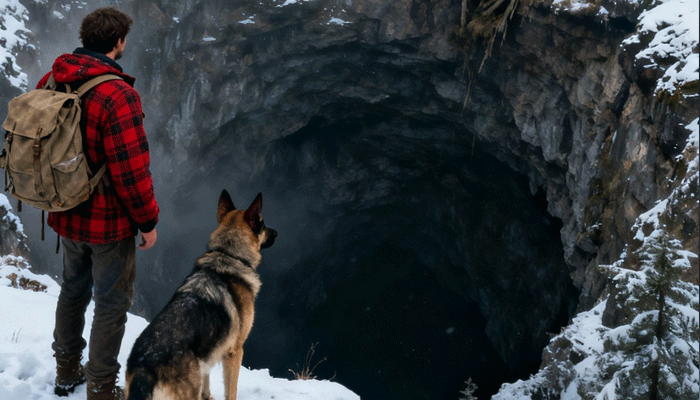
Ash was a black German shepherd with a gray streak around one eye and the steady gaze of something that judged men better than God did. Caleb had adopted him through a veterans’ program three years earlier, after a roadside blast in Kandahar had ended Caleb’s Army career and nearly ended everything else with it. Since then, Ash had become more than company. He was warning, witness, and whatever counted as family when the rest of yours had either died or disappeared.Family
Ash’s ears twitched. A low sound rolled out of his chest.
“I know,” Caleb said. “I don’t like it either.”
The forecast had called for snow flurries. That had been six hours ago, back when he’d left Missoula in a truck full of legal papers, old photographs, and the last of his mother’s belongings. He was headed to Red Hollow, the town he had left at eighteen and sworn never to see again. His mother had died three weeks earlier. A stroke, sudden and clean, the doctor had said, as if clean mattered.
The lawyer handling her estate had called twice. The family house needed to be sold. The property taxes were overdue. There were papers Caleb had to sign in person.
So he’d gone.
Not because he wanted the house. Not because he wanted the memories. Only because dead mothers didn’t leave room for unfinished business.
The truck fishtailed.
Caleb corrected hard to the left.
Too hard.
The rear tires slid off the shoulder. He felt the whole vehicle drop, tip, and lurch into a shallow ditch half-hidden under snow. The front bumper struck something buried—rock, stump, he couldn’t tell—and the airbag exploded in his face like a punch.
The world flashed white, then gray.
Silence.
Then the hiss of the engine.
Caleb blinked, tasting blood. His nose was running warm. Ash barked once—sharp, furious, alive.
“I’m good,” Caleb coughed, shoving the deflating airbag aside. “I’m good.”
His shoulder screamed when he moved. He checked himself fast. No broken arms. No broken legs. Neck stiff. Chest bruised. Probably a mild concussion. Nothing fatal yet.
He turned the key.
The engine groaned, clicked, and died.
Again.
Nothing.
The heater cut out. Cold began filling the cab immediately, sliding into the silence like it had been waiting its turn.
Caleb looked through the windshield. Just white. Endless white. Snow smashing sideways under the beam of one surviving headlight.
He grabbed his phone.
No signal.
Of course.
He let out one bitter laugh.
Red Hollow. He hadn’t even made it back, and the place was already trying to bury him.
Ash was on his feet now, nails ticking against the seat, staring at the passenger-side window.Doors & Windows
“What?”
The dog barked again and turned in a tight circle, then shoved his muzzle toward the glass.
Caleb squinted. At first he saw nothing. Then, for a fraction of a second through the white, he caught something warm and yellow far off through the trees.
A light.
His heart kicked once, hard.
Maybe a cabin. Maybe a ranch house. Maybe a hallucination from the airbag hit. But it was something.
He moved fast.Dogs
He pulled on his coat, found his gloves, grabbed the emergency flashlight, road flare, lighter, truck blanket, med kit, and backpack. He checked his pistol—legal, loaded, familiar—and shoved it into the holster inside his coat. Then he opened Ash’s door.
The wind hit like a living thing.
Ash leaped down into snow nearly up to his belly, then turned and looked back at Caleb as if to say, Well? Move.
Caleb climbed out, boots sinking deep. The cold bit through his jeans instantly. Snow whipped into his eyes hard enough to make him turn his face away.
He shut the truck door and slung the backpack over one shoulder.
“No wandering,” he told Ash. “You stay with me.”
Ash bolted forward three strides, stopped, and looked back again.
Caleb followed.
The light vanished, then appeared, then vanished again between the pines.
He and Ash pushed through waist-high drifts, across a narrow gulch, up a slope slick with buried rock. Twice Caleb slipped to one knee. Once he nearly lost the flashlight. His lungs burned within minutes. The storm swallowed every sound except wind.
Then the trees broke open.
And the house appeared.
It stood on a ridge like it had grown there.
Two stories. Gray stone. Dark roof weighted with snow. A wraparound porch, half-buried. One upstairs window glowed with a low amber light. Not electric-bright—more like lamplight, warm and old.Doors & Windows
The house should have comforted him.
Instead, something about it made his stomach tighten.
It was too far from the road. Too hidden. Too still.
Ash slowed at the edge of the yard, hackles raised.
Caleb stared at the front door, which stood painted dark green beneath a porch lamp that flickered in the storm.
“Hello?” he shouted.
No answer.
He climbed the porch steps. Snow had drifted against the railing. No fresh footprints that he could see—though in that weather, tracks wouldn’t last five minutes anyway.
He knocked hard.
“Hello? Anybody home?”
Nothing.
He tried the knob.
Locked.
He moved to the front window and cupped his gloved hands around the glass. Inside he saw a living room: stone fireplace, couch, bookshelf, lamp. Clean. Not abandoned.
“Damn it,” he muttered.
Ash let out a sudden growl and swung toward the side of the house.
“Easy.”
Caleb went to the porch bench, grabbed a cast-iron flowerpot, and smashed the small pane beside the mudroom door. He reached through carefully, unlocked it, and pushed inside.
Warmth did not greet him.
But shelter did.
The mudroom was cold, yet not frozen. The main house beyond smelled faintly of cedar smoke and old paper. Whoever lived there—or had lived there recently—had left the place sealed well enough to hold its own against the storm.
Caleb shut the door fast behind them and listened.
The house answered with silence.
No footsteps above. No television. No voices.
Ash moved ahead in a slow circle, nose working.
Caleb took off his gloves, flexed numb fingers, and called out one last time.
“I had to come in. My truck went off the road. I’m not looking for trouble.”
No answer.
He stepped into the living room.
A fire lay dead in the fireplace, reduced to cold ash. There was a lantern burning on the side table, turned low. Not electric after all. Oil.
That raised the hair on the back of his neck.
Someone had lit that lantern. Recently.
Then he saw the photograph on the mantel.
He stopped breathing.
It was old. Faded. Set in a simple wooden frame. A family standing in summer sunlight in front of a red barn.Family
A man in a deputy’s uniform.
A woman in a blue dress.
A teenage boy, thin and serious.
And a smaller child with a missing front tooth, grinning so wide it looked like he might split in half.
Caleb took one step closer.
It was his family.
Him at fifteen. His mother, Laura. His father, Deputy Mason Turner.
And Luke.
Little Luke Turner, nine years old forever, because nine was the age he had been when the snowstorm took him and the town decided the rest.
Caleb felt the room tilt.
He reached out with a trembling hand and lifted the frame.
On the back, written in black ink in a blocky hand he hadn’t seen in two decades, were six words:
If Caleb comes, tell him downstairs.
Ash let out a sharp bark from the hallway.
Caleb set the frame down slowly.
He looked at the dark hallway.
“Who the hell lives here?” he whispered.
Ash barked again, louder this time, then trotted toward the kitchen with purpose.
Caleb followed.
The kitchen was spotless in the strange way old places sometimes were—everything in order, everything worn, everything too quiet. There was a cast-iron stove, a long wooden table, shelves of canned food, and a back door bolted against the storm. The smell of cedar was stronger here.
Ash stood in front of the pantry door, staring.
Caleb opened it.
Shelves. Jars. Flour sack. No—
Ash shoved past him, pawing at the wooden floorboards beneath the lowest shelf. Nails scraped wood.
Caleb crouched.
There was a narrow line in the floor, nearly invisible unless you were looking for it. A seam.
His pulse quickened.
He shoved two sacks of potatoes aside and found a recessed iron ring set flat into the boards.
He looked at Ash.
Ash looked back with his ears pinned forward.
“All right.”
Caleb took the ring and pulled.
The square of floor lifted with a groan of old hinges. Beneath it, hidden under the pantry, was a steep set of wooden stairs dropping into darkness.
Cold air breathed up from below—not outside-cold, but cellar-cold. Earth. Dust. Something else underneath it.
Old metal. Damp stone.
And truth, maybe. That had a smell too.
Caleb grabbed the lantern from the living room, turned the wick up, and started down.
The stairs creaked under his weight. Ash stayed close to his leg.
The room below was larger than he expected. Part cellar, part workshop, part bunker. Shelves lined the walls, covered in boxes, binders, jars of nails, bundles of maps tied with string. A workbench ran along the far side beneath a row of boarded windows at ground level.Doors & Windows
On the wall above the bench hung county survey maps marked in red pencil.
On a pegboard nearby hung a deputy’s winter jacket.
Caleb walked to it as if pulled.
The patch on the shoulder was old county issue. The name over the pocket was faded but still legible.
TURNER
His father’s jacket.
Caleb closed his eyes.
For twenty-two years, one story had ruled Red Hollow.
Deputy Mason Turner had gone bad after his gambling debts caught up with him. He had kidnapped his youngest son during a snowstorm, maybe to hurt his wife, maybe in some drunken fugue nobody fully explained. When search teams found Mason’s patrol truck burned out near Wolf Creek three days later, with a body inside too charred to identify except by badge and dental records, the town called it an ending.
Luke’s body was never found.
The sheriff at the time—Vernon Hale—told everybody the same thing: Mason Turner had panicked, crashed, burned, and taken the truth with him.
Caleb had been fifteen. Old enough to understand disgrace. Young enough to be destroyed by it.
His mother had never believed the official story, not completely. But grief and humiliation had hollowed her out. By the time Caleb graduated high school, she was drinking every night and talking to Luke as if he were in the next room.
So Caleb had done what boys with broken homes and nowhere to put their rage often did.
He enlisted.
Now he stood in a hidden cellar under a stranger’s house, holding his father’s coat while a storm battered the mountain outside.
There was a cassette recorder on the workbench.
Next to it lay three cassette tapes, each labeled in black marker.
His throat went dry.
He picked up the third tape.
For Caleb.
He inserted it with fingers that suddenly didn’t feel like his own and pressed play.
Static hissed.
Then came the sound of breathing.
Then a voice Caleb had not heard since he was fifteen years old.
“Caleb… if this is you, then Arthur was right and you came back one day.”
Caleb grabbed the edge of the bench to stay upright.
His father’s voice was older than he remembered. More tired. More afraid.
“If you’re hearing this, I didn’t run. I need you to know that first. I did not take your brother. I didn’t hurt Luke. God help me, I tried to save him.”
Ash sat down at Caleb’s feet, eyes fixed on him.
On the tape, Mason Turner drew a shaky breath.
“I don’t know how much time I’ve got, so I’m going to say what matters plain. Sheriff Hale and Samuel Keene have been buying up half this county through threats, fake liens, and fires. I found records. Arthur Vance copied them. There’s water under Turner land and the Bennett parcels east of us—more than anyone knew. Keene wants it for his reservoir project, and Hale wants his cut.”
Caleb stared into the dark.
Arthur Vance.
The name hit some deep corner of memory. A tall man with a beard, smelling of tobacco and cold wind, who used to come by the Turner farm with rolled maps under one arm and call Caleb “soldier” before Caleb was old enough to shave. A surveyor. His father’s friend.
On the tape, Mason kept speaking.
“Luke heard something he shouldn’t have. He was at the station with me after school. He slipped outside, and I think he saw Hale and Keene with the county clerk. I sent him home. He never made it there.”
Caleb pressed a hand over his mouth.
“I followed tracks in the storm up to Arthur’s ridge house. I found Luke’s scarf near the porch and blood in the cellar. Not much, but enough. Hale’s deputy, Warren Pike, was here too. They know I know. Arthur says the records are hidden in the walls and under the floor. If I can get to Helena by morning, I can put all of this in state hands. If I can’t—”
A loud crack sounded on the tape, as if someone had slammed a door upstairs.
Mason’s voice dropped to a whisper.
“If I can’t, Caleb, take care of your mother. Don’t let them tell you who I was. Don’t let them bury Luke twice.”
The tape ended with a burst of static.
Caleb did not move.
He stood there with his hand over his mouth, eyes burning, while the silence after the recording settled over the cellar like ash.
Ash rose slowly and leaned his head against Caleb’s thigh.
Caleb sank onto the stool at the workbench.
His father had known.
Not suspected. Known.
Luke had been taken to this house.
Mason had found blood.
The sheriff had lied.
The whole damn town had swallowed it.
Caleb laughed once, but it broke in the middle and turned into something else. His chest tightened. He bent forward, elbows on his knees, fist pressed against his forehead.
He had spent half his life hating a dead man for leaving them in ruin.
Electronic Components
He had spent the other half refusing to think about it at all.
And all this time, the truth had been sitting in a hidden cellar on a mountain ridge, waiting for a snowstorm to drag him to its door.
After a long time, he stood.
“Okay,” he said hoarsely.
Ash looked up.
“Okay.”
He wiped his face with the heel of his hand and got to work.
There were ledgers in a wooden crate beneath the bench. Survey maps with parcels marked in red. Copies of deeds. Typed letters from Samuel Keene’s development company threatening foreclosure on families Caleb remembered from town—Bennetts, Carvers, Hollises, even the little Ortega ranch on the south road.
Another box held photographs.
Black-and-white prints, grainy but clear enough.
Pickup trucks parked at night near county land markers. Men unloading drums. Vernon Hale talking to Samuel Keene beside a bulldozer. Hale handing cash to a man Caleb recognized even after two decades: Deputy Warren Pike.
Then he found a journal.
Arthur Vance’s handwriting ran sharp and angled across the pages.
December 10
Mason is right. Keene has men moving equipment at night across county lots before appraisal. Hale covers the titles. If Turner refuses to sell, they mean to break him. Luke was at the office today. Child heard too much. Lord help us.
December 12
Mason followed Pike to the ridge. We found signs in the cellar. Boy alive when brought in—I’d swear it. Small handprint in dust beside furnace pipe. Vernon says Mason’s gone unstable. He’s laying groundwork already.
December 13
I told Mason to take Laura and Caleb and leave tonight. He refuses without Luke. Foolish brave man. I’ve hidden copies in the wall behind the workbench and in the floor under the feed bin. If I don’t make it, may whoever finds this finish what we could not.
Caleb searched the wall and found a loose plank behind the bench.
Inside it was a metal lockbox.
He pried it open with a screwdriver from the bench.
More papers.
A hand-drawn map of the house.
One line on the map was circled twice in red pencil.
CELLAR FLOOR / NORTH CORNER
Caleb’s skin went cold.
Ash had already moved there, nose low, pacing.
There was a patch of packed dirt in the far corner where the stone foundation gave way to earth. At first glance it looked no different from the rest of the old cellar floor. Then Caleb noticed it: the soil was slightly darker. Slightly softer.
Ash pawed once.
Then again.
Caleb swallowed hard.
“No,” he whispered.
But his hands were already reaching for the shovel leaned against the wall.
The first dig cut through dry packed dirt.
The second brought up softer earth beneath.
The third hit cloth.
Caleb froze.
Ash whined.
Caleb knelt slowly and brushed the dirt away with gloved fingers.
Red wool.
A scarf.
Small. Frayed.
He knew it before his mind fully caught up.
His mother had knitted Luke that scarf the winter he vanished because Luke had lost two store-bought ones in a single month and she’d threatened to tie the next one around his neck forever.
Caleb kept brushing dirt away.
A small curved bone emerged.
Then another.
His breath turned ragged.
“No,” he said again, but it was useless now. Not a denial. Only grief with nowhere left to go.
He sat back hard on the dirt floor, shovel falling from his hand.
Luke was here.
Luke had been here all along.
Not wandered off into the woods. Not taken far away. Not lost to the mountain.
Buried in a hidden cellar while the men who did it attended church and shook hands and called themselves pillars of Red Hollow.
Caleb bowed his head.
A sound came out of him then—not loud, not dramatic, just raw. The kind of sound a man made when something inside him finally tore all the way open.
Ash pressed against him, heavy and steady.
After a while Caleb forced himself back to work, because soldiers learned early that grief did not excuse you from the next task.
He uncovered enough to see the outline of a small skeleton curled on one side. Near the ribs lay a rusted sheriff’s toy badge Luke used to pin to everything when their father was alive and still looked like a hero. Near the skull lay a dented silver ring Caleb recognized with a jolt—his father’s wedding band.
Mason had been here.
He had reached the cellar.
Maybe too late.
Maybe not.
Caleb found one more thing near the bones: a spent .38 casing lodged in the dirt.
Evidence.
Real evidence.
The kind that could still speak after twenty-two years.
He sat back on his heels, heart pounding.
Then Ash’s head snapped toward the ceiling.
A second later Caleb heard it too.
Engine noise.
Muffled through the storm.
A vehicle pulling into the yard.
Caleb killed the lantern instantly.
The cellar dropped into darkness except for the weak flashlight beam Caleb thumbed low against his chest.
Ash stood rigid, silent now.
Another sound.
A car door slamming.
Then boots on the porch overhead.
Caleb’s body shifted automatically into alertness, grief shoved aside by training. He pocketed the casing, grabbed the tape, the journal, and the lockbox, then moved to the stairs with Ash beside him.
Voices above. Two men.
One called out through the house.
“Anybody in there?”
Caleb recognized the voice immediately, though age had thickened it.
Travis Hale.
Sheriff Travis Hale, son of Vernon Hale.
Caleb had known him in high school—a year older, golden-boy quarterback, already learning how to smile like the law belonged to his family. Back then people said he’d grow into the badge same as his father.Family
Apparently he had.
A second voice answered, lower, rougher. “Truck by the road’s his, all right.”
Deputy Colter Shaw. Caleb knew the name from the lawyer in town. Shaw handled code enforcement, evictions, and most of the dirty work respectable people preferred not to see.
Discover more
Windows
Dog
dog
Caleb crept up the stairs until he reached the pantry hatch. He left it open a crack.
Footsteps crossed the kitchen overhead.
Travis spoke again, casual and loud. “Caleb? If that’s you, it’s Sheriff Hale. We saw your truck in the ditch. Thought you might need help.”
Ash bared his teeth silently.
Caleb considered.
They knew it was him.
Maybe because the lawyer had mentioned his arrival. Maybe because Red Hollow still tracked every Turner breath. Maybe because Travis saw the registration when he passed the truck.
Either way, if they knew he was here, they also knew what this house was.
And if they knew what this house was, they knew what might still be inside it.
Caleb drew a slow breath, shut the hatch quietly, and climbed up.
He stepped into the pantry and pushed the door open.
Travis Hale turned from the stove with a smile that stopped short when he saw Caleb’s expression.
“Caleb,” Travis said. “Hell of a night.”
He wore a sheriff’s winter coat dusted with snow, hat in one hand, gloves in the other. He looked like the kind of man campaign posters were made for—broad shoulders, neat beard, friendly eyes. The lie was in how polished he was. Men who lived honestly usually wore the weather on them. Travis looked preserved.
Colter Shaw stood near the back door, thicker through the gut, one hand resting too close to his sidearm.
Caleb kept his face blank.
“Road found me first,” he said.
Travis nodded toward Ash. “Still like dogs, I see.”Dogs
Ash growled.
Travis’s smile thinned. “Guess he doesn’t remember me kindly.”
Caleb said nothing.
Travis glanced around the kitchen. “Place has been empty a long time. Dangerous to hole up here.”
“Didn’t feel empty.”
That landed.
Just for a second, Travis’s eyes sharpened.
“Find anything?” he asked lightly.
“Shelter.”
Colter snorted once, not amused.
Travis leaned against the table. “You’re a long way from wherever you’ve been hiding out. Heard about your mother. I’m sorry.”
“No, you’re not.”
The room went still.
Colter shifted his weight.
Travis’s face remained composed, but some warmth left it.
“Look,” he said, “storm’s only getting worse. We can take you into town. There’s no power here, no guarantee this old place holds. Better not risk it.”
“There’s a lantern lit in the living room,” Caleb said. “Somebody lit it.”
Travis smiled again, but it came slower now. “Probably one of the hunting clubs passing through. Kids mess around up here sometimes.”
“In a blizzard?”
“People do dumb things.”
Caleb held his gaze. “Your father used to say that too.”
At that, Colter looked at Travis. A quick flick. Nervous.
Travis let the silence stretch.
Then he shrugged. “My father said a lot of things.”
“Did he ever tell you what happened to my brother?”
Ash growled louder.
Colter’s hand settled fully on his sidearm now.
Travis’s face barely changed. “I was seventeen when Luke disappeared.”
“Old enough to hear things.”
“Old enough to hear a tragedy tear a family apart.” Travis tilted his head. “You shouldn’t go digging around old graves, Caleb.”Family
Too late.
Caleb knew it from the way Travis said graves and not rumors or stories or pain.
Travis saw something in Caleb’s face then. Some shift. Some confirmation.
His own expression hardened by a degree.
“There it is,” he said softly.
Caleb did not blink.
“There what is?”
“You found something.”
Colter moved first, taking one step from the back door.
Ash exploded into a bark so violent it made both men flinch.
Caleb’s hand moved inside his coat—not for the pistol, not yet, just enough.
“Take another step,” he said, “and you’ll bleed on this floor.”
For a moment none of them moved.
Wind hammered the windows.Doors & Windows
Then Travis lifted one hand slightly toward Colter without taking his eyes off Caleb.
“Easy,” he said. “Nobody wants that.”
Colter stopped.
Travis took a breath, reset his smile into something almost human again, and said, “Fine. You stay. We’ll send county snowcat by morning.”
“Don’t bother.”
Travis nodded slowly.
“Suit yourself.” He put on his hat. “But Caleb? Storms uncover all kinds of things. Not everything they reveal does a man good.”
Then he turned and walked out.
Colter backed toward the door, glaring at Ash, then followed.
Caleb stood motionless until he heard the front door shut.
Then he ran to the living room window.
A sheriff’s SUV sat in the yard, engine idling, red-and-blue light bar dark beneath snow. Travis and Colter got in—but the vehicle did not leave.
It stayed there.
Waiting.
“Damn it.”
Caleb moved fast.
He ran back to the cellar, grabbed everything portable—tapes, journal, lockbox, maps, photographs. He shoved them into his backpack and zipped it tight. Then he looked at Luke’s half-exposed remains in the earth and forced himself to think.
He could not carry Luke out in the storm, not without destroying the burial evidence. He could cover him again and come back with state investigators—if he lived long enough.
If.
He re-covered the grave lightly, marking the exact stones around it in his mind. Then he searched the cellar for another way out.
At the far wall behind shelves of mason jars, he found it: a narrow door opening to a coal chute and crawl tunnel leading up toward the slope behind the house. Frozen shut at the top, maybe. Maybe not.
Useful.
He memorized it.
By the time he came back upstairs, the SUV was gone.
Caleb didn’t believe for one second that meant they’d left.
He checked every window. Every door. He found a generator switch in the mudroom and went outside just long enough to dig snow away from the small generator shed attached to the side of the house. The fuel tank was half-full. He pulled the starter cord until the machine caught and the house hummed faintly to life.Doors & Windows
A few low lights flickered on downstairs.
Heat began to stir through ancient baseboards.
Good.
He searched cabinets until he found more lantern oil, batteries, a shotgun with six shells, two boxes of .38 rounds that matched the old casing, and a ham radio set mounted in a study upstairs.
The radio looked older than dirt but intact.
He switched it on.
Static.
He adjusted the knobs, checked power, tried a distress call.
Nothing.
Mountains, storm, old equipment. He might get through later. Or not.
He checked his phone again.
One bar flickered, then vanished.
He climbed upstairs.
The hallway smelled faintly of lavender and dust. Three bedrooms. One bath. One locked door at the end.
He forced the lock with a fireplace poker.
The room beyond had once been an office. Shelves of books. Filing cabinets. A desk facing the window. On the desk sat a framed photo of Arthur Vance in late middle age, beard gone white, one hand on the shoulder of Caleb’s father.
Both men were smiling.
Caleb stared for a long time.
Arthur had believed Mason. Enough to hide evidence. Enough to record the truth. Enough, maybe, to die for it.
There was another journal in the desk, dated three months after Luke’s disappearance.
Most of the entries were short. Frantic.
Hale’s men searched the house again. Did not find wall box.
Mason never reached Helena. Burned before county line.
Laura broken. Caleb angry. Cannot blame him. Boy has his father’s eyes when he hates.
If anything happens to me, ridge house must stand until the right storm brings the right man back.
Caleb shut the journal and let his head hang.
Arthur had known one day would come.
He had prepared for it.
Down below, Ash barked once.
Caleb spun and grabbed the shotgun.
Then came the sound—
A dull metallic clunk outside.
Then another.
He crossed to the window and wiped a circle clear in the frost.Doors & Windows
Figures moved through the storm below.
Two men near the generator shed.
One by the porch.
Gas cans in their hands.
So that was Travis Hale’s version of sending help by morning.
Caleb’s face went cold.
“All right,” he said softly.
Ash appeared in the doorway, already keyed to him.
“Stay close.”
Caleb killed the upstairs lights.
He moved downstairs in darkness and silence, every sense narrowing. Outside, shadows crossed the windows, blurred by blowing snow. He heard liquid splash against wood siding.
Gasoline.
They were going to erase the house.
Erase the evidence.
Erase Luke again.
Not tonight.
Caleb crouched beside the front window, cracked it two inches, and waited. He could have fired through the glass. He had a clean line on the man near the porch.
But soldiers learned another thing early: shooting was easy. Living with the exact moment before it was harder.
So he chose the flare first.
He snapped one road flare to life—violent red fire hissing in his fist—then pitched it through the cracked window toward the gas-soaked porch.
Outside, one of the men shouted.
The flare hit a railing post, bounced, and rolled under the steps, spitting crimson light across the yard.
“Move!” somebody yelled.
In the confusion, Caleb kicked open the front door and fired one shotgun blast into the air above their heads.
The boom slammed through the storm.
Three figures scattered.
“Next one won’t miss!” Caleb roared.
Ash launched onto the porch beside him, barking like hell itself.
The men stumbled back through snow. One dropped his gas can. Another slipped and nearly fell.
The sheriff’s SUV headlights snapped on from the far side of the yard, where it had been hiding beyond the tree line.
Travis stood beside it, one hand raised, face lit pale by the beams.
“You’re making this worse!” he shouted.
Caleb stepped off the porch with the shotgun leveled. Snow stung his cheeks. “Come take it then!”
Travis’s expression twisted. “You don’t know what you found!”
“I know where my brother is.”
That hit harder than the shotgun blast had.
Even through the storm Caleb saw it.
The truth landing square in Travis Hale’s face.
Behind him, Colter Shaw swore under his breath.
Ash’s bark deepened into a savage growl.
Travis recovered fast. “My father’s dead.”
“Good.”
“He can’t answer for whatever you think happened.”
“I’ve got tapes. Deeds. Pictures. A grave in the cellar.”
Colter looked at Travis again—really looked this time, panic breaking through obedience.
“You said there wasn’t—”
“Shut up,” Travis snapped.
There it was. The crack.
Caleb took one more step forward, boots grinding in snow.
“My father didn’t kill Luke,” he said. “Yours did.”
Travis’s eyes darkened.
“No,” he said quietly. “My father cleaned up a mess your father made.”
Caleb laughed once, furious and disbelieving. “That the story he fed you?”
“It’s the story that kept this county alive. Men like Keene built roads, schools, jobs. Your father was going to blow it apart over dirt and water rights.”
“Over kidnapping a child.”
“Over business.”
The word hung there.
Business.
Luke, nine years old, reduced to business.
Caleb saw red.
He started forward, shotgun up.
Travis went for his sidearm.
Everything happened at once.
Ash lunged.
Colter yelled.
A shot cracked through the storm, then another.
Caleb dropped sideways behind the stone porch column as wood splintered near his head. Ash slammed into Colter knee-high, knocking him backward into the snow. Travis fired again, the muzzle flash brief and bright.
Caleb returned one shotgun blast low, forcing Travis behind the SUV.
Then he grabbed Ash by the harness and dragged the dog back toward the house.Dogs
“In!” he shouted.
They burst through the front door just as another bullet punched through the frame.
Caleb slammed the deadbolt, shoved the couch against the entry, and ducked below the window line.
Ash spun in circles, barking madly, then stopped and stood facing the kitchen, listening.
Outside, the SUV engine revved.
Then went silent.
Bad.
Very bad.Doors & Windows
Caleb crouched low and moved room to room, checking sightlines. The men outside knew the house now. They’d circle. They’d try the back. Maybe the crawl tunnel if Travis remembered it from his father’s stories—or if Vernon had ever told him.
Caleb loaded fresh shells into the shotgun with shaking hands.
His shoulder burned. The concussion throbbed harder with every heartbeat.
He needed to end this before fatigue made choices for him.
The kitchen window shattered.
Caleb dropped flat as glass rained across the floor.
A hand came through, reaching for the latch.
Ash hit the window before Caleb could move, jaws snapping. A scream tore through the storm. The hand vanished.
“Good boy!” Caleb shouted.
He rushed the back hall, expecting entry there next.
Instead he heard boots overhead.
They were on the porch roof, climbing from the drifted side.
Smart.
Caleb sprinted upstairs. Halfway up he saw a man’s silhouette at the hallway window, shouldering it open.
Colter.
Caleb fired.
The blast blew out the rest of the glass and hurled Colter backward off the roofline into the snow below with a cry cut short by impact.
Caleb pumped the shotgun.
One shell left.
Then another sound came from behind him.
The click of a hammer cocking.
Travis Hale stood at the top of the back stairs, pistol aimed two-handed, face white with snow and rage. He had come in through the mudroom or a broken lower window while Caleb moved upstairs.Doors & Windows
“You always were stupid brave,” Travis said.
Caleb didn’t move.
The upstairs hall stretched narrow between them, dimly lit by storm light and one low lamp from the study.
Ash stood below the stairs somewhere out of sight, growling.
“Drop it,” Travis said.
Caleb set the shotgun down slowly with two fingers.
“That’s better.”
“You’re done, Travis.”
Travis almost smiled. “No. You’re a man with a head injury standing in an old murder house with a weapon and a dead deputy in the yard. Guess how that report reads.”
“Colter’s not dead.”
“Maybe not. Maybe I fix that after.”
Caleb’s eyes flicked once toward the study door.
Travis noticed.
“Don’t,” he said. “Whatever else you found, it dies here.”
Caleb kept his voice even. “Your father killed Luke.”
Travis’s jaw tightened. “My father built this county. Men like yours just wore the badge.”
“He buried a child.”
“My father told me your brother saw the holding room. Heard too much. Keene panicked. Pike got rough with the boy.” Travis’s nostrils flared. “After that, there wasn’t a clean solution.”
Caleb stared.
Travis had just stepped over the line without realizing it.
Confession.
Not enough for a court by itself, maybe. But Caleb’s phone—where?
In his shirt pocket.
Please.
Please let it still be recording.
When Travis came in, Caleb had slapped at the screen by habit while reaching for the shotgun. He hadn’t known if he’d hit audio record or nothing at all.
He needed more.
“What holding room?” Caleb asked.
Travis laughed once, bitterly. “You think this was just a house? Keene stored survey files here. Cash. Things he didn’t want in county books. Your father and Vance found out. Luke was in the cellar when Pike struck him. Hit his head on the furnace corner, if you must know. Father said he was still breathing when Mason got here. Then Mason pulled his gun, Pike fired, and after that…” Travis shrugged one shoulder. “After that there was no version of events anybody would survive.”
Caleb’s vision tunneled.
Luke had been alive.
Alive when Dad got here.
Travis kept talking, words coming easier now, perhaps because secrets fed on being spoken at last.
“Father told Keene to dump both bodies in the woods, but Pike lost his nerve. So they put the boy down in the earth and staged Mason’s truck on the county line. Everyone believed what they needed. That’s how towns stay standing, Caleb. On useful lies.”
Caleb looked at him and saw it clearly: not a monster separate from ordinary men, but the logical end of every comfortable excuse.
The men who protected evil were rarely wild-eyed. Mostly they were tidy. Reasonable. Elected.
Ash moved.
A black blur from the blind corner of the hall.
Travis flinched and fired.
The shot went wide, blasting plaster from the wall.
Caleb dove.
He hit Travis at the waist and drove him backward into the study door. The pistol skidded across the hallway floor. The two men crashed through the doorway into Arthur Vance’s office, slamming into the desk hard enough to tip the lamp.
Travis was stronger than he looked. Caleb was stronger where it counted. Years of training and pain had stripped him down to raw leverage and stubbornness. He smashed his forearm into Travis’s throat, took one punch to the ribs, another to the jaw, then drove his knee into Travis’s stomach.
They hit the floor tangled.
Travis clawed for Caleb’s eyes.
Caleb caught the wrist and slammed it against the desk leg until something cracked.
Travis screamed.
Ash lunged for Travis’s shoulder and held there, snarling, teeth sunk through coat and flesh.
“Off!” Caleb shouted.
Ash released instantly and backed up, still growling.
Travis scrambled toward the fallen pistol with blood on his sleeve.
Caleb snatched the brass fireplace poker from beside the desk and brought it down across Travis’s forearm.
The pistol spun away under the bookcase.
Travis collapsed against the wall, gasping.
Caleb stood over him, chest heaving, poker in both hands.
Downstairs, the front door banged in the wind. Somewhere outside, Colter groaned.
The whole house seemed to breathe.
Travis looked up through split lips and said, “You think this changes anything?”
Caleb pointed the poker at him. “It changes your last quiet night.”
Travis laughed blood into his teeth. “County judge golfs at Keene’s club. State rep took money from us for ten years. You drag this into daylight, half the town burns with it.”
“Then let it burn.”
Caleb yanked the cord from the desk lamp, rolled Travis onto his stomach, and bound his wrists tight behind his back despite the man’s curses and thrashing.
Then he patted his own pockets with numb fingers.
Phone.
Still there.
He pulled it out and looked at the screen.
The audio recorder was running.
He let out a breath so hard it nearly broke him.
Ash leaned against his leg, tail low, eyes fixed on Travis.
“You heard that?” Caleb asked quietly.
Ash huffed once.
“Yeah,” Caleb said. “Me too.”
He dragged Travis into the upstairs hallway and left him against the banister. Then he went downstairs to clear the rest.
Colter Shaw was alive, barely steady, half-buried in drifted snow beneath the shattered upstairs window. He had a broken leg, maybe worse. He reached weakly toward a dropped revolver when Caleb stepped onto the porch.Doors & Windows
Caleb kicked the gun away.
“Don’t.”
Colter looked up at him through blood and snow. “I didn’t know about the boy.”
“You brought gas.”
Colter said nothing.
Caleb cuffed him with his own handcuffs from the sheriff’s belt and hauled him by the collar into the mudroom out of the storm.
Then he got the ham radio again.
This time he carried it into the kitchen, ran fresh wire from the generator outlet, and kept adjusting until static sharpened into bursts of distant human noise.
He tried every emergency channel he knew.
Nothing.
Again.
Then, faint and clipped through the storm:
“—repeat station, identify.”
Caleb grabbed the mic. “This is Caleb Turner at Arthur Vance’s ridge house north of Red Hollow off Cedar Ridge Road. I have an armed county sheriff in custody, one deputy wounded, and evidence in a double homicide and child disappearance cold case. Repeat, child disappearance cold case. Need state police immediately.”
Static blasted back.
Then: “Identify again.”
He did. Slower.
A pause.
Then another voice, female, controlled. “Mr. Turner, this is Trooper Lena Ortiz, Montana Highway Patrol. I copy the address approximately. Weather is severe and local sheriff’s office has reported you armed and unstable.”
Caleb laughed with zero humor. “Of course they did.”
“What is your status?”
“I am armed. I am injured but mobile. Sheriff Travis Hale attempted to destroy the property and kill me after I located evidence tied to my brother Luke Turner’s disappearance in January 2004. I have recorded statements from Hale. I have physical evidence on scene. I need someone not wearing his badge.”
Static. Then Ortiz again.
“I know that case.”
“Then you know his father ran it.”
A beat passed.
When she answered, her voice had changed slightly.
“Yes,” she said. “Stay on the line.”
Caleb looked at Ash. The dog sat beside him, snow melting off his fur onto the kitchen floor.Dogs
Outside, the storm began—only barely—to lessen.
Trooper Ortiz came back a minute later.
“Mr. Turner, weather is delaying immediate ground response, but I have two units and county search-and-rescue staging from the south road as soon as visibility allows. Earliest estimate, ninety minutes. Can you hold position?”
“Yes.”
“Do not release either suspect. Do not leave the scene unless fire or collapse forces you out. Can you do that?”
Caleb looked around the old kitchen, the blood, the broken glass, the pantry door to the cellar.
“Yes,” he said. “I can hold.”
“Then hold.”
The next ninety minutes felt longer than twelve years in uniform.
Caleb kept Travis upstairs and Colter downstairs, both tied, both watched. He found a first-aid kit and wrapped the bite wound on Travis’s shoulder and splinted Colter’s leg because letting a man die was easier than living with letting him. He bound his own bleeding scalp and took painkillers from the kit with cold coffee he found in an old thermos by the stove.
Ash patrolled constantly.
Twice Travis tried talking.
First he went with contempt.
“You think your mother would’ve thanked you for this? Digging up that little body after all these years?”
Caleb kept checking knots and ignored him.
Later Travis tried reason.
“My father’s dead. Keene’s half-senile in an assisted living center in Helena. Pike drank himself into a ravine fifteen years ago. Who do you think you’re punishing?”
Caleb stopped at the foot of the stairs and looked up.
“Myself,” he said. “For waiting this long.”
That silenced Travis for a while.
Near dawn, the storm finally began to thin.
The white outside changed texture first. Then sound. Wind still moaned through the eaves, but it no longer slammed. It moved around the house instead of through it.
Gray morning seeped over the ridge.
Caleb stood in the living room with the shotgun across his arms and watched the sky pale.
Ash sat beside him, head high.
Then, far off, came the sound of engines.
Multiple.
Different from before.
He stepped onto the porch.
Down the slope, through thinning snow, a convoy crawled up the ridge road: a highway patrol SUV, a state police truck, and a search-and-rescue snowcat behind them.
For the first time all night, Caleb allowed himself to breathe.
Trooper Lena Ortiz came up the porch first, bundled in state winter gear, dark hair pulled tight beneath her hat, sidearm visible but low. She took one look at Caleb’s face, the broken window, the blood on the railing, and then at Ash beside him.Doors & Windows
“You Caleb Turner?”
“Yes.”
She nodded once. “Dog friendly?”
“To me.”
“That’ll do.”
Two more officers followed her inside.
Caleb handed over his pistol butt-first, then the shotgun. He told them where Travis and Colter were, where the tapes were, where the journal was, where the disturbed earth lay in the cellar.
Ortiz listened without interrupting.
Only when he said, “My brother is buried in the north corner under the cellar floor,” did anything visibly move in her expression.
She looked toward the pantry.
Then she looked back at Caleb and said, softly, “All right.”
The next hours unfolded like something Caleb watched from outside his own body.
Crime scene tape went up around the house.
A forensic team was radioed in.
Travis Hale was led out in handcuffs shouting about jurisdiction, misidentification, assault, insanity, and a dozen other words that sounded smaller each time they left his mouth. Colter went out on a stretcher, pale and silent.Electronic Components
Trooper Ortiz listened to the audio recording twice in her vehicle before she came back in. She didn’t comment on it beyond one sentence.
“He buried himself,” she said.
Then they opened the cellar.
Caleb did not go down when the forensic techs uncovered Luke. He stood in the kitchen doorway with Ash pressed against his leg and listened to the muted voices, the scrape of tools, the reverent hush that enters a room when the dead finally receive witnesses.
An hour later, Ortiz climbed back upstairs holding a small evidence bag.
Inside it lay the rusted silver ring.
Mason Turner’s wedding band.
“We found this beside the remains,” she said.
Caleb nodded once, because anything more might have broken him beyond repair.
By afternoon the story had reached town.
Red Hollow was only six thousand people, too small to hold a secret once law enforcement vehicles climbed a mountain in broad daylight. By evening every diner, barbershop, gas station, and church parking lot buzzed with versions of what had happened on the ridge.
Some said Caleb Turner had gone crazy and dug up old bones because war had rotted his mind.
Some said the Hale family had always had blood on its hands.Family
Some said everybody knew something had been wrong with Luke’s case and nobody had been brave enough to say it when it mattered.
That last group angered Caleb most.
Everybody knew, after the danger passed. That was the luxury of cowards.
He stayed in town because the state police asked him to.
At the Red Hollow Inn—the same brick building where his parents had once danced on volunteer fireman nights—he gave statement after statement. He turned over the journals, tapes, maps, and photographs. He identified names. He explained the audio. He described the scene at the house. He answered questions about his father, his mother, and the years between.
Ash never left his side.
On the second day, Trooper Ortiz brought him a folder.
Inside was the initial forensic summary.
Luke Turner’s remains showed blunt-force trauma to the skull and a gunshot wound through the upper chest. The bullet caliber was consistent with the old .38 casing recovered near the grave. The body had been buried in haste. Time in the ground matched the disappearance date.
Next to that report was another page.
A reopening notice for the death of Deputy Mason Turner.
Burn pattern analysis from archived photos suggested the truck fire had been intentionally accelerated. New review ordered.
Caleb stared at the page so long Ortiz finally said, “Your father’s name is going to be cleared.”
He looked up at her.
“You knew about Hale?” he asked.
Ortiz leaned against the motel room dresser and crossed her arms. “I knew enough to distrust the county. My father was a trooper out of Butte. He used to say Vernon Hale could walk through a church in daylight and still smell like kerosene.”
“Then why didn’t anyone stop him?”
She held Caleb’s gaze. “Because corrupt men survive on two things. Fear and patience. They count on decent people being tired.”
Caleb looked down at the folder again.
“I was tired,” he said.
“No,” Ortiz said. “You were surviving.”
Three days later, Samuel Keene died in an assisted living facility outside Helena before state investigators could question him. A stroke. Clean and sudden. Caleb found no poetry in it.
Warren Pike had already been dead for years.
Vernon Hale had been dead for eight.
That left Travis.
Under pressure, with the recordings, the house records, and Colter Shaw cutting a deal to save his own skin, Travis started talking.
Not out of conscience. Caleb never mistook it for that.
He talked because he realized the wall around him had cracked for good.
He confessed that his father had overseen a scheme to intimidate landowners into selling key parcels around Red Hollow for the Cedar Basin Reservoir Project, which Keene intended to control through shell companies. Appraisal fraud, arson, falsified tax liens, intimidation by deputies, rigged code violations—piece by piece the picture emerged. Mason Turner and Arthur Vance had found out. Luke had overheard a conversation at the sheriff’s office involving the ridge house and Keene’s records. Vernon Hale had sent Pike to retrieve the boy “until things cooled down.”
Things had not cooled.
Pike, drunk and violent, struck Luke in the cellar. Mason arrived before they finished deciding what to do. There was a struggle. Luke was shot. Mason pulled his weapon. Pike fired again, grazing Mason, and Vernon Hale—who had arrived moments earlier—took over from there. Mason was disarmed, beaten, and later murdered in the staged truck fire. Arthur Vance disappeared six months later after refusing to give up whatever records Hale believed he still had. His body was never found.
The house on the ridge had belonged to Arthur all along.
He had preserved it like a vault.
Not for evidence alone.
For memory.
In the office closet investigators found one more box Caleb had missed. Inside were letters Arthur had written over the years but never mailed.
Most were to Laura Turner.
One was to Caleb.
He read it alone that night.
If you ever stand in this room as a grown man, then things went worse than I hoped and better than I feared.
Your father was the bravest man I knew. Not because he carried a badge, but because he refused to trade the truth for comfort when comfort was all anybody else wanted.
I watched anger grow in you after Luke vanished. I do not blame you. Boys will hate whatever remains when love has nowhere to go. If you hated Mason, let it die with this letter. He went to that cellar for your brother. He would have burned for both his sons without hesitation.
I could not save him. I could not save the boy. The best I could do was leave a door open for the day one Turner came back strong enough to walk through it.
When that day comes, do not live only for revenge. Men like Hale already take enough of a life. Build something after.
Caleb folded the letter carefully and sat in the motel chair while Ash slept on the carpet at his feet.
He thought of his mother.
Laura Turner had died still uncertain, still wounded, still talking to Luke in the quiet hours. She had never known Mason was innocent. Never known Luke had not abandoned them. Never known Arthur Vance had fought for them in secret.
That hurt worse than he expected.
Some truths arrived too late to heal the people who deserved them most.
At Luke’s funeral—his real funeral, held twenty-two years late—half the town showed up.
The church overflowed.
People Caleb barely recognized came with casseroles, with tears, with apologies that varied in sincerity. Some had aged into regret. Some were simply there because scandal and grief in a small town were communal events, no matter how private the pain.
Caleb wore a black suit that pulled tight across shoulders built for uniforms, not ceremony. Ash lay at the end of the pew until the pastor asked if the dog should be taken outside.Dogs
“No,” Caleb said.
So Ash stayed.
Trooper Ortiz sat in the back.
The new acting sheriff stood two rows behind her with his hat in both hands.
At the front of the church were two framed photographs.
One of Luke at nine, missing his front tooth.
One of Mason in deputy uniform, young and serious.
Caleb looked at them and understood suddenly that funerals were not for endings. They were for corrections. Tiny, human corrections made in the face of irreversible things.
When it was his turn to speak, he stood at the pulpit and looked out over Red Hollow.
At the people who had whispered.
At the people who had looked away.
At the few who had helped.
At the many who had not.
His voice came rough, but steady.
“My brother was nine years old,” he said. “For twenty-two years, this town let his name disappear into weather and rumor. My father was called a kidnapper and a murderer by men who knew better. My mother died carrying that weight because too many people found it easier to accept a lie than challenge the men telling it.”
No one moved.
Caleb looked down once at Luke’s photo, then back up.
“I’m not here to say every person in this room caused what happened. But silence helps evil travel farther than it should. Remember that. Because the next time the truth costs something, and it will, the measure of a town is not how loudly it mourns afterward. It’s what it risks beforehand.”
He stepped away.
No applause came.
Good.
This wasn’t a speech for applause.
After the service, old Mrs. Carver from Main Street took his hand in both of hers and wept without words. A rancher named Eli Bennett admitted his father had warned him never to trust Vernon Hale but never said why. The county judge resigned two days later. Two councilmen followed. State investigators seized records from the courthouse basement and Keene Development’s remaining offices.
Everything cracked open at once.
That was how corruption often ended—not with one clean blow, but with rot finally admitting air.
By March, the state formally exonerated Mason Turner.
The declaration arrived on heavy paper with seals and signatures and official language too thin for the size of what it meant. Caleb read it twice and then took it to the cemetery where his mother was buried beneath a cottonwood on the south edge of town.
Ash sat beside him in the thawing grass.
Caleb knelt in front of Laura Turner’s headstone and laid the document there, weighed down with a stone.
“He didn’t do it,” Caleb said quietly.
The wind moved through the cemetery, gentle now.
“He went for Luke. He went back.”
Ash lowered his head.
Caleb let himself cry then, because there was no enemy watching, no mission to finish, no need to stand straight for anybody.
Only his mother.
Only the dead.
Only spring trying to come back to a place that had failed winter in every possible way.
He sold the family house.Family
That part surprised people.
They assumed a man who’d recovered his father’s name and buried his brother properly would reclaim the old Turner place like some final act of inheritance. But Caleb wanted no walls that had held that much decay. Too much whiskey in the floorboards. Too many years of Laura waiting by the window. Too much of fifteen-year-old Caleb stomping around with rage hot as fever.
Instead, he bought the ridge house from the state after the investigation closed.
Arthur Vance’s house.
The murder house, the papers called it once before the phrase became embarrassing.
Caleb repaired the broken windows himself. Rebuilt the porch railing. Tore out rotten boards, patched the roof, restored the office, sanded the kitchen table, and cleaned the cellar wall by wall until it looked less like a tomb and more like a place where men had once tried, failed, and still left something worth finding.Doors & Windows
He did not erase the north corner.
There he laid new stone, level and clean, with a brass plate set into it:
He kept Arthur’s letter in the study desk.
By June, wildflowers had come up along the ridge.
Ash liked to lie on the porch in the morning sun and watch the road below.
Caleb liked the quiet.
For the first time in years, quiet did not feel like something stalking him.
Trooper Ortiz visited once on her way through county business. She stood on the porch with a cup of coffee and looked out over the mountains.
“You going to live up here alone forever?” she asked.
Caleb smiled a little. “That the official state recommendation?”
“No. Officially, I’m just checking how the dog is.”
Ash thumped his tail once without opening his eyes.
Ortiz nodded toward the repaired barn out back. “Heard you hired two local vets and a carpenter.”
“Three vets now.”
“For what?”
Caleb looked across the yard where the old shed had been turned into a bunkhouse.
“For what comes after.”
She waited.
He shrugged. “Arthur told me not to live only for revenge.”
Ortiz took a sip of coffee. “Smart man.”
“So I’m turning it into a retreat. Short stays for vets who need somewhere quiet. Search-and-rescue training in winter. Maybe a grief group if I can find the right counselor who doesn’t talk like a brochure.”
Ortiz smiled.
Caleb looked at the ridge line, then at Ash.
“It shouldn’t just be a place where something terrible happened,” he said. “It should be a place that held.”
That summer, men started coming.
Some with combat patches. Some with missing fingers. Some with marriages already gone and others hanging by threads. One former medic slept on the porch the first two nights because closed rooms made him shake. A retired National Guard sergeant spent a week teaching avalanche rescue basics to teenagers from town. A Marine who hadn’t spoken much in months ended up telling the whole group, voice flat and honest, about the day he decided not to kill himself because his old labrador had lain down across the bathroom door and refused to move.
Ash attended every conversation like senior staff.
Red Hollow changed too.
Not all at once. Not perfectly.
Towns didn’t become noble just because their sins were exposed.
But they could become less blind.
A memorial plaque went up at the courthouse listing Luke Turner and Mason Turner by name. The county opened old property disputes tied to Keene’s shell companies. A scholarship was created in Arthur Vance’s name for students studying land management and public service ethics. The sheriff’s office underwent state oversight for two years. Some people complained. Good.
Let them.
Consequences were the first honest weather Red Hollow had seen in decades.
On the first anniversary of the storm, Caleb went down to the cellar alone.
He carried no flashlight this time. The new lights worked fine. The room no longer smelled of rot. It smelled of cedar and clean stone and old paper.
He stood at the brass plate and ran his thumb over Luke’s name.
Then he took out the old cassette labeled FOR CALEB and set it on the workbench.
He didn’t play it.
He no longer needed to.
He knew every word.
Behind him Ash padded down the stairs and came to stand at his side.
Caleb looked around the cellar—the maps, the shelves, the restored bench, the boxes now cataloged and archived, the place where grief had stopped being buried and started becoming useful.
“It was one night,” he said softly.
Ash looked up at him.
“One night out of a whole life.”
The dog leaned against his leg.Dogs
Caleb smiled, small but real.
Outside, snow began again—light this time, almost gentle, drifting across the ridge in slow white spirals.
Not every storm came to destroy.
Some came to uncover.
And some, if a man survived long enough to see it, came only to remind him that buried things did not stay buried forever.
Caleb turned off the cellar light, climbed the stairs with Ash beside him, and closed the hatch behind them.
Upstairs, the house waited warm and steady against the mountain.
No longer a place of hiding.
No longer a place of lies.
A place that had told the truth at last.
THE END